
Surgical Equipment Market Outlook: Size, Share, Trends, Growth Analysis, Competitive Landscape & Forecast, 2026-2033

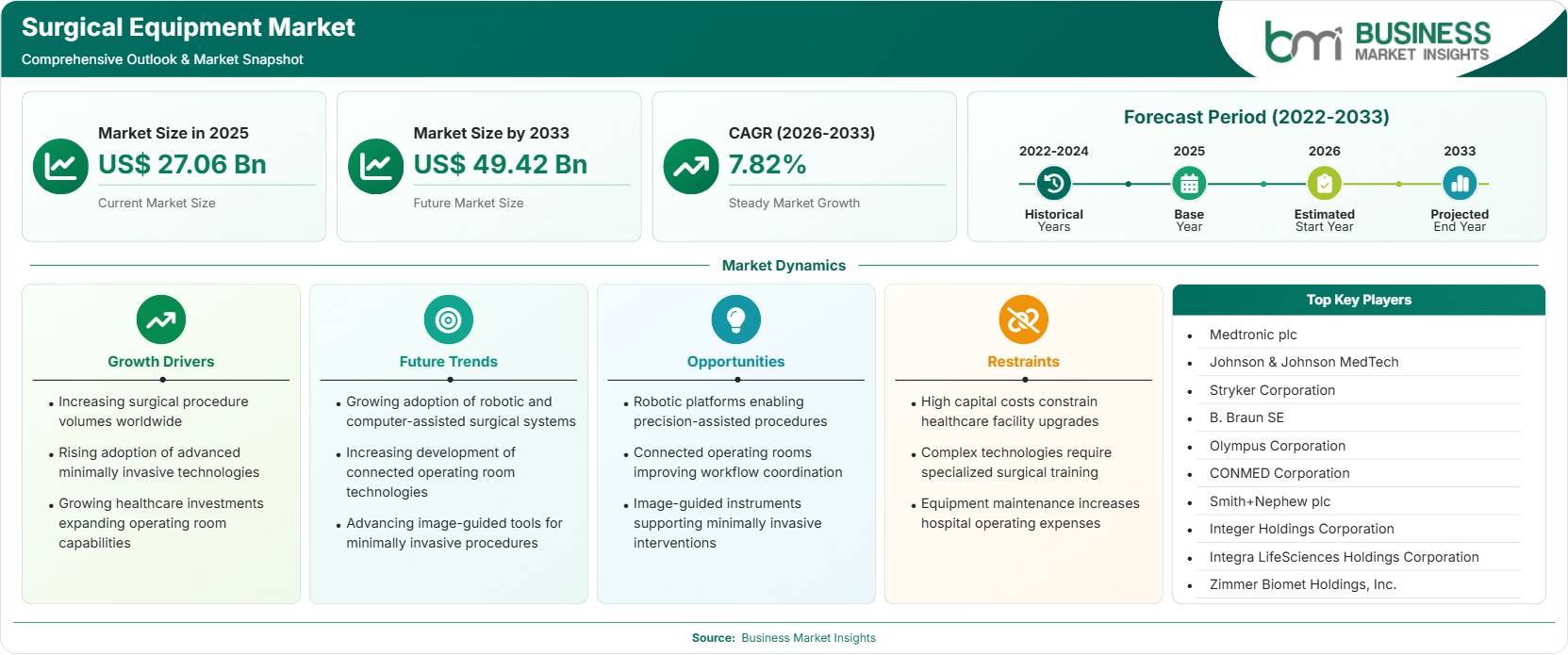
The Surgical Equipment Market size was valued at US$ 27.06 Billion in 2025 and is projected to reach US$ 49.42 Billion by 2033, growing at a CAGR of 7.82% during 2026–2033. Key growth drivers include rising surgical volumes, expanding minimally invasive procedures, aging populations, technological advancements in electrosurgical systems, and increasing outpatient surgery adoption, while emerging markets create strong investment opportunities.

Report Coverage
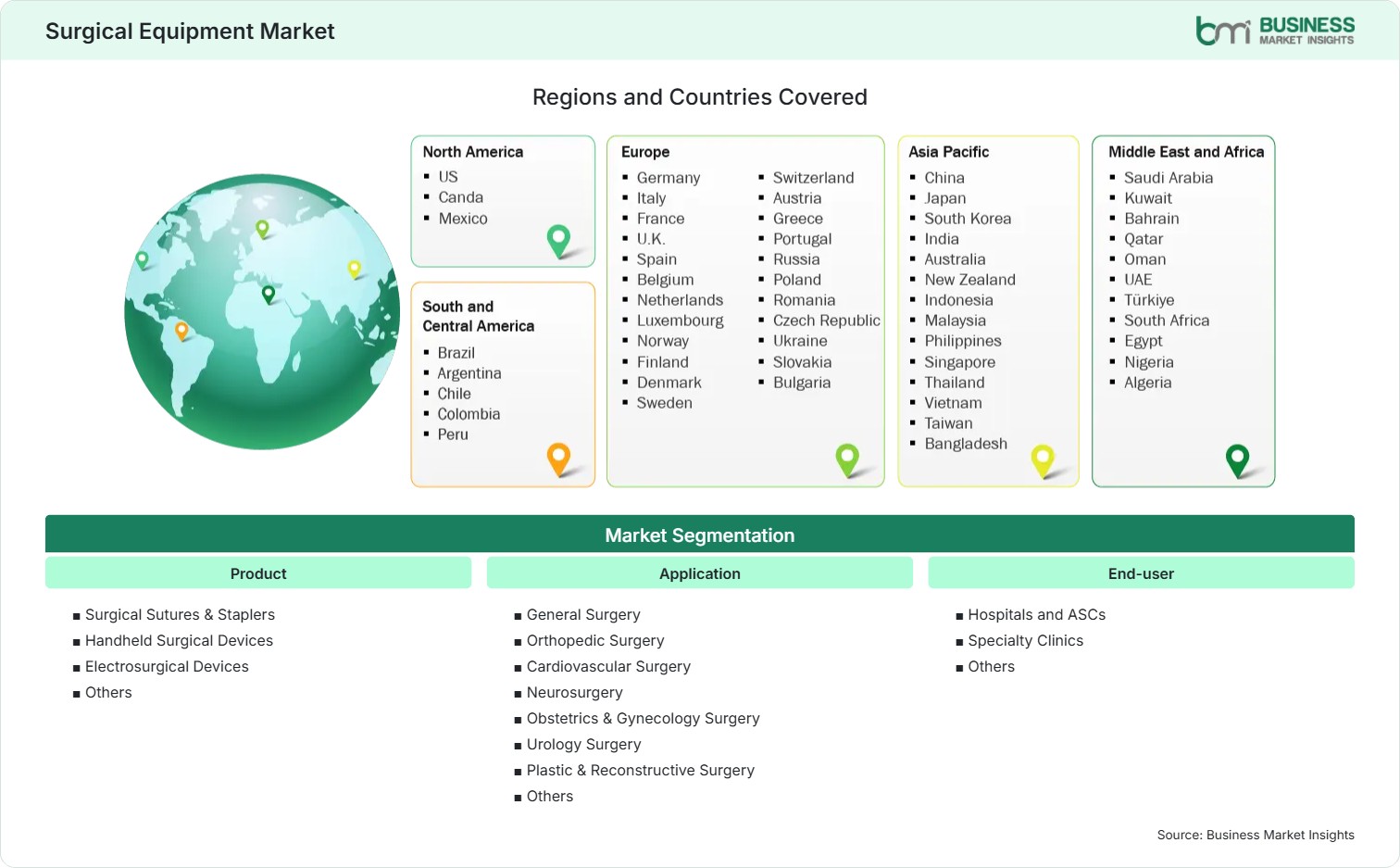
  • Product: Surgical Sutures & Staplers, Handheld Surgical Devices, Electrosurgical Devices, Others
  • Application: General Surgery, Orthopedic Surgery, Cardiovascular Surgery, Neurosurgery, Obstetrics & Gynecology Surgery, Urology Surgery, Plastic & Reconstructive Surgery, Others
  • End-user: Hospitals and ASCs, Specialty Clinics, Others
US$ 27.06 Bn Market size in 2025
US$ 49.42 Bn Market Size by 2033
7.82% CAGR, 2026 - 2033
2026-2033 Forecast Period

AI Overview

Surgical Equipment Market Summary

  • North America Region: North America holds a market share of 38%–41% in 2025, growing with a CAGR of 6.8%–7.4% during 2026–2033. Growth is supported by advanced hospital infrastructure, procedure intensity, robotic surgery adoption, reimbursement support, and continuous investment in operating-room modernization and digital surgical platforms worldwide. The U.S. remains the regional anchor, supported by high procedure volumes and an estimated 6.9%–7.5% CAGR.
  • Fastest Growing Region: Asia Pacific holds a 25%–28% share in 2025 and is expected to expand at 9.1%–9.8% CAGR. Expanding healthcare capacity, rising medical tourism, wider insurance coverage, domestic manufacturing initiatives, and increasing surgical access continue accelerating regional demand for advanced devices.
  • Leading Segment: Surgical Sutures & Staplers account for 34%–37% of the Surgical Equipment Market share in 2025 and are projected to grow at 7.0%–7.7% CAGR. Strong procedural usage, infection-control requirements, wound-closure innovation, and broad applicability across specialties support sustained demand and replacement cycles globally.
  • High Growth Segment: Electrosurgical Devices represent 22%–25% share in 2025 and are forecast to grow at 8.8%–9.5% CAGR. Adoption benefits from precision cutting, improved hemostasis, minimally invasive procedures, workflow efficiency improvements, and increasing integration across surgical specialties.
  • Key Market Opportunity: Expansion of ambulatory surgery centers, AI-assisted operating workflows, single-use instruments, and healthcare infrastructure investment across emerging economies creates substantial opportunities for manufacturers pursuing long-term geographic diversification and margin expansion.
  • Major Market Players: Medtronic plc; Johnson & Johnson MedTech; Stryker Corporation; B. Braun SE; Olympus Corporation; CONMED Corporation; Smith+Nephew plc; Integer Holdings Corporation; Integra LifeSciences Holdings Corporation; Zimmer Biomet Holdings, Inc.
Strategic Insights

Surgical Equipment Market: Strategic Insights

Surgical Equipment Market Strategic Framework
FREE PDF
Request your free sample
Request free sample
Stakeholder View

Key Takeaways

  • The value chain increasingly emphasizes precision manufacturing, sterilization standards, distribution efficiency, and after-sales support, creating competitive differentiation beyond device performance alone.
  • Electrosurgical platforms and outpatient surgery applications offer some of the strongest commercial opportunities as healthcare systems pursue efficiency and faster patient recovery pathways.
  • Innovation focus is shifting toward intelligent energy systems, robotic compatibility, disposable components, and enhanced surgical visualization integrated with digital workflows.
  • Asia Pacific presents the most compelling expansion opportunity due to healthcare infrastructure growth, procedural volume increases, and supportive manufacturing policies.
  • Strategic acquisitions continue as larger medtech firms expand procedural portfolios, strengthen geographic presence, and enhance technology capabilities across surgical specialties.
  • Sustainability initiatives are encouraging development of reusable systems and environmentally optimized supply chains without compromising patient safety requirements.
Geographic Outlook

Surgical Equipment Market Regional Highlights

North America Surgical Equipment Market

North America accounted for 38%–41% of global revenue in 2025 and is expected to grow at 6.8%–7.4% CAGR through 2033. The region benefits from advanced surgical infrastructure, widespread adoption of minimally invasive techniques, and strong hospital spending. The regional Surgical Equipment Market share remains the largest globally due to high procedure volumes, technology adoption, and favorable reimbursement frameworks. Increasing utilization of robotic surgery platforms and advanced electrosurgical devices supports continued expansion.

  • Large installed base of surgical technologies supports recurring demand for instruments and device upgrades.
  • Rising outpatient procedures encourage procurement of compact and workflow-efficient systems.
  • Strong clinical training networks accelerate adoption of advanced surgical solutions.
  • Hospital modernization programs continue supporting premium product penetration.

US Surgical Equipment Market

The U.S. represents approximately 79%–83% of North American revenue and is projected to expand at 6.9%–7.5% CAGR. Aging demographics, expanding surgical case volumes, and investments in digital surgery platforms support demand. Academic medical centers remain key adopters of advanced technologies.

  • Robotic-assisted surgery adoption strengthens demand for compatible surgical instruments.
  • Large healthcare expenditure supports procurement of premium systems.
  • Ambulatory surgery center expansion continues driving equipment purchases.
  • Procedure growth in orthopedic and cardiovascular specialties supports utilization.

Europe Surgical Equipment Market

Europe holds approximately a 26%–29% share in 2025 and is expected to grow at 6.6%–7.2% CAGR in the Surgical Equipment Market. Germany remains the leading market, while Poland and selected Central European countries exhibit faster expansion nearing 7.5%–8.2% CAGR. Demand is supported by healthcare modernization programs and increasing use of advanced energy devices.

  • Strong regulatory standards encourage adoption of quality-certified equipment.
  • Public healthcare investments support replacement cycles.
  • Aging populations increase procedural demand across specialties.
  • Surgical innovation centers accelerate clinical adoption.
  • Cross-border healthcare activity supports technology diffusion.

Asia Pacific Surgical Equipment Market

Asia Pacific accounts for 25%–28% share in 2025 and records the strongest regional expansion at 9.1%–9.8% CAGR. China leads regional revenue generation while India represents one of the fastest-growing opportunities with growth exceeding 10% in several specialty segments. Strong healthcare infrastructure investment accelerates Surgical Equipment Market growth prospects.

  • Medical tourism strengthens equipment purchasing across hospital networks.
  • Expanding insurance coverage improves surgical accessibility.
  • Domestic device manufacturing enhances product availability.
  • Government healthcare programs support capital investment.
  • Specialty-care expansion drives procedure growth.

Rest of World Surgical Equipment Market

Rest of World contributes 9%–12% share and is forecast to expand at 7.8%–8.6% CAGR. Brazil remains the leading Latin American market, while Saudi Arabia and the UAE demonstrate strong momentum due to healthcare transformation initiatives. Growing access to surgical care continues supporting equipment demand.

  • Hospital construction projects increase procurement activity.
  • Healthcare reforms strengthen specialty-care services.
  • Medical tourism supports technology investments.
  • Rising chronic disease burden drives procedural demand.
  • Foreign investment enhances availability of advanced surgical systems.
Global Market Geography
FREE PDF
Request your free sample
Request free sample
Segment Analysis

Surgical Equipment Market Segmentation

Product

Product category leadership remains in the hands of wound-closure techniques and cutting-edge energy systems. The category generates considerable revenue due to its repeated use and broad procedural applications. The Surgical Equipment Market scope continues to grow with advancements in precision tools. The product category share is 34%-37% for the most dominant categories, while growth technologies earn 8.8%-9.5% CAGR.

  • Surgical Sutures & Staplers: Essential across nearly all surgical procedures, supported by infection-control priorities, wound management needs, and continuous improvements in closure efficiency.
  • Forceps & Spatulas: Widely used in tissue handling and surgical manipulation, supporting consistent demand across general and specialty procedures.
  • Retractors: Important for operative visibility, benefiting from ergonomic design improvements and procedure-specific customization.
  • Dilators: Utilized in minimally invasive interventions and specialty procedures, supported by increasing procedural volumes.
  • Graspers: Demand rises with laparoscopic and robotic-assisted procedures requiring enhanced precision and control.
  • Auxiliary Instruments: Broad procedural utility supports stable purchasing activity across healthcare facilities.
  • Cutter Instruments: Precision requirements and minimally invasive trends continue stimulating adoption.
  • Electrosurgical Devices: The fastest-growing category due to tissue-sealing efficiency, reduced blood loss, and procedural workflow benefits.

Application

Application needs are affected by procedure volume, technological intensity, and patterns of healthcare spending. General surgery continues to be the most prevalent application domain, accounting for 24% - 28% of the market, while cardiovascular and neurosurgery applications are characterized by higher-value device needs. The Surgical Equipment Market trends increasingly reflect movement toward minimally invasive interventions.

  • General Surgery: Largest procedural base ensures sustained consumption of instruments, sutures, and electrosurgical devices.
  • Orthopedic Surgery: Aging populations and sports injuries support long-term procedural growth.
  • Cardiovascular Surgery: High-acuity procedures require advanced precision tools and energy systems.
  • Neurosurgery: Technological sophistication drives premium equipment adoption.
  • Obstetrics & Gynecology Surgery: Rising access to women's healthcare services increases utilization.
  • Urology Surgery: Endoscopic and minimally invasive procedures support demand.
  • Plastic & Reconstructive Surgery: Growing elective and reconstructive procedure volumes strengthen equipment requirements.

End-user

Hospitals and ASCs are the leading buyers, accounting for 68% to 72% of the market share, with an 8.0% to 8.7% CAGR in the Surgical Equipment Market. The procurement process is becoming more efficient, standardized, and outcome-based. There is an increased application of technology in specialty clinics for outpatients.

  • Hospitals and ASCs: Largest purchasing group supported by procedural concentration, reimbursement access, and infrastructure strength.
  • Specialty Clinics: Increasing surgical capabilities and outpatient treatment models support demand growth.

Surgical Equipment Market: Segmentation Size and Share Analysis (Type)

Product Type

Product-based demand continues to be driven by procedure frequency, technology complexity, and the need for replacement. Surgical Sutures & Staplers have the highest market shares, ranging from 34%-37% in 2025, and are expected to grow at a 7.0%–7.7% CAGR through 2033. Electrosurgical Devices emerge as the fastest-growing segment, with CAGRs between 8.8% and 9.5%, supported by increasing adoption of minimally invasive procedures and advanced tissue-management solutions.

  • Surgical Sutures & Staplers: Remain essential across general, cardiovascular, orthopedic, and obstetric procedures due to reliable wound closure, infection prevention, and procedural efficiency requirements.
  • Handheld Surgical Devices: Continue experiencing stable demand because of universal applicability across surgical specialties, frequent replacement cycles, and improved ergonomic instrument design.
    • Forceps & Spatulas: Critical for tissue manipulation and dissection procedures, with adoption strengthened by precision requirements in both open and minimally invasive surgeries.
    • Retractors: Support enhanced surgical visibility and access, benefiting from procedure-specific product innovations and growing operating-room efficiency demands.
    • Dilators: Increasingly utilized in urology, cardiovascular, and minimally invasive interventions requiring controlled access and procedural precision.
    • Graspers: Experience growing utilization due to laparoscopic and robotic-assisted procedures demanding secure tissue handling and maneuverability.
    • Auxiliary Instruments: Maintain broad demand across healthcare facilities because they support procedural consistency and surgical workflow efficiency.
    • Cutter Instruments: Benefit from increasing use in precision surgeries requiring controlled incisions and optimized surgical outcomes.
  • Electrosurgical Devices: Gain traction through superior hemostasis, reduced blood loss, enhanced precision, and compatibility with minimally invasive surgical techniques.

Application Type

Application-specific demand depends on the number of surgeries performed and the complexity and technological sophistication involved. General Surgery is the largest application segment, with a 24%-28% market share in 2025, and it maintains consistent growth over the forecast period. The demand for Cardiovascular Surgery, Neurosurgery, and Orthopedic Surgery is high due to the equipment requirements and procedural complexity.

  • General Surgery: Largest application category driven by broad procedural volumes across hospitals, ambulatory surgical centers, and specialty clinics.
  • Orthopedic Surgery: Supported by rising musculoskeletal disorders, aging populations, trauma cases, and increasing joint replacement procedures.
  • Cardiovascular Surgery: Requires sophisticated electrosurgical and precision instruments, supporting premium product demand and higher average selling prices.
  • Neurosurgery: Benefits from technological innovation and increasing demand for precision-guided surgical tools.
  • Obstetrics & Gynecology Surgery: Growth is linked to expanding women's healthcare access and increasing procedural volumes globally.
  • Urology Surgery: Rising kidney and urinary tract conditions support increasing instrument utilization, particularly in minimally invasive procedures.
  • Plastic & Reconstructive Surgery: Experiences demand from both reconstructive and elective procedures requiring advanced surgical precision.

End-user Type

Hospitals and ASCs represent the predominant procurement route, accounting for an estimated 68% to 72% of the market in 2025 and growing at a CAGR of 8.0% to 8.7% until 2033, driven by high concentration of procedures, infrastructural development, and technology acquisition programs. The importance of Specialty Clinics continues to rise as outpatient intervention capabilities expand.

  • Hospitals and ASCs: Lead adoption due to large patient volumes, access to capital budgets, and concentration of complex surgical procedures.
  • Specialty Clinics: Increasingly invest in advanced surgical systems to offer efficient outpatient treatment and specialty-focused care services.
Market Forces

Surgical Equipment Market Dynamics

Key Market Drivers

Growing Global Surgical Procedure Volumes

The rising burden of chronic diseases, trauma injuries, obesity, cancer, and cardiovascular disorders is significantly increasing surgical procedure volumes worldwide. According to healthcare bodies worldwide, there has been an increase in the number of procedures performed due to greater access to healthcare facilities in developing countries. Modern surgical equipment is being used in hospitals to improve productivity in the operating theater. Procedure growth is also due to an aging population, which is increasing the number of orthopedic, cardiovascular, and neurological procedures. There is a growing need for dependable surgical equipment, and systems continue to strengthen overall market expansion.

Expansion of Minimally Invasive Surgery Adoption

Due to short hospital stays, low risk of complications, minimal blood loss, and faster patient recovery time, minimally invasive surgery is gaining acceptance as a treatment modality of choice. This trend is contributing to increased demand for advanced handhelds, electrosurgical tools, energy-based systems, and precision-guided surgery devices. There is a greater emphasis on technologies that can provide greater surgical precision and more efficient operation. The growing trend towards laparoscopic, endoscopic, and robotic surgery across several specialties has improved market dynamics in both developed and emerging healthcare systems.

Technological Advancements in Surgical Platforms

Innovation in surgical technology is continuously revolutionizing the capabilities of the operating room. Companies are manufacturing intelligent electrosurgery systems, imaging systems, robotically compatible instruments, and digital workflow management tools that provide improved performance and increased productivity for surgeons. Improved ergonomics, energy conservation, and real-time data capabilities ensure better adoption among healthcare organizations. R&D investments have also enabled the development of specialty-specific product lines through innovation. Such innovations lead to shorter device replacement cycles, and healthcare organizations are upgrading their old systems to adopt newer ones.

Key Market Opportunities

Expansion of Ambulatory Surgical Centers

The expansion of ASCs worldwide has been continuous, as healthcare providers seek to deliver treatments in more cost-effective locations and in less time. There has been a growing need for compact, efficient, and specialized equipment to handle higher procedural volumes. Equipment manufacturers can benefit from developing surgical devices that are portable, single-use, and workflow-oriented. The shift of procedures from inpatient hospitals to ambulatory facilities will create an ongoing demand for equipment. Those who offer cost-effective and reliable equipment will benefit greatly from this trend. Suppliers that provide integrated solutions combining affordability, reliability, and operational efficiency are likely to gain substantial competitive advantages in this rapidly evolving care delivery model.

Emerging Market Healthcare Infrastructure Investments

Developing economies across Asia Pacific, Latin America, the Middle East, and Africa are increasing their investments in healthcare infrastructure, specialty hospitals, and the procurement of advanced medical technology. Government-supported healthcare modernization programs are improving access to surgery and increasing surgical capacity. Increases in middle-class populations and insurance penetration also contribute to the rising demand for quality healthcare services. This is creating some very promising opportunities for businesses to expand their regional presence and increase local production. Those that can offer affordable products without sacrificing quality or standards are poised to gain substantially from future buying efforts.

AI-Enabled and Smart Surgical Ecosystems

There are emerging possibilities in artificial intelligence, machine learning, and digitization within the surgical environment. Smart operation theatres employ connected devices, predictive maintenance, optimized workflows, and data-driven clinical support systems. This trend can benefit equipment makers by integrating analytics, automation, and interoperability into their product portfolios. Hospitals are increasingly seeking technology solutions to support planning, resource utilization, and clinical decision-making. There is great investment potential in the Surgical Equipment Market forecasts, driven by the combination of hardware and software.

Market Restraints and Challenges

High Capital Costs and Budget Constraints

Factor: The use of advanced surgical instruments, especially robots, advanced electrosurgical units, and operating theatre technologies, usually requires considerable upfront investment.

Impact: Budget constraints at hospitals, publicly funded health care facilities, and smaller surgical facilities may postpone purchase decisions and delay the adoption of technology. This cost pressure is even more pronounced in developing countries, where health care expenditure is relatively limited, access to advanced technologies is limited, and disparities in surgical care capabilities across healthcare institutions.

Complex Regulatory and Compliance Requirements

Factor: The surgical equipment must adhere to strict regulatory requirements for safety, efficacy, quality control, sterilization, and post-market surveillance across multiple jurisdictions.

Impact: There are difficulties arising from complex regulatory regimes, including longer product development timelines, higher compliance costs, and barriers to entering international markets. A delay in approval may delay business plans and revenues. Small companies have an even harder time in this area than big companies in the industry, with participants having extensive regulatory expertise.

Company Analysis

Competitive Landscape

The Surgical Equipment Market analysis reflects competition focused on innovation, procedural specialization, digital integration, and global distribution capabilities.

Company Name

Overview

Products and Services relevant to this market

Medtronic plc

Global medtech leader with extensive surgical technology portfolio and strong hospital relationships.

Stapling systems, electrosurgical devices, robotic-assisted surgery platforms, advanced energy solutions.

Johnson & Johnson MedTech

Diversified medical technology company with broad surgical and procedural expertise.

Sutures, staplers, energy devices, endocutters, minimally invasive surgical solutions.

Stryker Corporation

Major provider of surgical and operating-room technologies worldwide.

Surgical instruments, visualization systems, powered equipment, specialty surgery solutions.

B. Braun SE

International healthcare manufacturer with strong surgical product presence.

Sutures, surgical instruments, electrosurgical products, operating-room solutions.

Olympus Corporation

Leading endoscopy and surgical visualization specialist.

Endoscopic systems, energy devices, minimally invasive surgery technologies.

CONMED Corporation

Focused surgical technology company serving multiple specialties.

Electrosurgical systems, laparoscopic instruments, smoke evacuation technologies.

Smith+Nephew plc

Global medical technology company with strong surgical portfolio.

Advanced surgical devices, wound management products, sports medicine technologies.

Integer Holdings Corporation

Specialized medical device outsourcing and manufacturing provider.

Components and engineered solutions supporting surgical device production.

Integra LifeSciences Holdings Corporation

Specialist in neurosurgery and regenerative technologies.

Neurosurgical instruments, specialty surgical equipment, regenerative solutions.

Zimmer Biomet Holdings, Inc.

Orthopedic-focused technology company with surgical offerings.

Surgical instruments, orthopedic procedure systems, operating solutions.

Trust & Transparency

Research Methodology

The market analysis combines proprietary research with secondary data from government agencies, company disclosures, regulatory filings, industry databases and expert interviews. Market estimates are validated through data triangulation, cross-market benchmarking and analyst review.

View Full Research Methodology

Questions Answered

Frequently Asked Questions

What does a Surgical Equipment Market Report typically evaluate?

A comprehensive Market Report examines market size, competitive dynamics, technology developments, segmentation performance, regulatory influences, and regional growth opportunities.

How are manufacturers differentiating their offerings?

Companies increasingly compete through ergonomic designs, digital integration, robotic compatibility, disposable solutions, and advanced energy technologies that improve precision and operating-room efficiency.

Which region presents the strongest long-term investment opportunity?

Asia Pacific offers the strongest long-term opportunity because of infrastructure development, healthcare spending growth, expanding insurance coverage, and rising procedural volumes.

What role do ambulatory surgery centers play in demand expansion?

ASCs are increasing purchases of compact, efficient, and procedure-focused technologies designed to improve workflow efficiency, reduce recovery times, and support growing outpatient surgical volumes.

What factors are accelerating adoption of advanced surgical instruments?

Minimally invasive surgery growth, hospital modernization, outpatient care expansion, and demand for better clinical outcomes are encouraging broader adoption of advanced equipment and energy-based technologies.

Access the Full Surgical Equipment Market Report

Get segment-level forecasts, regional estimates, competitive benchmarking, company profiles and downloadable Excel datasets.

Access the full Surgical Equipment Market Report
350 pages PDF & Excel | 2026-09-10
Similar Research

Related Market Reports