
Surgical Drapes Market Outlook: Size, Share, Trends, Growth Analysis, Competitive Landscape & Forecast, 2026-2033

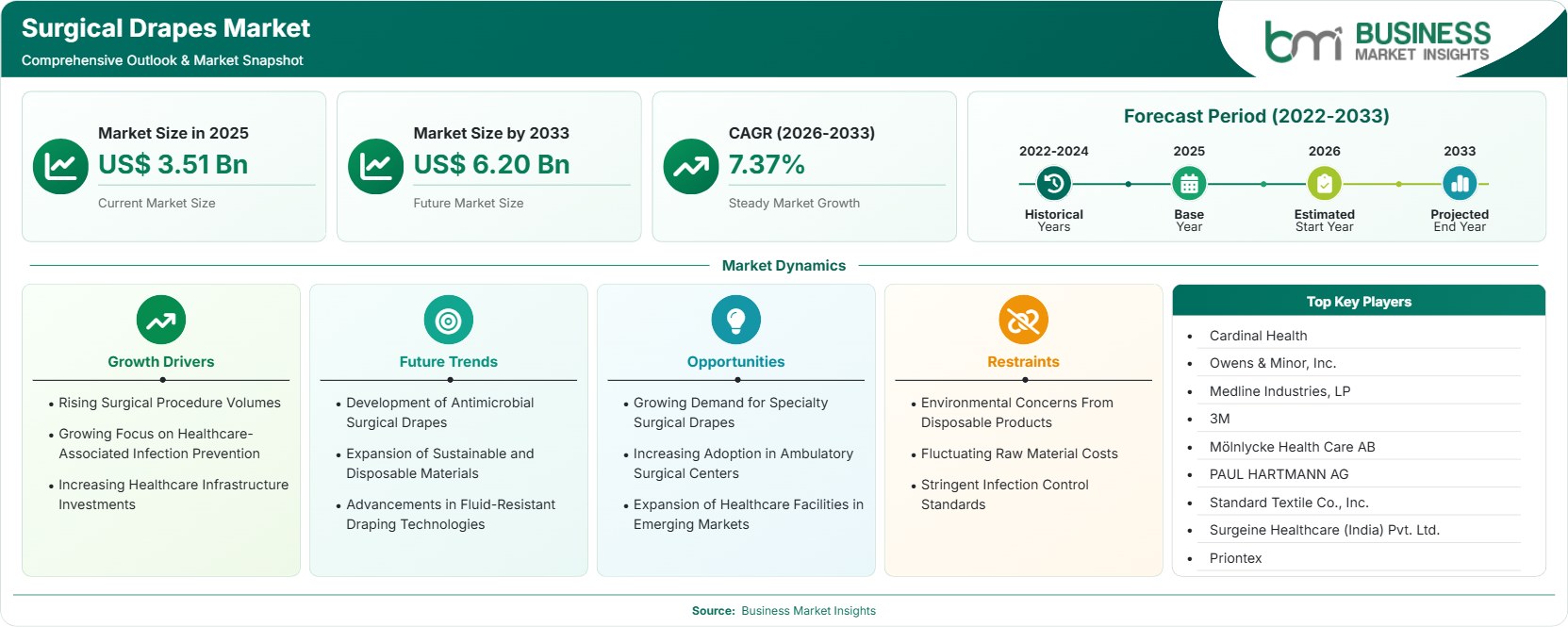
The Surgical Drapes Market size was valued at US$ 3.51 Billion in 2025 and is projected to reach US$ 6.20 Billion by 2033, growing at a CAGR of 7.37% during 2026–2033, supported by surgical volume expansion, infection prevention priorities, specialty draping innovation, and healthcare infrastructure investment.

Report Coverage
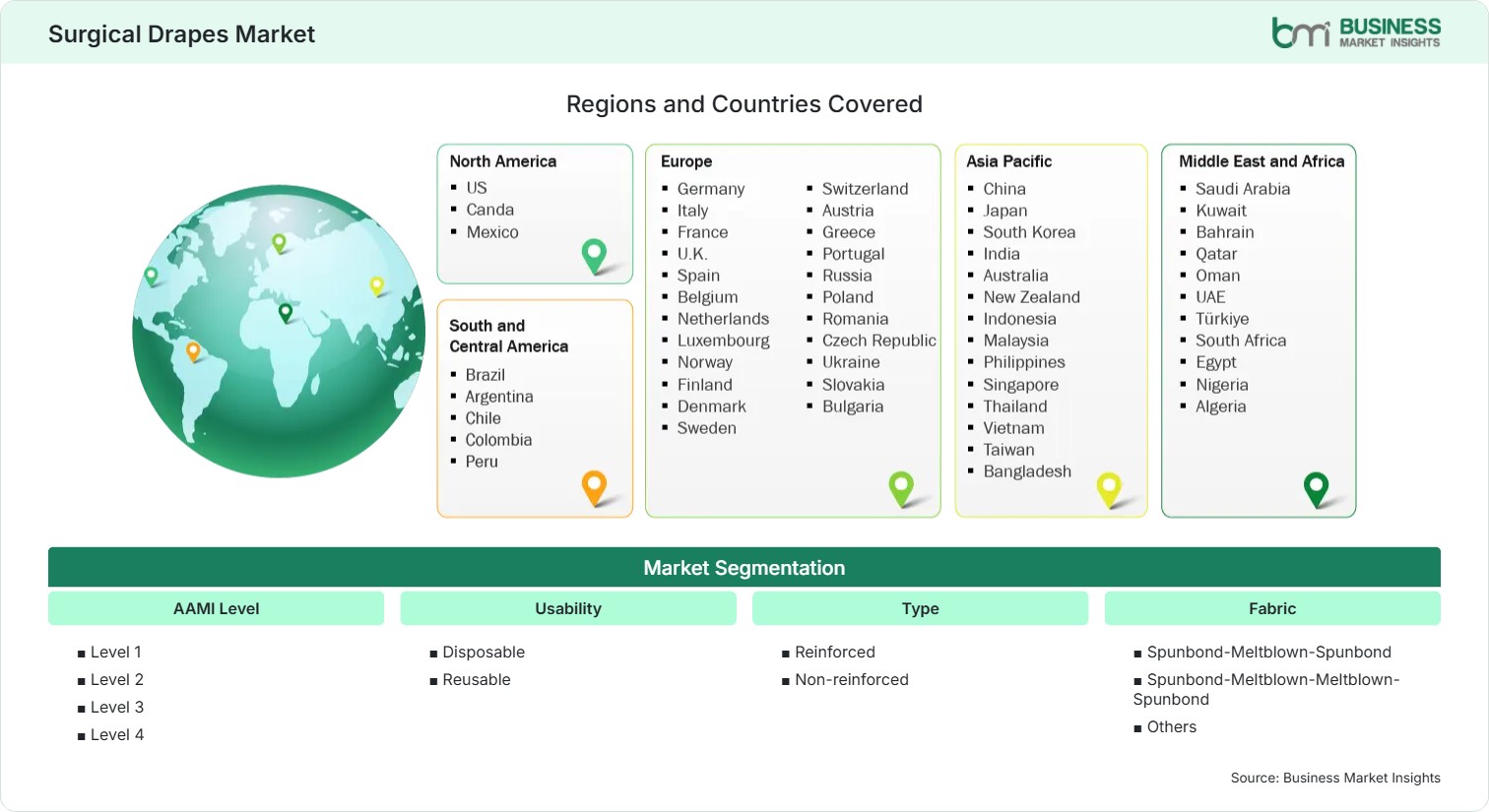
  • AAMI Level: Level 1, Level 2, Level 3, Level 4
  • Usability: Disposable, Reusable
  • Type: Reinforced, Non-reinforced
  • Fabric: Spunbond-Meltblown-Spunbond, Spunbond-Meltblown-Meltblown-Spunbond, Others
  • Lamination Type: Laminated, Non-laminated
US$ 3.51 Bn Market size in 2025
US$ 6.20 Bn Market Size by 2033
7.37% CAGR, 2026 - 2033
2026-2033 Forecast Period

AI Overview

Surgical Drapes Market Summary

  • North America Region: North America holds a market share of 34%–37% in 2025, growing with a CAGR of 6.8%–7.3% influenced by high surgical volumes, infection-control protocols, established procurement systems, specialty procedures, outpatient expansion, and replacement demand. The US market remains dominant within North America, supported by large hospital networks, ambulatory surgery growth, procedure-specific drape adoption, and stringent operating-room infection-control requirements, with a CAGR of 6.6%–7.1%.
  • Fastest Growing Region: Asia Pacific holds a market share of 25%–28% in 2025, growing with a CAGR of 8.2%–8.8% influenced by hospital construction, surgical capacity expansion, medical tourism, improving procurement standards, local manufacturing, and rising demand for sterile disposable products.
  • Leading Segment: Usability - Disposable holds a market share of 74%–78% in 2025, growing with a CAGR of 7.0%–7.5% influenced by infection prevention, labor efficiency, standardized procedure packs, simplified sterilization logistics, and increasing preference for ready-to-use sterile products.
  • High Growth Segment: AAMI Level 4 holds a market share of 22%–26% in 2025, growing with a CAGR of 8.2%–8.8% influenced by high-fluid procedures, stronger barrier requirements, advanced multilayer materials, cardiovascular interventions, orthopedic surgery, and demand for higher protection levels.
  • Key Market Opportunity: Specialty drapes combining fluid management, anatomical access, secure fixation, absorbency, and procedure-specific geometry can command premium positioning while reducing setup time and improving operating-room workflow efficiency.
  • Major Market Players: Cardinal Health; Owens & Minor, Inc.; Medline Industries, LP; 3M; Mölnlycke Health Care AB; PAUL HARTMANN AG; Standard Textile Co., Inc.; Surgeine Healthcare (India) Pvt. Ltd.; Priontex; Stryker Corporation.
Strategic Insights

Surgical Drapes Market: Strategic Insights

Surgical Drapes Market Strategic Framework
FREE PDF
Request your free sample
Request free sample
Stakeholder View

Key Takeaways

  • Supply chain resilience is becoming a competitive differentiator as manufacturers integrate sourcing, fabric conversion, sterilization, and distribution to ensure reliable product availability.
  • Procedure-specific products present good opportunities for growth, especially when considering orthopedic, cardiovascular, ophthalmic, and minimally invasive surgery applications needing highly sophisticated barriers and tailored designs.
  • Innovations in the area concentrate on sustainable and advanced materials, such as light-weight multi-layered fabrics and enhanced fluid resistance.
  • Asia Pacific offers strong long-term expansion potential, driven by hospital construction, rising healthcare spending, increasing surgical volumes, and greater infection-prevention awareness.
  • Strategic partnerships and portfolio expansion remain important investment themes as suppliers broaden procedural kits, sterile consumables, and healthcare distribution networks.
  • Regulatory compliance and infection-control standards increasingly influence purchasing, with healthcare facilities prioritizing barrier effectiveness, clinical performance, procedural suitability, and recognized safety requirements.
Geographic Outlook

Surgical Drapes Market Regional Highlights

North America Surgical Drapes Market

North America held 34%–37% share in 2025 and is projected to grow at 6.8%–7.3% through 2033. The region benefits from mature hospital procurement, high procedure volumes, strong infection-prevention protocols, and extensive ambulatory surgery infrastructure. The Surgical Drapes Market share is supported by established manufacturers and broad product availability.

  • High procedure intensity supports replacement demand and preference for ready-to-use sterile configurations across hospitals and ASCs.
  • Advanced cardiovascular, orthopedic, and laparoscopic procedures increase demand for reinforced and procedure-specific draping systems.
  • US group purchasing organizations strengthen standardized sourcing while encouraging suppliers to demonstrate clinical and economic value.
  • Sustainability initiatives are encouraging evaluation of reusable and lower-impact disposable alternatives alongside conventional single-use products.

US Surgical Drapes Market

The US Surgical Drapes Market represented 78%–82% of North American demand in 2025 and is projected to expand at 6.6%–7.1% through 2033. Large integrated delivery networks, high ambulatory surgery penetration, and strong medical-device procurement infrastructure support adoption.

  • Ambulatory surgery centers are increasing demand for standardized sterile sets that reduce preparation time and simplify inventory management.
  • Orthopedic and cardiovascular procedures support premium reinforced and high-barrier configurations for longer and higher-fluid interventions.
  • Supplier differentiation increasingly depends on clinical evidence, customization, supply reliability, and integrated operating-room portfolios.

Europe Surgical Drapes Market

Europe holds an estimated 27%–30% of Surgical Drapes Market share in 2025 and is projected to grow at a CAGR of 6.8%–7.3% through 2033. Demand is supported by advanced healthcare systems, strong infection-control frameworks, and increasing procedure volumes associated with aging demographics. Western European countries lead regional revenues, while Central and Eastern European markets demonstrate stronger growth momentum due to healthcare modernization initiatives and infrastructure investments.

  • Germany remains the leading national market, supported by extensive hospital networks, high surgical activity, and strong adoption of advanced procedural consumables.
  • Poland represents one of the fastest-growing opportunities, benefiting from healthcare infrastructure upgrades and increasing public and private healthcare investments.
  • Sustainability initiatives are driving interest in reusable solutions and environmentally conscious manufacturing approaches without compromising clinical performance standards.
  • Healthcare providers continue adopting preium procedural products designed to improve staff comfort, fluid control, and operating-room efficiency.
  • Rising minimally invasive surgery adoption is increasing demand for specialty draping configurations optimized for evolving procedural requirements.

Asia Pacific Surgical Drapes Market

Asia Pacific represented 25%–28% of Surgical Drapes Market share in 2025 and is projected to record the fastest CAGR of 8.2%–8.8% through 2033. China, Japan, India, South Korea, and Australia form the principal demand centers, while India is projected to expand at 9.0%–9.6%.

  • China combines large procedure volumes with expanding tertiary hospitals and domestic medical-device manufacturing capabilities.
  • India benefits from private hospital expansion, medical tourism, and increasing adoption of standardized sterile operating-room supplies.
  • Japan emphasizes high-performance materials, procedural precision, and advanced hospital workflow management.
  • Southeast Asian healthcare investment is expanding demand for disposable drapes as new surgical facilities enter operation.
  • Australia maintains premium demand supported by established infection-control practices and sophisticated hospital procurement systems.

Rest of World Surgical Drapes Market

Rest of World accounted for 9%–12% share in 2025 and is projected to grow at 7.0%–7.6% through 2033. South and Central America benefit from private hospital investment and expanding surgical access, with Brazil and Mexico representing leading Surgical Drapes Market. In the Middle East and Africa, Saudi Arabia, the United Arab Emirates, and South Africa provide important demand centers as healthcare infrastructure develops.

  • Brazil and Mexico lead regional demand through large hospital systems and expanding private healthcare investment.
  • Saudi Arabia and the UAE favor premium sterile products aligned with advanced specialty and medical-tourism facilities.
  • South Africa serves as an important manufacturing and distribution base for sub-Saharan healthcare markets.
  • Local distributors remain critical where hospitals require reliable delivery and technical support alongside product availability.
Global Market Geography
FREE PDF
Request your free sample
Request free sample
Segment Analysis

Surgical Drapes Market Segmentation

AAMI Level

AAMI Level classification determines barrier performance according to liquid exposure and procedural requirements. Level 1 and Level 2 support lower-fluid applications, while Levels 3 and 4 address progressively demanding environments. The segment structure favors Level 4, with a 22%–26% Surgical Drapes Market share in 2025 and 8.2%–8.8% CAGR through 2033, reflecting complex procedures requiring stronger protection.

  • Level 1: Supports procedures with limited fluid exposure, emphasizing lightweight construction, flexibility, and economical sterile coverage for lower-risk surgical environments.
  • Level 2: Provides improved liquid resistance for moderate exposure procedures, balancing barrier protection, comfort, drapeability, and cost-sensitive procurement requirements.
  • Level 3: Addresses higher-fluid procedures through stronger barrier structures and improved reinforcement, supporting orthopedic, abdominal, and cardiovascular operating-room applications.
  • Level 4: Serves the highest liquid-barrier requirements, using advanced multilayer materials for procedures involving substantial fluid exposure and prolonged operative duration.

Usability

Usability differentiates disposable and reusable draping models according to facility infrastructure, infection-control policies, labor availability, and lifecycle economics. Disposable products led with 74%–78% share in 2025 and are projected to grow at 7.0%–7.5% through 2033. Reusable products retain opportunities where sterilization systems and sustainability objectives support repeated use.

  • Disposable: Provides sterile, ready-to-use coverage while reducing onsite laundering requirements, supporting rapid operating-room turnover and standardized procedure-pack workflows.
  • Reusable: Supports repeated utilization through controlled laundering and sterilization, appealing to facilities evaluating lifecycle costs, textile durability, and waste reduction.

Type

Product differentiation based on reinforcement features significantly influences purchasing decisions across surgical specialties. This segment holds approximately 15%–18% share in 2025 and is forecast to grow at a CAGR of 7.3%–7.8% during the assessment period. Procedure complexity, fluid management needs, and healthcare-associated infection prevention priorities are strengthening demand for advanced design configurations.

  • Reinforced: Adds targeted strength and absorbency around operative zones, improving fluid management and durability during demanding orthopedic, cardiovascular, and abdominal procedures.
  • Non-reinforced: Provides standardized coverage for routine surgery where extreme fluid resistance or enhanced structural support is not required.

Fabric

Fabric innovation remains central to product performance, clinician comfort, and infection-prevention effectiveness. This segment contributes around 12%–15% share in 2025 and is projected to expand at a CAGR of 7.7%–8.2%. Manufacturers continue developing multilayer nonwoven structures that enhance strength, breathability, fluid resistance, and procedural performance across diverse surgical applications.

  • Spunbond-Meltblown-Spunbond (SMS): Combines strength and fluid resistance with softness and drapeability, supporting broad adoption across general and specialty surgical procedures.
  • Spunbond-Meltblown-Meltblown-Spunbond (SMMS): Adds meltblown filtration layers for stronger barrier performance, supporting procedures with elevated fluid exposure and contamination-control requirements.
  • Others: Include spunlace, laminates, and specialty composite fabrics developed for specific combinations of absorbency, impermeability, flexibility, and durability.

Lamination Type

Lamination technologies play a significant role in improving fluid resistance and procedural safety outcomes. The segment accounts for approximately 8%–11% share in 2025 and is likely to achieve a CAGR of 7.8%–8.4% through the forecast horizon. Growing emphasis on advanced protection capabilities is driving continued adoption across high-risk surgical environments.

  • Laminated: Uses film or composite layers to improve impermeability and resistance to fluid strike-through, supporting high-fluid and prolonged procedures.
  • Non-laminated: Relies on engineered textile structures for barrier performance, offering flexibility and breathability across routine surgical applications.

Application

Application-specific requirements are fostering increasing product customization and clinical specialization. This segment captures approximately 22%–25% share in 2025 and is anticipated to record a CAGR of 8.0%–8.6% through 2033.

  • Urology: Requires fluid-management capabilities and procedure-specific openings, supporting specialized drapes for cystoscopy, transurethral, and renal interventions.
  • Orthopedics: Demands strong, tear-resistant, and high-coverage designs capable of supporting long procedures with substantial instrument and fluid exposure.
  • Ophthalmology: Prioritizes precise fenestration, low-lint construction, gentle patient contact, and integrated fluid-management features for delicate procedures.
  • Cardiology: Benefits from highly absorbent and fluid-resistant configurations suited to catheterization, cardiovascular surgery, and image-guided interventions.
  • Laparoscopy: Requires flexible configurations accommodating ports, equipment, tubing, and access points while maintaining an effective sterile barrier.
  • Others: Include general, neurological, gynecological, ENT, and trauma applications requiring procedure-specific coverage and sterile-field protection.

End User

End-user purchasing behavior continues shaping product development and distribution strategies throughout the industry. This segment accounts for roughly 18%–21% share in 2025 and is expected to expand at a CAGR of 7.9%–8.5%. Rising procedure volumes and operational efficiency initiatives remain key demand drivers.

  • Hospitals & ASCs: Represent the largest purchasing base, requiring broad drape portfolios, sterile packs, reliable replenishment, and procedure-specific configurations.
  • Specialty Clinics: Generate focused demand for ophthalmic, orthopedic, urological, and minimally invasive drapes where compact workflows favor standardized sterile solutions.
  • Others: Include diagnostic centers, specialty treatment facilities, and healthcare institutions with procedure-specific sterile barrier requirements.
Market Forces

Surgical Drapes Market Dynamics

Key Market Drivers

Rising Surgical Procedure Volumes

The increasing number of surgical procedures performed globally remains a primary catalyst for demand expansion. Higher numbers of aged individuals, increasing instances of cardiovascular diseases, orthopaedic problems, complications due to obesity, and cancer incidences have led to increased procedures being conducted in healthcare sectors. Sterile barrier products are needed by surgical units on a continual basis so that procedure integrity is maintained and risks of contamination are prevented. Such factors continue to drive the Surgical Drapes Market growth, especially in orthopaedic, cardiovascular, ophthalmic, and minimally invasive fields.

Growing Focus on Healthcare-Associated Infection Prevention

Healthcare providers worldwide continue to intensify efforts to reduce healthcare-associated infections and surgical site infections. Infection control guidelines are considered an essential quality benchmark by bodies such as the World Health Organization and other health experts. Improved barrier systems, reinforced barriers, and fluid-resistant layered systems are being used more and more because of their capability to lower the chances of contamination. Procurement is prioritized by clinical efficiency rather than just cost considerations. All these changes are affecting the Surgical Drapes Market trends and encouraging the manufacturers to develop specialized products for high-risk operations and advanced surgeries.

Increasing Healthcare Infrastructure Investments

Significant investments in healthcare infrastructure across developed and emerging economies continue to support industry expansion. Both government and privately funded organizations are developing new hospitals, ambulatory surgery centers, specialty centers, and modernizing their healthcare infrastructure owing to increasing demand from patients. Simultaneously, old healthcare facilities are upgrading their medical procedures and using modern barrier systems to enhance the safety of medical procedures. The development of healthcare infrastructure is especially evident in Asia Pacific, the Middle East, and certain Latin American countries, where there is an increasing availability of healthcare.

Key Market Opportunities

Growing Demand for Specialty Surgical Drapes

The shift toward procedure-specific solutions presents a substantial opportunity for manufacturers. Healthcare professionals demand customized products that cater to orthopedic, cardiovascular, ophthalmic, neurological, and minimally invasive surgery needs. These products help increase the efficiency of the workflow, access to the surgical site, fluid management, and outcomes in terms of infection control. Specialization in procedures at the healthcare facilities will widen the market for advanced products. Hence, Surgical Drapes Market Forecast reports that growth opportunities are available to the firms that offer clinically proven customized products.

Increasing Adoption in Ambulatory Surgical Centers

The rapid expansion of ambulatory surgical centers creates attractive long-term demand opportunities. Healthcare systems shift appropriate surgical procedures from inpatient care centers to more cost-effective outpatient centers. Ambulatory surgical centers emphasize efficiencies of operations, fast room turnovers, standardized processes, and infection prevention compliance, and this drives up the demand for disposable and procedure-specific products. Insurance coverage expansion and patient preference for less invasive surgeries drive the ambulatory surgical environment even more. Suppliers with appropriate products and logistics will be able to capitalize on that trend.

Expansion of Healthcare Facilities

Healthcare capacity expansion across developing economies represents a major commercial opportunity. Investment in the building of new hospitals, specialized care institutes, university hospitals, and healthcare networks is resulting in growing procurement needs for sterile consumables. Urbanization, increasing expenditures for healthcare, and growing accessibility of advanced medical procedures are leading to increased demand for surgical supplies. More attention is being paid to healthcare products that are safe, comfortable, efficient, and compliant with the regulations. The more healthcare systems develop and procedures become complicated, the more potential becomes for manufacturers to capture demand centers worldwide.

Market Restraints and Challenges

Environmental Concerns from Disposable Products

Factor: Rising utilization of single-use products generates substantial healthcare waste and increases scrutiny from environmental regulators, healthcare administrators, and sustainability-focused stakeholders. Impact: Healthcare facilities and procurement agencies are beginning to consider the impact that consumable items have on the environment when making their procurement decisions. Adhering to these environmental standards can result in the need for further investment in materials science, supply chains, and waste reduction.

Fluctuating Raw Material Costs

Factor: Production depends heavily on nonwoven fabrics, polypropylene derivatives, laminates, packaging materials, and transportation inputs that are subject to pricing volatility. Impact: Fluctuations are known to have the potential impact on manufacturing economics, margin volatility, and procurement planning of both suppliers and healthcare organizations. Higher costs of materials may prompt price changes which cause problems when making purchases for cost-sensitive healthcare organizations.

Company Analysis

Competitive Landscape

The competitive environment remains characterized by product innovation, procedure-specific portfolio expansion, healthcare distribution capabilities, and manufacturing scale. Current Surgical Drapes Market analysis indicates that leading participants are focusing on advanced barrier materials, integrated surgical solutions, supply-chain resilience, and regulatory compliance to strengthen their positions across hospital and outpatient care settings.

Company Name

Overview

Products and Services relevant to this market

Cardinal Health

Diversified healthcare company with a dedicated surgical drapes and gowns portfolio and clinical product-development capabilities.

Surgical drapes, gowns, procedure packs, operating-room supplies, specialty draping solutions, and clinical support.

Owens & Minor, Inc.

Healthcare logistics and products provider with self-manufactured and sourced medical products across care settings.

HALYARD-branded surgical products, drapes, gowns, infection-prevention products, and supply-chain services.

Medline Industries, LP

Large medical-supply manufacturer and distributor with extensive operating-room product coverage.

SMS drapes, orthopedic drapes, high-fluid drapes, equipment drapes, procedure-specific drapes, and OR supply services.

3M

Global technology company with a broad healthcare portfolio and extensive surgical-drape product range.

Steri-Drape products, incise drapes, aperture drapes, isolation drapes, surgical sheets, specialty drapes, and surgical packs.

Mölnlycke Health Care AB

Specialist medical-technology company focused on surgical and wound-care solutions.

Universal drapes, specialty drapes, procedure-specific sets, urology, orthopedic, cardiovascular, ENT, and laparoscopic drapes.

PAUL HARTMANN AG

European healthcare manufacturer offering a broad operating-room drape portfolio under the Foliodrape brand.

Drape sheets, surgical sets, specialty drapes, urology and ophthalmology sets, adhesive drapes, and accessories.

Standard Textile Co., Inc.

Textile specialist with an established reusable surgical-drape portfolio covering multiple procedure configurations.

Reusable surgical drapes, laparotomy drapes, orthopedic drapes, split drapes, table covers, and specialty textile products.

Surgeine Healthcare (India) Pvt. Ltd.

Indian surgical-disposables manufacturer offering sterile drapes and procedure packs for multiple specialties.

SMS, SMMS, trilaminate and spunlace drapes, cardiovascular, urology, orthopedic, ophthalmic, and general surgery products.

Priontex

South African medical-textile specialist serving reusable and single-use surgical textile requirements.

Reusable and single-use drapes, laminated fabrics, theatre rentals, decontamination, procedure packs, and textile services.

Stryker Corporation

Medical-technology company serving operating-room, surgical visualization, orthopedic, neurotechnology, and procedural markets.

Surgical equipment, visualization systems, procedural technologies, PPE, and sterile-barrier-related surgical accessories.

Trust & Transparency

Research Methodology

The market analysis combines proprietary research with secondary data from government agencies, company disclosures, regulatory filings, industry databases and expert interviews. Market estimates are validated through data triangulation, cross-market benchmarking and analyst review.

View Full Research Methodology

Questions Answered

Frequently Asked Questions

What is covered in a Surgical Drapes Market Report?

A detailed report usually includes an assessment of the market size, competition, regional performance, innovations, regulation impact, market segmentation, growth potential, and demand scenarios.

How is sustainability affecting purchasing decisions?

Healthcare institutions are looking at environmental considerations, waste production, and reuse while weighing sustainability needs against infection prevention needs and performance requirements.

Which end-user category generates the highest revenue?

The hospitals and ambulatory surgery centers make the biggest contribution in terms of revenue due to their high number of surgeries, large procurement activities, and need for standardized infection control products.

How do AAMI levels influence product selection?

AAMI levels determine the ability to protect against fluid penetration and the passage of pathogens. The level selected depends on the procedure performed.

What factors are increasing demand for Surgical Drapes Market worldwide?

An increase in the number of surgical procedures, higher standards of infection control, more ambulatory surgical centers and investment in healthcare infrastructure are driving demand.

Access the Full Surgical Drapes Market Report

Get segment-level forecasts, regional estimates, competitive benchmarking, company profiles and downloadable Excel datasets.

Access the full Surgical Drapes Market Report
350 pages PDF & Excel | 2026-09-15
Similar Research

Related Market Reports