
Surgical Instruments Tracking Systems Market Outlook: Size, Share, Trends, Growth Analysis, Competitive Landscape & Forecast, 2026-2033

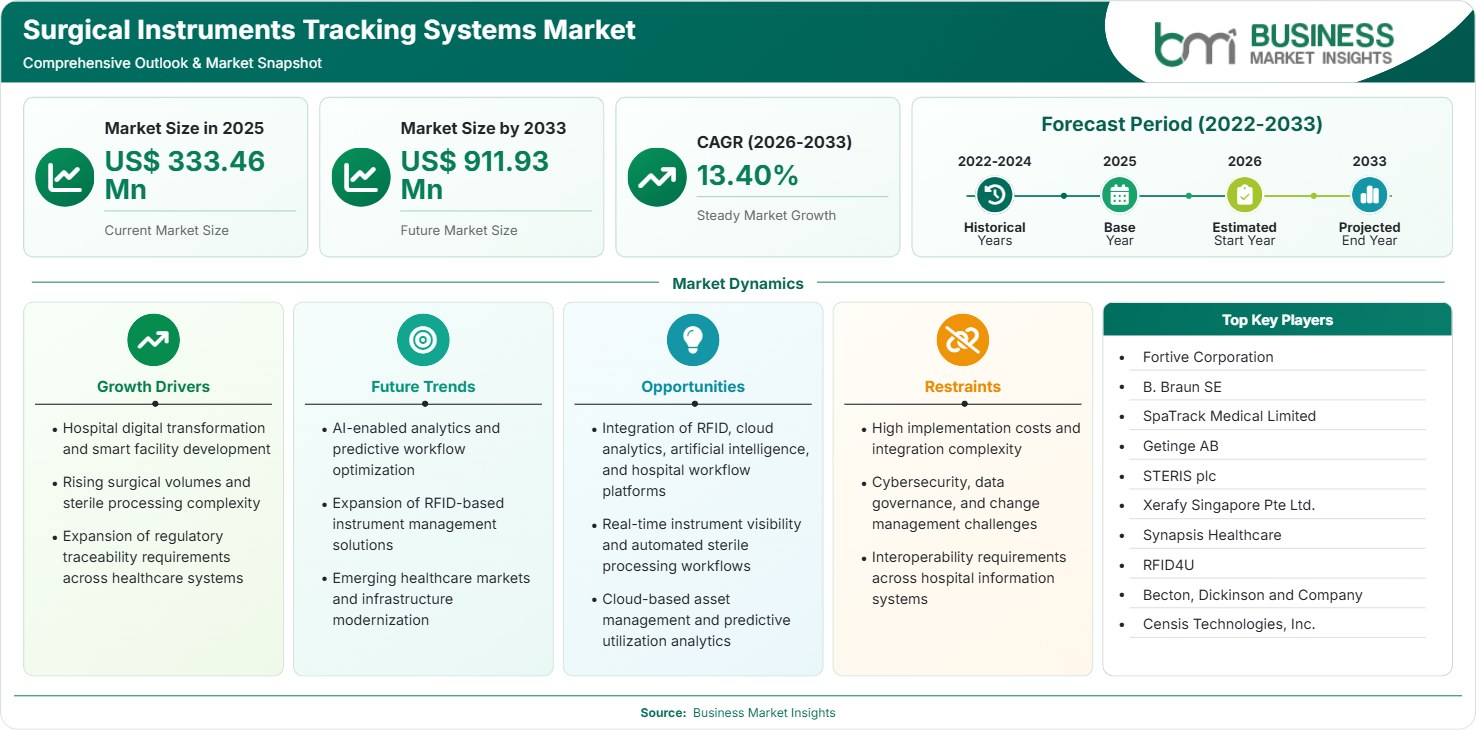
The Surgical Instruments Tracking Systems Market size was valued at US$ 333.46 Million in 2025 and is projected to reach US$ 911.93 Million by 2033, growing at a CAGR of 13.40% during 2026–2033, driven by hospital digitalization, RFID adoption, regulatory traceability requirements, sterile processing optimization, and increasing investments in patient safety and intelligent asset management solutions.

Report Coverage
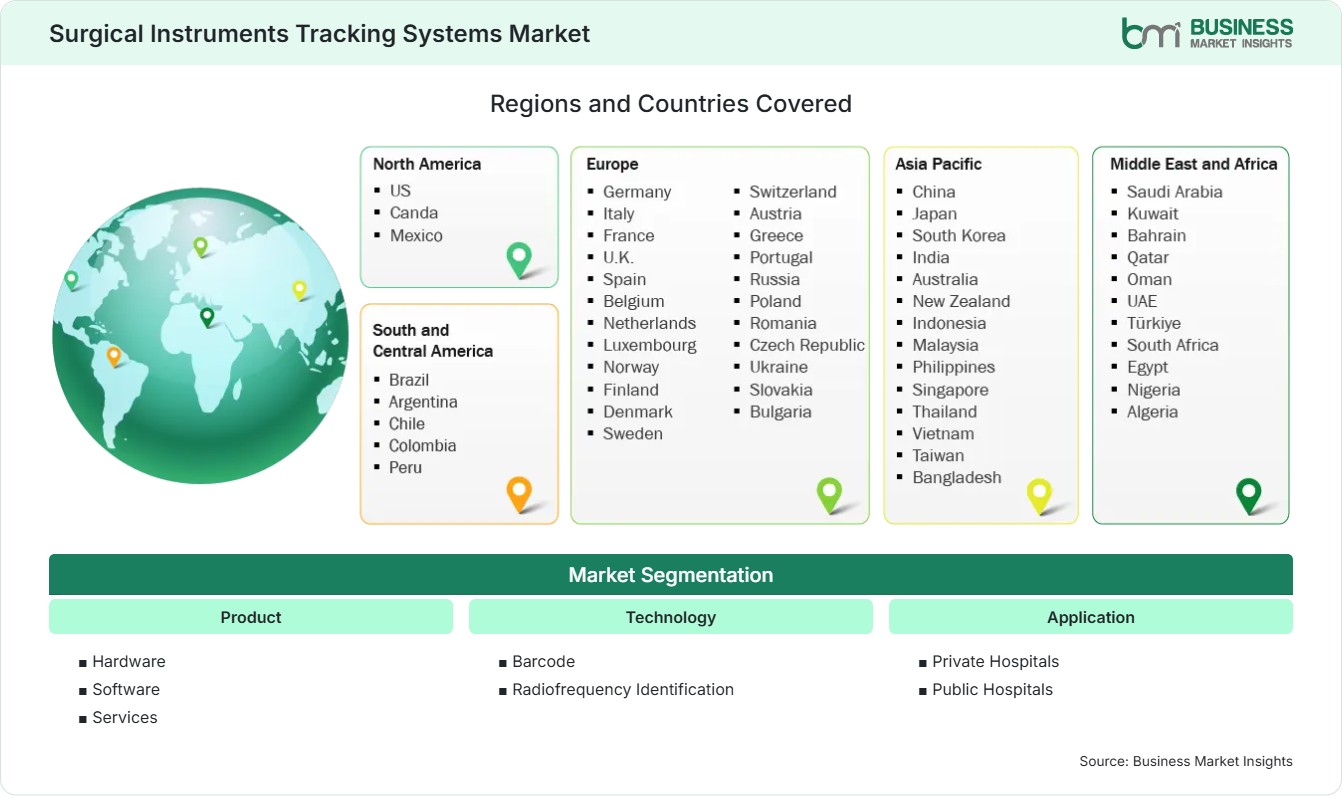
  • Product: Hardware, Software, Services
  • Technology: Barcode, Radiofrequency Identification
  • Application: Private Hospitals, Public Hospitals
US$ 333.46 Mn Market size in 2025
US$ 911.93 Mn Market Size by 2033
13.40% CAGR, 2026 - 2033
2026-2033 Forecast Period

AI Overview

Surgical Instruments Tracking Systems Market Summary

  • North America Region: North America holds Surgical Instruments Tracking Systems Market share of 45%–48% in 2025, growing with a CAGR of 12.0%–13.0% during 2026–2033, supported by FDA traceability mandates, hospital automation initiatives, RFID deployment, patient safety priorities, sterile processing modernization, healthcare IT investments, inventory optimization, compliance requirements, workflow efficiency improvements, and increasing adoption of intelligent surgical asset management platforms.
  • Brief U.S. analysis: The U.S. remains the regional leader, benefiting from advanced hospital infrastructure and widespread tracking technology deployment, recording a CAGR of 12.5%–13.5% through 2033.
  • Fastest Growing Region: Asia Pacific accounts for 23%–26% share of the Surgical Instruments Tracking Systems Market in 2025 and is projected to expand at a CAGR of 15.5%–16.8% during 2026–2033, supported by healthcare infrastructure investments, rising surgical volumes, expanding private hospital networks, digital transformation initiatives, medical tourism growth, RFID adoption, government modernization programs, increasing healthcare expenditure, and stronger patient safety standards.
  • Leading Segment: Hardware represents 42%–46% share in 2025 and is anticipated to grow at a CAGR of 12.5%–13.5% during 2026–2033, driven by demand for scanners, RFID readers, tagging solutions, sterilization-compatible devices, workflow automation, instrument visibility, inventory control, hospital digitization, operating room efficiency improvements, and asset utilization optimization.
  • High Growth Segment: Radiofrequency Identification (RFID) captures 31%–35% share in 2025 and is forecast to grow at a CAGR of 15.8%–17.0% during 2026–2033, supported by real-time visibility, non-line-of-sight tracking, automation benefits, enhanced durability, operational efficiency gains, inventory accuracy, regulatory compliance, analytics integration, and expanding deployment across modern surgical environments.
  • Key Market Opportunity: Expanding integration of RFID, cloud analytics, artificial intelligence, and hospital workflow platforms creates opportunities to improve tray accuracy, predictive maintenance, compliance documentation, utilization tracking, and operating room productivity globally.
  • Major Market Players: Fortive Corporation, B. Braun SE, SpaTrack Medical Limited, Getinge AB, STERIS plc, Xerafy Singapore Pte Ltd., Synapsis Healthcare, RFID4U, Becton, Dickinson and Company, and Censis Technologies, Inc.
Strategic Insights

Surgical Instruments Tracking Systems Market: Strategic Insights

Surgical Instruments Tracking Systems Market Strategic Framework
FREE PDF
Request your free sample
Request free sample
Stakeholder View

Key Takeaways

  • The industry ecosystem is evolving from standalone tracking tools toward integrated platforms connecting sterile processing departments, operating rooms, inventory systems, and hospital enterprise software, creating greater interoperability across healthcare operations.
  • RFID-enabled deployments represent the strongest commercial opportunity due to their ability to automate workflows, improve instrument visibility, reduce manual errors, and enhance inventory management across large healthcare facilities.
  • Product innovation is increasingly focused on cloud-based analytics, predictive utilization management, artificial intelligence-assisted workflows, and real-time location technologies that improve operational decision-making.
  • Asia Pacific presents a compelling investment case as healthcare infrastructure modernization, medical tourism expansion, and increasing surgical procedure volumes accelerate technology adoption across major healthcare systems.
  • Strategic partnerships, software integration agreements, and portfolio expansion initiatives are becoming key competitive strategies as vendors seek broader hospital network penetration and recurring service revenues.
  • Long-term value creation increasingly depends on vendors' ability to deliver comprehensive traceability, compliance management, analytics capabilities, and scalable deployment models rather than hardware alone.
Geographic Outlook

Surgical Instruments Tracking Systems Market Regional Highlights

North America Surgical Instruments Tracking Systems Market

North America accounts for around 45%-48% of total revenue in 2025 and is estimated to witness a CAGR of 12.0%-13.0% in 2026-2033. North America is supported by high adoption of healthcare IT, regulatory compliance, and instrument traceability systems. The Surgical Instruments Tracking Systems market share is still high in North America, owing to well-developed hospital infrastructure and investments in digital surgical theaters. Continuous modernization of sterile processing operations further strengthens regional competitiveness.

  • Healthcare organizations continue expanding RFID-enabled inventory management programs to improve instrument visibility, reduce loss rates, strengthen compliance documentation, and optimize utilization across large surgical departments and hospital networks.
  • FDA device identification requirements and broader healthcare traceability initiatives are encouraging hospitals to deploy sophisticated tracking solutions integrated with enterprise information systems and quality management workflows.
  • Large academic medical centers are prioritizing automation projects designed to improve tray accuracy, streamline sterilization processes, and enhance operating room scheduling efficiency across multiple facilities.
  • Vendors are increasingly introducing cloud-based analytics capabilities, allowing healthcare organizations to improve asset utilization, monitor performance metrics, and support strategic procurement decisions.
  • Growing emphasis on patient safety and operational accountability continues to support long-term Surgical Instruments Tracking Systems Market growth throughout the region.

US Surgical Instruments Tracking Systems Market

The U.S. is the major contributor, accounting for 79% to 83% of North America's revenue, and is expected to grow at a CAGR of 12.5% to 13.5% during 2033. Heavy expenditure on the health care industry, rapid digitization, and the use of enterprise-level hospital devices have made the United States the leading national market for traceable medical devices. Hospitals are becoming increasingly concerned about instrument traceability to ensure compliance and improve outcomes while supporting broader smart hospital transformation strategies.

  • Major health systems are integrating tracking platforms with electronic health records, inventory systems, and surgical workflow applications to improve operational coordination and documentation quality.
  • Increasing adoption of RFID-enabled solutions is helping healthcare facilities reduce manual tracking burdens while enhancing utilization visibility and compliance management capabilities.
  • Investments in smart hospital initiatives continue driving demand for connected asset management systems capable of supporting real-time operational intelligence and workflow automation.
  • Private hospital networks increasingly view instrument traceability platforms as strategic investments supporting efficiency, cost control, and patient safety objectives.

Europe Surgical Instruments Tracking Systems Market

Europe accounted for 25%–28% of the worldwide revenue share in 2025 and is expected to register a CAGR of 12.8%–13.8% over 2026–2033 within the Surgical Instruments Tracking Systems Market. The continued emphasis on medical device traceability regulations, healthcare digitalization trends, and increased investments in hospital efficiency will support market adoption. Germany remains the market leader, while Poland and other Central European countries are proving to be high-growth markets due to modernization initiatives and expanding healthcare technology investments.

  • European hospitals are increasingly implementing UDI-aligned identification frameworks to improve traceability, strengthen compliance, and enhance visibility across sterile processing operations.
  • Germany benefits from extensive hospital infrastructure and strong healthcare technology investment, maintaining leadership across regional deployments and solution adoption.
  • Nordic countries continue adopting advanced workflow management systems that combine asset tracking, sterilization monitoring, and analytics-driven operational optimization.
  • Poland and neighboring markets are attracting technology investment as healthcare providers modernize facilities and expand digital transformation programs.
  • Integration of cloud platforms and RFID technologies is becoming a major differentiator among healthcare providers seeking operational excellence.

Asia Pacific Surgical Instruments Tracking Systems Market

The Asia Pacific market is estimated to account for 23%-26% of worldwide income in 2025 and is expected to achieve the highest CAGR of 15.5%-16.8% through 2033. Increasing numbers of surgical procedures, the development of healthcare facilities, and technology investments are boosting usage. China currently holds the largest regional share, while India shows the highest growth potential owing to the drive towards digitalization and the optimization of healthcare institutions.

  • Healthcare providers are increasingly deploying barcode and RFID technologies to manage growing instrument inventories and support higher surgical procedure volumes.
  • China benefits from extensive hospital modernization projects and expanding adoption of intelligent healthcare technologies across large urban medical centers.
  • India is emerging as a high-growth market supported by expanding private healthcare infrastructure, medical tourism growth, and digital health initiatives.
  • Regional governments are supporting healthcare quality improvement programs that encourage adoption of traceability and workflow management technologies.
  • Investments in smart hospitals and connected healthcare infrastructure continue creating favorable conditions for long-term expansion.

Rest of World Surgical Instruments Tracking Systems Market

The Rest of World accounted for approximately 6% to 8% share of world revenue in 2025 and is estimated to register a CAGR of 13.5% to 14.8% from 2026 to 2033 in the Surgical Instruments Tracking Systems Market. The adoption is largely seen in leading hospitals, but significant investments are being made in selected countries. Brazil is the leader in driving demand in South and Central America, whereas the United Arab Emirates is the key market in the Middle East & Africa, owing to smart healthcare policies and hospital upgrade projects. Healthcare players in these regions are increasingly focused on operational efficiency and patient safety through digital healthcare transformation to improve service quality and resource utilization.

  • Gulf countries continue investing in advanced healthcare infrastructure, creating opportunities for intelligent tracking technologies and integrated workflow management solutions.
  • Brazil remains a key regional market supported by healthcare expansion projects and increasing adoption of hospital automation technologies.
  • Private healthcare providers are driving early adoption by prioritizing operational efficiency, compliance readiness, and patient safety initiatives.
  • International technology partnerships are helping healthcare facilities accelerate implementation of advanced traceability systems and best-practice workflows.
  • Growing awareness of long-term cost savings and quality improvements continues strengthening adoption prospects across emerging healthcare markets.
Global Market Geography
FREE PDF
Request your free sample
Request free sample
Segment Analysis

Surgical Instruments Tracking Systems Market Segmentation

Product

The products segment is led by the hardware segment, which has a market share of 42%-46% in 2025 and is expected to record a CAGR of 12.5%-13.5% during the forecast period. This segment is propelled by the rising adoption of RFID readers, barcode readers, instrumentation tags, and sterilizable identification solutions. Integration of the hardware segment with cloud-based workflow solutions and hospital information solutions is improving operational visibility and compliance management.

  • Hardware: RFID readers, barcode scanners, tracking stations, and durable instrument tags remain essential for instrument identification and traceability across sterilization, storage, transportation, and operating room workflows.
  • Software: Software platforms enable lifecycle management, compliance documentation, tray assembly verification, utilization analytics, and interoperability with enterprise healthcare systems, creating operational efficiencies and supporting data-driven decision-making.
  • Services: Implementation, maintenance, training, validation, and consulting services are gaining importance as healthcare providers seek optimized deployment strategies and long-term performance improvements from tracking investments.

Technology

Barcode technology was the largest segment by market share, accounting for 65%–69%, while its CAGR was 11.8%–12.8%. The scope of the Surgical Instruments Tracking Systems Market is continuously growing due to upgrades in traceability system models, with healthcare organizations using both bar codes and RFID technologies. Bar codes offer cost-effectiveness and established procedures, whereas RFID systems are growing in popularity due to their automation and real-time benefits.

  • Barcode: Barcode-based systems remain widely adopted due to affordability, operational familiarity, regulatory compliance support, straightforward deployment requirements, and compatibility with existing hospital information technology environments.
  • Radiofrequency Identification (RFID): RFID technology provides real-time tracking, enhanced inventory accuracy, automated data capture, reduced manual intervention, and improved visibility across complex surgical instrument management workflows.

Application

The private hospital category accounted for 56%–60% in 2025 and is expected to grow at a CAGR of 14.2%–15.2% in the Surgical Instruments Tracking Systems Market, making it the fastest-growing application category. With increasing investments by healthcare organizations in sophisticated traceability systems to improve patient safety, accountability, inventory management, and process efficiency, the trend is likely to continue to support adoption across hospital environments globally.

  • Private Hospitals: Private healthcare networks increasingly invest in intelligent tracking solutions to improve surgical workflow efficiency, strengthen compliance management, reduce instrument loss, and optimize asset utilization.
  • Public Hospitals: Public healthcare institutions are adopting traceability platforms to improve accountability, support regulatory compliance, enhance patient safety outcomes, and modernize sterile processing operations.
Market Forces

Surgical Instruments Tracking Systems Market Dynamics

Key Market Drivers

Expansion of Regulatory Traceability Requirements Across Healthcare Systems

Regulatory authorities and accreditation bodies now demand complete documentation of the use of surgical instruments, sterilization processes, and maintenance procedures. Regulatory mandates, including the FDA Unique Device Identification scheme, UDI regulations in Europe, GS1 identification standards, and sterilization guidelines, are urging healthcare organizations to enhance traceability systems. Hospitals are adopting automated systems to maintain audit capability, ensure effective recalls, and reduce compliance risks. Thus, the focus on an accurate and transparent documentation process is generating continuous demand for tracking systems. The Surgical Instruments Tracking Systems Market is hence becoming more relevant as part of compliance modernization efforts than as an investment in inventory management alone.

Rising Surgical Volumes and Sterile Processing Complexity

A growing number of orthopedic, cardiovascular, neurological, and minimally invasive surgical procedures has increased the demand for efficient sterile processing departments globally. As instrument inventories grow, tracking processes are becoming more prone to errors due to inadequate documentation, instrument misplacement, and inefficient workflows. Efficient tracking technologies aid healthcare facilities in managing their visibility throughout the instrument lifecycle, increasing tray accuracy and reducing downtime. Increasing efficiency is a priority for healthcare facilities amid workforce shortages and the high cost of healthcare services, which are putting conventional processes under pressure.

Hospital Digital Transformation and Smart Facility Development

There are considerable investments in the global healthcare industry towards state-of-the-art smart hospital solutions. Examples of solutions that are part of current trends include asset tracking, RFID infrastructure, cloud computing and analytics, automation software solutions, and connected healthcare solutions. The Surgical Instruments Tracking Systems Market trends have gradually converged towards digital transformation, focusing on interoperability, predictive analytics, and automation. Hospitals seek to develop a system to ensure instrument data is seamlessly integrated with operating room management, inventory, and enterprise systems. With the increased adoption of smart hospitals around the globe, traceability solutions have progressed from being mere solutions to becoming the core of operations.

Key Market Opportunities

AI-Enabled Analytics and Predictive Workflow Optimization

AI is increasingly becoming a critical addition to the traceability solutions employed in healthcare. Sophisticated analytics will enable the identification of recurring obstacles, the forecasting of tray requirements, the efficient distribution of instruments, and the effective planning of maintenance. Workflow assisted by AI will also enable utilization review and exception management, enabling hospitals to eliminate inefficiencies and improve preparedness. As healthcare institutions begin to capitalize on digital solutions to increase their profitability, intelligent analytics capabilities will present themselves as an exciting point of differentiation. The Surgical Instruments Tracking Systems Market forecasts are incorporating the value that predictive decision support solutions can bring.

Expansion of RFID-Based Instrument Management Solutions

The adoption of RFID is currently at an early stage when compared with the use of barcodes in many hospitals and other health care institutions, implying substantial room for growth. It enables non-line-of-sight recognition, real-time visibility, automated scanning, and improved inventory accuracy. Large hospitals are becoming more willing to invest in RFID, recognizing its potential to reduce labor costs and improve compliance management. RFID is becoming better recognized for its long-term advantages and is beginning to be adopted in operating rooms, sterile processing areas, and other supply chain environments.

Emerging Healthcare Markets and Infrastructure Modernization

The development of healthcare infrastructure in the Asia-Pacific, Latin America, and some Middle Eastern nations will create ideal market conditions for healthcare technology companies. Significant investments in digital health solutions, smart hospitals, and quality improvement programs have been made by governments and the private sector in these nations. The growing number of surgical procedures, expansion of private healthcare networks, and demands for patient safety are driving this adoption process. Technology companies that can form local partnerships and implement models will be able to take advantage of such opportunities.

Market Restraints and Challenges

High Implementation Costs and Integration Complexity

Factor: Deployment of enterprise-scale tracking infrastructure requires substantial investment in hardware, software, RFID components, networking capabilities, validation activities, and staff training. Integration with hospital information systems often adds technical complexity and implementation risk.

Impact: Smaller healthcare facilities and budget-constrained organizations may delay adoption because of capital expenditure concerns and uncertain return-on-investment timelines. Multi-site healthcare networks also face challenges associated with standardization and interoperability requirements. These financial and operational barriers can slow implementation cycles despite recognized efficiency benefits and regulatory drivers. Consequently, adoption rates vary considerably between large healthcare systems and resource-constrained facilities.

Cybersecurity, Data Governance, and Change Management Challenges

Factor: Increasing connectivity between tracking platforms, cloud environments, enterprise applications, and hospital networks creates new cybersecurity and governance requirements. Healthcare providers must protect sensitive operational data while maintaining regulatory compliance and system reliability.

Impact: Concerns regarding cybersecurity risks, user adoption barriers, workforce training requirements, and workflow disruption can extend procurement and deployment timelines. Organizations often require extensive validation, governance frameworks, and stakeholder engagement before large-scale implementation. These challenges increase project complexity and can affect realization of expected operational benefits during early deployment phases.

Company Analysis

Competitive Landscape

The competitive environment is characterized by increasing investments in RFID-enabled solutions, cloud-based traceability platforms, sterile processing automation, and enterprise healthcare integration. Surgical Instruments Tracking Systems Market analysis indicates that vendors are expanding software capabilities, analytics functionality, and interoperability with hospital information systems to strengthen differentiation. Strategic partnerships, product enhancements, and recurring-service business models remain important competitive priorities across the industry.

Company Name

Overview

Products and Services Relevant to this Market

Fortive Corporation

Diversified industrial technology company with a strong healthcare technology portfolio through Censis, serving hospitals and sterile processing departments globally.

Instrument-level tracking systems, sterile processing workflow software, compliance management tools, analytics platforms, and cloud-enabled perioperative asset management solutions.

B. Braun SE

Global medical technology company with extensive hospital, surgical, and sterilization expertise supporting healthcare operational efficiency initiatives.

Surgical instrument management solutions, sterilization workflows, traceability support systems, and integrated healthcare technology platforms.

SpaTrack Medical Limited

Specialized healthcare technology provider focused on surgical asset management and instrument traceability solutions for hospitals.

Instrument tracking software, workflow optimization tools, compliance documentation systems, and surgical inventory visibility platforms.

Getinge AB

Major healthcare technology company with strong presence in sterilization, infection control, and surgical workflow management.

T-DOC instrument tracking platform, sterile supply workflow optimization solutions, traceability systems, and department management software.

STERIS plc

Leading provider of infection prevention, sterilization, and procedural products supporting healthcare facilities globally.

SPM instrument tracking solutions, sterile processing management software, workflow automation tools, and compliance-focused tracking platforms.

Xerafy Singapore Pte Ltd.

Specialist RFID technology company recognized for durable healthcare-grade identification and tracking solutions.

RFID tags, healthcare asset identification technologies, surgical instrument tracking components, and traceability infrastructure solutions.

Synapsis Healthcare

Healthcare technology provider supporting digital transformation and workflow optimization across hospital environments.

Instrument traceability systems, workflow software, compliance management solutions, and healthcare process automation tools.

RFID4U

RFID-focused solutions provider supporting healthcare asset tracking, inventory management, and operational visibility initiatives.

RFID deployment services, readers, tags, tracking infrastructure, consulting services, and healthcare asset management solutions.

Trust & Transparency

Research Methodology

The market analysis combines proprietary research with secondary data from government agencies, company disclosures, regulatory filings, industry databases and expert interviews. Market estimates are validated through data triangulation, cross-market benchmarking and analyst review.

View Full Research Methodology

Questions Answered

Frequently Asked Questions

Which end-user category presents the strongest commercial opportunity?

Private hospitals represent the most attractive opportunity because they increasingly invest in digital transformation, smart hospital technologies, workflow automation, and advanced traceability platforms to improve efficiency and patient outcomes.

What does the Surgical Instruments Tracking Systems Market Report cover?

The report evaluates market size, technology adoption, product trends, application opportunities, competitive developments, regional performance, growth drivers, restraints, and future investment prospects across the global healthcare ecosystem.

How do tracking systems improve hospital operations?

These solutions help reduce instrument loss, improve sterilization documentation, enhance inventory visibility, optimize asset utilization, support regulatory compliance, and improve coordination between operating rooms and sterile processing departments.

Which technology segment is expected to experience the strongest expansion?

RFID technology is projected to achieve the highest growth rate due to real-time visibility, automation benefits, reduced manual intervention, improved inventory accuracy, and expanding deployment across large healthcare facilities.

What factors are accelerating adoption of surgical instrument tracking solutions?

Increasing regulatory compliance requirements, rising surgical procedure volumes, hospital digitalization initiatives, patient safety priorities, and demand for operational efficiency are encouraging healthcare providers to adopt advanced traceability technologies and workflow management platforms.

Access the Full Surgical Instruments Tracking Systems Market Report

Get segment-level forecasts, regional estimates, competitive benchmarking, company profiles and downloadable Excel datasets.

Access the full Surgical Instruments Tracking Systems Market Report
350 pages PDF & Excel | 2026-08-31