Market Summary
Executive Summary and Global Market Analysis
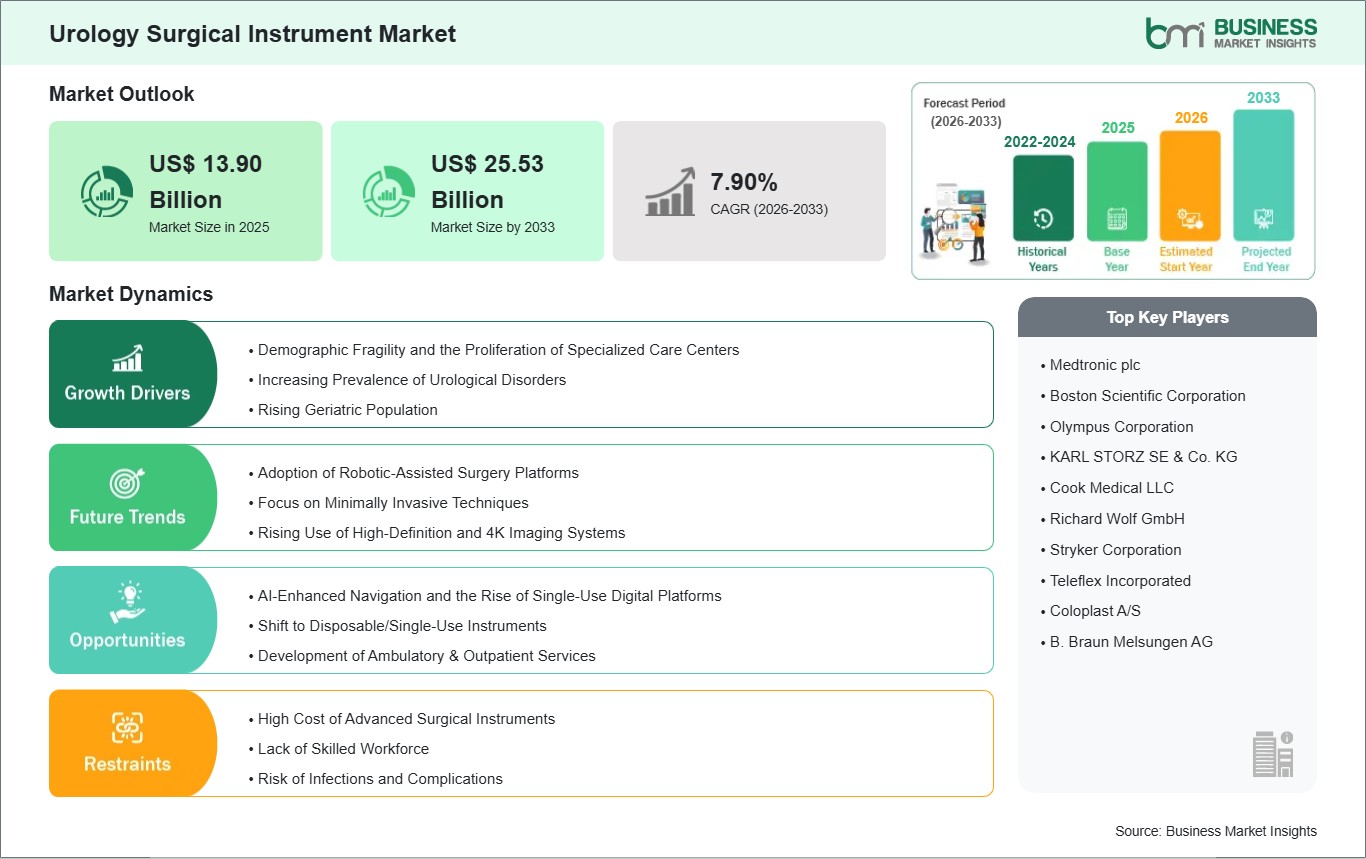
Urology surgical instruments refer to a specialized category of medical tools designed for the diagnosis, management, and surgical treatment of disorders affecting the urinary tract and the male reproductive system. The urology surgical instrument market is an essential and technologically advanced segment of the global medical device market. It provides immense strategic value by enabling healthcare providers to address the increasing clinical burden of urological malignancies and functional disorders across hospitals, ambulatory surgical centers, and specialty clinics. Market expansion is fundamentally driven by the global aging population, who exhibit a higher susceptibility to benign prostatic hyperplasia, urinary incontinence, and various forms of urologic cancer. Furthermore, the shift toward minimally invasive surgery (MIS), supported by advancements in flexible endoscopy and robotic assistance, is improving patient outcomes by reducing post-operative pain, minimizing blood loss, and accelerating recovery times.
However, several factors can restrain market growth. The high acquisition and maintenance costs of advanced imaging systems and robotic platforms can be a significant barrier for healthcare facilities in cost-sensitive or emerging regions. Stringent regulatory frameworks and the lengthy certification processes required for new surgical instruments often delay product commercialization and increase development expenses. Additionally, the industry faces constraints due to the risks of cross-contamination associated with reusable instruments, necessitating rigorous sterilization protocols or a strategic shift toward single-use, disposable alternatives.
Despite these hurdles, the market holds significant opportunities in the integration of artificial intelligence for real-time procedural guidance and enhanced diagnostic visualization. The rise of single-use endoscopes, which eliminate the need for reprocessing and reduce infection risks, and the expansion of outpatient urological services are expected to support long-term development within the sector. Manufacturers are also finding growth potential in the development of thulium and holmium laser systems for precise tissue ablation and stone fragmentation.
Segment Analysis
Urology Surgical Instrument Market Segmentation
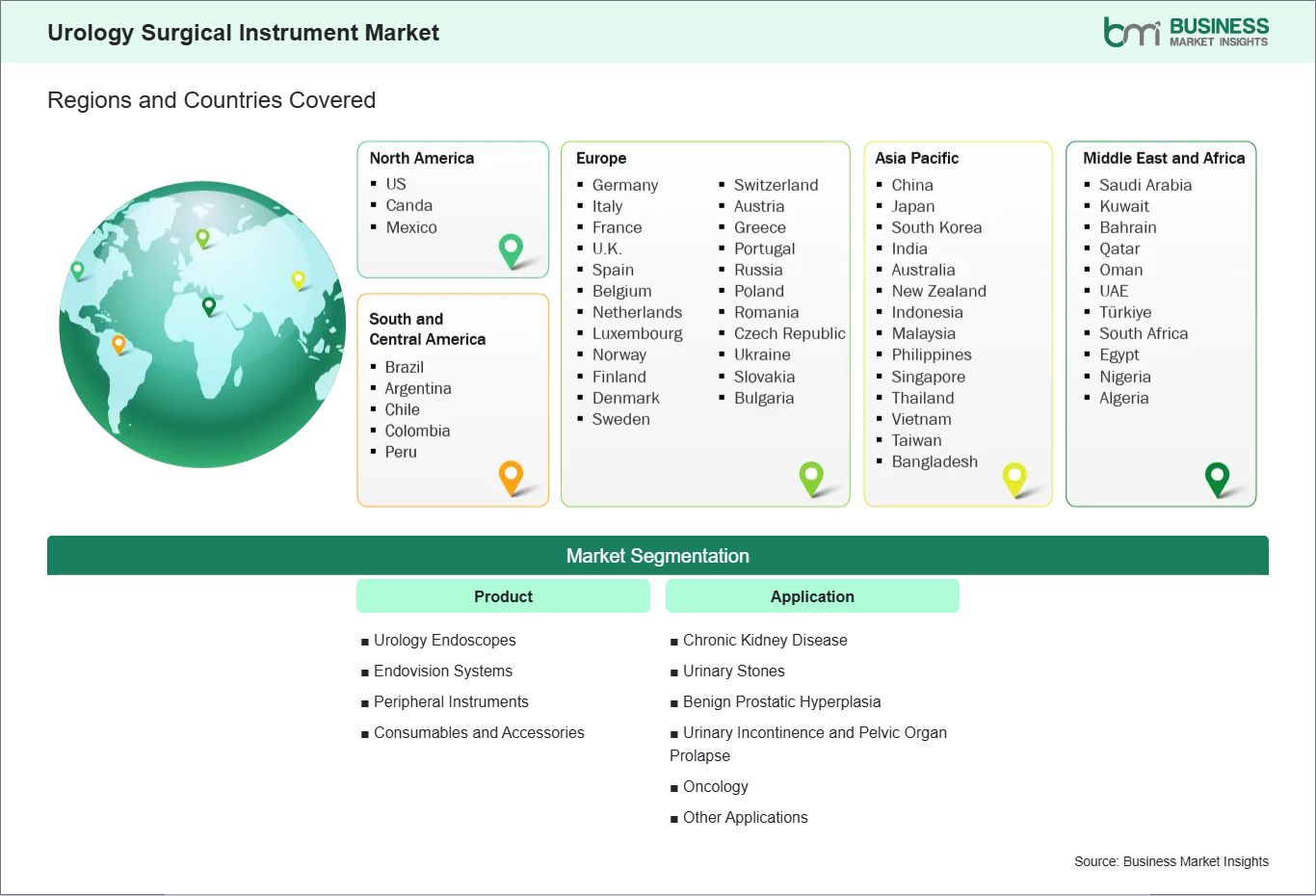
Key segments that contributed to the derivation of the Urology Surgical Instrument market analysis are product and application.
- By Product, the market is segmented into Urology Endoscopes, Endovision Systems, Peripheral Instruments, and Consumables and Accessories.
- By Application, the market is divided into Chronic Kidney Disease, Urinary Stones, Benign Prostatic Hyperplasia, Urinary Incontinence and Pelvic Organ Prolapse, Oncology, and Other Applications.
Market Forces
Urology Surgical Instrument Market Drivers and Opportunities
Demographic Fragility and the Proliferation of Specialized Care Centers
The primary driver for the Urology Surgical Instrument Market is the accelerating global prevalence of urological malignancies and chronic conditions, particularly those associated with an aging population. The Increasing Burden of Benign Prostatic Hyperplasia (BPH), Kidney Stones, and Bladder Cancers acts as a foundational catalyst, as these conditions, often exacerbated by rising rates of diabetes and hypertension, necessitate a higher volume of specialized surgical interventions. This momentum is further propelled by the Global Shift Toward Minimally Invasive Surgery (MIS); healthcare systems are increasingly prioritizing laparoscopic and robotic techniques over traditional open surgery to reduce hospital stays, minimize blood loss, and accelerate patient recovery.
In the technology sphere, the Rapid Adoption of Robotic-Assisted Surgical Systems serves as a critical driver, providing surgeons with enhanced dexterity and 3D visualization for complex procedures such as prostatectomies and nephrectomies. Furthermore, the Expansion of Ambulatory Surgical Centers (ASCs) and Specialized Urology Clinics is decentralizing care, creating a robust demand for modular and portable instrument sets tailored for outpatient settings. Together, these factors, demographic vulnerability, the MIS mandate, and infrastructure modernization, ensure a resilient and technologically advanced growth path for the global urology surgical instrument market.
AI-Enhanced Navigation and the Rise of Single-Use Digital Platforms
A significant high-value opportunity lies in the convergence of Urology Surgical Instruments with Artificial Intelligence (AI) and Real-Time Decision Support. Next-generation smart instruments are being developed with integrated sensors that provide haptic feedback and AI-driven image analysis, helping surgeons distinguish between healthy tissue and malignancies during tumor resection. There is also a major growth frontier in the development of Advanced Single-Use Flexible Endoscopy Platforms; as hospitals seek to optimize operational efficiency and infection control, manufacturers who provide high-definition, disposable ureteroscopes with integrated working channels for stone management are poised to capture significant market share.
Furthermore, the expansion of Laser-Based Lithotripsy and Thulium Fiber Laser Systems presents a lucrative opportunity, offering precise stone fragmentation and soft-tissue ablation with minimal thermal damage to surrounding structures. Beyond hardware, the rise of 3D-Printed, Patient-Specific Surgical Guides offers a unique frontier, allowing for personalized procedural planning for complex renal or pelvic reconstructions. Manufacturers who focus on Ergonomically Optimized Single-Port Robotic Tools and those pioneering Wireless Endovision Systems are positioned to lead the most innovative and high-margin segments of the global urology surgical instrument market.
Size and Share Analysis
Urology Surgical Instrument Market Size and Share Analysis
Based on the product, the Urology Endoscopes subsegment holds the primary market presence, serving as the essential technological cornerstone of the specialty. These instruments are indispensable for the market, maintaining the largest market share as cystoscopes, ureteroscopes, and nephroscopes are required for the vast majority of diagnostic and operative urological workflows. While Endovision Systems and Peripheral Instruments provide critical support, they function as secondary components to the high-utilization endoscopy platforms. However, a notable trend is the surge in the Consumables and Accessories subsegment, which is registering the highest pace of adoption.
Report Coverage
Urology Surgical Instrument Market Report Coverage and Deliverables
The "Urology Surgical Instrument Market Size and Forecast (2022–2033)" report provides a detailed analysis of the market covering below areas:
- Urology Surgical Instrument market size and forecast at global, regional, and country levels for all market segments covered under the scope
- Urology Surgical Instrument market trends, as well as drivers, restraints, and opportunities
- Urology Surgical Instrument market analysis covering key trends, global and regional framework, major players, regulations, and recent developments
- Industry landscape and competition analysis covering market concentration, heat map analysis, prominent players, and recent developments for the Urology Surgical Instrument market
- Detailed company profiles, including SWOT analysis
Geographic Insights
Urology Surgical Instrument Market Geographic Insights
The geographical scope of the Urology Surgical Instrument market report is divided into five regions: North America, Asia Pacific, Europe, Middle East & Africa, and South & Central America.
North America maintains a commanding market position, supported by a sophisticated network of specialized urology departments and the early clinical integration of robotic-assisted surgical platforms. Europe represents a mature and highly regulated market where growth is sustained by a robust framework for medical device innovation and a strong institutional preference for minimally invasive endourological procedures. Asia Pacific is identified as the most rapidly advancing region, propelled by accelerating healthcare modernization, rising incidences of urolithiasis and prostate disorders, and significant public investments in surgical infrastructure across emerging economies.
The Asia-Pacific Urology Surgical Instrument Market is segmented into China, Japan, South Korea, India, Australia, and the Rest of Asia Pacific. China serves as a central hub for market expansion, driven by an aging demographic susceptible to benign prostatic hyperplasia (BPH) and government initiatives to expand access to specialty care in secondary cities. India is experiencing a notable surge in demand as private healthcare networks invest in advanced lithotripsy and endoscopy suites to address the high volume of kidney stone cases. Japan and South Korea continue to lead in the adoption of high-specification instruments, focusing on miniaturized and single-use technologies to improve procedural efficiency and patient safety in specialized geriatric care settings.
Industry Activity
Recent Developments
The Urology Surgical Instrument market is evaluated by gathering qualitative and quantitative data post primary and secondary research, which includes important corporate publications, association data, and databases. A few of the key developments in the Urology Surgical Instrument market are:
- In December 2025, Medtronic received FDA clearance for its Hugo™ robotic-assisted surgery system for minimally invasive urologic procedures, including prostatectomy, nephrectomy, and cystectomy. The modular robotic platform enhances surgeon flexibility, workflow efficiency, and patient outcomes, expanding access to advanced robotic-assisted urology care in the U.S.
- In September 2025, Olympus announced a global distribution partnership with MacroLux Medical for single-use urology products, including cystoscopes, ureteroscopes, and suction access sheaths. The collaboration expands access to innovative urologic instruments, enhancing surgical precision, clinical efficiency, and adoption of disposable solutions worldwide.
Trust & Transparency
Research Methodology
The market analysis combines proprietary research with secondary data from government agencies, company disclosures, regulatory filings, industry databases and expert interviews. Market estimates are validated through data triangulation, cross-market benchmarking and analyst
review.
View Full Research Methodology
Key Sources Referred:
World Bank – Global Trade Indicators World Trade Organization (WTO) (International Monetary Fund )IMF International Trade Administration (ITA) Company website Company annual reports Company investor presentations