
Surgical Sutures Market Outlook: Size, Share, Trends, Growth Analysis, Competitive Landscape & Forecast, 2026-2033

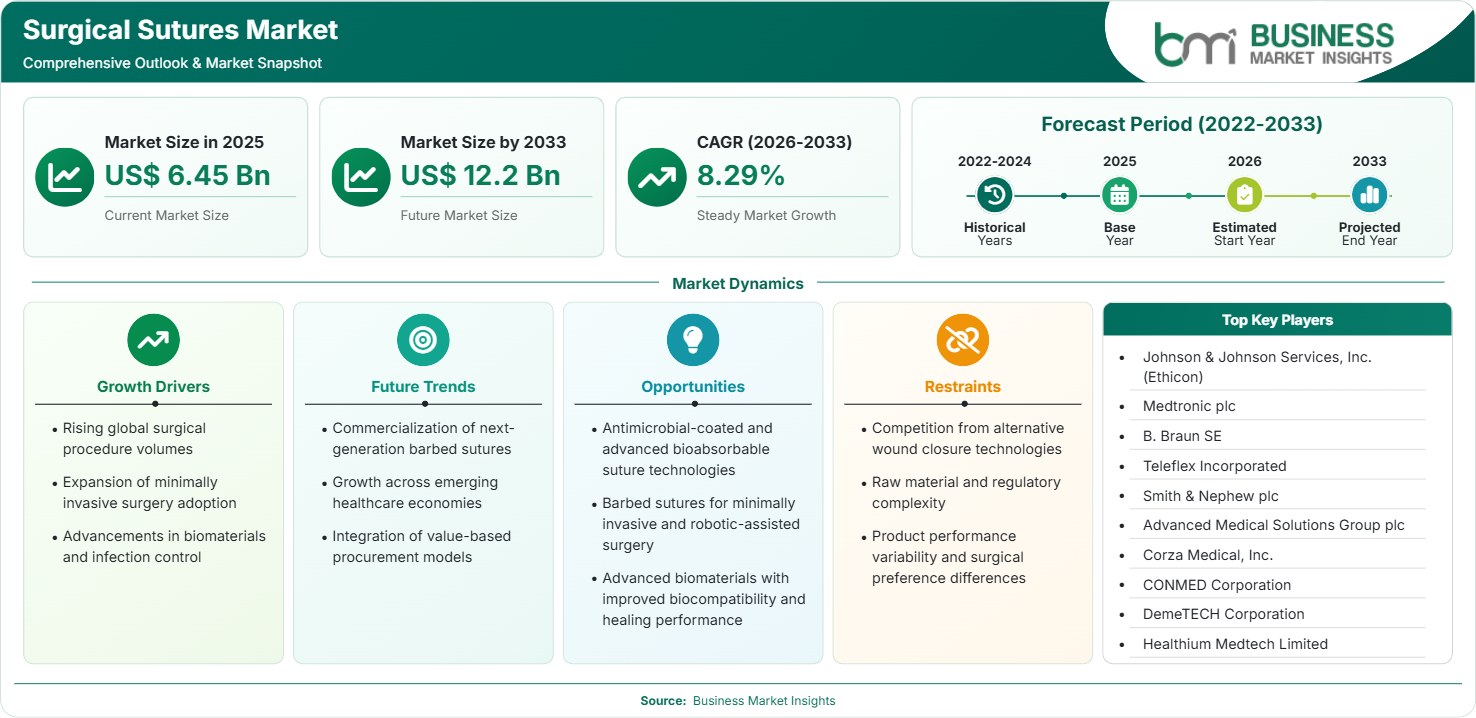
The Surgical Sutures Market size was valued at US$ 6.45 Billion in 2025 and is projected to reach US$ 12.2 Billion by 2033, growing at a CAGR of 8.29% during 2026–2033. Rising surgical volumes, expanding minimally invasive procedures, increasing chronic disease burden, and innovation in absorbable and antimicrobial suture technologies continue creating strong growth opportunities globally.

Report Coverage
  • Product Type: Absorbable, Non-absorbable
  • Form: Natural, Synthetic
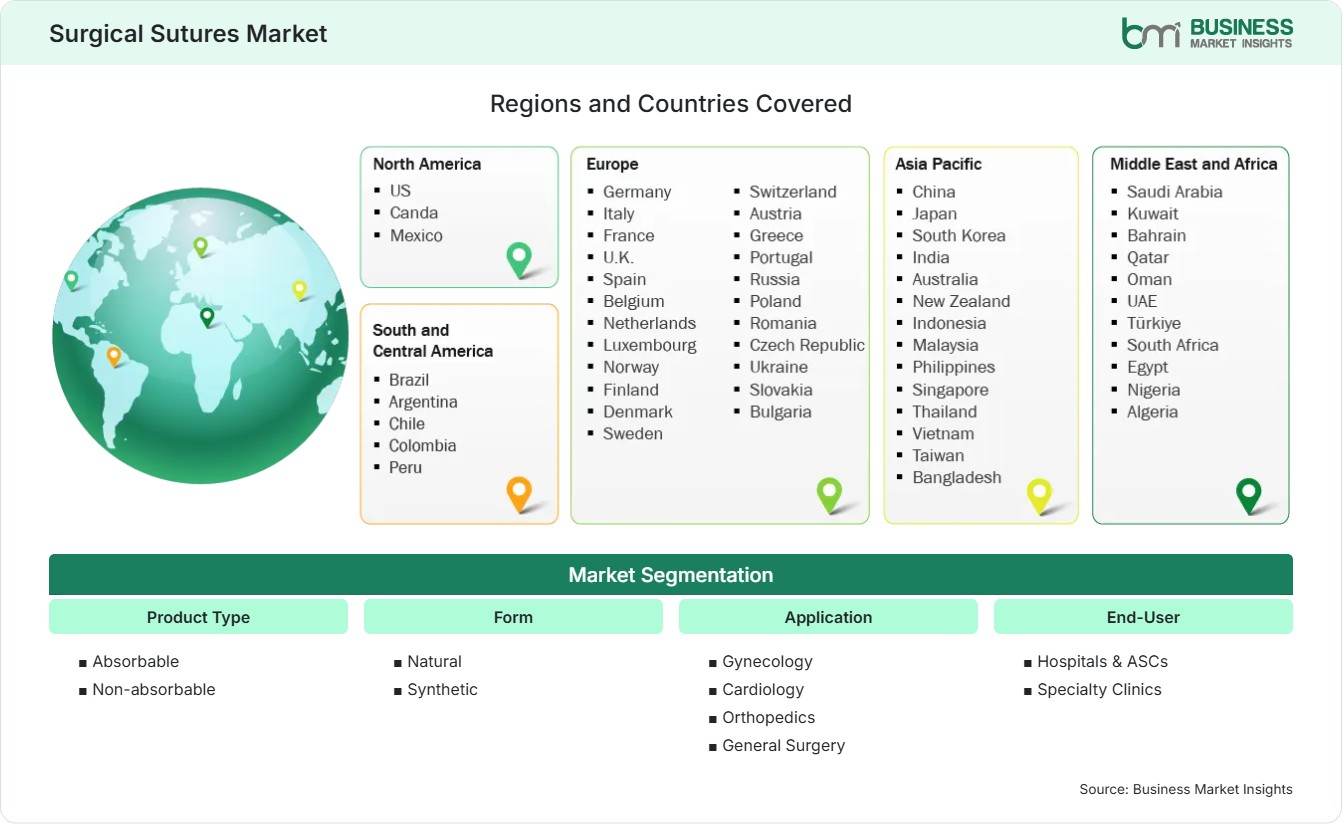
  • Application: Gynecology, Cardiology, Orthopedics, General Surgery
  • End-User: Hospitals & ASCs, Specialty Clinics
US$ 6.45 Bn Market size in 2025
US$ 12.2 Bn Market Size by 2033
8.29% CAGR, 2026 - 2033
2026-2033 Forecast Period

AI Overview

Surgical Sutures Market Summary

  • North America Region: North America holds a market share of 34%–37% in 2025, growing at a CAGR of 7.3%–7.8% during 2026–2033. Key drivers include advanced surgical infrastructure, higher procedure volumes, innovation adoption, infection-control initiatives, reimbursement support, outpatient surgery expansion, premium wound-closure demand, hospital modernization, surgeon preference, and procurement standardization opportunities. US market benefits from high elective procedure volumes and innovation investments, advancing at 7.4%–7.9% CAGR.
  • Fastest Growing Region: Asia Pacific holds a Surgical Sutures Market share of 24%–27% in 2025, growing at a CAGR of 9.8%–10.5% during 2026–2033. Key drivers include healthcare expansion, rising medical tourism, growing surgical access, hospital investments, urbanization, chronic disease treatment demand, local manufacturing growth, procurement reforms, specialist workforce expansion, and greater healthcare affordability.
  • Leading Segment: Absorbable sutures account for a 58%–62% share in 2025 and are projected to expand at 8.5%–9.1% CAGR. Demand is supported by reduced follow-up requirements, infection management advantages, improved healing outcomes, broader procedural suitability, surgeon preference, premium product adoption, and technological development.
  • High Growth Segment: Synthetic sutures represent 66%–70% share in 2025 and are expected to grow at 9.0%–9.7% CAGR. Growth is supported by predictable absorption profiles, superior tensile strength, biocompatibility improvements, product innovation, wider clinical applications, regulatory acceptance, and increasing use across complex surgeries.
  • Key Market Opportunity: Expansion of antimicrobial-coated, barbed, and advanced bioabsorbable closure technologies presents strong potential as healthcare providers seek lower infection rates, shorter operating times, reduced complications, improved outcomes, and procedural efficiency.
  • Major Market Players: Johnson & Johnson Services, Inc. (Ethicon), Medtronic plc, B. Braun SE, Teleflex Incorporated, Smith & Nephew plc, Advanced Medical Solutions Group plc, Corza Medical, Inc., CONMED Corporation, DemeTECH Corporation, Healthium Medtech Limited.
Strategic Insights

Surgical Sutures Market: Strategic Insights

Surgical Sutures Market Strategic Framework
FREE PDF
Request your free sample
Request free sample
Stakeholder View

Key Takeaways

  • The value chain is increasingly integrated, with manufacturers combining raw material sourcing, needle technologies, sterilization processes, and distribution capabilities to improve quality control and supply reliability.
  • Gynecology, cardiology, and orthopedic procedures offer strong revenue upside because procedural volumes continue increasing across both developed and emerging healthcare systems.
  • Innovation efforts are shifting toward antimicrobial coatings, barbed configurations, bioactive materials, and synthetic absorbable formulations that improve healing performance and surgical efficiency.
  • India, China, Southeast Asia, and Gulf Cooperation Council countries present compelling investment cases due to hospital construction programs and growing surgical infrastructure.
  • Strategic acquisitions remain common as established device companies seek access to specialty wound closure portfolios, regional distribution networks, and advanced biomaterial technologies.
  • Ambulatory surgical center expansion is reshaping procurement patterns, encouraging demand for cost-efficient yet clinically advanced closure products.
Geographic Outlook

Surgical Sutures Market Regional Highlights

North America Surgical Sutures Market

North America represents the largest regional position with 34%–37% Surgical Sutures Market share in 2025 and a projected CAGR of 7.3%–7.8% through 2033. High surgical procedure volumes, strong reimbursement frameworks, widespread adoption of premium absorbable products, and advanced hospital infrastructure support demand. Growing outpatient surgery activity and infection-prevention initiatives are encouraging adoption of antimicrobial and specialty sutures. Innovation leadership, favorable regulatory frameworks, and established supplier networks further strengthen regional competitiveness and procurement stability.

  • Hospitals increasingly standardize absorbable and antimicrobial products to improve patient outcomes and reduce postoperative complications.
  • Ambulatory surgical centers expand procurement volumes as same-day procedures become more common.
  • Technological integration supports demand for barbed sutures in minimally invasive surgeries.
  • Consolidated healthcare systems favor long-term supplier agreements and premium product categories.
  • Cardiovascular and orthopedic interventions remain major contributors to regional consumption.

US Surgical Sutures Market

The United States accounts for 78%–82% of North American revenue and advances at 7.4%–7.9% CAGR. Demand originates from high surgical utilization rates, strong healthcare spending, and rapid adoption of procedural innovations. Large integrated healthcare networks increasingly prioritize products demonstrating clinical value and infection-control performance. Academic medical centers and specialty institutions continue influencing adoption of advanced wound closure technologies, creating opportunities for differentiated product portfolios and premium offerings.

  • Wider use of robotic-assisted surgery supports demand for specialized closure solutions.
  • Private healthcare investment strengthens access to advanced biomaterials and premium technologies.
  • Trauma, bariatric, cardiac, and orthopedic procedures sustain consistent consumption levels.
  • Procurement emphasis increasingly includes clinical outcomes and total cost-of-care considerations.

Europe Surgical Sutures Market

Europe holds approximately a 27%–30% share in 2025 and is expected to register a 7.8%–8.4% CAGR in the Surgical Sutures Market. Germany leads regional demand through high surgical volumes and advanced healthcare infrastructure, while Eastern Europe demonstrates faster expansion. Aging populations, rising chronic disease prevalence, and procedure growth support adoption of absorbable and synthetic products. Regulatory focus on quality and patient safety encourages premium product penetration. Healthcare modernization initiatives continue strengthening long-term procedural demand.

  • Germany remains the leading national market, supported by extensive hospital capacity.
  • Poland and Romania demonstrate comparatively faster growth due to healthcare investments.
  • Higher adoption of antimicrobial technologies enhances product value propositions.
  • Public procurement encourages quality-focused supplier competition.
  • Orthopedic and cardiovascular procedures contribute significantly to regional revenue.

Asia Pacific Surgical Sutures Market

Asia Pacific accounts for 24%–27% share in 2025 and is forecast to expand at 9.8%–10.5% CAGR, making it the fastest-growing regional market. China leads demand, while India and Southeast Asia record accelerated expansion. Increasing healthcare access, hospital construction, medical tourism, and chronic disease treatment requirements support growth. Rising domestic manufacturing capabilities improve availability and cost competitiveness. Regional governments continue investing heavily in surgical infrastructure development.

  • China remains the largest regional market with strong production and consumption capabilities.
  • India demonstrates some of the fastest regional expansion through healthcare capacity growth.
  • Medical tourism strengthens demand for high-quality closure technologies.
  • Increasing surgeon training improves adoption of advanced synthetic products.
  • Local manufacturing investments support supply-chain resilience and affordability.

Rest of World Surgical Sutures Market

Rest of World represents 10%–12% share and is expected to grow at 8.5%–9.2% CAGR of the Surgical Sutures Market. South and Central America benefit from expanding private healthcare infrastructure and increasing elective procedures. Middle East and Africa markets are supported by healthcare diversification initiatives, specialty hospital investments, and growing access to surgical care. Brazil leads Latin America, while Saudi Arabia and the UAE demonstrate strong momentum across the Middle East segment.

  • Brazil remains the largest South and Central American market.
  • Saudi Arabia advances through extensive healthcare modernization programs.
  • UAE investments support adoption of premium surgical technologies.
  • Expansion of specialist hospitals increases procedural capacity.
  • Healthcare access improvements stimulate long-term procedure growth.
Global Market Geography
FREE PDF
Request your free sample
Request free sample
Segment Analysis

Surgical Sutures Market Segmentation

Product Type

Product Type remains a core differentiation area. Absorbable sutures hold 58%–62% share in 2025 and grow at 8.5%–9.1% CAGR, benefiting from reduced removal requirements and broader procedural use. Non-absorbable variants remain essential where long-term tissue support is required. The Surgical Sutures Market scope continues expanding as advanced biomaterials improve performance across diverse specialties.

  • Absorbable: Extensively used in internal tissue closure, supported by healing efficiency, lower follow-up requirements, and growing acceptance across gynecology, cardiovascular, and general surgery procedures.
  • Non-absorbable: Preferred in applications requiring long-term support, including cardiovascular and orthopedic interventions where durability and sustained tensile strength remain critical.

Form

Form segmentation is dominated by synthetic materials, accounting for a 66%–70% share in 2025 and expanding at 9.0%–9.7% CAGR. Demand reflects superior consistency, predictable performance, and innovation in polymer technologies. Natural variants retain relevance in selected procedures where handling characteristics and surgeon familiarity remain influential procurement considerations.

  • Natural: Utilized in specific clinical applications where established handling properties and procedural familiarity influence product selection.
  • Synthetic: Driven by innovation, controlled absorption profiles, enhanced biocompatibility, and broader application across modern surgical specialties.

Application

The application demand is highly diverse, with General Surgery holding a market share of 32% to 36% by 2025 and a CAGR of 8.0% to 8.6%. Increased surgical volumes due to chronic diseases, trauma treatment, and electives drive the use of sutures. This application is an indicator of major Surgical Sutures Market trends associated with growing procedural complexity and outpatient surgery adoption.

  • Gynecology: Increasing cesarean procedures and reproductive health surgeries sustain product demand across healthcare systems.
  • Cardiology: High requirements for precision closure continue supporting use of advanced synthetic and non-absorbable materials.
  • Orthopedics: Joint reconstruction and trauma procedures create steady consumption across hospitals and specialist centers.
  • General Surgery: Broad procedural applicability makes this category the largest consumption segment.

End-user

Hospitals & ASCs represent 74% to 78% market share by 2025, with 8.3% to 8.9% CAGR due to high levels of surgeries and scale of procurement. Specialty Clinics are expected to grow as procedures become increasingly specialized. The segment will be critical for utilization trends, as advanced surgeries are being conducted in institutional care settings.

  • Hospitals & ASCs: Major procurement centers with broad procedural portfolios and growing adoption of premium closure technologies.
  • Specialty Clinics: Benefiting from focused surgical expertise, ambulatory care growth, and increasing procedural specialization.
Market Forces

Surgical Sutures Market Dynamics

Key Market Drivers

Rising Global Surgical Procedure Volumes

The rise in the number of patients suffering from cardiovascular diseases, cancers, obesity, injuries, and orthopedic conditions continues to drive an increasing number of surgeries globally. According to the WHO, an estimated hundreds of millions of surgical procedures are performed every year, driving steady demand for wound closure devices. The increased availability of health care facilities in developing economies also helps drive the number of procedures. Post-pandemic recovery from elective surgery adds to the demand drivers. Health care facilities will always need reliable wound-closure technology that promotes healing and prevents infection. These structural healthcare trends create long-term demand visibility and strengthen manufacturer investment confidence across global markets.

Expansion of Minimally Invasive Surgery Adoption

Minimally Invasive techniques are becoming more popular because of shorter recovery times and lower complication rates. These techniques need advanced solutions that provide ease of handling and efficiency during the procedure. Healthcare organizations are using absorbable, synthetic, and barbed sutures to meet current surgical needs. The increasing investment in the Robotic Assisted Surgery platform is driving the need for innovation. Increased expertise among surgeons with new product designs is promoting usage in fields such as cardiology, gynecology, and general surgery. Product developers continue to focus on performance improvements, creating favorable conditions for sustained demand throughout the forecast period.
Advancements in Biomaterials and Infection Control

Advancements in materials technology represent another key source of development. New materials such as antimicrobial-coated sutures, innovative polymers, and bioabsorbables are under development to improve tissue compatibility and wound-healing outcomes. Post-surgical infections pose a threat to achieving quality improvement and cost savings. Clinical research on the efficacy of advanced wound-closure techniques supports the use of high-quality products regardless of cost. Research collaborations and regulatory approvals are contributing to the innovation pipeline. Improved material performance allows for a wider range of uses and better procedural outcomes across multiple specialties.

Key Market Opportunities

Commercialization of Next-Generation Barbed Sutures

The advantage of barbed sutures lies in eliminating the need for knots, thereby shortening operative time and increasing efficiency. Surgeon adoption of laparoscopic and minimally invasive procedures will make the business model even more attractive to investors. Companies that can prove their clinical and economic value have the opportunity to differentiate themselves from competitors. Innovations in strength maintenance, absorption rate, and handleability are the drivers of market growth. Emerging economies offer significant potential as advanced surgery becomes more common. The investment rationale is solid due to the alignment with provider goals. Future Surgical Sutures Market Forecasts increasingly reflect the uptake of specialty closure technologies.

Growth Across Emerging Healthcare Economies

Rapid development of healthcare infrastructure in Asian, Middle Eastern, African, and Latin American regions offers substantial earning potential. New hospitals, specialized centers, and ambulatory centers need total surgical products procurement. Growth in healthcare spending and insurance coverage makes access to surgery easier. Localized production methods can address affordability and logistical challenges. Expanding regional presence by international firms in response to rising demand for surgery can be profitable, driven by improved healthcare standards in those regions. These markets remain comparatively underpenetrated, providing substantial room for long-term expansion.

Integration of Value-Based Procurement Models

The health care industry is currently focusing on clinical outcomes and overall cost-of-care measures rather than just acquisition cost when assessing products. Sutures that show low infection risk and better healing performance are likely to win over the market. Companies that produce such products and invest in clinical data generation and validation could create a strong competitive advantage. This situation enables the development of superior products that deliver measurable healthcare value while supporting hospital efficiency objectives.

Market Restraints and Challenges

Competition from Alternative Wound Closure Technologies

Factor: The growing availability of staple devices, tissue glues, sealants, and innovative closure techniques provides healthcare providers with additional treatment options. Impact: For some procedures, these treatment options will help avoid the use of conventional suture devices and will put further pressure on prices. Manufacturers need to continue their efforts at innovation to stay relevant in procedure development. These treatments focus on efficiency and shorter operating times, requiring manufacturers to demonstrate clinical benefits. Competition is especially high for high-volume procedures where workflow optimization remains a key decision criterion.

Raw Material and Regulatory Complexity

Factor: Medical-grade polymers, the need for sterilization, and strict regulatory compliance make production complex. Impact: Cost fluctuations and lengthy approval periods may affect product release timing and revenue generation. Manufacturers active in different regions must comply with diverse standards for product quality and documentation. Sustaining product performance amid regulatory changes requires considerable investments in compliance, validation, and manufacturing. These pressures may disproportionately affect smaller participants and contribute to market consolidation.

Company Analysis

Competitive Landscape

The competitive environment reflects ongoing innovation, strategic partnerships, and portfolio expansion. This Surgical Sutures Market analysis indicates strong competition among diversified medical technology companies and specialty wound-closure providers.

Company Name

Overview

Products and Services relevant to this market

Johnson & Johnson Services, Inc. (Ethicon)

Global surgical technology leader with extensive wound closure expertise and broad hospital reach.

Absorbable sutures, non-absorbable sutures, antimicrobial sutures, wound closure technologies.

Medtronic plc

Major medical device company serving multiple surgical specialties worldwide.

Sutures, barbed closure systems, surgical instruments, procedural technologies.

B. Braun SE

Integrated healthcare manufacturer with strong surgical product portfolio.

Synthetic sutures, absorbable sutures, wound management solutions.

Teleflex Incorporated

Global provider focused on surgical and interventional technologies.

Surgical sutures, specialty closure products, operating room solutions.

Smith & Nephew plc

Advanced medical technology company with surgical and wound care capabilities.

Surgical repair products, wound management and closure solutions.

Advanced Medical Solutions Group plc

Specialist developer of tissue repair and wound closure technologies.

Surgical sutures, tissue adhesives, sealants, biomaterial products.

Corza Medical, Inc.

Dedicated surgical solutions provider with broad wound closure portfolio.

Sharpoint sutures, barbed sutures, absorbable and non-absorbable products.

CONMED Corporation

Healthcare technology company serving surgical specialties globally.

Surgical sutures, procedural products, advanced surgical solutions.

DemeTECH Corporation

Manufacturer known for diverse suture offerings and global distribution.

Nylon, silk, absorbable and specialty suture products.

Healthium Medtech Limited

Expanding medical device company with strong emerging-market presence.

Surgical sutures, wound closure products, advanced surgery consumables.

Trust & Transparency

Research Methodology

The market analysis combines proprietary research with secondary data from government agencies, company disclosures, regulatory filings, industry databases and expert interviews. Market estimates are validated through data triangulation, cross-market benchmarking and analyst review.

View Full Research Methodology

Questions Answered

Frequently Asked Questions

What does this Surgical Sutures Market Report highlight for investors?

The Market Report highlights opportunities in antimicrobial technologies, advanced biomaterials, emerging healthcare economies, specialty surgery expansion, and consolidation strategies among global manufacturers.

Which end users account for most product consumption?

Hospitals and ambulatory surgical centers account for the majority of consumption because they perform the highest number of surgical procedures and procure a broad range of wound closure products.

How are synthetic sutures influencing industry development?

Synthetic products provide predictable performance, consistent absorption behavior, improved strength characteristics, and broader suitability across modern surgical procedures, supporting adoption across hospitals and specialty centers.

Which region offers the strongest future growth potential?

Asia Pacific presents the strongest growth potential due to expanding healthcare coverage, hospital development, increasing surgical volumes, medical tourism, and rising adoption of advanced surgical technologies.

What factors are driving demand for advanced sutures?

Advanced sutures are increasingly adopted because healthcare providers seek lower infection rates, stronger wound healing outcomes, reduced procedural time, and improved patient recovery across multiple surgical specialties.

Access the Full Surgical Sutures Market Report

Get segment-level forecasts, regional estimates, competitive benchmarking, company profiles and downloadable Excel datasets.

Access the full Surgical Sutures Market Report
350 pages PDF & Excel | 2026-09-02