
Surgical Stapling Devices Market Outlook: Size, Share, Trends, Growth Analysis, Competitive Landscape & Forecast, 2026-2033

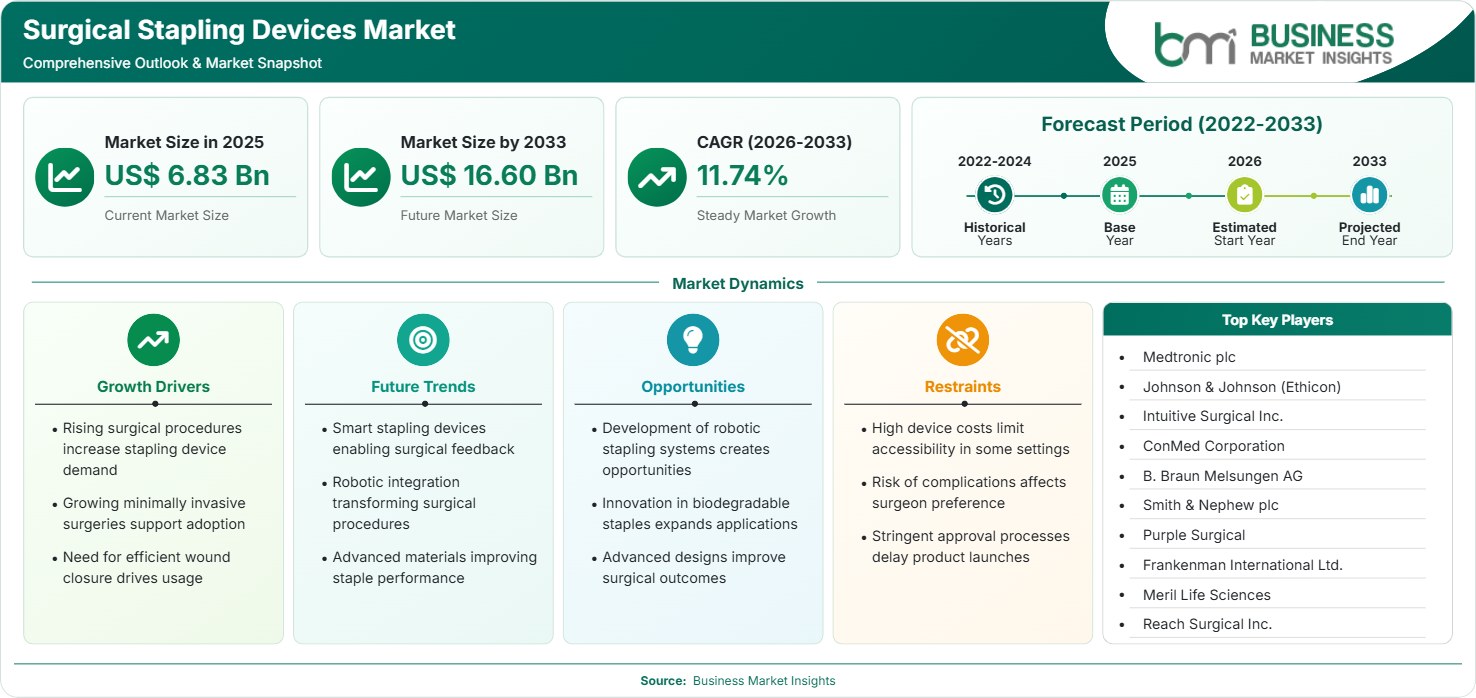
The Surgical Stapling Devices Market size was valued at US$ 6.83 billion in 2025 and is projected to reach US$ 16.60 billion by 2033, growing at a CAGR of 11.74% during 2026–2033. Rising surgical volumes, expanding minimally invasive procedures, demand for efficient tissue closure, and development of robotic and advanced stapling technologies are creating opportunities for manufacturers.

Report Coverage
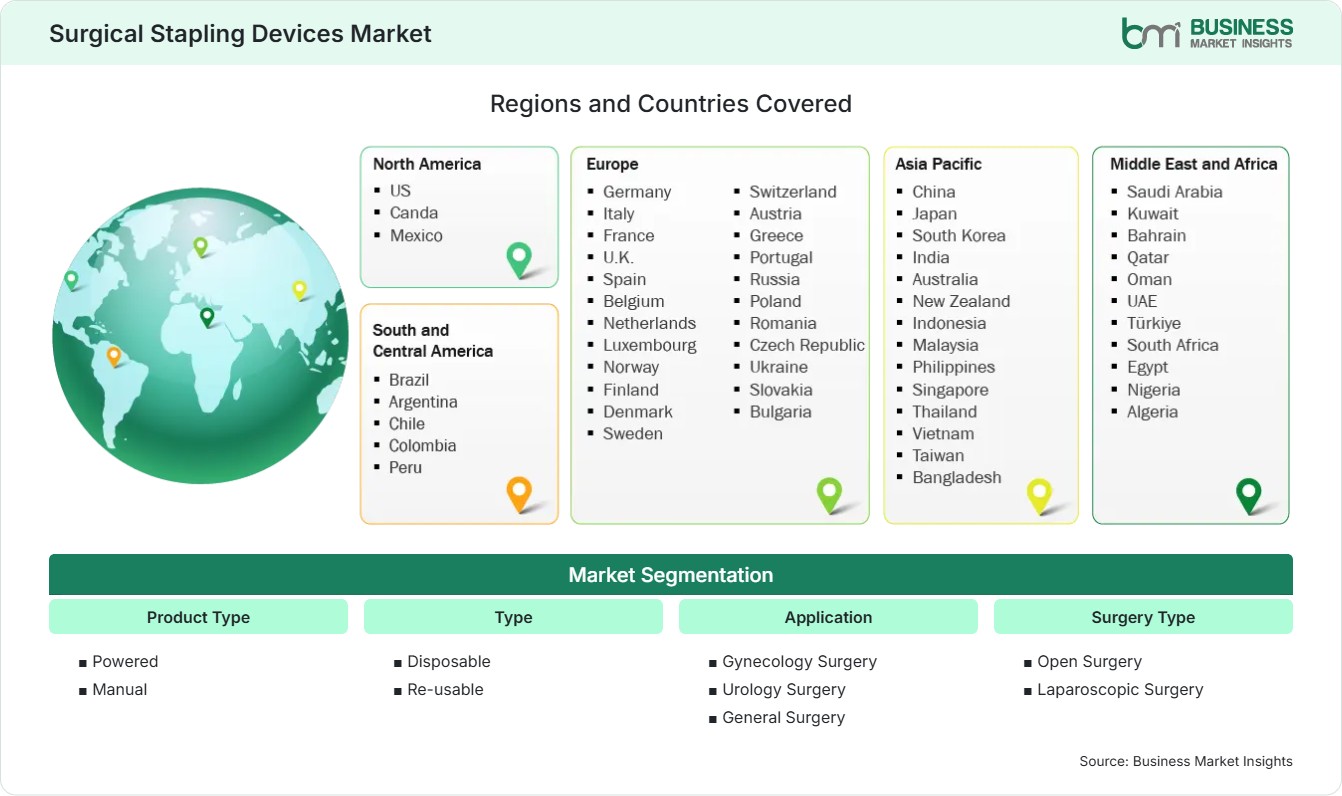
  • Product Type: Powered, Manual
  • Type: Disposable, Re-usable
  • Application: Gynecology Surgery, Urology Surgery, General Surgery
  • Surgery Type: Open Surgery, Laparoscopic Surgery
  • End-user: Hospitals, Specialty Clinics
US$ 6.83 Bn Market size in 2025
US$ 16.60 Bn Market Size by 2033
11.74% CAGR, 2026 - 2033
2026-2033 Forecast Period

AI Overview

Surgical Stapling Devices Market Summary

  • North America Region: North America holds 34%–37% market share in 2025 and is expected to expand at a CAGR of 10.8%–11.5% during 2026–2033. High procedure volumes, advanced hospital infrastructure, minimally invasive surgery adoption, and technology-intensive operating rooms support regional demand. The U.S. represents the largest regional market, with a CAGR of 11.0%–11.7%, supported by established surgical centers, robotic procedures, and replacement demand.
  • Fastest Growing Region: Asia Pacific represents 25%–28% market share in 2025 and is projected to register a CAGR of 13.0%–13.8% during 2026–2033. Expanding hospital capacity, increasing surgical volumes, improving access to minimally invasive procedures, and growing adoption of advanced surgical technologies are accelerating stapling device demand.
  • Leading Segment: Manual devices account for 57%–61% market share in 2025 and are expected to grow at a CAGR of 10.8%–11.5% during 2026–2033. Broad clinical familiarity, lower acquisition costs, established surgical workflows, and extensive use across general and specialty procedures sustain demand.
  • High Growth Segment: Laparoscopic surgery captures 44%–48% market share in 2025 and is projected to achieve a CAGR of 12.8%–13.6% during 2026–2033. Increasing preference for smaller incisions, faster recovery, improved visualization, and technological advancement in minimally invasive procedures are supporting adoption.
  • Key Market Opportunity: Robotic integration, powered stapling, biodegradable staple development, and digitally enabled surgical platforms are creating opportunities to improve tissue approximation, procedural consistency, ergonomics, and clinical workflow efficiency.
  • Major Market Players: Medtronic plc, Johnson & Johnson, Intuitive Surgical, Inc., CONMED Corporation, B. Braun Melsungen AG, Smith & Nephew plc, Purple Surgical, Frankenman International Limited, Meril Life Sciences Pvt. Ltd., and Reach Surgical, Inc.
Strategic Insights

Surgical Stapling Devices Market: Strategic Insights

Surgical Stapling Devices Market Strategic Framework
FREE PDF
Request your free sample
Request free sample
Stakeholder View

Key Takeaways

  • The value chain is shifting toward integrated surgical ecosystems in which stapling devices increasingly complement laparoscopic instruments, robotic platforms, energy systems, and procedure-specific tools rather than operating as isolated products.
  • Powered stapling represents an important upside area because automated firing mechanisms can address ergonomic challenges and support consistent staple deployment during procedures involving difficult access or repetitive firing requirements.
  • Product development is increasingly focused on articulation, controlled compression, improved staple formation, tissue-specific configurations, and compatibility with minimally invasive and robotic surgical platforms.
  • Asia Pacific presents a compelling expansion opportunity as hospitals increase minimally invasive capabilities and surgical infrastructure, particularly in large urban healthcare systems where specialist procedures are becoming more accessible.
  • Competitive positioning is increasingly influenced by portfolio breadth, surgeon familiarity, hospital contracting relationships, manufacturing scale, and the ability to integrate stapling technologies into broader surgical ecosystems.
Geographic Outlook

Surgical Stapling Devices Market Regional Highlights

North America Surgical Stapling Devices Market

North America accounted for 34%–37% Surgical Stapling Devices Market share in 2025 and is expected to grow at a CAGR of 10.8%–11.5% during 2026–2033. Regional demand is supported by sophisticated hospital infrastructure, high utilization of minimally invasive techniques, established surgical training, and strong purchasing capacity. The United States remains the principal contributor, supported by large procedure volumes, advanced specialty centers, robotic surgery adoption, and replacement demand for disposable and powered stapling technologies.

  • Hospitals increasingly prioritize stapling devices that improve procedural efficiency, ergonomics, and consistency across complex minimally invasive operations.
  • Established robotic and laparoscopic surgery infrastructure provides manufacturers with opportunities to introduce advanced stapling systems compatible with sophisticated operating-room workflows.
  • Canada contributes through expanding specialty-care capabilities, increasing minimally invasive procedures, and continued adoption of modern surgical technologies within major healthcare facilities.
  • Procedure-specific products are gaining attention as surgeons seek improved access, articulation, and controlled closure across gastrointestinal and other complex surgical interventions.

US Surgical Stapling Devices Market

The United States contributes 78%–82% of North American demand and is projected to register a CAGR of 11.0%–11.7% during 2026–2033. The market benefits from extensive hospital networks, specialist surgical centers, high adoption of minimally invasive procedures, and strong interest in robotic-assisted interventions. Demand is also supported by established replacement cycles and hospital purchasing programs focused on procedure efficiency and consistent clinical performance.

  • Advanced surgical centers continue adopting technologies designed to improve instrument handling and closure consistency during laparoscopic and robotic procedures.
  • Hospital procurement increasingly evaluates stapling products according to reliability, procedural efficiency, ergonomics, training requirements, and compatibility with established surgical platforms.
  • Manufacturers can expand through specialty applications where complex anatomy requires articulated, powered, or procedure-specific stapling configurations.

Europe Surgical Stapling Devices Market

Europe represents 27%–30% Surgical Stapling Devices Market share in 2025 and is anticipated to grow at a CAGR of 10.2%–11.0% during 2026–2033. Germany, France, the United Kingdom, Italy, and Spain represent leading demand centers supported by developed healthcare infrastructure and established surgical capabilities. Germany remains an important market, while the United Kingdom and France offer opportunities through increasing minimally invasive procedures and hospital technology modernization.

  • European hospitals are increasingly adopting minimally invasive approaches that require compact, precise, and application-specific tissue closure instruments.
  • Germany maintains strong demand through advanced surgical infrastructure, specialist hospitals, and established medical device procurement networks supporting sophisticated surgical technologies.
  • France and the United Kingdom provide growth opportunities through continued development of laparoscopic and robotic surgical capabilities across major healthcare institutions.
  • Manufacturers are emphasizing ergonomic design and procedural efficiency as hospitals seek technologies capable of supporting standardized surgical workflows.

Asia Pacific Surgical Stapling Devices Market

Asia Pacific holds 25%–28% Surgical Stapling Devices Market share in 2025 and is projected to achieve the highest 13.0%–13.8% CAGR during 2026–2033. China, Japan, South Korea, and India represent major regional markets, while India and Southeast Asia provide particularly strong expansion potential. Increasing hospital capacity, rising surgical procedure volumes, improved specialist availability, and broader adoption of minimally invasive techniques are creating favorable conditions for stapling device manufacturers.

  • China represents a major demand center because expanding hospital infrastructure and growing surgical capabilities are increasing utilization of advanced tissue closure technologies.
  • India offers substantial upside as private and public healthcare providers increase access to minimally invasive procedures and modern operating-room technologies.
  • Japan and South Korea support premium device adoption through sophisticated healthcare infrastructure, specialist expertise, and established minimally invasive surgical practices.
  • Southeast Asian healthcare systems provide additional opportunities as private hospitals invest in advanced surgical equipment and improve specialist procedure capabilities.

Rest of World Surgical Stapling Devices Market

The Rest of World region accounts for 10%–13% Surgical Stapling Devices Market share in 2025 and is expected to expand at a CAGR of 10.5%–11.4% during 2026–2033. South America is supported by expanding private healthcare infrastructure and specialist surgery, with Brazil representing a leading market. Mexico also contributes through private hospital investment and growing access to minimally invasive procedures.

The Middle East and Africa provide emerging opportunities as healthcare providers expand specialty hospitals and modern operating-room capacity. Saudi Arabia and the United Arab Emirates represent important markets, while South Africa contributes through established private healthcare networks and specialist surgical services. Increasing availability of minimally invasive procedures is supporting technology adoption.

  • Brazil provides regional scale through its large healthcare system, private hospital networks, and growing utilization of advanced surgical procedures.
  • Gulf healthcare investment is creating demand for modern operating-room technologies, including disposable and powered devices for specialist surgical applications.
  • South Africa offers opportunities through established private hospitals and increasing availability of specialist surgical services.
  • Regional distributors remain important for expanding access, training surgeons, managing inventories, and supporting after-sales service for medical device manufacturers.
Global Market Geography
FREE PDF
Request your free sample
Request free sample
Segment Analysis

Surgical Stapling Devices Market Segmentation

Product Type

The Product Type segment is shaped by surgeon preference, procedure complexity, hospital procurement priorities, and demand for consistent tissue closure. Manual devices accounted for 57%–61% Surgical Stapling Devices Market share in 2025 and are projected to grow at a CAGR of 10.8%–11.5% during 2026–2033, while powered systems gain traction through ergonomics and controlled firing.

  • Powered: Powered systems improve firing ergonomics and may reduce manual force requirements, supporting adoption in complex minimally invasive procedures and applications involving repeated staple deployment.
  • Manual: Manual devices retain broad utilization because of familiarity, established surgical techniques, cost considerations, and suitability across diverse open and minimally invasive procedures.

Type

The Type segment reflects hospital preferences regarding infection control, convenience, procedural volume, and device economics. Disposable configurations maintain strong adoption because they simplify preparation and reduce reprocessing requirements, while reusable systems remain relevant where hospitals prioritize equipment utilization and long-term purchasing efficiency across recurring procedures.

  • Disposable: Disposable devices provide procedure-ready functionality, simplify operating-room preparation, and reduce reprocessing requirements, supporting use across high-volume surgical environments and infection-control focused facilities.
  • Re-usable: Reusable devices can support repeated utilization where reprocessing infrastructure is available, providing hospitals with an alternative procurement model for selected surgical procedures and settings.

Application

The Application segment is influenced by procedure volume, surgical complexity, anatomical requirements, and adoption of minimally invasive approaches. General surgery remains a broad demand base, while gynecology and urology provide additional opportunities as specialist procedures increasingly incorporate laparoscopic and technologically advanced tissue closure techniques.

  • Gynecology Surgery: Stapling devices support tissue closure in selected gynecological procedures, with adoption influenced by increasing minimally invasive techniques and demand for efficient, controlled surgical workflows.
  • Urology Surgery: Urological procedures create demand for precise tissue handling and closure technologies, particularly where minimally invasive approaches require compact instruments capable of controlled deployment.
  • General Surgery: General surgery represents a broad application base because stapling devices support multiple tissue management and closure requirements across common and complex operative procedures.

Surgery Type

The Surgery Type segment is increasingly influenced by the shift toward less invasive surgical approaches and hospital investment in advanced operating-room infrastructure. Laparoscopic surgery accounted for 44%–48% Surgical Stapling Devices Market share in 2025 and is projected to expand at a CAGR of 12.8%–13.6% during 2026–2033, supported by technology adoption and procedural preference.

  • Open Surgery: Open procedures continue requiring dependable stapling technologies, particularly for complex operations where surgeons need rapid and consistent tissue closure across larger operative fields.
  • Laparoscopic Surgery: Laparoscopic procedures are driving innovation through demand for articulated, compact, and ergonomically optimized stapling devices suitable for restricted access and minimally invasive workflows.

End-user

The End-user segment is shaped by surgical procedure concentration, equipment procurement, specialist availability, and hospital investment priorities. Hospitals represent the principal demand base because they perform diverse procedures at high volumes, while specialty clinics provide growth opportunities where ambulatory and focused surgical services increasingly adopt minimally invasive technologies.

  • Hospitals: Hospitals dominate demand because they conduct diverse surgical procedures and maintain procurement systems capable of supporting multiple stapling platforms across specialties and operating rooms.
  • Speciality Clinics: Speciality clinics increasingly adopt compact and procedure-specific stapling solutions as outpatient and focused surgical services expand their minimally invasive procedure capabilities.
Market Forces

Surgical Stapling Devices Market Dynamics

Key Market Drivers

Rising surgical procedures increase stapling device demand

The growth in surgical volume creates an immediate need for tissue closure systems in hospitals and specialty care clinics. Growing volumes of surgeries performed in general surgery, gynecology, urology, and other specialties are driving an expanding base of staplers and rising demand for disposable solutions. High-volume surgery rooms benefit from tools capable of performing closure at high speed and with predictable staple formation. Along with rising complexities of procedures, manufacturers develop application-specific versions of their tools.

Growing minimally invasive surgeries support adoption

Minimally invasive surgical procedure demands the development of instruments that can work through limited openings and offer precise control over tissue manipulation and approximation. The use of laparoscopic and robotic surgery hence calls for the development of articulate shafts, low profile designs, motorized firing devices, and visualization compatibility. The technology behind surgical staplers is being modified in order to meet the needs of the procedures while making less physical exertion necessary for firing. Minimally invasive capabilities in hospitals could increase procedure efficiency and diversify specialist services. The expansion of these techniques is shaping Surgical Stapling Devices Market trends by encouraging manufacturers to design devices specifically for confined anatomical spaces and complex procedural sequences.

Need for efficient wound closure drives usage

The efficiency of wound closure remains significant, as the surgical team needs predictable tissue approximation during surgery. The use of staplers may facilitate the creation of a consistent wound closure process that does not rely entirely on the suturing technique where the staple is a valid option. This need is more urgent in surgeries that entail quick tissue handling or wound closures at different sites.

Key Market Opportunities

Development of robotic stapling systems creates opportunities

Robotic surgery creates opportunities for stapling manufacturers to develop devices that complement articulated robotic instruments and digitally controlled surgical workflows. Robotic platforms can provide surgeons with enhanced instrument positioning, visualization, and control, creating demand for stapling technologies capable of operating within highly coordinated procedural environments. Surgical Stapling Devices Market Forecasts indicate that robotic integration can become an important source of premium product demand as hospitals expand advanced surgical programs.

Innovation in biodegradable staples expands applications

Biodegradable staple development provides an opportunity to address applications where material behavior after tissue closure is an important consideration. Research and product development can focus on materials capable of providing adequate mechanical support during healing while subsequently reducing the need for permanent foreign material. Such technologies could broaden the range of procedures in which stapling solutions are considered, provided they achieve appropriate performance, biocompatibility, handling characteristics, and regulatory acceptance.

Advanced designs improve surgical outcomes

Innovative device design creates opportunities to optimize surgical workflow by improving articulation, compression, staple creation, and device configuration based on the procedures performed. The manufacturers may utilize the engineering solutions to solve typical problems related to inadequate access, tissue variability, and firing cycles. Device design focused on a particular anatomical application may enable configuration selection according to the needs of the procedure.

Market Restraints and Challenges

High device costs limit accessibility in some settings

Factor: Advanced surgical stapling devices will face high acquisition costs due to complex features such as power-driven operation, specialized cartridges, precise components, and application-specific engineering design. This factor could result in hospitals with tight budgets favoring the use of existing manual devices. Impact: High device costs could reduce deployment in price-sensitive healthcare facilities, delaying the penetration of powered and robot-compatible devices. The impact is even more pronounced in emerging healthcare facilities, especially given tight budget constraints and varied reimbursement scenarios.

Risk of complications affects surgeon preference

Factor: Surgical stapling is a process which demands proper selection of devices, handling of tissues, formation of staples and surgical technique, and improper usage of these factors could lead to complications which affect the level of clinical confidence. Performance of the device may also depend on the type of tissue, anatomical position and complexity of the procedure. Impact: The issue of complications could motivate the surgeons to stick to their familiar devices and may delay the use of new technology until sufficient clinical experience is gained. The manufacturers thus need to focus on proper deployment, ergonomic control, instructions, education and design.

Company Analysis

Competitive Landscape

The competitive environment is characterized by product innovation, surgical platform integration, procedure-specific development, manufacturing scale, and strong relationships with hospitals and surgeons. Surgical Stapling Devices Market Analysis indicates that leading companies are competing through powered technologies, minimally invasive solutions, robotic integration, improved ergonomics, and broader procedural portfolios. Established manufacturers benefit from clinical familiarity and distribution infrastructure, while specialized suppliers can compete through focused product designs, cost positioning, and regional expansion.

Company Name

Overview

Products and Services relevant to this market

Medtronic plc

Global medical technology company with a broad surgical portfolio and established presence across multiple procedural specialties.

Surgical stapling devices, powered stapling technologies, cartridges, tissue closure systems, and related surgical instruments.

Johnson & Johnson

Diversified healthcare company with Ethicon serving surgical markets through established closure and minimally invasive technologies.

Surgical staplers, powered stapling systems, cartridges, reloads, tissue closure products, and surgical instruments.

Intuitive Surgical, Inc.

Surgical technology company focused on robotic-assisted procedures and integrated technologies for minimally invasive surgery.

Robotic stapling instruments, robotic surgical accessories, integrated procedure technologies, and related digital surgical platforms.

CONMED Corporation

Medical technology manufacturer providing surgical products for minimally invasive and general surgical procedures.

Surgical staplers, laparoscopic instruments, tissue closure products, and complementary minimally invasive surgical technologies.

B. Braun Melsungen AG

Global healthcare supplier serving hospitals with surgical, pharmaceutical, and medical technology products.

Surgical stapling products, closure technologies, surgical instruments, and supporting operating-room solutions.

Smith & Nephew plc

Medical technology company focused on advanced surgical and orthopedic solutions for healthcare providers globally.

Surgical instruments, tissue management products, closure technologies, and devices supporting minimally invasive procedures.

Purple Surgical

Specialist surgical device company focused on products for minimally invasive procedures and operating-room efficiency.

Laparoscopic surgical instruments, stapling solutions, trocar-related products, and minimally invasive surgical technologies.

Frankenman International Limited

Medical device manufacturer supplying surgical products with emphasis on tissue closure and minimally invasive applications.

Surgical staplers, powered and manual closure devices, cartridges, and procedure-focused surgical instruments.

Meril Life Sciences Pvt. Ltd.

Medical technology company developing and manufacturing products across multiple clinical specialties and surgical applications.

Surgical stapling devices, laparoscopic instruments, tissue closure technologies, and related medical devices.

Reach Surgical, Inc.

Surgical technology company specializing in advanced stapling solutions for minimally invasive procedures.

Powered surgical staplers, laparoscopic stapling systems, reloads, cartridges, and related tissue closure technologies.

Trust & Transparency

Research Methodology

The market analysis combines proprietary research with secondary data from government agencies, company disclosures, regulatory filings, industry databases and expert interviews. Market estimates are validated through data triangulation, cross-market benchmarking and analyst review.

View Full Research Methodology

Questions Answered

Frequently Asked Questions

What information is included in the Surgical Stapling Devices Market Report?

The Market Report covers market size, regional dynamics, segmentation, competitive positioning, product trends, growth drivers, opportunities, restraints, recent industry developments, and strategic factors influencing adoption through 2033.

Which region offers the strongest expansion potential?

Asia Pacific provides substantial expansion potential because healthcare infrastructure is developing across major economies while minimally invasive procedures and specialist surgical services are becoming more widely available. China, India, Japan, and South Korea represent important demand centers.

How is robotic surgery influencing stapling device development?

Robotic surgery is encouraging manufacturers to develop articulated, compact, and platform-compatible stapling instruments. Integration with robotic systems can improve instrument positioning and support coordinated surgical workflows, creating opportunities for premium procedure-specific products.

Which product type is expected to provide strong growth opportunities?

Powered devices offer strong growth potential because they can reduce manual firing effort, improve ergonomics, and support controlled deployment during complex laparoscopic and robotic procedures. Their adoption is particularly relevant in hospitals investing in advanced surgical technology.

What factors are driving the Surgical Stapling Devices Market?

Demand is being supported by rising surgical procedure volumes, expansion of minimally invasive techniques, increasing preference for efficient tissue closure, development of powered devices, and broader adoption of advanced surgical platforms across hospitals and specialty clinics.

Access the Full Surgical Stapling Devices Market Report

Get segment-level forecasts, regional estimates, competitive benchmarking, company profiles and downloadable Excel datasets.

Access the full Surgical Stapling Devices Market Report
350 pages PDF & Excel | 2026-08-19