
Sterilization Equipment Market Outlook: Size, Share, Trends, Growth Analysis, Competitive Landscape & Forecast, 2026-2033

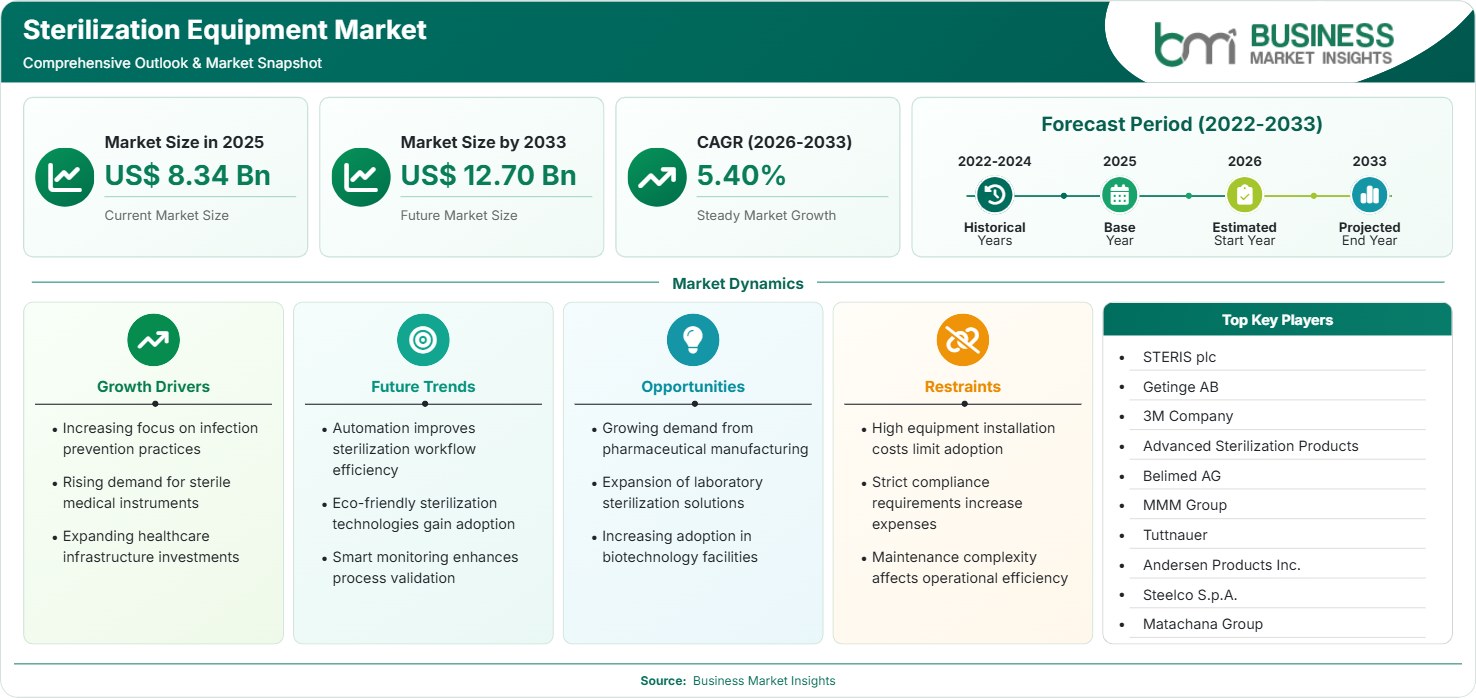
The Sterilization Equipment Market size was valued at US$ 8.34 billion in 2025 and is projected to reach US$ 12.7 billion by 2033, growing at a CAGR of 5.40% during 2026–2033. Increasing focus on infection prevention practices, rising demand for sterile medical instruments, expanding healthcare infrastructure investments, growing pharmaceutical manufacturing capacity, and increasing adoption of advanced sterilization technologies across healthcare and life science facilities are supporting market expansion.

Report Coverage
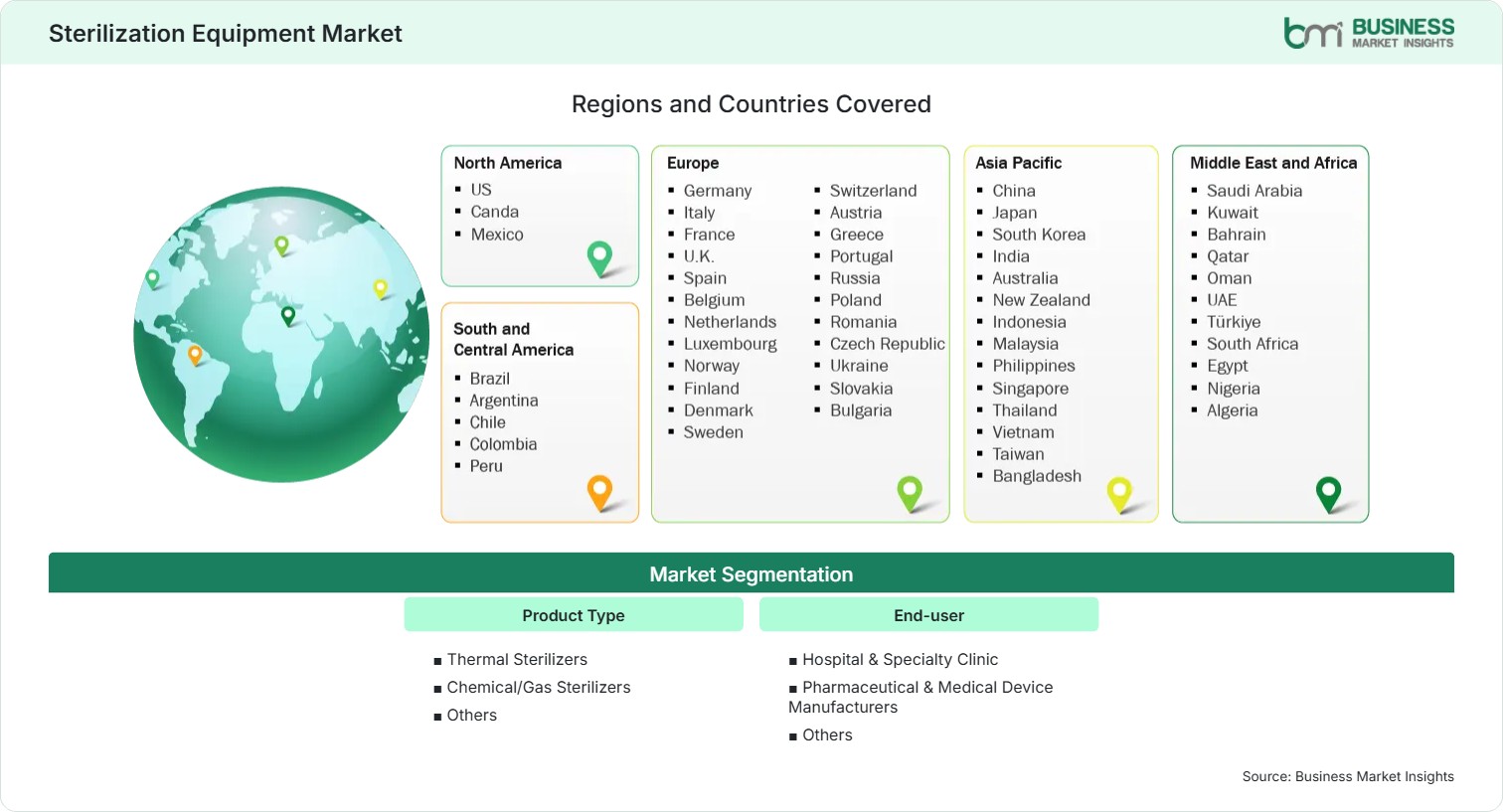
  • Product Type: Thermal Sterilizers (Dry-heat Sterilizers and Moist-heat Sterilizers), Chemical/Gas Sterilizers (Hydrogen Peroxide Sterilizers, Ethylene Oxide Sterilizers, Nitrogen Dioxide Sterilizers, Others), Others
  • End-user: Hospital & Specialty Clinic, Pharmaceutical & Medical Device Manufacturers, Others
US$ 8.34 Bn Market size in 2025
US$ 12.70 Bn Market Size by 2033
5.40% CAGR, 2026 - 2033
2026-2033 Forecast Period

01 AI Overview

Sterilization Equipment Market Summary

  • North America Region: North America holds 38%–41% sterilization equipment market share in 2025 and is projected to expand at a CAGR of 5.1%–5.5% during 2026–2033. Strong healthcare infrastructure, stringent infection control standards, increasing hospital modernization programs, and growing pharmaceutical manufacturing activities support regional demand. The United States remains the primary contributor due to advanced healthcare facilities, regulatory compliance requirements, and continuous investment in sterilization technologies, registering a CAGR of 5.2%–5.6% during the forecast period.
  • Fastest Growing Region: Asia Pacific accounts for 25%–28% sterilization equipment market share in 2025 and is expected to grow at a CAGR of 6.2%–6.7% during 2026–2033. Rising healthcare infrastructure development, expanding medical device manufacturing, increasing pharmaceutical production, and growing adoption of advanced infection control systems are accelerating regional opportunities.
  • Leading Segment: Thermal Sterilizers represent 43%–46% sterilization equipment market share in 2025 and are expected to grow at a CAGR of 5.0%–5.4% during 2026–2033. High reliability, widespread hospital adoption, cost efficiency, and established use in medical instrument processing continue supporting segment leadership across healthcare facilities.
  • High Growth Segment: Hydrogen Peroxide Sterilizers account for 18%–21% market share in 2025 and are projected to expand at a CAGR of 6.5%–7.0% during 2026–2033. Growing preference for low-temperature sterilization, compatibility with heat-sensitive devices, reduced processing time, and improved environmental performance are supporting adoption.
  • Key Market Opportunity: Expansion of pharmaceutical manufacturing facilities, biotechnology laboratories, advanced research centers, and medical device production units is creating demand for scalable sterilization systems with improved automation, efficiency, and regulatory compliance capabilities.
  • Major Market Players: STERIS plc, Getinge AB, 3M Company, Advanced Sterilization Products, Belimed AG, MMM Group, Tuttnauer, Andersen Products Inc., Steelco S.p.A., and Matachana Group.
02 Strategic Insights

Sterilization Equipment Market: Strategic Insights

sterilization-equipment-market-market-strategic-framework
FREE PDF
Request your free sample
Request free sample
03 Stakeholder View

Key Takeaways

1. The value chain for sterilization equipment is changing due to the increased collaboration between sterilization equipment makers, healthcare facilities, drug companies, medical devices manufacturers and technology providers that enhance efficiency in sterilization process.

2. Pharmaceutical and medical device manufacturing facilities represent major growth opportunities as increasing production volumes require advanced sterilization systems capable of supporting large-scale operations and stringent quality standards.

3. Innovation is shifting toward automated sterilization platforms, digital monitoring solutions, low-temperature technologies, environmentally efficient processes, and integrated data management systems that enhance operational control and traceability.

4. Asia Pacific provides significant investment potential due to expanding healthcare infrastructure, increasing medical device manufacturing, rising pharmaceutical production, and growing adoption of international infection prevention standards.

5. Strategic acquisitions, partnerships, and technology collaborations are enabling companies to strengthen product portfolios, expand geographic presence, and accelerate development of advanced sterilization solutions for diverse end-user requirements.

6. Sustainability considerations are increasingly influencing product development as manufacturers focus on reducing chemical consumption, improving energy efficiency, and developing environmentally responsible sterilization technologies without compromising safety performance.

04 Geographic Outlook

Sterilization Equipment Market Regional Highlights

North America Sterilization Equipment Market

North America accounted for 38%–41% of the Sterilization Equipment Market Share in 2025 and is anticipated to expand at a CAGR of 5.1%–5.5% during 2026–2033. Advantages of the region include a sophisticated healthcare infrastructure, good regulation, high adoption rates of automated sterilization technologies, and constant investments in hospital upgrading. The development of pharmaceutical production and the growth of the medical devices industry also contribute to the need for more sophisticated sterilization solutions in the region.

  • Hospitals continue upgrading sterilization departments with automated systems, digital monitoring tools, and advanced processing technologies to improve infection control efficiency and operational reliability.
  • Stringent healthcare regulations and quality standards encourage adoption of validated sterilization equipment across hospitals, pharmaceutical facilities, and medical device manufacturing environments.
  • Pharmaceutical companies are increasing investments in production facilities, creating demand for scalable sterilization systems that meet strict manufacturing and safety requirements.
  • Growing adoption of low-temperature sterilization technologies supports processing of heat-sensitive medical instruments while improving operational flexibility across healthcare settings.
  • Research institutions and biotechnology facilities are expanding laboratory capabilities, increasing demand for reliable sterilization solutions for specialized applications.

US Sterilization Equipment Market

The United States represented 32%–35% of the global market in 2025 and is projected to grow at a CAGR of 5.2%–5.6% during 2026–2033. Healthcare spending, increasing emphasis on infection control, superior medical device production and pharmaceutical innovations will keep propelling market growth. The nation is one of the largest adopters of sterilization technology due to its well-developed infrastructure of hospitals and stringent regulatory standards.

  • Healthcare facilities continue investing in next-generation sterilization equipment to improve workflow efficiency, infection control outcomes, and compliance with healthcare safety standards.
  • Expansion of pharmaceutical and biotechnology manufacturing facilities increases demand for advanced sterilization systems supporting production quality and regulatory requirements.
  • Increasing adoption of automated sterilization monitoring solutions enables healthcare providers to improve process validation, documentation, and operational transparency.
  • Medical device manufacturers continue upgrading sterilization infrastructure to support growing production volumes and maintain product safety standards.

Europe Sterilization Equipment Market

Europe held 27%–30% market share in 2025 and is expected to register a CAGR of 4.9%–5.3% through 2026–2033. Strong healthcare quality standards, expanding pharmaceutical manufacturing, and increasing emphasis on sustainable sterilization practices support regional growth. Germany leads the regional market with a CAGR of 5.1%–5.5%, while Italy is projected to experience higher growth at 5.6%–6.0% due to expanding healthcare investments and medical device production capabilities.

  • Market dominance in Germany is attributed to its advanced healthcare infrastructure, medical devices manufacturing facilities, and use of automation in sterilization equipment.
  • Italy shows growing demand owing to growth in pharmaceutical manufacturing, healthcare system development, and increased use of advanced sterilization solutions.
  • There is growing trend among European healthcare systems in using environment-friendly sterilization solutions to cut down chemicals and enhance sustainability performance.
  • Infection control and safe use of medical devices remains the key driver in the regulatory policies that encourage investments in sterile equipment.
  • Increasing biotechnological and laboratory capacities across Europe drives demand for advanced sterilization solutions.

Asia Pacific Sterilization Equipment Market

Asia Pacific accounted for 25%–28% market share in 2025 and is forecast to grow at the highest CAGR of 6.2%–6.7% during 2026–2033. Expanding healthcare infrastructure, increasing pharmaceutical manufacturing capacity, rising medical device production, and improving infection control awareness are driving regional expansion. China leads the regional market with a CAGR of 6.3%–6.8%, while India records the fastest growth at 6.8%–7.2% due to healthcare investment and manufacturing expansion.

  • China continues strengthening domestic healthcare and pharmaceutical manufacturing capabilities, increasing demand for advanced sterilization equipment across multiple applications.
  • India benefits from healthcare infrastructure development, expanding medical device manufacturing, and increasing adoption of international sterilization standards.
  • In Japan and South Korea, there is continued investment in the latest healthcare technologies that help in adopting automated and digital sterilization techniques.
  • Biotechnology research in Asia Pacific region increases the demand for sophisticated lab sterilization systems.
  • Modernization efforts in government healthcare departments promote hospitals to update their sterilization infrastructure.

Rest of World Sterilization Equipment Market

The Rest of World region accounted for 7%–10% market share in 2025 and is projected to grow at a CAGR of 5.3%–5.8% during 2026–2033. South & Central America are experiencing increasing healthcare modernization and expanding pharmaceutical activities, while the Middle East & Africa are investing in healthcare infrastructure development. Brazil leads South & Central America with a CAGR of 5.5%–5.9%, while Saudi Arabia records strong growth at 5.8%–6.2% due to healthcare expansion initiatives.

  • Brazil continues improving healthcare infrastructure and pharmaceutical manufacturing capabilities, supporting increasing demand for sterilization systems.
  • Saudi Arabia is investing in healthcare modernization projects, specialty facilities, and advanced infection prevention technologies.
  • Emerging healthcare markets are adopting international sterilization standards to improve patient safety and operational quality.
  • Expansion of private hospitals and specialty clinics creates additional demand for efficient sterilization equipment solutions.
  • Biotechnology and laboratory development initiatives are supporting adoption of specialized sterilization technologies across emerging economies.
global-market-geography
FREE PDF
Request your free sample
Request free sample
05 Segment Analysis

Sterilization Equipment Market Segmentation

Product Type

The Product Type segment accounted for 68%–71% of the overall market in 2025 and is expected to grow at a CAGR of 5.3%–5.7% during 2026–2033. Increasing demand for reliable sterilization processes, expanding healthcare facilities, and rising adoption across pharmaceutical and medical device manufacturing environments continue supporting segment development. The Sterilization Equipment Market Forecasts indicate sustained demand for advanced systems offering improved efficiency, automation, and regulatory compliance.

  • Thermal Sterilizers: Remain widely adopted due to proven effectiveness, operational reliability, cost efficiency, and extensive usage for sterilizing reusable medical instruments across healthcare facilities.
  • Dry-heat Sterilizers: Support applications requiring high-temperature processing and are preferred for specific instruments, laboratory equipment, and materials requiring moisture-free sterilization methods.
  • Moist-heat Sterilizers: Maintain strong demand due to efficient microbial elimination, shorter processing cycles, and widespread application in hospitals and healthcare institutions.
  • Chemical/Gas Sterilizers: Increasingly used for heat-sensitive devices requiring low-temperature sterilization, supporting applications in medical device manufacturing and specialty healthcare environments.
  • Hydrogen Peroxide Sterilizers: Experience growing adoption due to rapid processing, environmental advantages, and compatibility with advanced medical instruments requiring gentle sterilization methods.
  • Ethylene Oxide Sterilizers: Continue supporting complex sterilization applications because of broad material compatibility and effectiveness across medical devices with intricate designs.
  • Nitrogen Dioxide Sterilizers: Gain attention through low-temperature processing capabilities and potential applications in advanced medical device sterilization workflows.
  • Others: Include emerging sterilization technologies addressing specialized requirements across healthcare, laboratory, and industrial applications.

End-user

The End-user segment represented 74%–77% market share in 2025 and is projected to grow at a CAGR of 5.2%–5.6% during 2026–2033. Increasing healthcare infrastructure development, rising medical device production, and growing pharmaceutical manufacturing activities continue supporting demand. The Sterilization Equipment Market Trends indicate increasing adoption of automated and digitally monitored systems across diverse healthcare and industrial environments.

  • Hospital & Specialty Clinic: Represents a major application area due to increasing infection prevention requirements, surgical procedure volumes, and demand for reliable instrument sterilization workflows.
  • Pharmaceutical & Medical Device Manufacturers: Increasingly invest in advanced sterilization systems to support manufacturing quality, regulatory compliance, and production expansion across global markets.
  • Others: Includes research laboratories, biotechnology facilities, academic institutions, and specialized healthcare centers requiring customized sterilization solutions for diverse applications.
06 Market Forces

Sterilization Equipment Market Dynamics

Key Market Drivers

Increasing focus on infection prevention practices

Growing emphasis on healthcare-associated infection prevention continues driving adoption of advanced sterilization equipment across hospitals, specialty clinics, and healthcare facilities. Various international healthcare associations such as the World Health Organization (WHO) keep stressing on the significance of having proper infection control and prevention processes to ensure the safety of the patients. Various healthcare providers are making investments in automation equipment, technology for monitoring, and processing equipment to enhance the operational efficiency. Such efforts will drive the growth of the Sterilization Equipment Market owing to various factors.

Rising demand for sterile medical instruments

Increasing surgical procedures, expanding healthcare services, and rising utilization of reusable medical instruments are creating continuous demand for effective sterilization solutions. Hospital settings and specialized clinics call for sophisticated equipment that is able to provide constant sterilization efficiency along with high patient turnover rates. Additionally, manufacturers of medical devices use state-of-the-art sterilization technology to make their products safe for use and comply with regulations. The increasing demand for minimally invasive surgery and sophisticated medical devices leads to higher demand for efficient sterilization technologies.

Expanding healthcare infrastructure investments

Healthcare infrastructure development across emerging and developed economies is creating significant demand for modern sterilization systems. Governments and private health care providers have started investing in hospitals, specialized clinics, diagnostic centers, and laboratories that require high-quality infection control infrastructure. Rising spending on health care, increasing efforts to modernize, and rising number of surgeries have led to the use of automated and large-scale sterilization equipment. This development is improving the access to health care services while driving the demand for reliable sterilization devices.

Key Market Opportunities

Growing demand from pharmaceutical manufacturing

Expansion of pharmaceutical production facilities worldwide is creating attractive opportunities for sterilization equipment manufacturers. Demand for medicines, biologicals, vaccines, and other sterile pharmaceutical preparations has increased, requiring effective sterilization equipment that will be up to par with the manufacturing standards. Sterilization equipment is receiving investments by pharmaceutical companies due to its ability to enhance the efficiency of their production process. Increased investments in biotechnology and contract manufacturing have opened more avenues for such equipment.

Expansion of laboratory sterilization solutions

Growing research activities in biotechnology, molecular biology, and pharmaceutical development are increasing demand for laboratory sterilization systems. Research organizations and diagnostic laboratories need dependable instruments to ensure a contamination-free environment along with precise results from experiments conducted by them. There are manufacturers that are coming up with small-scale, automated, and specially designed sterilization systems to cater to different needs of laboratories. The rising spending on scientific research facilities will help sterilization equipment manufacturers earn revenues.

Increasing adoption in biotechnology facilities

Rapid growth of biotechnology facilities is generating demand for advanced sterilization systems capable of supporting complex biological manufacturing processes. Cellular therapies, gene therapies, and biopharmaceuticals demand extremely precise conditions of manufacturing in which contamination control is of utmost importance. More and more companies are implementing cutting-edge sterilization techniques which provide better process control and efficiency. The expansion of the manufacturing capacity of biotechnology within important healthcare markets will contribute to the implementation of these specialized techniques.

Market Restraints and Challenges

High equipment installation costs limit adoption

Factor: Advanced sterilization equipment requires significant capital investment due to sophisticated engineering, automation features, installation requirements, and facility modifications. Impact: High initial costs can restrict adoption among smaller hospitals, clinics, and laboratories with limited budgets, particularly in emerging economies. Organizations may delay equipment upgrades or continue using conventional systems, slowing technology adoption despite increasing demand for improved sterilization performance and infection control capabilities.

Strict compliance requirements increase expenses

Factor: Sterilization equipment must comply with stringent regulatory standards, validation procedures, documentation requirements, and quality control protocols across healthcare and pharmaceutical applications. Impact: Compliance obligations increase operational expenses, extend implementation timelines, and require continuous monitoring and maintenance investments. Manufacturers and end-users must allocate additional resources toward certification, training, and regulatory adherence, which can increase overall ownership costs and create challenges for market expansion.

07 Company Analysis

Competitive Landscape

The competitive landscape is shaped by continuous innovation, regulatory compliance expertise, product portfolio expansion, and strategic collaborations among leading manufacturers. Companies are focusing on automated sterilization platforms, environmentally efficient technologies, digital monitoring capabilities, and application-specific solutions to strengthen their market positions. Increasing demand across healthcare, pharmaceutical, and biotechnology applications is driving comprehensive Sterilization Equipment Market Analysis and encouraging companies to invest in advanced product development.

Company Name

Overview

Products and Services Relevant to this Market

STERIS plc

Global provider of infection prevention, sterilization, and surgical solutions serving healthcare and life science industries.

Steam sterilizers, low-temperature sterilizers, hydrogen peroxide systems, sterilization services, and infection prevention solutions.

Getinge AB

Swedish healthcare technology company specializing in infection control, surgical workflows, and life science solutions.

Steam sterilizers, washer disinfectors, low-temperature sterilization systems, and hospital infection control equipment.

3M Company

Diversified technology company providing healthcare solutions including sterilization monitoring and infection prevention products.

Sterilization indicators, monitoring systems, infection prevention products, and healthcare sterilization accessories.

Advanced Sterilization Products

Healthcare technology company focused on innovative low-temperature sterilization technologies.

Hydrogen peroxide sterilization systems, sterilization consumables, accessories, and infection prevention solutions.

Belimed AG

Swiss company specializing in infection control solutions for hospitals and healthcare facilities.

Steam sterilizers, washer disinfectors, automated cleaning systems, and sterile processing technologies.

MMM Group

German manufacturer providing sterilization and laboratory equipment solutions globally.

Steam sterilizers, laboratory sterilizers, healthcare sterilization systems, and decontamination equipment.

Tuttnauer

Global sterilization equipment manufacturer serving healthcare, laboratory, and research applications.

Autoclaves, steam sterilizers, laboratory sterilizers, infection control equipment, and accessories.

Andersen Products Inc.

Healthcare technology company focused on advanced sterilization and contamination control solutions.

Ethylene oxide sterilizers, sterilization accessories, and specialized processing equipment.

Steelco S.p.A.

Italian manufacturer specializing in cleaning, disinfection, and sterilization solutions.

Sterilizers, washer disinfectors, low-temperature systems, and automated sterile processing solutions.

Matachana Group

Spanish healthcare technology company specializing in sterilization and infection control equipment.

Steam sterilizers, low-temperature sterilization systems, hospital solutions, and sterilization technology services.

10 Trust & Transparency

Research Methodology

The market analysis combines proprietary research with secondary data from government agencies, company disclosures, regulatory filings, industry databases and expert interviews. Market estimates are validated through data triangulation, cross-market benchmarking and analyst review.

View Full Research Methodology

11 Questions Answered

Frequently Asked Questions

What does the Sterilization Equipment Market Report include?

The Market Report covers market size, segmentation, regional analysis, competitive landscape, industry trends, growth drivers, restraints, opportunities, recent developments, and future outlook across healthcare and life science applications.

How is technology influencing sterilization equipment development?

Manufacturers are integrating automation, digital monitoring, low-temperature technologies, and advanced validation systems to improve efficiency, reduce processing time, and enhance compliance across healthcare and life science applications.

Which region offers strong growth opportunities for sterilization equipment manufacturers?

Asia Pacific provides significant growth opportunities due to healthcare infrastructure expansion, pharmaceutical manufacturing growth, increasing medical device production, and rising adoption of advanced infection control practices.

Which segment dominates the Market?

Thermal sterilizers represent a leading product segment due to their reliability, cost efficiency, widespread healthcare adoption, and proven effectiveness in sterilizing reusable medical instruments.

What factors are driving the Sterilization Equipment Market?

Increasing focus on infection prevention, rising demand for sterile medical instruments, expanding healthcare infrastructure, pharmaceutical manufacturing growth, and increasing adoption of advanced sterilization technologies are driving market expansion.

Access the Full Sterilization Equipment Market Report

Get segment-level forecasts, regional estimates, competitive benchmarking, company profiles and downloadable Excel datasets.

Access the full Sterilization Equipment Market Report
350 pages PDF & Excel | 2026-08-04