
Ultrasound Equipment Market Outlook: Size, Share, Trends, Growth Analysis, Competitive Landscape & Forecast, 2026-2033

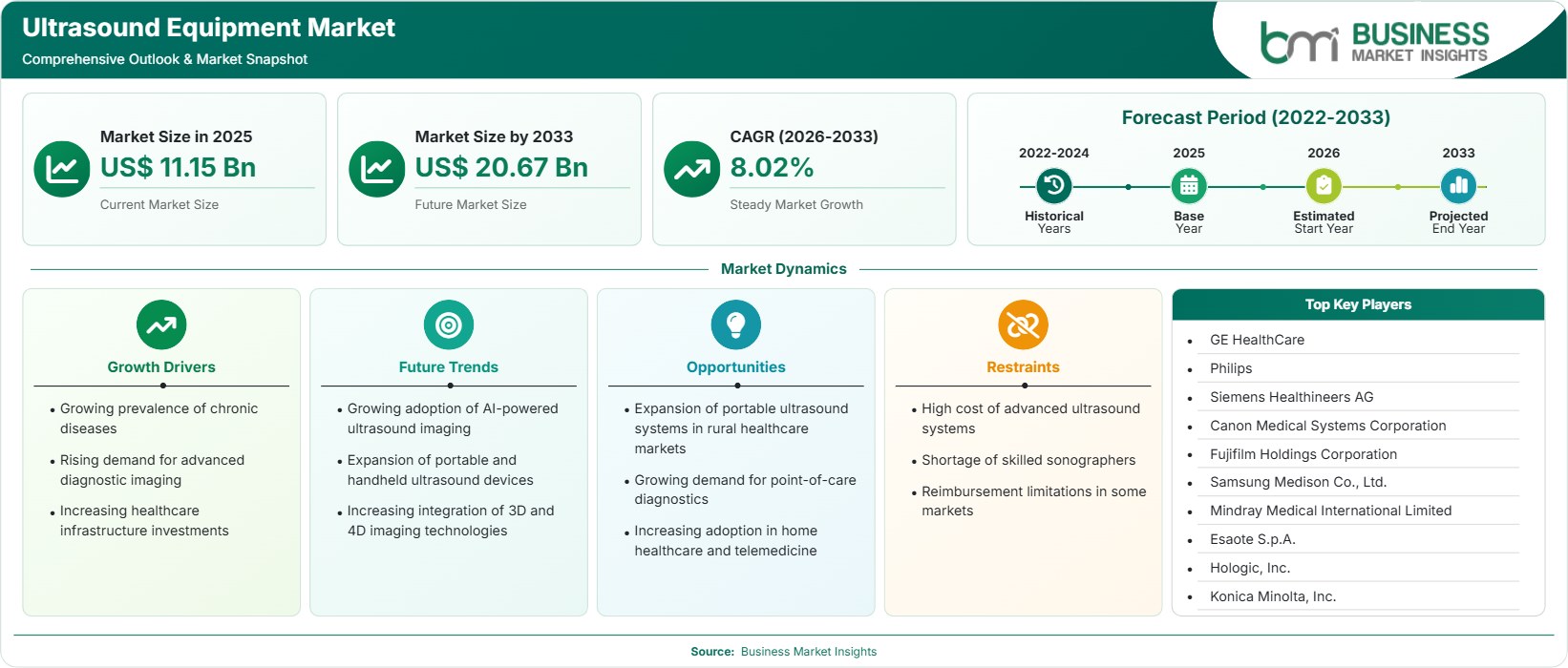
The Ultrasound Equipment Market size was valued at US$ 11.15 Billion in 2025 and is projected to reach US$ 20.67 Billion by 2033, growing at a CAGR of 8.02% during 2026–2033. Market expansion is supported by the growing prevalence of chronic diseases, increasing demand for advanced diagnostic imaging technologies, and rising healthcare infrastructure investments. Expanding point-of-care diagnostics and portable ultrasound adoption are creating additional opportunities across developed and emerging healthcare markets.

Report Coverage
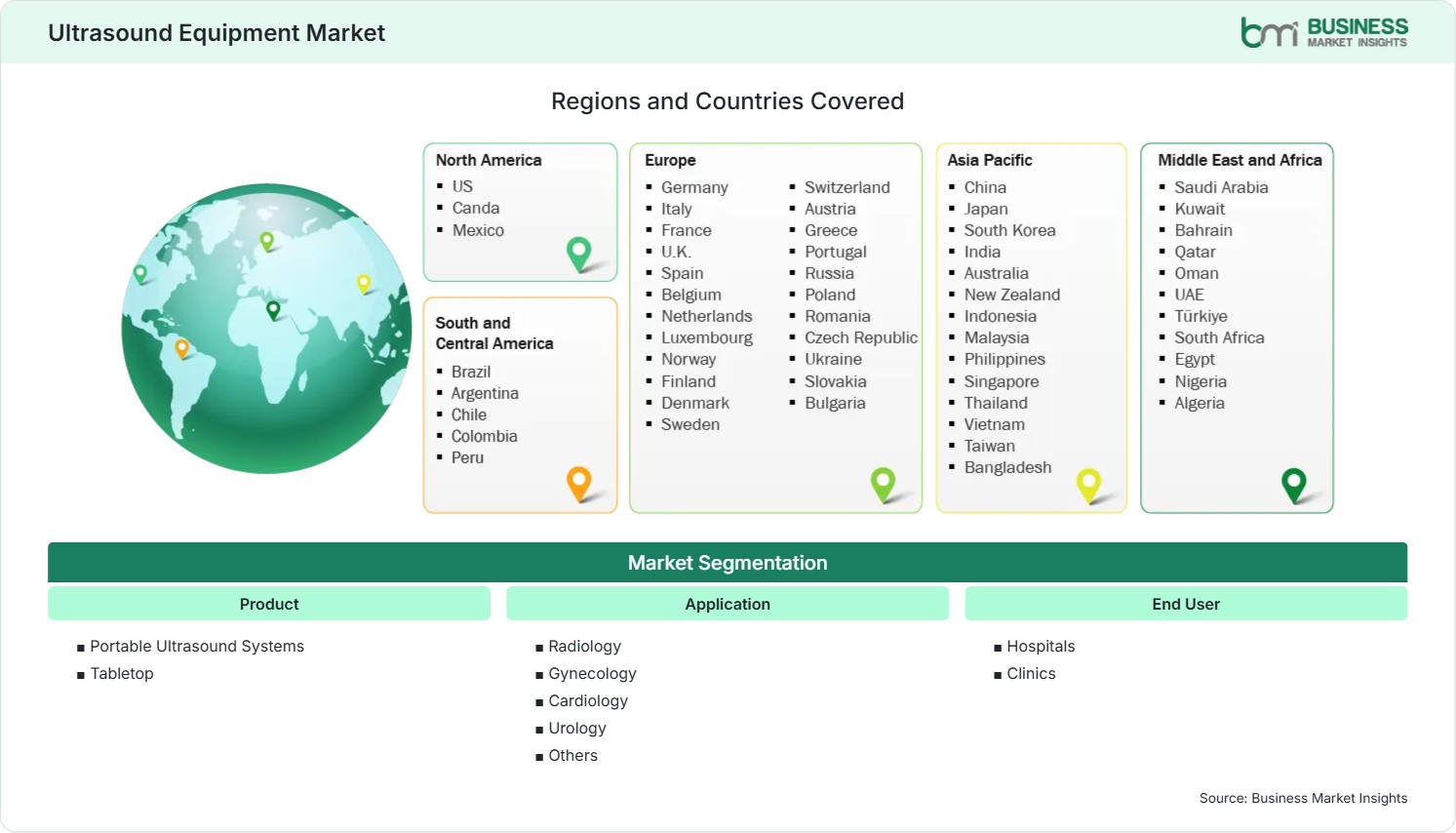
  • Product: Portable Ultrasound Systems, Tabletop
  • Application: Radiology, Gynecology, Cardiology, Urology, Others
  • End User: Hospitals, Clinics
US$ 11.15 Bn Market size in 2025
US$ 20.67 Bn Market Size by 2033
8.02% CAGR, 2026 - 2033
2026-2033 Forecast Period

01 AI Overview

Ultrasound Equipment Market Summary

  • North America Region: North America holds a 36%–39% share in 2025 and is projected to grow at a 7.5%–8.0% CAGR during 2026–2033. Demand is driven by advanced healthcare infrastructure, high diagnostic imaging utilization, increasing chronic disease burden, favorable reimbursement systems, expanding point-of-care imaging adoption, and continuous technological innovation. The U.S. market remains dominant, growing at a 7.6%–8.1% CAGR through the forecast period.
  • Fastest Growing Region: Asia Pacific accounts for 26%–29% share in 2025 and is expected to register a 9.0%–9.6% CAGR during 2026–2033. Healthcare infrastructure expansion, increasing healthcare expenditure, growing patient population, and greater access to diagnostic technologies continue supporting rapid growth.
  • Leading Segment: Portable Ultrasound Systems account for 42%–46% share in 2025 and are projected to grow at a 8.5%–9.1% CAGR through 2033. Demand is driven by mobility, point-of-care diagnostics, emergency care applications, and improved accessibility across healthcare settings.
  • High Growth Segment: Cardiology represents 24%–28% share in 2025 and is forecast to expand at a 9.1%–9.8% CAGR during 2026–2033. Rising cardiovascular disease prevalence and increasing demand for non-invasive imaging continue supporting growth.
  • Key Market Opportunity: Growing adoption of portable and handheld imaging technologies across remote healthcare facilities, home healthcare environments, and telemedicine platforms is creating substantial commercial opportunities.
  • Major Market Players: GE HealthCare, Philips, Siemens Healthineers AG, Canon Medical Systems Corporation, Fujifilm Holdings Corporation, Samsung Medison Co., Ltd., Mindray Medical International Limited, Esaote S.p.A., Hologic, Inc., Konica Minolta, Inc.
02 Strategic Insights

Ultrasound Equipment Market: Strategic Insights

Ultrasound Equipment Market Strategic Framework
FREE PDF
Request your free sample
Request free sample
03 Stakeholder View

Key Takeaways

  • The ultrasound imaging ecosystem is increasingly integrating equipment manufacturers, healthcare providers, software developers, and telehealth platforms to improve diagnostic accessibility and workflow efficiency across clinical settings.
  • Cardiology applications present substantial growth opportunities due to the rising prevalence of cardiovascular diseases and increasing need for non-invasive diagnostic imaging procedures.
  • Technological innovation is focused on artificial intelligence-assisted imaging, enhanced image quality, wireless connectivity, cloud-based data management, and miniaturized handheld ultrasound devices.
  • Asia Pacific offers a strong investment opportunity supported by healthcare infrastructure development, expanding insurance coverage, growing diagnostic awareness, and increasing healthcare expenditure.
  • Manufacturers are expanding portable and point-of-care ultrasound portfolios while investing in software enhancements to improve clinical productivity and diagnostic accuracy.
  • The transition toward decentralized healthcare delivery is encouraging adoption of compact imaging systems suitable for outpatient facilities, emergency care environments, and home healthcare applications.
04 Geographic Outlook

Ultrasound Equipment Market Regional Highlights

North America Ultrasound Equipment Market

North America accounted for approximately 36%–39% of the Ultrasound Equipment Market share in 2025 and is anticipated to grow at a 7.5%–8.0% CAGR through 2033. The region benefits from advanced healthcare infrastructure, high healthcare expenditure, and extensive adoption of diagnostic imaging technologies. Increasing prevalence of chronic diseases and rising utilization of point-of-care imaging continue supporting demand. Technological innovation and favorable reimbursement environments further contribute to market expansion across hospitals, clinics, and specialty diagnostic centers.

  • Growing adoption of AI-enabled ultrasound platforms is improving diagnostic efficiency and workflow optimization across healthcare facilities.
  • Hospitals continue investing in premium imaging systems to support early diagnosis and improve patient management outcomes.
  • Point-of-care ultrasound utilization is expanding in emergency medicine, critical care, and outpatient settings.
  • Increasing demand for minimally invasive diagnostic procedures supports sustained imaging equipment investments.

US Ultrasound Equipment Market

The United States accounts for approximately 78%–82% share within North America and is expected to expand at a 7.6%–8.1% CAGR during 2026–2033. Growth is supported by growing chronic disease incidence, continuous healthcare technology investments, and increasing use of imaging diagnostics in preventive healthcare. Strong adoption of portable systems and advanced imaging platforms continues strengthening ultrasound equipment market demand across healthcare institutions.

  • Healthcare providers are increasingly utilizing portable ultrasound systems to improve bedside diagnostic capabilities.
  • Rising cardiovascular disease prevalence supports increasing demand for cardiac imaging applications.
  • Expansion of outpatient care settings is creating opportunities for compact and handheld systems.
  • Technological advancements continue supporting replacement demand for legacy imaging equipment.

Europe Ultrasound Equipment Market

Europe represented approximately 27%–30% share in 2025 and is projected to register a 7.8%–8.3% CAGR through 2033. Demand is supported by aging populations, expanding diagnostic imaging utilization, and increasing healthcare modernization initiatives. Germany remains the leading regional ultrasound equipment market, while Eastern European countries are witnessing accelerated adoption through healthcare infrastructure improvements. Continuous investments in diagnostic technologies continue supporting growth.

  • Germany leads regional demand due to strong healthcare infrastructure and advanced diagnostic capabilities.
  • Rising chronic disease burden is increasing utilization of imaging procedures across healthcare settings.
  • Public healthcare investments continue supporting procurement of advanced imaging technologies.
  • Adoption of portable devices is expanding across outpatient and community healthcare environments.

Asia Pacific Ultrasound Equipment Market

Asia Pacific accounted for approximately 26%–29% share in 2025 and is projected to grow at a 9.0%–9.6% CAGR through 2033. Expanding healthcare infrastructure, increasing healthcare expenditure, and growing awareness of early disease diagnosis continue supporting market development. China remains the largest regional ultrasound equipment market, while India represents one of the fastest-growing countries. Growing accessibility of diagnostic imaging services is strengthening equipment demand.

  • China continues investing heavily in diagnostic infrastructure and advanced medical technologies.
  • India is witnessing strong demand due to healthcare expansion and rising patient volumes.
  • Portable ultrasound systems are gaining popularity in rural and underserved healthcare facilities.
  • Increasing adoption of point-of-care diagnostics is supporting market growth across multiple applications.

Rest of World Ultrasound Equipment Market

The Rest of World region accounted for approximately 6%–8% share in 2025 and is forecast to expand at a 8.0%–8.7% CAGR through 2033. Growth is driven by healthcare infrastructure improvements, increasing diagnostic awareness, and government investments in healthcare accessibility. South and Central America and the Middle East are leading adoption, while parts of Africa are gradually strengthening imaging capabilities through healthcare modernization initiatives in ultrasound equipment market forecasts.

  • Brazil remains a significant market supported by healthcare infrastructure investments and growing diagnostic demand.
  • Gulf countries continue investing in advanced medical equipment procurement and hospital expansions.
  • Increasing healthcare access is creating opportunities for portable and cost-effective ultrasound systems.
  • Public health modernization initiatives are supporting adoption of advanced diagnostic imaging technologies.
Global Market Geography
FREE PDF
Request your free sample
Request free sample
05 Segment Analysis

Ultrasound Equipment Market Segmentation

Product

The product segment is led by portable ultrasound systems, accounting for approximately 42%–46% share in 2025 and projected to grow at a 8.5%–9.1% CAGR through 2033. Rising demand for point-of-care imaging, improved portability, and expanding use across emergency, primary care, and remote healthcare settings continue driving ultrasound equipment market trends adoption. Technological advancements and affordability improvements are further supporting market penetration.

  • Portable Ultrasound Systems: Widely utilized in hospitals and diagnostic centers due to superior imaging capabilities, multi-specialty applications, and suitability for high-volume patient examinations.
    • Compact: Compact portable systems offer a balance between performance and portability, supporting efficient diagnostic imaging in clinics, ambulatory facilities, and emergency departments.
      • Built-in Console: Preferred for streamlined operation, integrated controls, durable performance, and ease of use in busy clinical environments requiring reliable diagnostic workflows.
      • Touchscreen: Demand is increasing due to intuitive interfaces, improved workflow efficiency, enhanced mobility, and simplified operation across various healthcare applications.
    • Handheld: Experiencing strong adoption owing to portability, affordability, point-of-care utility, and growing use in remote healthcare and telemedicine environments.
  • Tabletop: Utilized primarily in specialty clinics and smaller healthcare facilities where space efficiency and cost-effectiveness remain key purchasing considerations.

Application

The application segment is driven by increasing utilization of diagnostic imaging across multiple medical specialties. Cardiology represents approximately 24%–28% share in 2025 and is expected to advance at a 9.1%–9.8% CAGR through 2033. Rising incidence of cardiovascular disorders, growing demand for non-invasive diagnosis, and continuous technological advancements continue supporting ultrasound equipment market expansion globally.

  • Radiology: Remains a major application area due to widespread use in abdominal, musculoskeletal, vascular, and soft tissue imaging procedures.
  • Gynecology: Strong adoption is supported by increasing prenatal care requirements, reproductive health assessments, and routine women's healthcare examinations.
  • Cardiology: The leading high-growth application driven by rising cardiovascular disease prevalence and increasing demand for echocardiography procedures.
  • Urology: Growing utilization is supported by increasing diagnosis of kidney disorders, urinary tract conditions, and prostate-related diseases.

End User

The end-user segment is dominated by hospitals, which account for approximately 68%–72% share in 2025 and are projected to grow at a 7.8%–8.4% CAGR through 2033. Large patient volumes, advanced diagnostic infrastructure, and availability of specialized healthcare professionals continue supporting ultrasound equipment market demand. Growing investments in imaging technologies across healthcare facilities further strengthen market expansion.

  • Hospitals: Represent the largest end-user category due to comprehensive diagnostic services, higher imaging procedure volumes, and significant capital investment capabilities.
  • Clinics: Adoption is increasing as outpatient care expands and providers seek compact, cost-effective ultrasound systems capable of supporting diverse diagnostic applications.
06 Market Forces

Ultrasound Equipment Market Dynamics

Key Market Drivers

Growing Prevalence of Chronic Diseases

The growing incidence of chronic illnesses including heart diseases, cancer, liver diseases, and kidney diseases increases the need for diagnostic imaging equipment in the global market. The use of ultrasound technology is an effective method in terms of cost, safety, and radiation exposure, and has become popular among various healthcare institutions. It is common practice nowadays for doctors to use ultrasound imaging for the early detection and diagnosis of illnesses, treatment planning, and patient management. With the aging population and the rising prevalence of chronic illnesses worldwide, the demand for sophisticated ultrasound systems will continue to grow.

Rising Demand for Advanced Diagnostic Imaging

Healthcare professionals have been relying on the use of advanced imaging devices in order to achieve accurate diagnosis. Contemporary ultrasound devices provide high-quality images, real-time visualization, AI integration, and efficient workflows. This improves clinical decision-making across several medical specialties. Awareness of early disease detection and prevention of health problems is another factor that contributes to the increased number of imaging procedures. Medical institutions continue to search for innovative technology that improves the efficiency of the process and provides quality patient care.

Increasing Healthcare Infrastructure Investments

The government and private healthcare providers have been making substantial investments in developing healthcare infrastructure, diagnostic facilities, and equipment. The development of hospitals, specialized clinics, and community healthcare facilities is leading to the need for better imaging equipment. Developing countries are concentrating on enhancing the accessibility and quality of healthcare and diagnostics. This is contributing to the growth of the ultrasound systems market in both urban and rural settings. Investments in healthcare improvements and rising demand for quality diagnostics will continue to drive market growth.

Key Market Opportunities

Expansion of Portable Ultrasound Systems in Rural Healthcare Markets

The adoption of portable ultrasound machines is revolutionizing the delivery of medical services in remote and underdeveloped areas lacking infrastructure for sophisticated diagnostic equipment. The fact that they are easy to use, deployable, and require minimal setup makes them more appropriate for clinics that offer community health services. Governments and health service providers are becoming increasingly interested in portable imaging equipment to provide accessible diagnosis, reduce referrals, and enable earlier disease diagnosis. Portable ultrasound devices will see high demand in the coming years because of expanding healthcare coverage in underdeveloped countries.

Growing Demand for Point-of-Care Diagnostics

There have been increasing efforts in the healthcare sector to integrate point-of-care diagnostics to accelerate clinical decision-making and improve outcomes. The role of ultrasound machines has become crucial because they provide instant image results in emergency rooms, intensive care units, ambulatory centers, and even outpatient clinics. There has been an increased focus on fast diagnosis, reduced waiting times for patients, and workflow optimization that has been pushing health care professionals to embrace point-of-care imaging. The development of portable ultrasound machines has played a key role in this respect.

Increasing Adoption in Home Healthcare and Telemedicine

The growing shift toward home healthcare services and telemedicine is creating new opportunities for ultrasound equipment manufacturers. Portable and handheld devices enable imaging procedures to be performed outside traditional hospital settings and support remote patient monitoring and virtual consultations. Healthcare organizations are now looking into technologies that make things easier for patients and cut costs for the hospitals. Technologies like connectivity, cloud-based image sharing, and telehealth have made the use of ultrasound devices more viable for use in the home healthcare environment. This trend is likely to drive demand for smaller, easy-to-use imaging devices.

Market Restraints and Challenges

High Cost of Advanced Ultrasound Systems

Factor: Advanced ultrasound systems incorporate sophisticated imaging technologies, artificial intelligence capabilities, premium probes, and advanced software platforms that increase acquisition and maintenance costs. Impact: High capital expenditure can limit adoption among smaller healthcare facilities and budget-constrained providers. Cost concerns may delay equipment replacement cycles and restrict access to premium diagnostic technologies in developing regions. Manufacturers continue exploring cost-optimization strategies to improve affordability while maintaining performance and clinical capabilities.

Shortage of Skilled Sonographers

Factor: Effective ultrasound imaging depends on trained sonographers and healthcare professionals capable of operating equipment and interpreting diagnostic findings accurately. Impact: Workforce shortages can limit utilization rates, reduce diagnostic efficiency, and create operational challenges for healthcare institutions. Growing demand for imaging services is increasing pressure on healthcare systems to expand training and education programs. Addressing this talent gap remains critical for maximizing the clinical value of ultrasound technologies and supporting broader market adoption.

07 Company Analysis

Competitive Landscape

The competitive landscape is characterized by ongoing investment in imaging innovation, artificial intelligence integration, portable device development, and workflow optimization technologies. The Ultrasound Equipment Market analysis suggests that manufacturers are strengthening their market presence through product innovation, strategic partnerships, and expansion of point-of-care imaging portfolios.

Company Name

Overview

Products and Services relevant to this market

GE HealthCare

Global medical technology company offering a comprehensive portfolio of diagnostic imaging solutions for diverse healthcare applications.

Ultrasound systems, handheld ultrasound devices, AI-assisted imaging solutions, diagnostic platforms, and clinical workflow technologies.

Philips

Leading healthcare technology company focused on advanced diagnostic imaging and connected care solutions.

Ultrasound equipment, cardiovascular imaging systems, portable scanners, point-of-care solutions, and healthcare informatics.

Siemens Healthineers AG

Major medical imaging provider delivering innovative diagnostic technologies across healthcare environments.

Diagnostic ultrasound systems, imaging software, cardiovascular imaging solutions, and AI-enabled clinical tools.

Canon Medical Systems Corporation

Healthcare imaging company specializing in high-performance ultrasound and diagnostic imaging technologies.

Ultrasound platforms, diagnostic imaging equipment, clinical visualization tools, and healthcare workflow solutions.

Fujifilm Holdings Corporation

Global healthcare technology provider expanding capabilities across diagnostic imaging and healthcare solutions.

Ultrasound systems, portable imaging technologies, diagnostic platforms, and healthcare information management solutions.

Samsung Medison Co., Ltd.

Medical device company known for advanced ultrasound innovations supporting multiple clinical specialties.

Women's health ultrasound systems, portable imaging devices, diagnostic platforms, and specialty imaging solutions.

Mindray Medical International Limited

Global medical equipment manufacturer with a strong presence in diagnostic imaging technologies.

Portable ultrasound systems, premium imaging platforms, point-of-care devices, and clinical diagnostic solutions.

Esaote S.p.A.

Specialized provider of diagnostic imaging solutions focused on ultrasound and dedicated healthcare applications.

Ultrasound systems, specialty imaging solutions, portable scanners, and clinical diagnostic technologies.

Hologic, Inc.

Medical technology company focused on diagnostic and women's health imaging applications.

Ultrasound imaging systems, women's health diagnostic solutions, clinical imaging technologies, and healthcare support services.

Konica Minolta, Inc.

Technology company expanding healthcare offerings through advanced diagnostic imaging and digital solutions.

Ultrasound equipment, healthcare imaging technologies, diagnostic platforms, and digital healthcare solutions.

10 Trust & Transparency

Research Methodology

The market analysis combines proprietary research with secondary data from government agencies, company disclosures, regulatory filings, industry databases and expert interviews. Market estimates are validated through data triangulation, cross-market benchmarking and analyst review.

View Full Research Methodology

11 Questions Answered

Frequently Asked Questions

How is ultrasound used in point-of-care diagnostics?

Point-of-care ultrasound enables clinicians to perform real-time imaging at the bedside or in outpatient settings, helping accelerate diagnosis, improve treatment decisions, and enhance patient management.

Which region is expected to witness the fastest ultrasound equipment market growth?

Asia Pacific is projected to record the fastest expansion due to healthcare infrastructure development, increasing healthcare expenditure, and broader access to diagnostic imaging technologies.

Why is cardiology a high-growth application area?

Cardiology is experiencing strong growth because of the rising global burden of cardiovascular diseases and increasing reliance on echocardiography for diagnosis and disease management.

Which product segment leads the market?

Portable ultrasound systems lead the market due to their mobility, flexibility, growing use in emergency care, and increasing adoption across outpatient and remote healthcare settings.

What is driving growth in the ultrasound equipment market report?

Growth is primarily driven by increasing prevalence of chronic diseases, rising demand for non-invasive diagnostic imaging, expanding healthcare infrastructure, and growing adoption of point-of-care imaging technologies.

Access the Full Ultrasound Equipment Market Report

Get segment-level forecasts, regional estimates, competitive benchmarking, company profiles and downloadable Excel datasets.

Access the full Ultrasound Equipment Market Report
350 pages PDF & Excel | 2026-08-24