
Portable Ultrasound Market Outlook: Size, Share, Trends, Growth Analysis, Competitive Landscape & Forecast, 2026-2033

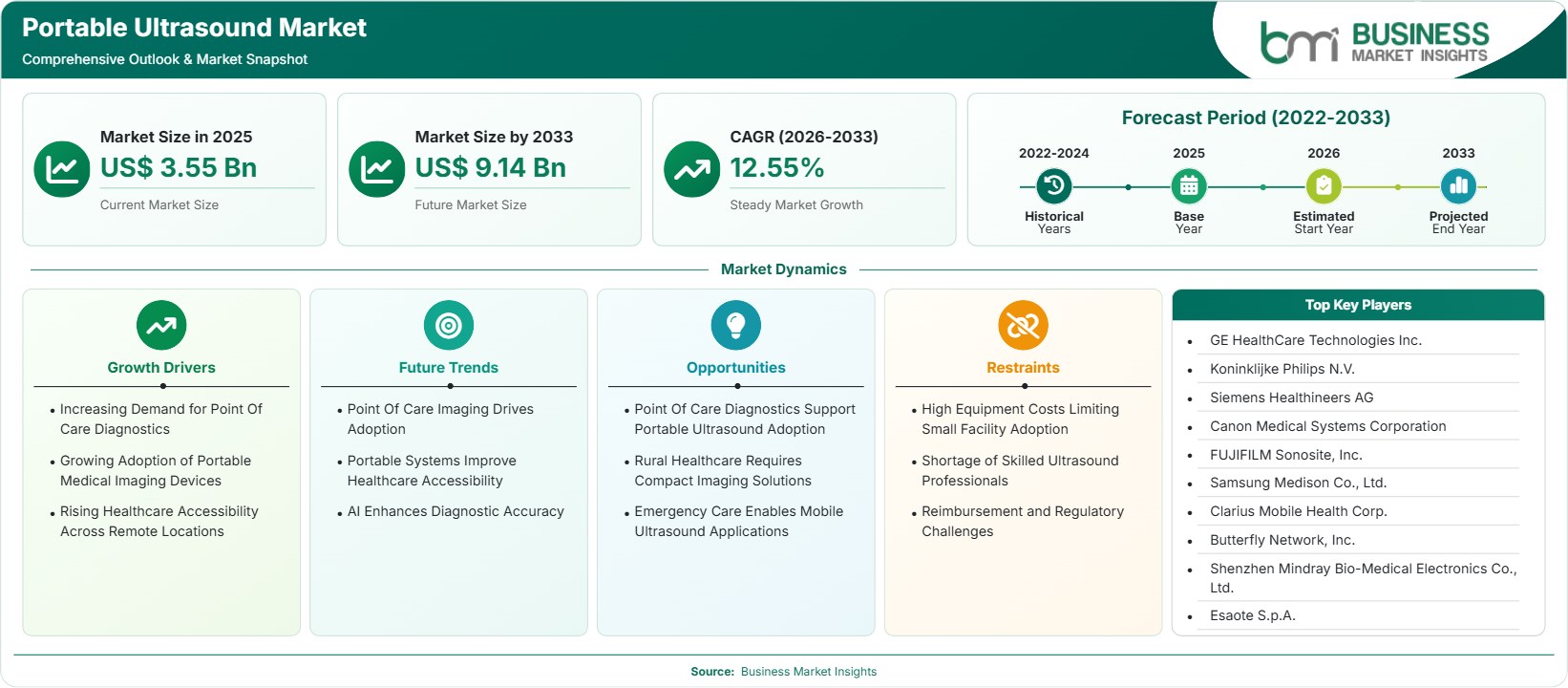
The Portable Ultrasound Market size was valued at US$ 3.55 Billion in 2025 and is projected to reach US$ 9.14 Billion by 2033, growing at a CAGR of 12.55% during 2026–2033. Key drivers include point-of-care imaging adoption, AI-enabled diagnostics, rural healthcare expansion, emergency medicine utilization, and handheld device innovation. Opportunities emerge from tele-ultrasound networks, home healthcare integration, and emerging market infrastructure investments.

Report Coverage
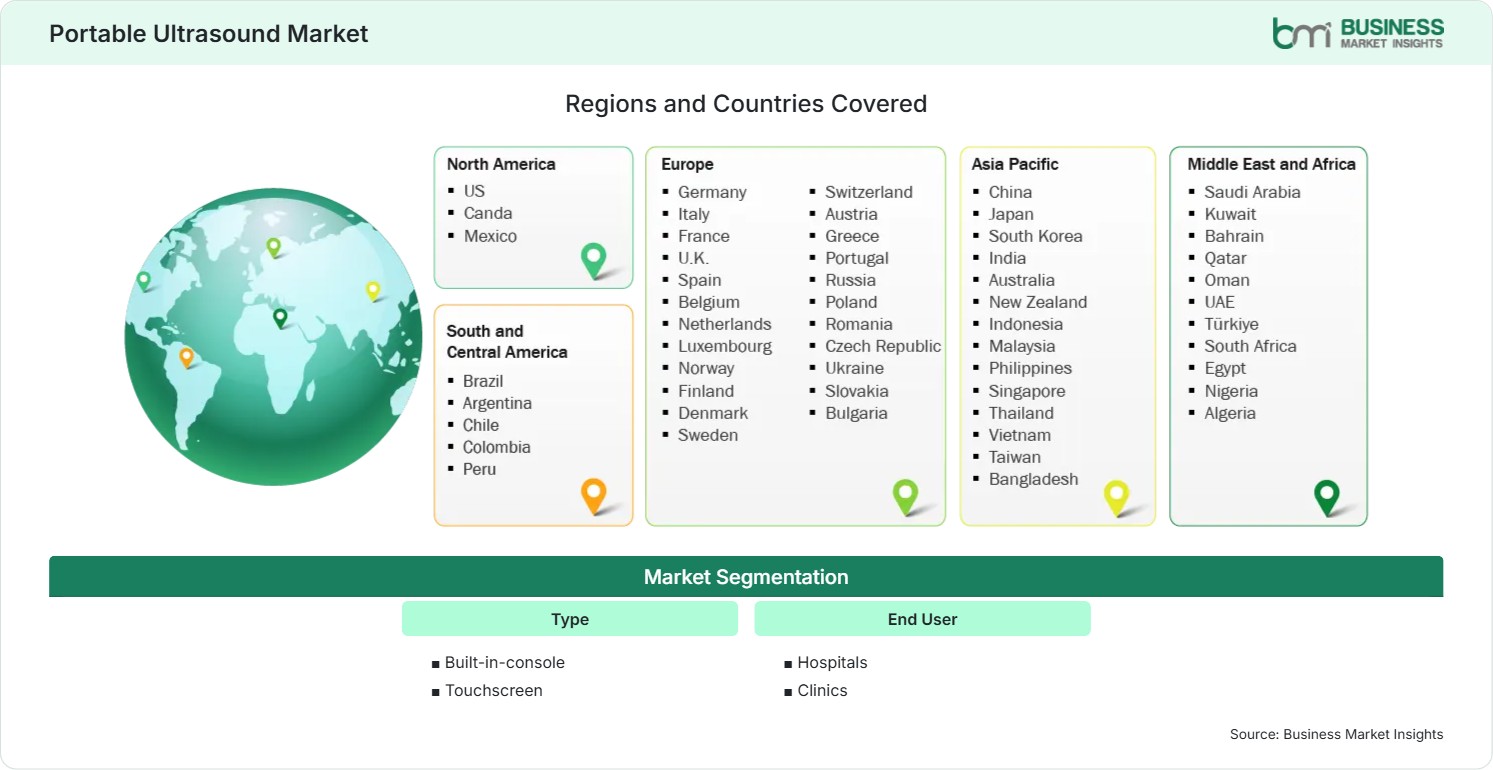
  • Type: Built-in-console, Touchscreen
  • End User: Hospitals, Clinics
US$ 3.55 Bn Market size in 2025
US$ 9.14 Bn Market Size by 2033
12.55% CAGR, 2026 - 2033
2026-2033 Forecast Period

AI Overview

Portable Ultrasound Market Summary

  • North America Region: North America holds a market share of 38%–41% in 2025, growing with a CAGR of 11.2%–11.8% during 2026–2033. Growth is supported by widespread point-of-care ultrasound adoption, emergency care utilization, reimbursement support, AI imaging integration, clinician training expansion, outpatient diagnostic demand, aging populations, and connected healthcare ecosystems. Brief U.S. analysis: strong hospital procurement, growing handheld deployment, and expanding emergency medicine applications support a CAGR of 11.0%–11.6%.
  • Fastest Growing Region: Asia Pacific accounts for 24%–27% share in 2025 and advances at a CAGR of 13.8%–14.5%. Key drivers include healthcare digitization, population growth, rural imaging accessibility, domestic manufacturing investments, government screening programs, rising chronic diseases, expanding insurance coverage, clinician adoption, and increasing primary healthcare infrastructure.
  • Leading Segment: Hospitals represent 68%–72% share in 2025 and grow at a CAGR of 12.0%–12.6%. Demand is supported by emergency diagnostics, intensive care imaging, bedside examinations, workflow efficiency improvements, multi-specialty utilization, clinician preference for rapid assessments, procurement modernization, and growing patient throughput requirements.
  • High Growth Segment: Touchscreen systems hold 54%–58% share in 2025 and expand at a CAGR of 13.2%–13.8%. Growth benefits from intuitive interfaces, AI-assisted workflows, portability improvements, image sharing capabilities, clinician productivity gains, software upgrades, training simplification, and increasing point-of-care adoption across specialties.
  • Key Market Opportunity: Tele-ultrasound platforms paired with cloud connectivity enable specialist-guided diagnostics across underserved areas, reducing referral delays, expanding screening access, strengthening remote consultations, improving workflow efficiency, and supporting scalable healthcare delivery models.
  • Major Market Players: GE HealthCare Technologies Inc., Koninklijke Philips N.V., Siemens Healthineers AG, Canon Medical Systems Corporation, FUJIFILM Sonosite, Inc., Samsung Medison Co., Ltd., Clarius Mobile Health Corp., Butterfly Network, Inc., Shenzhen Mindray Bio-Medical Electronics Co., Ltd., and Esaote S.p.A.
Strategic Insights

Portable Ultrasound Market: Strategic Insights

Portable Ultrasound Market Strategic Framework
FREE PDF
Request your free sample
Request free sample
Stakeholder View

Key Takeaways

  • The value chain increasingly combines probe manufacturers, semiconductor suppliers, software developers, cloud-platform providers, and healthcare systems, creating opportunities for vertically integrated diagnostic ecosystems.
  • Hospital-based emergency imaging and outpatient diagnostic pathways offer the strongest commercial upside because rapid bedside assessment continues replacing traditional workflow-intensive imaging approaches.
  • Product innovation is shifting toward AI-assisted measurement automation, wireless operation, smartphone compatibility, and cloud-enabled collaboration that improve clinician productivity and diagnostic consistency.
  • Asia Pacific presents an attractive investment environment due to healthcare modernization programs, growing clinician density, and rising demand for affordable imaging technologies.
  • Strategic acquisitions and partnerships increasingly focus on artificial intelligence software, imaging analytics, and digital health integration capabilities that strengthen device differentiation.
  • Training and education platforms are becoming competitive differentiators as vendors seek to increase utilization rates and clinician confidence across broader specialties.
Geographic Outlook

Portable Ultrasound Market Regional Highlights

North America Portable Ultrasound Market

North America accounts for 38%–41% of global revenue in 2025 and progresses at a CAGR of 11.2%–11.8% through 2033. The region benefits from established healthcare infrastructure, strong adoption of point-of-care ultrasound, and high procurement spending among hospitals and ambulatory providers. The Portable Ultrasound Market share remains highest in this region due to widespread clinician familiarity and ongoing innovation. Demand continues to expand across emergency care, critical care, musculoskeletal imaging, cardiology, and home-based healthcare applications.

  • Hospital networks increasingly deploy handheld imaging systems to reduce diagnostic delays and improve bedside decision-making efficiency across emergency and intensive care departments.
  • Reimbursement support and established clinical guidelines encourage integration into routine diagnostic workflows, particularly in cardiology and emergency medicine environments.
  • Artificial intelligence-enabled devices are gaining traction because automated measurements improve consistency and reduce training requirements for new users.
  • Rural healthcare programs support adoption by improving access to imaging services in geographically underserved communities.

US Portable Ultrasound Market

The United States represents approximately 78%–82% of North American demand and records a CAGR of 11.0%–11.6%. Portable medical devices have gained popularity in applications such as emergency medicine, outpatient diagnostic testing, intensive care, and home health care. This trend is bolstered by active research, well-established reimbursement mechanisms, and increased technology integration. Leading medical equipment manufacturers keep introducing improved portable and touch-screen devices, which increases adoption within physicians' offices and ambulatory care centers.

  • Academic medical centers are actively evaluating AI-supported ultrasound workflows that improve image acquisition quality and diagnostic confidence.
  • Expanding telehealth utilization supports remote interpretation models and specialist-guided examinations in underserved communities.
  • Emergency departments prioritize portable imaging to accelerate triage and treatment decisions while optimizing resource utilization.

Europe Portable Ultrasound Market

Europe captures 26%–29% market share in 2025 and advances at a CAGR of 11.0%–11.6%. Demand will be driven by aging demographics, high incidences of diseases, and robust public healthcare services. Germany continues to be the top generator of revenues, whereas Central and Eastern European nations show better adoption momentum. Imaging devices that can be taken anywhere have started being used for primary care, emergency medicine, and community health. The government-backed digital health programs also favor the use of diagnostic technologies.

  • Germany leads regional demand through advanced healthcare infrastructure and active procurement of portable imaging solutions.
  • Spain and Poland demonstrate stronger growth rates due to modernization initiatives and increasing point-of-care adoption.
  • Clinical focus on preventive care encourages broader utilization in screening and monitoring applications.
  • Integration with digital health platforms enhances interoperability and supports regional healthcare transformation objectives.

Asia Pacific Portable Ultrasound Market

Asia Pacific holds 24%–27% share in 2025 and is the fastest growing regional market with a CAGR of 13.8%–14.5%. China stands to be the largest regional opportunity, with India and Southeast Asia being significant in terms of expansion. The region has benefited from investments in healthcare infrastructure, increased awareness of diagnostics, government screening programs, and greater access to clinicians. There is continued demand for cost-effective and portable diagnostic devices.

  • China strengthens market leadership through domestic manufacturing capabilities and expanding healthcare infrastructure investments.
  • India records one of the strongest adoption profiles due to rural healthcare initiatives and increasing diagnostic accessibility programs.
  • Primary care modernization encourages deployment of compact imaging technologies across non-traditional clinical settings.
  • Vendor localization strategies improve affordability and broaden customer reach throughout the region.

Rest of World Portable Ultrasound Market

The Rest of World region accounts for 8%–10% of revenue and grows at a CAGR of 12.0%–12.8%. South and Central America benefit from healthcare modernization efforts and increasing access to diagnostic services. Meanwhile, Middle East and Africa adoption is driven by investments in healthcare infrastructure, medical tourism, and expanding clinical capacity. Brazil leads regional demand in Latin America, while Saudi Arabia and the UAE provide strong growth opportunities through healthcare diversification and digital transformation strategies.

  • Brazil remains the largest Latin American contributor due to expansion of diagnostic services and hospital modernization investments.
  • Saudi Arabia demonstrates notable growth through Vision-related healthcare development initiatives and technology adoption programs.
  • Mobile healthcare services create opportunities for portable imaging utilization across remote populations.
  • Public-private partnerships improve healthcare access and support deployment of advanced diagnostic equipment.
Global Market Geography
FREE PDF
Request your free sample
Request free sample
Segment Analysis

Portable Ultrasound Market Segmentation

Type

Type products account for the full market landscape, with touchscreen systems leading adoption. This segment reflects evolving clinician preferences for intuitive interfaces, software-driven workflows, and rapid image interpretation. The Portable Ultrasound Market trends indicate stronger demand for touchscreen-enabled devices. Type segment revenue distribution shows touchscreen systems holding 54%–58% share in 2025 and advancing at 13.2%–13.8% CAGR, while built-in-console products maintain relevance in high-volume clinical environments.

  • Built-in-console: Preferred in established hospital departments where durability, larger displays, and advanced imaging functionality remain essential for comprehensive examinations and procedural guidance.
  • Touchscreen: Increasingly adopted due to streamlined workflows, user-friendly interfaces, software upgrades, connectivity capabilities, and compatibility with modern point-of-care imaging environments.

End User

End-user demand is led by hospitals, reflecting broad utilization across emergency medicine, cardiology, intensive care, and surgical environments. The Portable Ultrasound Market scope continues to expand as portable imaging migrates beyond radiology departments. Hospitals represent 68%–72% share in 2025 and grow at 12.0%–12.6% CAGR, while clinic adoption strengthens through outpatient diagnostic expansion, convenience needs, and reduced infrastructure requirements.

  • Hospitals: Major purchasers due to high patient volumes, emergency care utilization, multidisciplinary imaging needs, and investments in workflow optimization technologies.
  • Clinics: Growing adoption supported by outpatient diagnostics, decentralized care delivery, physician convenience, and demand for cost-effective imaging solutions.
Market Forces

Portable Ultrasound Market Dynamics

Key Market Drivers

Expansion of Point-of-Care Imaging Utilization

Healthcare providers increasingly use portable imaging systems at the bedside to support faster clinical decision-making. Point-of-care ultrasound adoption has been adopted by emergency medicine, anesthesiology, critical care, and general practice due to increased efficiencies gained from the ability to get images instantly. Programs run by the WHO that focus on improving diagnosis and healthcare access through diagnostics act as an indirect driving factor for the use of portable imaging devices. Portability decreases the need for imaging centers and allows for rapid assessment. The existence of wireless devices and probes that connect to smartphones has enhanced the use of these imaging devices.

Advancements in AI-Enabled Ultrasound Technology

Artificial intelligence is improving workflow efficiency through automated measurements, image optimization, and clinical decision support capabilities. Manufacturers increasingly integrate software tools that help reduce operator variability and improve examination consistency. AI-assisted intelligent imaging makes the technology easier to use by less experienced specialists and provides opportunities for higher productivity in resource-restricted conditions. The rise in computing power, networking capabilities, and machine learning algorithms ensures continuous development of platforms. Taking into account the increasing focus on efficiency and standardization in healthcare institutions, advanced software is becoming an essential element of systems.

Rising Burden of Chronic and Cardiovascular Diseases

Growing prevalence of cardiovascular disease, diabetes-related complications, and chronic health conditions increases demand for accessible diagnostic imaging. Healthcare providers require rapid assessment tools capable of supporting timely disease management and monitoring. The use of portable ultrasound machines allows for early diagnosis in ambulatory, emergency, and rural care centers. Aging populations in North America, Europe, and some areas in Asia add further impetus to the demand for diagnostic tests. More screening programs and preventive care programs help increase utilization levels. This demographic trend will provide a solid base for growth in the coming years.

Key Market Opportunities

Tele-Ultrasound and Remote Specialist Collaboration

Remote analysis through imaging provides opportunities for extending diagnostic capabilities into areas that are underserved. Cloud-based technology allows the examination done by the frontline physician to be evaluated by the specialist. Emerging healthcare systems increasingly view connected diagnostics as a scalable method to address workforce shortages. Investment in broadband infrastructure and telemedicine networks supports implementation. Portable Ultrasound Market Forecasts considers the business potential of tele-ultrasound systems. Businesses that integrate imaging devices with collaboration tools can create distinctive business models through which they can make money both through selling products and services.

Home Healthcare and Community-Based Diagnostics

Healthcare delivery continues shifting toward outpatient and home-based care models. Portable imaging technology has the potential to facilitate disease surveillance in chronic diseases, follow-up examinations after acute care, and community screening efforts. Changes in demographics and efforts towards health care cost reduction result in treatment that is delivered outside of hospitals. The use of portable imaging helps deliver examinations in close proximity to the patient while maintaining high diagnostic accuracy. Increased reimbursement for home health care and further improvements in the usability of the equipment are positive trends.

Emerging Market Infrastructure Development

Many developing nations continue expanding healthcare networks and increasing investment in diagnostic accessibility. The portability of imaging represents an excellent solution in terms of requiring lower infrastructural costs compared to regular imaging equipment. Public health initiatives that aim at addressing maternal health, cardiac screening, and rural healthcare accessibility help with the purchase of equipment. The localization of production and technology transfers ensures low costs and easy availability. With increasing health insurance, there will be a higher demand for diagnostic services than the rate of development of infrastructure.

Market Restraints and Challenges

High Training Requirements and Operator Dependence

Factor: Ultrasound quality remains heavily influenced by user expertise, examination technique, and interpretation capability. Impact: Healthcare organizations need to provide continuous training programs for clinicians, which will raise the implementation costs and will take more time to implement due to a lack of experience on the part of users. Even with AI-driven process support, it will not be possible to remove the necessity of developing skills in any way. There is a possibility of facing staff shortage problems in smaller hospitals, which can act as barriers to proper usage.

Cost Pressures and Procurement Budget Constraints

Factor: Advanced portable systems increasingly incorporate premium software, connectivity tools, and artificial intelligence functionality. Impact: Acquisition-related costs can hinder healthcare providers with budgetary constraints, even though these costs offer efficiency in the long run. Public health facilities and smaller healthcare facilities tend to invest in the necessary infrastructure first before adding more diagnostic tools. The subscription model of software is another way of increasing the overall cost of ownership. Changes in currency, reliance on imports, and restrictions on reimbursement could influence purchasing decisions.

Company Analysis

Competitive Landscape

The competitive environment is characterized by product innovation, AI integration, and expanding point-of-care applications. Ongoing Portable Ultrasound Market analysis indicates that established imaging companies and specialized handheld ultrasound providers compete through software capabilities, mobility, image quality, and clinical workflow enhancements.

Company Name

Overview

Products and Services relevant to this market

GE HealthCare Technologies Inc.

Global medical technology leader with strong point-of-care imaging portfolio and extensive hospital relationships.

Vscan handheld ultrasound systems, portable imaging platforms, AI-enabled workflow solutions.

Koninklijke Philips N.V.

Major healthcare technology provider focused on connected diagnostics and digital health.

Lumify portable ultrasound, imaging software, cloud-enabled clinical applications.

Siemens Healthineers AG

International imaging company with broad diagnostic technologies and healthcare digitalization expertise.

Portable ultrasound systems, imaging informatics, AI-assisted diagnostic tools.

Canon Medical Systems Corporation

Established imaging manufacturer emphasizing advanced visualization and clinical productivity.

Compact ultrasound systems, diagnostic imaging platforms, workflow optimization solutions.

FUJIFILM Sonosite, Inc.

Dedicated point-of-care ultrasound specialist with strong emergency medicine presence.

Portable ultrasound devices, bedside imaging solutions, clinician education services.

Samsung Medison Co., Ltd.

Ultrasound-focused manufacturer leveraging electronics expertise and imaging innovation.

Portable ultrasound platforms, women's health imaging, AI-enhanced scanning tools.

Clarius Mobile Health Corp.

Specialist provider focused on wireless handheld ultrasound technologies.

Smartphone-based ultrasound scanners, cloud tools, AI-assisted imaging capabilities.

Butterfly Network, Inc.

Digital health company known for semiconductor-based handheld ultrasound innovation.

Butterfly iQ devices, software subscriptions, imaging collaboration services.

Shenzhen Mindray Bio-Medical Electronics Co., Ltd.

Global medical equipment supplier with growing international imaging footprint.

Portable ultrasound systems, monitoring technologies, integrated diagnostic solutions.

Esaote S.p.A.

Imaging specialist serving musculoskeletal, cardiovascular, and general diagnostic applications.

Portable ultrasound equipment, dedicated clinical imaging solutions, software platforms.

Trust & Transparency

Research Methodology

The market analysis combines proprietary research with secondary data from government agencies, company disclosures, regulatory filings, industry databases and expert interviews. Market estimates are validated through data triangulation, cross-market benchmarking and analyst review.

View Full Research Methodology

Questions Answered

Frequently Asked Questions

What does a Portable Ultrasound Market Report typically evaluate?

A comprehensive report assesses technology developments, competition, regional performance, segment opportunities, regulatory influences, investment activity, and long-term demand patterns affecting industry participants.

Which region offers the strongest long-term growth potential?

Asia Pacific presents the strongest growth opportunity due to healthcare infrastructure investment, rising diagnostic awareness, expanding insurance coverage, and increasing accessibility of healthcare services.

How does portability improve healthcare delivery?

Portable systems enable imaging at the point of care, reducing diagnostic delays, minimizing patient transport, improving workflow efficiency, and expanding access in remote or underserved areas.

What technological advancement is most influencing product development?

Artificial intelligence integration is increasingly important because it improves image optimization, automates measurements, enhances workflow efficiency, and supports clinicians with varying ultrasound experience levels.

Which healthcare setting generates the highest demand for portable ultrasound systems?

Hospitals represent the largest demand center because portable imaging supports emergency medicine, intensive care, surgical guidance, cardiology, and bedside diagnostics across multiple specialties.

Access the Full Portable Ultrasound Market Report

Get segment-level forecasts, regional estimates, competitive benchmarking, company profiles and downloadable Excel datasets.

Access the full Portable Ultrasound Market Report
350 pages PDF & Excel | 2026-09-04