
Personal Protective Equipment PPE Market Outlook: Size, Share, Trends, Growth Analysis, Competitive Landscape & Forecast, 2026-2033

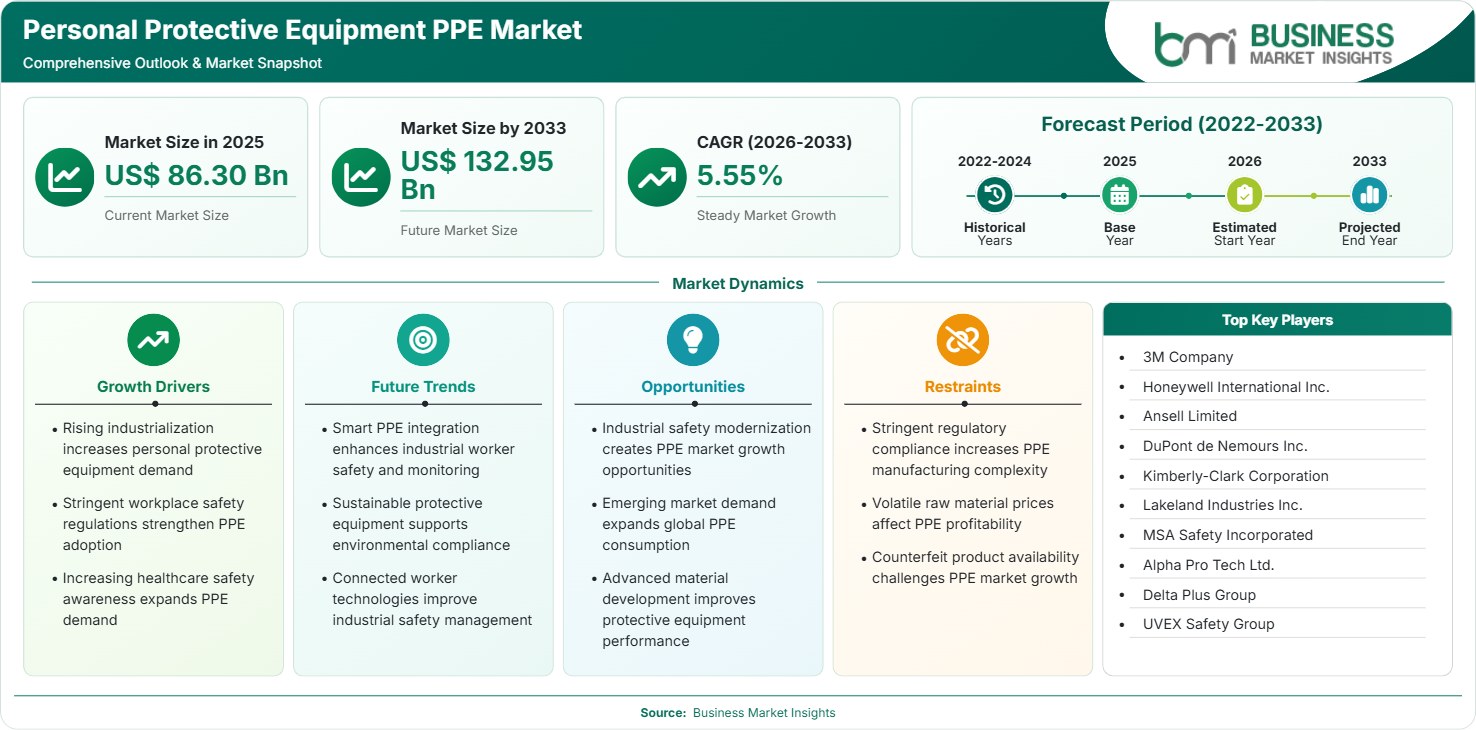
The Personal Protective Equipment PPE Market size was valued at US$ 86.3 billion in 2025 and is projected to reach US$ 132.95 billion by 2033, growing at a CAGR of 5.55% during 2026–2033. Rising industrial safety awareness, expanding workplace compliance requirements, and increasing healthcare protection standards continue supporting product demand. Innovation in protective materials, smart safety technologies, and sustainable PPE solutions is creating new growth opportunities across industrial and healthcare sectors.

Report Coverage
  • Product: Hand Protection, Eye & Face Protection, Hearing Protection, Protective Clothing, Respiratory Protection, Protective Footwear, Fall Protection, Head Protection
  • End-use Industry: Manufacturing, Construction, Automotive, Oil & Gas, Healthcare, Food, Chemical, Transportation
US$ 86.30 Bn Market size in 2025
US$ 132.95 Bn Market Size by 2033
5.55% CAGR, 2026 - 2033
2026-2033 Forecast Period

01 AI Overview

Personal Protective Equipment PPE Market Summary

  • North America Region: North America accounted for 33%–36% of global revenue in 2025 and is projected to grow at a CAGR of 5.2%–5.7% during 2026–2033. Strong occupational safety regulations, mature industrial infrastructure, and high compliance across manufacturing and healthcare sectors continue supporting regional demand. The United States contributes approximately 83%–86% of regional revenue and is expected to register a CAGR of 5.3%–5.8%, supported by workplace safety investments and industrial modernization.
  • Fastest Growing Region: Asia Pacific represented 28%–31% of global revenue in 2025 and is forecast to record the highest CAGR of 6.4%–6.9% due to rapid industrialization, expanding manufacturing activities, infrastructure development, and strengthening workplace safety regulations.
  • Leading Segment: Hand Protection accounted for 26%–29% of total revenue in 2025 and is expected to expand at a CAGR of 5.6%–6.0% because of widespread usage across manufacturing, healthcare, construction, and chemical industries.
  • High Growth Segment: Respiratory Protection represented 13%–16% of market revenue in 2025 and is projected to grow at a CAGR of 6.7%–7.2% driven by increasing industrial air quality standards, healthcare demand, and hazardous workplace applications.
  • Key Market Opportunity: Industrial automation, advanced protective materials, expanding workplace safety investments, and growing demand from emerging economies continue creating attractive opportunities for PPE manufacturers.
  • Major Market Players: 3M Company, Honeywell International Inc., Ansell Limited, DuPont de Nemours Inc., Kimberly-Clark Corporation, Lakeland Industries Inc., MSA Safety Incorporated, Alpha Pro Tech Ltd., Delta Plus Group, UVEX Safety Group.
02 Strategic Insights

Personal Protective Equipment PPE Market: Strategic Insights

Personal Protective Equipment PPE Market Strategic Framework
FREE PDF
Request your free sample
Request free sample
03 Stakeholder View

Key Takeaways

  • Industrial safety ecosystems are evolving toward integrated worker protection strategies combining certified PPE, digital monitoring technologies, predictive safety management, and compliance-focused workplace practices.
  • The strongest Personal Protective Equipment PPE Market growth opportunities are emerging from respiratory protection, healthcare applications, industrial automation, and expanding manufacturing investments across developing economies.
  • Product innovation increasingly emphasizes lightweight protective materials, improved comfort, enhanced durability, smart sensing capabilities, and sustainable manufacturing to improve user acceptance and workplace productivity.
  • Asia Pacific presents the strongest long-term investment opportunity due to rapid industrial expansion, infrastructure projects, manufacturing growth, and strengthening occupational safety regulations.
  • Strategic acquisitions, manufacturing capacity expansion, product certification, and distribution partnerships continue strengthening competitive positioning among global PPE manufacturers.
  • Companies capable of combining regulatory compliance, product innovation, sustainability, and cost efficiency are expected to strengthen their long-term competitive advantage.
04 Geographic Outlook

Personal Protective Equipment PPE Market Regional Highlights

North America Personal Protective Equipment PPE Market

North America accounted for 33%–36% of global revenue in 2025 and is projected to register a CAGR of 5.2%–5.7% through 2033. Strong occupational safety regulations, industrial automation, and high compliance across manufacturing, healthcare, oil & gas, and construction industries continue supporting regional demand. The Personal Protective Equipment PPE Market share remains supported by continuous investments in worker safety programs and regulatory compliance initiatives.

  • The United States maintains regional leadership through strong workplace safety standards, industrial modernization, and consistent investment in employee protection solutions.
  • Canada continues strengthening demand through expanding mining activities, healthcare infrastructure, and occupational safety compliance across industrial sectors.
  • Manufacturers continue investing in advanced protective materials, ergonomic product designs, and reusable PPE solutions to improve workplace productivity.
  • Growing adoption of connected safety technologies and digital workplace monitoring supports increasing deployment of intelligent protective equipment.

US Personal Protective Equipment PPE Market

The United States represented approximately 83%–86% of North American revenue in 2025 and is expected to expand at a CAGR of 5.3%–5.8% during the forecast period. Continuous investment in industrial safety, healthcare protection, and infrastructure modernization supports stable demand across multiple end-use industries.

  • Manufacturing organizations increasingly prioritize certified protective equipment to improve worker safety, regulatory compliance, and operational reliability.
  • Healthcare providers continue expanding PPE procurement to strengthen infection prevention, emergency preparedness, and occupational health protection.
  • Construction companies increasingly adopt advanced safety equipment supporting workforce protection across infrastructure and commercial development projects.

Europe Personal Protective Equipment PPE Market

Europe accounted for 27%–30% of global revenue in 2025 and is projected to expand at a CAGR of 5.1%–5.6% during 2026–2033. Strict occupational health regulations, established manufacturing industries, and continuous investment in industrial worker safety support regional demand. Germany remains the leading market, while the United Kingdom is projected to register the fastest regional growth with a CAGR of 5.7%–6.2% through increasing industrial modernization and healthcare safety investments.

  • Germany maintains regional leadership through strong automotive, manufacturing, chemical, and engineering industries requiring certified protective equipment, aligning with Personal Protective Equipment PPE Market trends.
  • The United Kingdom continues expanding PPE adoption through healthcare investments, construction activities, and workplace safety modernization initiatives.
  • France experiences stable demand from industrial manufacturing, transportation, food processing, and public sector safety applications.
  • European manufacturers continue developing environmentally responsible protective equipment using recyclable materials and sustainable production technologies.
  • Workplace digitalization is encouraging adoption of intelligent safety equipment supporting improved worker monitoring and compliance management.

Asia Pacific Personal Protective Equipment PPE Market

Asia Pacific represented 28%–31% of global revenue in 2025 and is expected to record the highest CAGR of 6.4%–6.9% during the forecast period. Rapid industrialization, expanding manufacturing facilities, infrastructure investments, and stricter workplace safety standards continue driving regional expansion. China accounts for the largest regional Personal Protective Equipment PPE Market, while India is expected to register the fastest growth with a CAGR of 6.9%–7.4% through increasing industrial production and infrastructure development.

  • China continues strengthening regional demand through manufacturing expansion, industrial exports, and government-supported workplace safety improvements.
  • India experiences increasing adoption across manufacturing, construction, chemicals, healthcare, and transportation sectors due to expanding industrial activity.
  • Japan maintains stable demand through advanced manufacturing, electronics production, and strict industrial safety requirements.
  • Southeast Asian economies continue increasing PPE consumption through foreign investments, industrial parks, and infrastructure modernization.
  • Manufacturers continue expanding regional production facilities to improve supply chain efficiency and meet growing industrial demand.

Rest of World Personal Protective Equipment PPE Market

The Rest of World accounted for 9%–11% of global revenue in 2025 and is projected to grow at a CAGR of 5.8%–6.3% through 2033. South & Central America and the Middle East & Africa continue benefiting from mining activities, oil & gas projects, industrial expansion, and improving occupational safety standards.

Growing government investment in industrial development and workplace compliance continues supporting long-term PPE demand across emerging economies.

  • Brazil remains the leading South & Central American market through expanding manufacturing, mining, and infrastructure development projects.
  • The United Arab Emirates demonstrates strong demand supported by construction, energy projects, aviation, and industrial diversification initiatives.
  • Saudi Arabia continues increasing PPE procurement through industrial expansion, petrochemical investments, and large-scale infrastructure projects.
  • South Africa supports regional growth through mining operations, industrial manufacturing, and workplace safety compliance initiatives.
  • International manufacturers continue strengthening regional distribution partnerships and localized manufacturing capabilities to improve market accessibility.
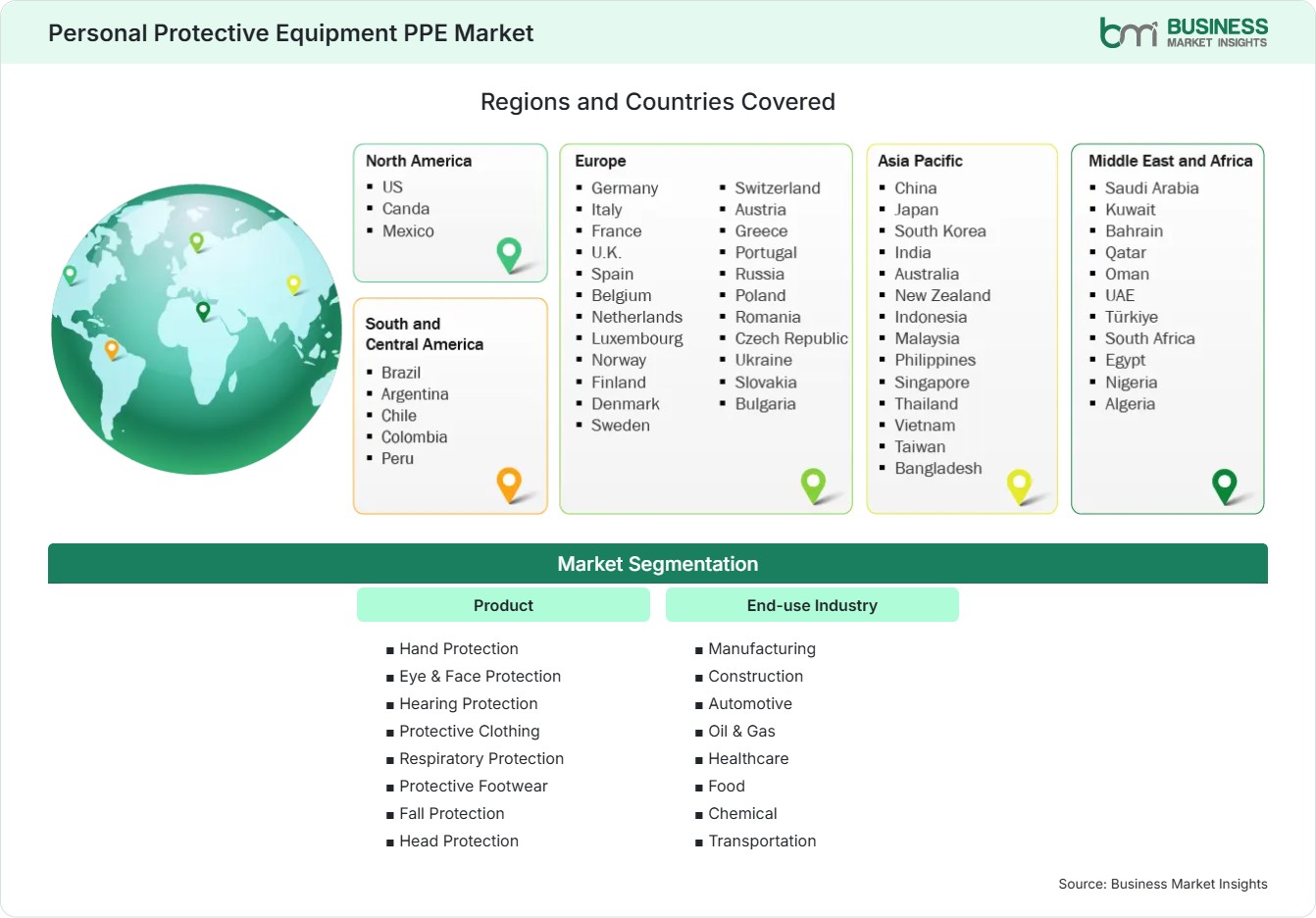
Global Market Geography
FREE PDF
Request your free sample
Request free sample
05 Segment Analysis

Personal Protective Equipment PPE Market Segmentation

Product

The Product segment accounted for 68%–71% of total market revenue in 2025 and is projected to expand at a CAGR of 5.6%–6.1% during 2026–2033. Continuous product innovation, stricter workplace regulations, and increasing worker protection awareness continue supporting adoption across industrial and healthcare environments. The Personal Protective Equipment PPE Market Scope continues expanding as manufacturers introduce lightweight materials, ergonomic designs, reusable solutions, and enhanced protective performance.

  • Hand Protection: Hand protection products remain the largest category due to widespread usage across manufacturing, healthcare, construction, automotive, food processing, and chemical industries.
  • Eye & Face Protection:
    • Safety Spectacles: Safety spectacles provide essential eye protection against dust, debris, chemical exposure, and workplace hazards across industrial environments.
    • Safety Goggles: Safety goggles offer enhanced protection in hazardous environments involving chemicals, airborne particles, and laboratory operations.
    • Welding Shields: Welding shields protect workers from sparks, heat, ultraviolet radiation, and intense light generated during welding operations.
    • Face Shields: Face shields support full-face protection in healthcare, manufacturing, laboratory, and industrial environments requiring splash and impact resistance.
    • Head Gear: Protective head gear enhances worker safety across construction, manufacturing, mining, and heavy industrial applications.
  • Hearing Protection:
    • Ear Plugs: Ear plugs reduce occupational noise exposure while providing comfortable hearing protection across industrial workplaces.
    • Cap Mounted Earmuffs: Cap mounted earmuffs integrate with industrial helmets to provide effective hearing protection in high-noise environments.
    • Hearing Bands: Hearing bands offer lightweight hearing protection for intermittent workplace noise exposure and industrial maintenance activities.
  • Protective Clothing: Protective clothing provides resistance against chemicals, biological hazards, heat, flames, and hazardous industrial environments.
  • Respiratory Protection:
    • Air Purifying Respirators (APR): APR systems protect workers by filtering airborne contaminants in industrial, healthcare, and chemical applications.
    • Supplied Air Respirators: Supplied air respirators provide clean breathing air in hazardous workplaces containing oxygen-deficient or toxic environments.
  • Protective Footwear: Protective footwear minimizes workplace injuries through impact resistance, slip protection, electrical insulation, and ergonomic comfort.
  • Fall Protection: Fall protection systems reduce injury risks during elevated construction, maintenance, utility, and industrial operations.
  • Head Protection: Head protection products safeguard workers against impact, falling objects, and workplace hazards across multiple industries.

End-use Industry

The End-use Industry segment represented 29%–32% of total revenue in 2025 and is projected to grow at a CAGR of 5.5%–6.0% during the forecast period. Expanding industrial activities, healthcare investments, and regulatory compliance continue driving PPE demand across multiple industries. The Personal Protective Equipment PPE Market Trends indicate increasing adoption of specialized protective equipment designed for industry-specific safety requirements.

  • Manufacturing: Manufacturing remains the largest end-use sector due to extensive worker safety requirements across production facilities.
  • Construction: Construction companies increasingly deploy certified PPE to improve worker protection across commercial, residential, and infrastructure projects.
  • Automotive: Automotive manufacturers utilize PPE to protect workers involved in assembly, welding, painting, and maintenance operations.
  • Oil & Gas: Oil & gas companies require specialized protective equipment for hazardous exploration, production, refining, and maintenance activities.
  • Healthcare: Healthcare organizations utilize PPE extensively for infection prevention, patient care, laboratory operations, and emergency response.
  • Food: Food processing industries implement protective equipment to maintain worker safety, hygiene, and regulatory compliance.
  • Chemical: Chemical manufacturing facilities require advanced PPE to protect workers from hazardous substances and industrial processes.
  • Transportation: Transportation companies increasingly utilize PPE across logistics, aviation, rail, and warehousing operations to improve worker safety.
06 Market Forces

Personal Protective Equipment PPE Market Dynamics

Key Market Drivers

Rising industrialization increases personal protective equipment demand

The rapid industrialization process in various sectors such as manufacturing, mining, construction, energy, and logistics is greatly driving up the requirement of certified worker safety products. As per statistics provided by the International Labour Organization (ILO), millions of workers suffer from accidents every year, which highlights the growing investments being made by employers in safety measures. The growth of industrial capacities, infrastructure developments, and automation of factories is continually fueling the demand for safety products. Developing countries are enhancing their industrial capabilities whereas multinational companies are establishing uniform safety practices globally.

Stringent workplace safety regulations strengthen PPE adoption

Governments and organizations that ensure the safety of occupations are making continuous efforts to improve regulations in the work environment, which necessitate that employers must supply certified personal protective equipment to their employees in hazardous surroundings. Regulators such as OSHA, EU-OSHA, and other safety regulating organizations are constantly upgrading their guidelines for mandatory compliance in industrial settings, health-care sector, and construction industry. This would motivate organizations to replace old equipment, perform safety audits, and use certified protective products.

Increasing healthcare safety awareness expands PPE demand

The focus on disease prevention and health care workers' safety is still very much evident as organizations stock up on appropriate protective equipment to ensure the safety of doctors and other health care workers. Respiratory protection, protective garments, gloves, eye protection, and face shields are increasingly becoming part of procurement budgets. Investments in health care facilities, emergency preparedness, and disease prevention have led to increased demand for quality protective equipment.

Key Market Opportunities

Industrial safety modernization creates PPE market growth opportunities

Industrial automation, digital work transformation, and smart manufacturing have prompted companies to embrace advanced personal protective equipment featuring ergonomic design, increased comfort, durability, and advanced monitoring. Companies are adopting lighter materials, wearables, and connected safety equipment that boost efficiency while ensuring that employees are well protected. Ongoing investments in the modernization of industries in the manufacturing, mining, construction, and energy sectors offer growth prospects for PPE manufacturers globally.

Emerging market demand expands global PPE consumption

The fast-growing industrialization in APAC, Latin America, Middle East, and Africa is still contributing to the creation of good growth potential for manufacturers of PPE products. The governments have been spending money on building infrastructures, industrial zones, hospitals, and occupational safety regulations, which result in an increase in demand for certified protective gear. Expansion of local production, better occupational safety regulations, and growing safety awareness will drive product adoption.

Advanced material development improves protective equipment performance

Innovations in engineered fabrics, lightweight polymers, composite material technology, and coating technology are making it possible for companies to produce equipment that is stronger, more comfortable, and more energy-efficient. Investments in research have made improvements in areas such as heat protection, chemical protection, impact absorption, breathability, and longevity of the products. These technological developments will facilitate widespread usage in industries that need special protection.

Market Restraints and Challenges

Stringent regulatory compliance increases PPE manufacturing complexity

Factor: Manufacturers must meet various requirements for product certification, testing, material use, and quality control across several countries before marketing their protective equipment.

Impact: Product development and manufacture will become more complicated due to a lot of certification processes involved, which will take a longer period and incur higher expenses.

Volatile raw material prices affect PPE profitability

Factor: Price instability of polymers, artificial textiles, rubber, special materials, metals, and other industrial raw materials is an important determinant of production economics.

Impact: Volatility of costs influences profits, price policies, purchasing policies, and many other processes of business operations. Companies actively seek ways to limit their vulnerability to changes in costs of industrial raw materials.

07 Company Analysis

Competitive Landscape

The competitive landscape remains highly competitive with established multinational manufacturers focusing on certified product innovation, sustainability, advanced protective materials, and digital safety technologies. The Personal Protective Equipment PPE Market Analysis indicates that strategic acquisitions, regional manufacturing expansion, and product certification continue strengthening competitive positioning.

Company Name

Overview

Products and Services relevant to this market

3M Company

Global manufacturer specializing in industrial safety and worker protection technologies.

Respirators, hearing protection, protective eyewear, head protection, fall protection, and industrial PPE.

Honeywell International Inc.

Diversified industrial technology company serving global occupational safety markets.

Respiratory protection, protective clothing, gloves, footwear, head protection, and hearing protection products.

Ansell Limited

Global specialist in protective solutions for industrial and healthcare environments.

Industrial gloves, medical gloves, chemical protection, protective clothing, and workplace safety solutions.

DuPont de Nemours Inc.

Advanced materials company providing protective technologies for hazardous environments.

Chemical protective apparel, flame-resistant garments, cleanroom clothing, and industrial protective materials.

Kimberly-Clark Corporation

Global consumer and professional safety products manufacturer.

Protective apparel, disposable garments, gloves, masks, and healthcare protective solutions.

Lakeland Industries Inc.

Manufacturer focused on industrial and hazardous environment protective apparel.

Chemical suits, firefighting apparel, disposable clothing, and industrial protective garments.

MSA Safety Incorporated

Global provider of worker safety equipment and industrial protection technologies.

Head protection, respiratory protection, gas detection, fall protection, and firefighter safety equipment.

Alpha Pro Tech Ltd.

Manufacturer specializing in disposable protective products for healthcare and industry.

Protective apparel, face shields, masks, building products, and infection control solutions.

Delta Plus Group

International manufacturer of workplace safety equipment and protective solutions.

Helmets, gloves, footwear, respiratory protection, protective clothing, and fall protection equipment.

UVEX Safety Group

Global producer of premium occupational safety and protective equipment.

Safety eyewear, helmets, hearing protection, footwear, gloves, and respiratory safety products.


10 Trust & Transparency

Research Methodology

The market analysis combines proprietary research with secondary data from government agencies, company disclosures, regulatory filings, industry databases and expert interviews. Market estimates are validated through data triangulation, cross-market benchmarking and analyst review.

View Full Research Methodology

11 Questions Answered

Frequently Asked Questions

How do market forecasts help businesses?

Personal Protective Equipment PPE Market forecasts enable manufacturers, distributors, investors, and industrial buyers to evaluate future demand, identify investment opportunities, optimize production planning, and develop long-term business strategies.

What does a market report include?

A Personal Protective Equipment PPE Market report provides comprehensive analysis covering market size, competitive landscape, regional outlook, technology developments, segmentation, industry trends, growth drivers, opportunities, restraints, and strategic company profiles.

Which region is expected to grow the fastest during the forecast period?

Asia Pacific is projected to record the highest growth due to rapid industrialization, expanding manufacturing capacity, infrastructure investments, strengthening workplace safety regulations, and increasing adoption of certified protective equipment.

Which product category dominates the market?

Hand Protection represents the largest product category owing to its widespread use across manufacturing, healthcare, construction, chemical processing, logistics, and industrial maintenance applications requiring continuous worker protection.

Which industries generate the highest demand for personal protective equipment?

Manufacturing, construction, healthcare, oil & gas, chemical processing, transportation, automotive, and food processing industries collectively account for the majority of global PPE demand because of stringent workplace safety requirements and hazardous operating environments.

Access the Full Personal Protective Equipment PPE Market Report

Get segment-level forecasts, regional estimates, competitive benchmarking, company profiles and downloadable Excel datasets.

Access the full Personal Protective Equipment PPE Market Report
350 pages PDF & Excel | 2026-08-04