
Plant Extracts Market Outlook: Size, Share, Trends, Growth Analysis, Competitive Landscape & Forecast, 2026-2033

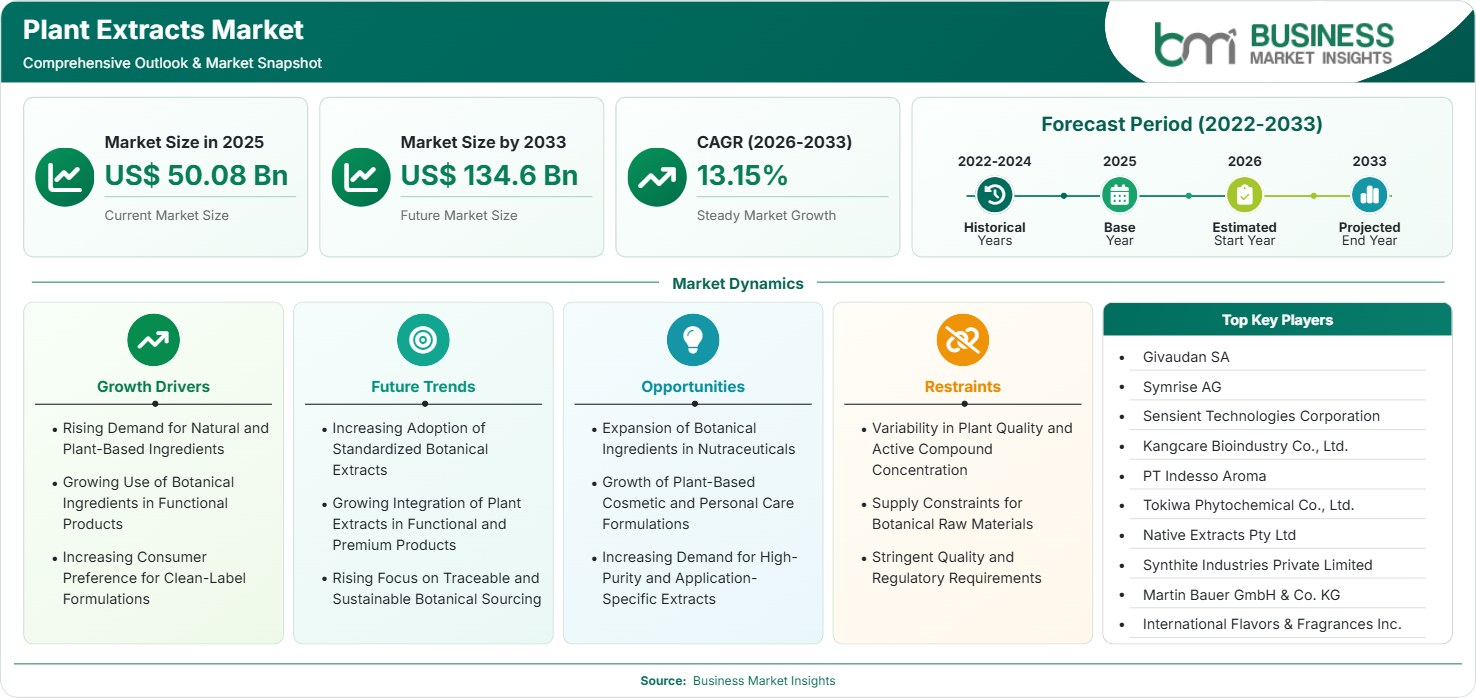
The Plant Extracts Market size was valued at US$ 50.08 Billion in 2025 and is projected to reach US$ 134.6 Billion by 2033, growing at a CAGR of 13.15% during 2026–2033, driven by nutraceutical demand, botanical medicines, clean-label foods, premium cosmetics, sustainable extraction, and traceable sourcing.

Report Coverage
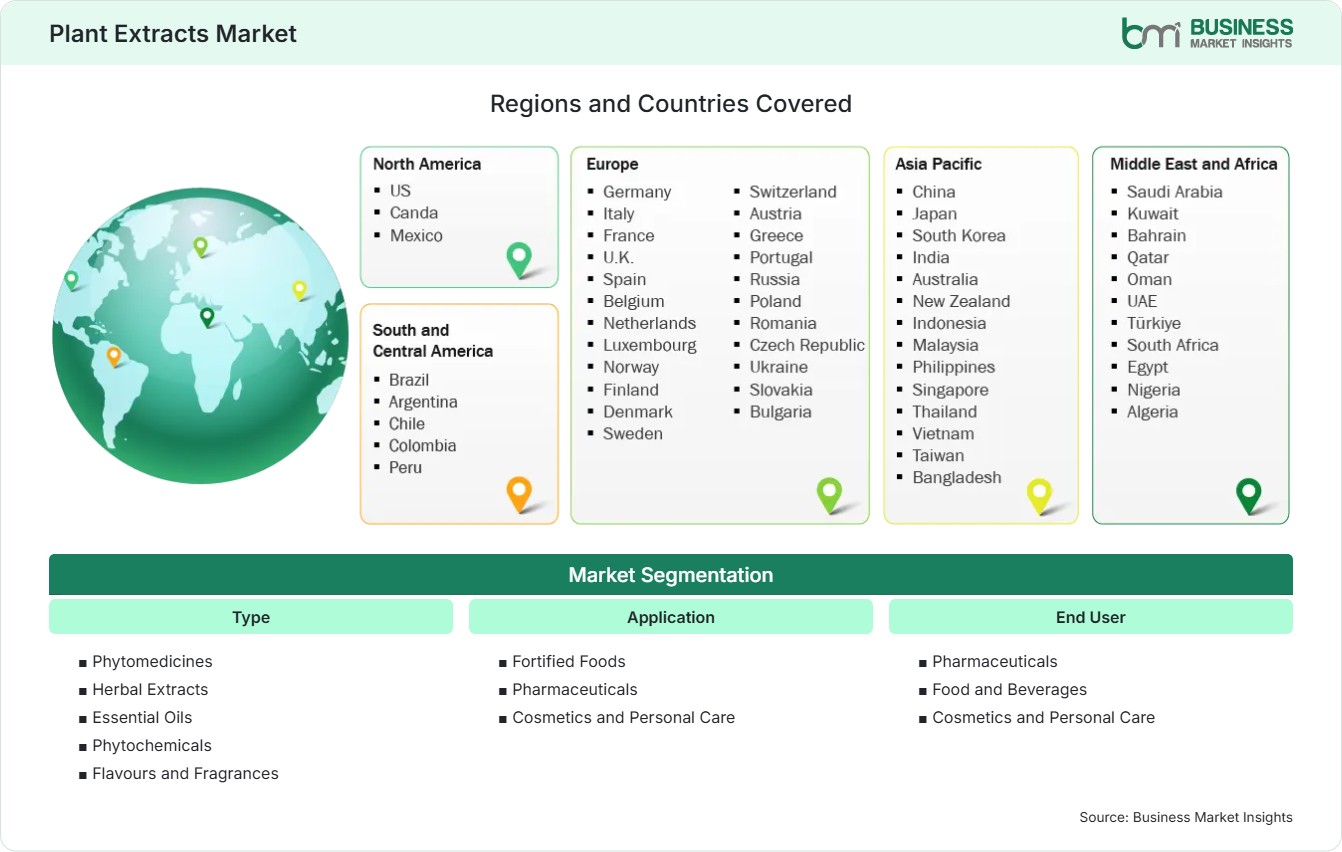
  • Type: Phytomedicines, Herbal Extracts, Essential Oils, Phytochemicals, Flavours and Fragrances
  • Application: Fortified Foods, Pharmaceuticals, Cosmetics and Personal Care
  • End User: Pharmaceuticals, Food and Beverages, Cosmetics and Personal Care
US$ 50.08 Bn Market size in 2025
US$ 134.6 Bn Market Size by 2033
13.15% CAGR, 2026 - 2033
2026-2033 Forecast Period

AI Overview

Plant Extracts Market Summary

  • North America Region: North America holds 28%–31% share in 2025, growing at 11.2%–12.1% CAGR, influenced by nutraceutical innovation, clean-label formulations, functional beverages, premium skincare, botanical medicines, and advanced ingredient development. The US holds 82%–86% of North American demand, growing at 11.5%–12.4% CAGR, supported by supplements, functional foods, beauty products, and evidence-based botanical formulations.
  • Fastest Growing Region: Asia Pacific holds 30%–34% share in 2025, expanding at 14.5%–15.5% CAGR, driven by traditional medicine modernization, rising incomes, nutraceutical adoption, domestic extraction capacity, pharmaceutical applications, functional foods, beverages, and rapidly expanding beauty markets.
  • Leading Segment: Herbal Extracts hold 34%–38% share in 2025 and grow at 13.0%–14.0% CAGR, supported by broad adoption in nutraceuticals, pharmaceuticals, fortified foods, beverages, cosmetics, traditional medicine, and standardized botanical formulations.
  • High Growth Segment: Phytomedicines hold 18%–22% share in 2025 and expand at 14.5%–15.5% CAGR, supported by clinical validation, standardized extracts, preventive healthcare, traditional medicine integration, physician acceptance, and regulatory modernization across healthcare systems.
  • Key Market Opportunity: Standardized extracts, clinically supported botanicals, traceable sourcing, biotechnology-enabled extraction, premium cosmetic actives, and application-specific ingredients provide opportunities for higher margins and long-term formulation partnerships.
  • Major Market Players: Givaudan SA, Symrise AG, Sensient Technologies Corporation, Kangcare Bioindustry Co., Ltd., PT Indesso Aroma, Tokiwa Phytochemical Co., Ltd., Native Extracts Pty Ltd, Synthite Industries Private Limited, Martin Bauer GmbH & Co. KG, International Flavors & Fragrances Inc.
Strategic Insights

Plant Extracts Market: Strategic Insights

Plant Extracts Market Strategic Framework
FREE PDF
Request your free sample
Request free sample
Stakeholder View

Key Takeaways

  • Integration within the supply chain is creating a competitive advantage because the quality of the botanics relies on authentication, growing, harvesting, storing, extraction and analysis. Supplier integration would improve reliability and decrease procurement risk.
  • The potential for phytomedicines, nutraceuticals, fortified foods, and cosmeceutical actives is high since there is an increasing consumer demand for products which provide functionality.
  • Extraction innovation is moving toward selective, low-temperature, solvent-efficient, and precision processes that improve active-compound recovery while protecting sensitive botanical constituents.
  • There are many investment opportunities in India due to its medicinal plant resource base, traditional medicine experience, processing capability, exporting ability, and standardization of botanical ingredients.
  • The investment trend has become oriented towards premium quality natural ingredients, extraction facilities, biotech, botanical sourcing network, and diversification into applications.
  • Customer qualification is becoming a strategic differentiator as pharmaceutical, food, and cosmetic manufacturers require authenticated identity, contaminant controls, stability information, marker compounds, and consistent commercial specifications.
Geographic Outlook

Plant Extracts Market Regional Highlights

North America Plant Extracts Market

North America holds 28%–31% of Plant Extracts Market share in 2025 and grows at 11.2%–12.1% CAGR through 2033. The region benefits from nutraceutical, functional food, beverage, beauty, and pharmaceutical demand. The US represents 82%–86% of regional demand and advances at 11.5%–12.4% CAGR. Canada contributes through natural health products, while Mexico supports manufacturing and sourcing. Regional suppliers increasingly compete through standardized extracts, analytical documentation, application support, and differentiated botanical ingredients.

  • Nutraceutical brands increasingly require standardized botanicals with defined active markers, creating demand for consistent composition and stronger technical documentation.
  • Functional beverage manufacturers favor soluble botanical ingredients with controlled color, taste, stability, and compatibility across acidic and processed environments.
  • Premium skincare demand supports botanical actives positioned around soothing, antioxidant, barrier-supporting, and appearance-enhancing applications.
  • Contract manufacturing partnerships are expanding as suppliers combine ingredients with formulation guidance, customization, quality services, and commercialization support.

US Plant Extracts Market

The Plant Extracts Market in US accounts for 82%–86% of North American demand and grows at 11.5%–12.4% CAGR during 2026–2033. Demand is supported by dietary supplements, sports nutrition, functional foods, beverages, beauty products, and botanical pharmaceutical research. Developers increasingly prioritize standardized composition, validated testing, clean-label positioning, and credible substantiation. Regulatory distinctions between supplements and botanical drugs encourage suppliers to develop application-specific documentation and manufacturing systems aligned with intended product use.

  • Evidence-backed botanical ingredients are gaining importance as brands seek stronger differentiation and consumer confidence in functional health products.
  • Formulators increasingly require better solubility, taste management, stability, and dispersion for convenient consumer formats.
  • Botanical pharmaceutical development provides opportunities for suppliers with strong pharmacognosy, analytical testing, raw-material controls, manufacturing consistency, and regulatory expertise.

Europe Plant Extracts Market

Europe holds 27%–30% share in 2025 and grows at 11.8%–12.7% CAGR. Germany and France remain leading markets, while Italy, Spain, and the United Kingdom provide specialty demand. Germany can capitalize on its strengths in phytomedicines, Germany is strong in standardized herbal medicines, professional healthcare applications, and technologically differentiated botanicals. French consumers prioritize traceability, safety, quality, compliant claims, and standardization of manufacture. The regional trend creates potential for premium botanicals with proven origins and standardized chemical composition.

  • Germany is an established phytomedicine market with a strong demand for standardize herbs, health care applications, and technically differentiated botanical ingredients.
  • France provides opportunities in fragrance, cosmetics, natural actives, and premium botanical materials where origin and sensory characteristics influence purchasing.
  • Italy is the country that offers opportunities in the fields of nutraceuticals, food, and cosmetic ingredients, allowing development of extract solutions and multifunctional botanical raw materials.
  • Spain benefits from Mediterranean botanical resources and growing demand for natural ingredients across wellness, food, fragrance, and personal care.

Asia Pacific Plant Extracts Market

Plant Extracts Market in Asia Pacific holds 30%–34% share in 2025 and records the fastest growth at 14.5%–15.5% CAGR. China and India provide the majority of regional consumption and manufacturing capabilities, while Japan and South Korea bring formulation capabilities. India has medicinal-plant farming, ayurvedic practices, extraction capabilities, and export capabilities. China has the advantage of traditional medicine and wide botanical diversity. Japan is focused on purity and technical differentiation, and Southeast Asia brings biodiversity and farming opportunities. Higher wellness and beauty spending will further increase the demand for applications.

  • India provides for vertical integration opportunities with medicinal-plant cultivation, traditional medicine, extraction capabilities, technical skills, and export capacity.
  • China supports large-scale botanical consumption across traditional medicine, supplements, foods, beverages, cosmetics, and functional ingredients.
  • Japan is interested in highly purified and technically advanced extracts, so it provides opportunities for advanced analytical and specification-based suppliers.
  • Southeast Asia has biodiversity-based opportunities where cultivation, authentication, partnerships with farmers, and processing create premium ingredients platforms.

Rest of World Plant Extracts Market

Plant Extracts Market in South and Central America provide opportunities through biodiversity, agriculture, food ingredients, nutraceuticals, and cosmetics. Brazil represents the largest commercial base, while Mexico and Colombia offer growing botanical-processing opportunities. The region increasingly favors value-added extraction because local processing can capture greater value than exporting minimally processed plant materials.

The Middle East and Africa provide emerging demand across pharmaceuticals, wellness, cosmetics, food, and traditional medicine. UAE, Saudi Arabia, and South Africa provide important commercial hubs. RoW expands at 11.0%–12.0% CAGR, supported by premium wellness consumption, improving distribution infrastructure, and interest in natural ingredients.

  • Brazil provides a strong platform for biodiversity-driven ingredients, food applications, cosmetics, nutraceuticals, and specialized botanical processing.
  • Colombia offers opportunities for origin-specific botanicals and natural wellness ingredients, supported by biodiversity and specialty processing capabilities.
  • UAE and Saudi Arabia provide premium wellness, beauty, hospitality, and distribution opportunities for differentiated botanical ingredients.
  • South Africa combines pharmaceutical, nutraceutical, cosmetic, and traditional medicine demand, creating opportunities for standardized botanical products.
Global Market Geography
FREE PDF
Request your free sample
Request free sample
Segment Analysis

Plant Extracts Market Segmentation

Type

Herbal Extracts hold 34%–38% share in 2025 and grow at 13.0%–14.0% CAGR, supported by broad use across nutraceuticals, pharmaceuticals, foods, beverages, and cosmetics. The Plant Extracts Market scope increasingly favors standardized extracts offering consistent composition, traceability, and application-specific functionality.

  • Phytomedicines: Standardized therapeutic preparations benefit from clinical research, marker-compound controls, pharmaceutical-quality manufacturing, and greater acceptance of evidence-based botanical healthcare.
  • Herbal Extracts: Broad compatibility across supplements, functional foods, beverages, pharmaceuticals, and cosmetics supports demand for consistent, concentrated, application-ready botanical ingredients.
  • Essential Oils: Fragrance, personal care, aromatherapy, and flavor applications support demand, while purity, origin, sensory profiles, and sustainable distillation improve positioning.
  • Phytochemicals: Concentrated plant compounds serve nutraceutical, pharmaceutical, food, and cosmetic applications, encouraging purification, characterization, and specialized analytical capabilities.
  • Flavours and Fragrances: Natural botanical flavor and fragrance ingredients support clean-label positioning, distinctive sensory profiles, premium development, and origin-based differentiation.

Application

Fortified Foods, Pharmaceuticals, and Cosmetics and Personal Care represent complementary demand pools with distinct formulation and regulatory requirements. Pharmaceuticals prioritize efficacy and quality, while food and beauty applications emphasize sensory performance, safety, stability, consumer appeal, and recognizable natural positioning across multiple product categories.

  • Fortified Foods: Botanical extracts support functional positioning in everyday foods while requiring controlled taste, color, dosage, stability, and processing compatibility.
  • Pharmaceuticals: Botanical medicines require identity, purity, consistency, safety, and evidence controls, making standardized manufacturing important for higher-value therapeutic applications.
  • Cosmetics and Personal Care: Botanical actives support skincare, haircare, cleansing, and soothing products, with demand favoring traceability, efficacy, sensory quality, and formulation compatibility.

End User

Pharmaceuticals, Food and Beverages, and Cosmetics and Personal Care provide distinct commercial pathways. Plant Extracts Market trends favor multifunctional ingredients that combine natural origin with stability, efficacy, sensory quality, and application compatibility across increasingly sophisticated finished products.

  • Pharmaceuticals: Developers prioritize reproducible composition, validated analytical methods, controlled raw materials, and documented manufacturing for reliable therapeutic performance.
  • Food and Beverages: Manufacturers seek recognizable botanical benefits while managing bitterness, color, solubility, oxidation, dosage, and processing interactions.
  • Cosmetics and Personal Care: Formulators increasingly use botanical extracts for premium positioning, multifunctionality, sustainable sourcing, origin storytelling, and efficacy-oriented differentiation.
Market Forces

Plant Extracts Market Dynamics

Key Market Drivers

Consumer demand for natural functional ingredients

Consumers increasingly expect botanical ingredients to provide identifiable functionality alongside natural positioning. This serves the market needs for supplements, fortified foods, beverages, cosmetics, and wellness products. The Plant Extracts Market growth is increasingly becoming dependent on the composition, performance, evidence, and sourcing of plant extracts. Products have evolved towards targeted applications such as digestion wellness, cognitive wellness, sleep, healthy aging, skin wellness, and antioxidants. Market trends also point to the need for clean-label materials with predictable sensory and functional performance. Suppliers who provide consistency in terms of active markers, contaminant management, origin and applications can build better relationships with customers compared to bulk suppliers.

Modernization of botanical medicine

Traditional botanical knowledge is increasingly being translated into structured healthcare products through standardized extracts, analytical validation, clinical research, and controlled manufacturing. Pharmaceutical and nutraceutical businesses need to ensure that their ingredients are authentic, that the extraction process is repeatable, and that marker compounds, stability, and safety have been tested and verified. Regulatory reform is leading to greater clarification in the distinctions between foods, supplements, cosmetics, and medicines. Such trends benefit suppliers that have both technical and regulatory sophistication, since high-value customers demand detailed documentation prior to qualification. Increasingly, the market is rewarding businesses that link botanical sourcing with extraction technology, quality control, formulation, and validation.

Expansion of botanical ingredients in beauty

Beauty and personal care companies are expanding botanical portfolios as consumers seek natural-origin products with credible efficacy and distinctive sensory characteristics. Extracts from plants may allow for all three of these elements to occur at once. The largest demand is seen in products that deal with skin appearance, calming and soothing effects, barrier enhancement, scalp conditions, antioxidant properties, and luxurious fragrance. To answer this demand, companies are using more pure extracts, better standardization, sustainability in their sourcing practices, and delivery systems designed for specific uses. Therefore, competition in the Plant Extracts Market is becoming increasingly focused on technical effectiveness rather than the availability of the botanical itself. Firms that combine extraction facilities with formulating labs and customer development teams will be able to take advantage of this trend.

Key Market Opportunities

Clinically supported nutraceutical extracts

Nutraceutical companies can move botanical products toward targeted, evidence-backed formulations addressing stress, cognition, sleep, digestive health, metabolic wellness, immunity, and healthy aging. Extracts standardized using human research could be useful in enhancing differentiation in capsules, powders, gummies, beverages, and functional foods. Botanical extract platforms that have been validated could even be used in different delivery systems and in different geographical markets. Manufacturers that would control aspects such as extraction criteria, stabilization, analysis, and substantiation of their products would establish long-term relationships with formulation companies. As per the Plant Extracts Market forecast, this approach could provide more profitable margins compared to selling bulk botanicals since consumers are demanding scientific data as well as consistency in the formula of the botanicals.

Traceable biodiversity and origin-specific ingredients

Biodiversity-rich regions provide opportunities to develop differentiated botanical ingredients linked to specific origins, cultivation practices, farmer networks, and processing methods. Commercial value lies in managed sourcing and not wild harvesting. Value can be increased by suppliers through cultivation, authenticity, processing, and traceability in proximity to areas of production. Ingredients from specific origins can be used to create high-value products for application in food, beverages, cosmetics, perfumes, and nutritional supplements, especially when origin is important for product appeal. Integrated sourcing increases consistency in quality and improves visibility in the supply chain. Those companies that invest in working with farmers and responsible cultivation are able to build valuable ingredient platforms while mitigating risks associated with wild harvesting.

Biotechnology-enabled extraction

Biotechnology offers opportunities to improve extraction selectivity, recovery, purity, sustainability, and availability of difficult-to-source botanical constituents. Enzymatic extraction, fermentation, cell culture, fractionation, and advanced purification techniques could supplement conventional processing systems where fluctuations in the raw material and its availability pose constraints to scale up. Applications of Plant Extracts Market for commercial purposes will be those that show tangible benefits with respect to yield, consistency, energy requirement, purity, or formulation performance. This technology could help suppliers develop proprietary ingredients based on the value added rather than the volume of extraction. The use of biotechnology can aid in developing cosmetics actives, nutraceuticals, and phytochemicals. Investments should be made in scalable processes to minimize the constraints in production without losing the botanical identity.

Market Restraints and Challenges

Raw-material variability and climate exposure

Factor: Botanical supply depends on species identity, weather, soil, harvest timing, geographic origin, storage, and post-harvest handling. Impact: The level of variability affects the concentration of the active compounds, contaminants profile, the color, aroma, and the yield of extraction. This increases the testing expenses and makes the commercial standardization difficult. The climate volatility can magnify such challenges by altering the yield and growing conditions. The suppliers need verified seeds, control of cultivation process, multi-regional procurement, farming audit, inventory management, and improved analysis system. Such processes incur extra expenses and make the botanical products less cost-effective compared to chemical-based products. Small-scale processors face challenges since they lack resources to develop laboratory facilities, cultivation, inventory, and extraction technologies.

Regulatory complexity and substantiation costs

Factor: Botanical products can fall under different regulatory requirements depending on intended use, claims, dosage, composition, and geography. Impact: Different documentation is required for foods, dietary supplements, cosmetics, and pharmaceuticals, raising compliance costs and product development time periods. More advanced products demand more proof regarding identity, purity, safety, stability, and efficacy. For organizations active in several countries, there are various claim types, classification types, test expectations, and labeling requirements to contend with. Small businesses may find it difficult to finance such activities, thereby restricting their involvement in the production of pharmaceutical products and internationally regulated products.

Company Analysis

Competitive Landscape

The competitive environment includes diversified flavor, fragrance, nutrition, cosmetic, and botanical ingredient suppliers alongside specialized extract manufacturers. Plant Extracts Market analysis indicates that competitive differentiation increasingly depends on extraction technology, sourcing depth, analytical capabilities, formulation support, quality systems, geographic coverage, and customization.

Company Name

Overview

Products and Services relevant to this market

Givaudan SA

Global ingredients company with capabilities across fragrance, taste, beauty, wellness, natural ingredients, and biotechnology.

Natural extracts, botanical wellness ingredients, cosmetic actives, fragrance materials, flavor solutions, extraction, and application development.

Symrise AG

Diversified global supplier serving flavors, fragrances, cosmetic ingredients, functional ingredients, and natural ingredient markets.

Botanical extracts, natural fragrance ingredients, cosmetic actives, functional ingredients, aroma solutions, and formulation services.

Sensient Technologies Corporation

Global color, flavor, and ingredient specialist serving food, beverage, pharmaceutical, cosmetic, and nutraceutical manufacturers.

Natural flavors, botanical ingredients, extracts, colors, pharmaceutical ingredients, and formulation support.

Kangcare Bioindustry Co., Ltd.

Specialist botanical ingredient manufacturer supplying plant-derived extracts and active ingredients to international customers.

Herbal extracts, standardized botanicals, plant actives, customized extraction, and bulk botanical ingredient solutions.

PT Indesso Aroma

Indonesian natural ingredient producer with expertise in spices, botanicals, essential oils, and aromatic materials.

Essential oils, spice extracts, natural flavors, botanical extracts, aroma ingredients, and integrated sourcing.

Tokiwa Phytochemical Co., Ltd.

Japanese specialist focused on botanical extracts and phytochemical ingredients for health and wellness applications.

Standardized extracts, phytochemicals, nutraceutical ingredients, functional botanicals, analytical support, and specialty development.

Native Extracts Pty Ltd

Australian botanical supplier emphasizing native plants, natural extracts, and application-oriented ingredient solutions.

Australian botanicals, herbal extracts, nutraceutical ingredients, native plant ingredients, and customized solutions.

Synthite Industries Private Limited

Indian producer with strong expertise in spice extraction, natural ingredients, and botanical processing.

Spice oleoresins, essential oils, botanical extracts, natural flavors, nutraceutical ingredients, and extraction services.

Martin Bauer GmbH & Co. KG

Global botanical specialist supplying plant ingredients across beverages, pharmaceuticals, nutrition, and consumer applications.

Herbal extracts, botanical raw materials, plant powders, natural actives, tea ingredients, sourcing, and quality services.

International Flavors & Fragrances Inc.

Diversified global ingredients company with extensive natural fragrance, flavor, food, and bioscience capabilities.

Natural extracts, botanical materials, fragrance ingredients, flavor solutions, cosmetic ingredients, and application development.

Trust & Transparency

Research Methodology

The market analysis combines proprietary research with secondary data from government agencies, company disclosures, regulatory filings, industry databases and expert interviews. Market estimates are validated through data triangulation, cross-market benchmarking and analyst review.

View Full Research Methodology

Questions Answered

Frequently Asked Questions

How can sustainability create competitive differentiation?

Sustainability can be integrated through controlled cultivation, responsible harvesting, solvent recovery, energy efficiency, waste utilization, farmer development, and traceable sourcing. These measures can improve resource efficiency while strengthening differentiation for customers seeking responsibly sourced natural ingredients.

Why is botanical authentication becoming more important?

Authentication helps prevent substitution, adulteration, misidentification, and inconsistent raw materials. Chemical fingerprinting, chromatography, spectroscopy, microscopy, and related analytical approaches strengthen quality control for pharmaceutical, nutraceutical, food, and premium cosmetic applications.

Which extraction technologies offer strong commercial potential?

Supercritical extraction, membrane separation, enzyme-assisted extraction, molecular distillation, and precision fractionation can improve selectivity and recovery. The strongest technologies deliver measurable gains in purity, yield, sustainability, stability, or formulation performance.

How can suppliers improve botanical supply security?

Suppliers can combine controlled cultivation, multi-region sourcing, farmer partnerships, authentication systems, strategic inventories, and integrated processing. Long-term sourcing relationships are valuable for specialty botanicals with restricted growing regions or substantial seasonal variability.

What makes standardized botanical extracts attractive to manufacturers?

As per Plant Extracts Market Report, Standardization provides consistent active-compound levels and improves batch reproducibility. It supports technical documentation, formulation control, quality assurance, and premium positioning, particularly for pharmaceuticals, nutraceuticals, functional foods, and high-value cosmetic products.

Access the Full Plant Extracts Market Report

Get segment-level forecasts, regional estimates, competitive benchmarking, company profiles and downloadable Excel datasets.

Access the full Plant Extracts Market Report
350 pages PDF & Excel | 2026-09-15
Similar Research

Related Market Reports