
E-pharmacy Market Outlook: Size, Share, Trends, Growth Analysis, Competitive Landscape & Forecast, 2026-2033

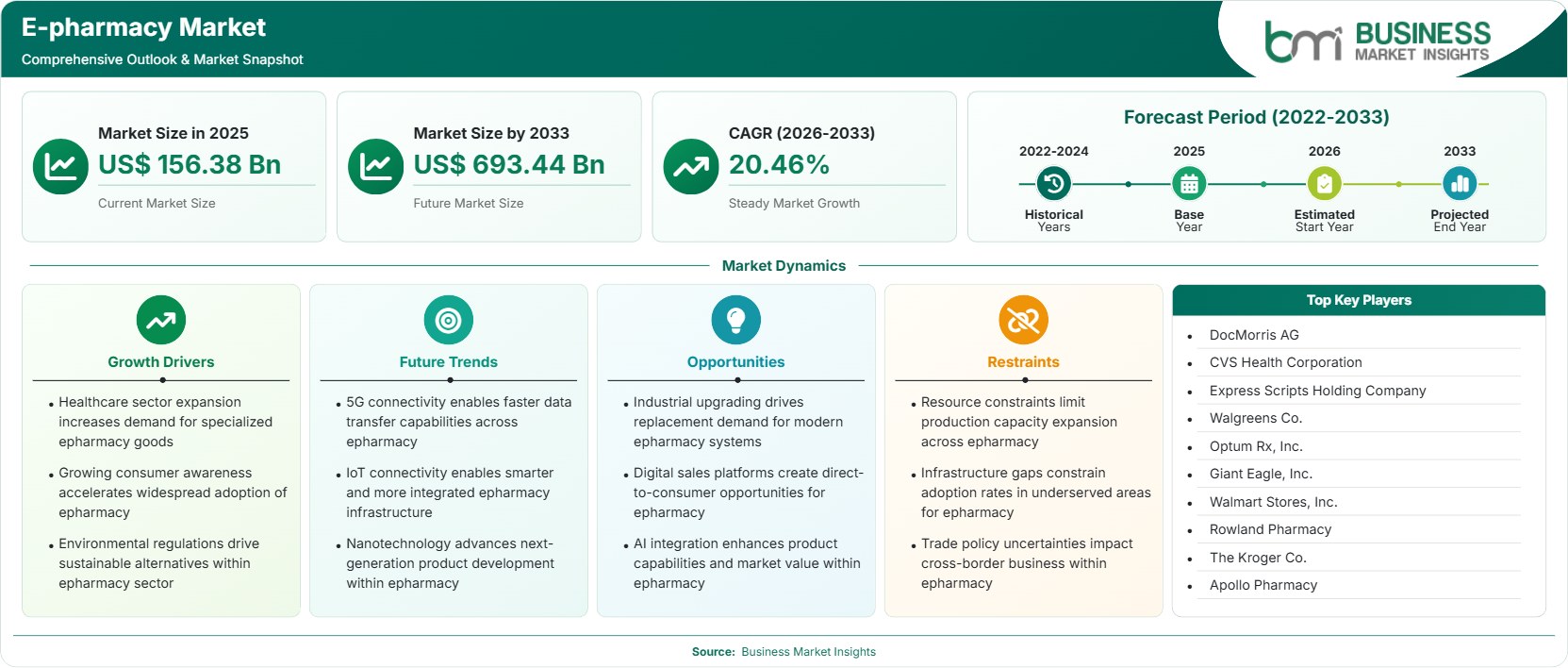
The E-Pharmacy Market size was valued at US$ 156.38 Billion in 2025 and is projected to reach US$ 693.44 Billion by 2033, growing at a CAGR of 20.46% during 2026–2033, supported by digital prescriptions, home delivery, chronic-care demand, telehealth integration, and personalized pharmacy services.

Report Coverage
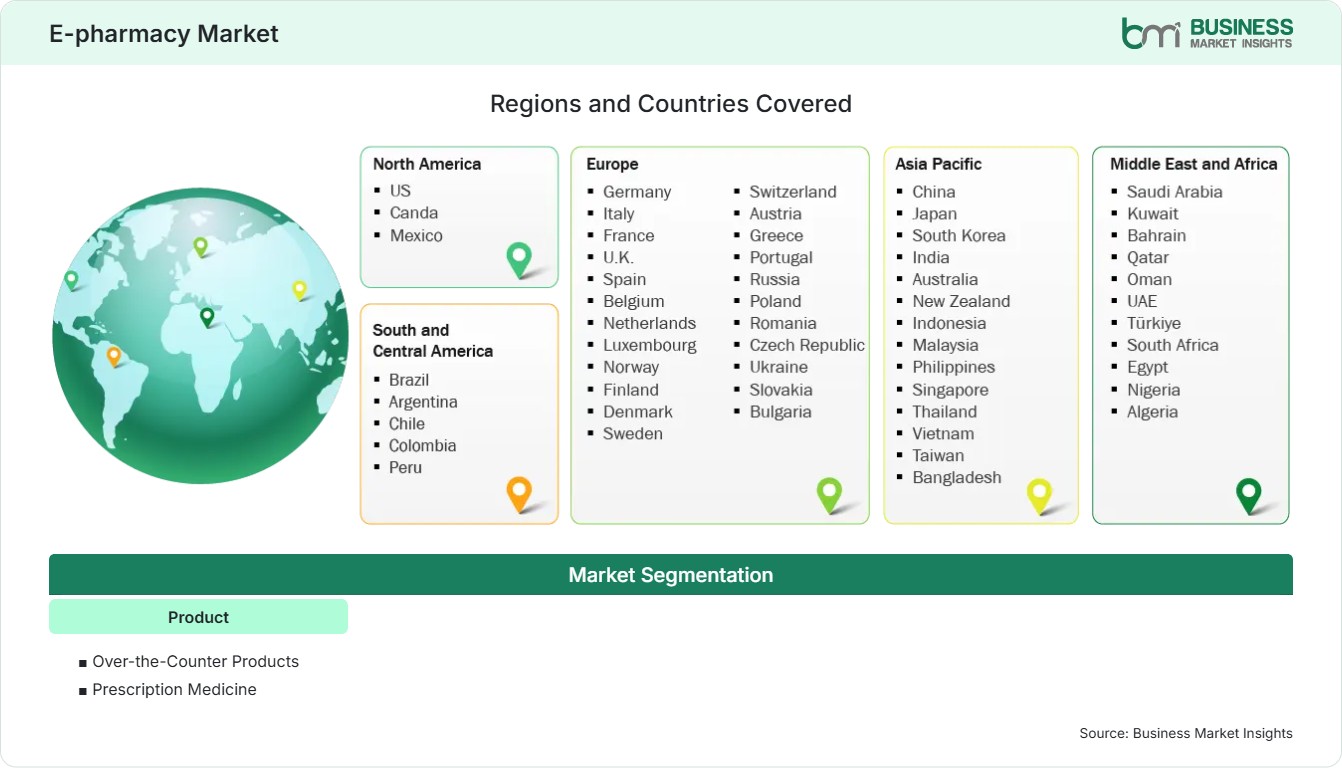
  • Product: Over-the-Counter Products, Prescription Medicine
US$ 156.38 Bn Market size in 2025
US$ 693.44 Bn Market Size by 2033
20.46% CAGR, 2026 - 2033
2026-2033 Forecast Period

01 AI Overview

E-pharmacy Market Summary

  • North America Region: North America E-Pharmacy Market share range 51%–55% (2025) , CAGR range 18%–20% (2026–2033) , key drivers and opportunities include established digital pharmacy infrastructure, prescription delivery, high healthcare spending, insurance integration, chronic disease management, and expanding specialty medicine fulfillment. The US market is driven by mature e-prescribing, home delivery, pharmacy benefit integration, and digital refill services, supporting a 18%–20% CAGR through 2033.
  • Fastest Growing Region: Asia Pacific , share range 17%–20% (2025) , CAGR range 23%–26% (2026–2033) , key drivers and opportunities include expanding smartphone penetration, urban healthcare access, digital payments, telemedicine adoption, online medicine ordering, improving logistics infrastructure, and increasing demand for affordable pharmaceutical products.
  • Leading Segment: Over-the-Counter Products , share range 62%–67% (2025) , CAGR range 19%–21% (2026–2033) , key drivers and opportunities include frequent consumer purchases, wellness demand, repeat ordering, broad product availability, price comparison, personalized recommendations, and integration with online retail ecosystems and subscription services.
  • High Growth Segment: Prescription Medicine , share range 33%–38% (2025) , CAGR range 21%–24% (2026–2033) , key drivers and opportunities include electronic prescriptions, chronic disease treatment, specialty medicines, remote consultations, automated refills, insurance-linked ordering, home delivery, adherence programs, and increasing patient preference for digitally coordinated healthcare.
  • Key Market Opportunity: The strongest opportunity lies in integrating pharmacy ordering, teleconsultation, electronic prescriptions, AI-supported medication guidance, insurance verification, refill automation, and temperature-controlled delivery into unified digital healthcare journeys.
  • Major Market Players: DocMorris AG, CVS Health Corporation, Express Scripts Holding Company, Walgreens Co., Optum Rx, Inc., Giant Eagle, Inc., Walmart Stores, Inc., Rowland Pharmacy, and The Kroger Co.
02 Strategic Insights

E-pharmacy Market: Strategic Insights

E-pharmacy Market Strategic Framework
FREE PDF
Request your free sample
Request free sample
03 Stakeholder View

Key Takeaways

  • E-Pharmacy Market value chain is moving from standalone online medicine retailers toward integrated ecosystems connecting manufacturers, wholesalers, pharmacies, payers, prescribers, logistics providers, digital health platforms, and consumers. Competitive advantage increasingly depends on coordinating these participants rather than simply offering an online storefront.
  • Growth opportunity insight: Prescription Medicine provides the strongest upside because chronic therapies, specialty medicines, recurring refills, and remote consultations create higher-frequency digital interactions. Platforms capable of coordinating prescription verification, insurance processing, clinical support, and delivery can capture greater lifetime customer value.
  • Innovation trend: AI is moving beyond recommendation engines into prescription interpretation, medication verification, workflow automation, personalization, and patient engagement. Optum reported AI-based pill validation performing more than 5 million checks monthly, demonstrating the operational relevance of artificial intelligence in pharmacy fulfillment.
  • The E-Pharmacy Market forecast suggest that the Asia Pacific provides the strongest expansion case because large populations, growing internet adoption, mobile payments, urbanization, and uneven physical pharmacy access create conditions for digital-first medication distribution and localized fulfillment networks.
  • Investment and M&A trend: Investment is increasingly directed toward platforms combining pharmacy with telemedicine, AI, healthcare navigation, and delivery rather than isolated e-commerce capabilities. DocMorris’s 2026 Google partnership illustrates this shift toward AI-powered digital health ecosystems.
  • Strategic insight: Temperature-controlled fulfillment, specialty medicines, GLP-1 therapies, and chronic-care subscriptions are emerging as high-value service categories where delivery reliability, clinical oversight, and patient support can differentiate providers.
04 Geographic Outlook

E-pharmacy Market Regional Highlights

North America E-Pharmacy Market

North America holds a 51%–55% share in 2025 and is projected to grow at an 18%–20% CAGR through 2033. Mature e-commerce infrastructure, widespread e-prescribing, insurance integration, pharmacy benefit management, and home delivery support adoption. The region also benefits from established consumer familiarity with digital refills. FDA safety guidance reinforces licensed online pharmacy models, strengthening compliant operators and increasing the value of traceable prescription fulfillment networks.

  • Increased prescription delivery occurs as big pharmaceutical companies use digital order placement along with the presence of local pharmacies, fulfillment centers, and automated alerts for people who require consistent access to medication.
  • Fulfillment processes are becoming more complicated due to the emergence of specialty medications that require temperature tracking, pharmacist involvement, security, adherence assistance, and delivery visibility during digital prescription journeys.
  • At present, the United States still is the main region that constitutes the E-Pharmacy Market since there are interconnected prescription ecosystems within pharmacy benefit managers, retail chains, insurance companies, and digital platforms for recurring orders.
  • Canada presents another market opportunity in terms of digital health adoption and remote access needs, especially for those who live outside large urban areas..

US E-Pharmacy Market

The US represents approximately 90%–96% of E-Pharmacy Market activity and is positioned for an 18%–20% CAGR through 2033. High prescription utilization, insurance-linked pharmacy benefits, established mail-order systems, and extensive retail pharmacy networks support digital adoption. CVS offers same-day or one-to-two-day prescription delivery, while Walmart integrates eligible medications into broader digital fulfillment.

  • Digital prescription management has emerged as a standard interface for consumers, and refill requests, delivery tracking, order notifications, family prescription management, and interactions with pharmacists are increasingly being handled via mobile applications.
  • The use of cold-chain delivery is increasing the range of addressable products, as in 2025, Walmart stated that more than 90% of prescriptions could be delivered directly to consumers including those that require refrigeration.
  • Pharmacy workflows using AI technology are enhancing patient safety and efficiency, such as CVS utilizing AI to interpret and standardize prescription instructions.

Europe E-Pharmacy Market

Europe accounts for a 22%–25% share in 2025 and is forecast to expand at a 19%–21% CAGR through 2033. Germany and the United Kingdom are leading E-Pharmacy Market, while France, Italy, Spain, and the Netherlands provide meaningful expansion potential. Germany is particularly relevant for digital prescription adoption and online pharmacy development. European regulation emphasizes authorization, verification, and consumer protection through the common online pharmacy logo.

  • Germany is one of the dominant nations because of robust online pharmacy activity, adoption of e-prescriptions, and consumer familiarity with remote medical purchase. DocMorris reported 33.2% growth in Rx revenue in 2025.
  • United Kingdom enjoys an advanced digital healthcare environment and robust consumer acceptance of online healthcare service utilization but with prescriptions dispensing being tightly linked to regulatory necessities.
  • France and the Netherlands are promising markets due to their developed healthcare systems, advanced internet usage, and need for convenience of medications purchasing and repeat-ordering.
  • Verification of EU allows consumers to distinguish licensed pharmacies from scammers, adding value to online platforms with proper licensing and supply chain credentials.

Asia Pacific E-pharmacy Market

Asia Pacific represents a 17%–20% share in 2025 and is the fastest-growing region, with a projected 23%–26% CAGR through 2033. China, Japan, India, Australia, and South Korea are leading digital-health markets, while India and Southeast Asia provide particularly strong expansion potential through mobile commerce and healthcare digitization.

  • China offers large-scale digital commerce capabilities, sophisticated logistics, and extensive smartphone adoption, enabling online pharmaceutical platforms to combine medicine ordering with health information and digital payment services.
  • India is a high-growth E-Pharmacy Market because e-pharmacy platforms can connect urban consumers with broad product portfolios while digital health infrastructure and online consultations support increasingly integrated care journeys.
  • Japan provides stable demand supported by an aging population, chronic disease management needs, high digital infrastructure quality, and consumer interest in convenient healthcare services.
  • Southeast Asian countries are developing attractive opportunities as smartphone-led commerce, telemedicine, and digital payment adoption lower barriers to online medicine purchasing and remote healthcare engagement.

Rest of World E-pharmacy Market

Rest of World represents approximately 3%–6% of global activity in 2025 and is projected to grow at an 18%–21% CAGR through 2033. South and Central America are supported by increasing internet adoption, urbanization, digital payments, and demand for convenient medicine access. Brazil and Mexico provide the strongest regional opportunities because of population scale and established digital commerce ecosystems.

Middle East and Africa offer developing opportunities through smartphone adoption, telemedicine, private healthcare investment, and improved logistics. The United Arab Emirates, Saudi Arabia, and South Africa are leading markets, while digitally underserved populations create longer-term potential for compliant online pharmacy models.

  • Brazil can support scalable digital pharmacy expansion through established e-commerce infrastructure, dense urban populations, and increasing consumer comfort with online healthcare transactions.
  • Mexico offers opportunities around digital ordering, chronic-care refills, and last-mile delivery, particularly in metropolitan areas where convenience and price transparency influence pharmacy selection.
  • Saudi Arabia and the UAE provide attractive investment environments because healthcare digitization, technology adoption, and private-sector modernization support online pharmacy development.
  • South Africa can benefit from digital medicine access models that reduce geographic barriers and connect consumers with licensed pharmacy services through mobile-first platforms.
Global Market Geography
FREE PDF
Request your free sample
Request free sample
05 Segment Analysis

E-pharmacy Market Segmentation

Product

The Product segment is divided between Over-the-Counter Products and Prescription Medicine. Over-the-Counter Products represented the leading category with a 62%–67% share in 2025 and is projected to grow at a 19%–21% CAGR during 2026–2033. Prescription Medicine holds a 33%–38% share and is forecast to grow at a faster 21%–24% CAGR as e-prescriptions, specialty medicines, chronic therapies, and remote consultations increase adoption. Industry estimates also identify OTC products as the leading product category, while prescription medicines show stronger growth momentum.

  • Over-the-Counter Products: Consumers increasingly purchase vitamins, wellness products, pain relief medicines, cold and flu remedies, and personal healthcare products online because digital channels enable convenience, comparison, recurring purchases, and doorstep fulfillment.
  • Prescription Medicine: Electronic prescriptions, chronic disease treatment, specialty therapies, remote consultations, automatic refills, insurance integration, and pharmacist support are expanding digital prescription fulfillment and strengthening recurring customer relationships.
06 Market Forces

E-pharmacy Market Dynamics

Key Market Drivers

Digital Prescription and Home Delivery Adoption

Digital prescriptions and delivery services are revolutionizing medicine buying by decreasing visits to the physical pharmacy and simplifying ongoing treatment. CVS provides customers with the opportunity to handle their prescriptions through technology and get their medicines delivered through same-day or one to two days service, while Optum offers electronic prescriptions, automatic refills, order tracking, and three months supply. The company Walmart has incorporated the prescription delivery process within its overall digital commerce system. These features will contribute directly to the business growth since they turn the pharmacy process into the recurring digital process. The E-pharmacy Market trend will benefit those companies offering prescription verification, inventory management, pharmacist assistance, delivery tracking, and secure packing.

AI-Enabled Pharmacy Operations and Personalization

AI has evolved from being a consumer-focused technology into a layer of operation for the digital pharmacy space. AI can be utilized in prescription interpretation, drug verification, forecast modeling, anti-fraud measures, product recommendations, refill reminders, customer service, and task prioritization. According to reports by Optum, their AI-powered pill authentication solution executes over 5 million checks per month, assisting pharmacists with drug verification. Additionally, CVS uses AI-powered prescription interpretation and standardization of instructions in pharmacy operations. This development increases efficiency while giving pharmacists time to focus on patient-centered tasks. As more and more transaction and engagement data is accumulated in these platforms, personalization will increase the efficacy of product discovery, adherence communications, refills, and therapy support without taking pharmacist intervention away from critical decisions. This is driving E-Pharmacy Market growth.

Chronic Disease and Specialty Medication Demand

Management of chronic conditions provides for a structurally appealing case for digital pharmacy due to the recurring need by the patients for refills, compliance management, clinical insights and delivery. Specialty drugs provide even more value as they could require temperature-controlled logistics, special handling, pharmacist counselling and scheduling of deliveries. The specialty and home delivery services provided by Optum provide an example of such a case, with its Charlotte site delivering more than 13 million prescriptions annually and complex drugs that require special handling. GLP-1 drugs will be creating yet another demand for digital pharmacies as they are combining drug access with digital health navigation and guidance services.

Key Market Opportunities

Integrated Telemedicine and Pharmacy Platforms

The combination of telemedicine and digital pharmacy opens the door to streamline the process of the healthcare experience from initial assessment to prescription dispensing and delivery. Virtual consultations, e-prescription, medication ordering, insurance verification, pharmacist counseling, and home delivery can be done via one platform. This has been achieved by DocMorris through its AI-based health platform that integrates symptom checker, telemedicine, pharmacies, and digital solutions. This type of technology would help increase the chances of converting healthcare consultations into prescriptions while offering other engagement channels for investors. This is especially relevant for areas with limited physical pharmacy presence and increasing adoption of mobile healthcare solutions.

Specialty and Temperature-Controlled Delivery

Temperature-controlled logistics provide an attractive opportunity because specialty medicines and biologics require more sophisticated fulfillment than standard parcel delivery. Walmart expanded delivery in 2025 to include refrigerated and reconstituted prescriptions and reported that refrigerated medications represented more than 30% of its pharmacy sales. This demonstrates how cold-chain capabilities can enlarge the digital pharmacy product portfolio while improving convenience for patients requiring insulin and other temperature-sensitive therapies. Investment opportunities extend across insulated packaging, temperature monitoring, route optimization, delivery authentication, pharmacy automation, and real-time tracking. Providers that establish reliable cold-chain networks can differentiate beyond price and delivery speed, while pharmaceutical manufacturers can use these networks to strengthen direct patient access and treatment-support programs.

Emerging-Market Digital Pharmacy Expansion

Emerging markets offer a long-term E-Pharmacy Market growth opportunity because online pharmacy platforms can scale faster than conventional physical networks in regions with rising smartphone use and uneven healthcare access. Asia Pacific is positioned for the highest regional growth range of 23%–26%, supported by digital commerce, telemedicine, mobile payments, and expanding logistics capabilities. Platforms can localize inventory, payment options, language interfaces, delivery models, and pharmacist access according to national requirements. Partnerships with licensed pharmacies and healthcare providers can reduce regulatory risk while enabling asset-light geographic expansion. Investors should prioritize businesses that demonstrate strong repeat purchasing, reliable last-mile delivery, regulatory compliance, and positive unit economics rather than relying solely on customer acquisition growth.

Market Restraints and Challenges

Regulatory Fragmentation and Prescription Controls

Factor: Online medicine distribution is governed by different prescription, licensing, advertising, data protection, dispensing, and delivery rules across jurisdictions. The European Union allows member states to impose specific conditions on online medicine sales, including restrictions on prescription medicines, while the United States requires consumers to verify licensed online pharmacies and prescription requirements. Impact: Compliance increases technology, legal, pharmacist, and operational costs and can slow geographic expansion. FDA warns that only a small proportion of active online pharmacy websites comply with US pharmacy laws and practice standards. Platforms therefore require robust verification, pharmacist oversight, secure data systems, and jurisdiction-specific compliance processes before scaling.

Counterfeit Medicines and Consumer Trust Risk

Factor: Unauthorized online sellers, counterfeit products, misleading websites, and inadequate storage conditions can undermine consumer confidence in digital medicine purchasing. WHO reports that more than one in ten medicines in low- and middle-income countries are estimated to be substandard or falsified, while FDA continues to issue warning letters against unsafe online pharmacy operators. Impact: Legitimate platforms must invest in authentication, traceability, secure packaging, supplier verification, pharmacist access, and consumer education. These requirements increase operating complexity but also raise the competitive importance of trusted brands. The challenge is especially relevant as cross-border e-commerce and social media make unauthorized medicine promotion easier to distribute.

07 Company Analysis

Competitive Landscape

The E-pharmacy Market analysis indicates that competition is shifting toward integrated pharmacy ecosystems, combining digital ordering with prescription management, payer relationships, physical pharmacy networks, telemedicine, specialty fulfillment, and last-mile logistics.

Company Name

Overview

Products and Services relevant to this market

DocMorris AG

European digital pharmacy and health platform combining online pharmacy, telemedicine, and digital health capabilities.

Prescription medicines, OTC products, online pharmacy services, telemedicine, digital health support, and AI-enabled patient journeys.

CVS Health Corporation

Integrated US healthcare company with retail pharmacy, pharmacy benefit management, specialty pharmacy, and digital prescription services.

Prescription delivery, OTC products, mail-order pharmacy, specialty medicines, digital refills, pharmacy benefit services, and patient support.

Express Scripts Holding Company

Large pharmacy benefit management organization serving prescription plan members through integrated pharmacy services.

Mail-order pharmacy, prescription fulfillment, pharmacy benefit management, medication access, and digital prescription management.

Walgreens Co.

Major US pharmacy operator combining retail pharmacy infrastructure with digital ordering and prescription fulfillment capabilities.

Prescription medicines, OTC products, online refills, delivery, pharmacy services, and digital health engagement.

Optum Rx, Inc.

Pharmacy care services company integrating home delivery, specialty pharmacy, digital tools, and pharmacy benefit capabilities.

Home delivery, specialty medicines, prescription management, automatic refills, digital tools, pharmacist support, and medication tracking.

Giant Eagle, Inc.

Regional retailer operating pharmacy services supported by store infrastructure and digital customer engagement.

Prescription medicines, OTC products, pharmacy services, refills, health products, and delivery-oriented digital ordering.

Walmart Stores, Inc.

Large retail and pharmacy operator using extensive store infrastructure to support digitally coordinated medicine delivery.

Prescription medicines, OTC products, same-day delivery, refrigerated medicines, refills, pharmacy services, and digital ordering.

Rowland Pharmacy

Community pharmacy operator providing medication access and pharmacy services through established local healthcare relationships.

Prescription medicines, OTC products, pharmacy dispensing, health advice, repeat prescriptions, and customer-focused pharmacy services.

The Kroger Co.

Large US retailer with pharmacy operations integrated into grocery, digital commerce, and customer loyalty infrastructure.

Prescription medicines, OTC products, refills, pharmacy services, health products, and digital customer engagement.

10 Trust & Transparency

Research Methodology

The market analysis combines proprietary research with secondary data from government agencies, company disclosures, regulatory filings, industry databases and expert interviews. Market estimates are validated through data triangulation, cross-market benchmarking and analyst review.

View Full Research Methodology

11 Questions Answered

Frequently Asked Questions

What should investors examine when evaluating an online pharmacy business?

Investors should assess repeat purchase rates, prescription mix, customer acquisition costs, fulfillment economics, delivery density, regulatory exposure, pharmacist capacity, technology scalability, specialty medicine capabilities, and the strength of relationships with payers and healthcare providers.

How can online pharmacies build consumer trust?

Trust depends on pharmacy licensing, prescription controls, verified suppliers, secure packaging, pharmacist access, transparent policies, and traceable fulfillment. Regulatory verification tools such as the EU common logo also help consumers identify legitimate online pharmacy providers.

Why are cold-chain capabilities becoming strategically important?

More specialty medicines and biologics require controlled temperatures during transportation. Reliable cold-chain infrastructure allows digital pharmacies to expand beyond conventional medicines while improving access to insulin, GLP-1 therapies, and other temperature-sensitive treatments.

What role does AI play in online pharmacy operations?

AI can assist with prescription interpretation, pill verification, inventory planning, customer service, personalization, fraud detection, and workflow automation. The strongest commercial applications combine AI with pharmacist oversight rather than replacing clinical judgment.

What are driving factor in E-Pharmacy Market report?

Recurring prescriptions, home delivery, automated refills, order tracking, and pharmacist access reduce the effort required to maintain treatment routines. These features are particularly valuable for patients managing multiple medications or conditions requiring long-term therapy.

Access the Full E-pharmacy Market Report

Get segment-level forecasts, regional estimates, competitive benchmarking, company profiles and downloadable Excel datasets.

Access the full E-pharmacy Market Report
350 pages PDF & Excel | 2026-08-26