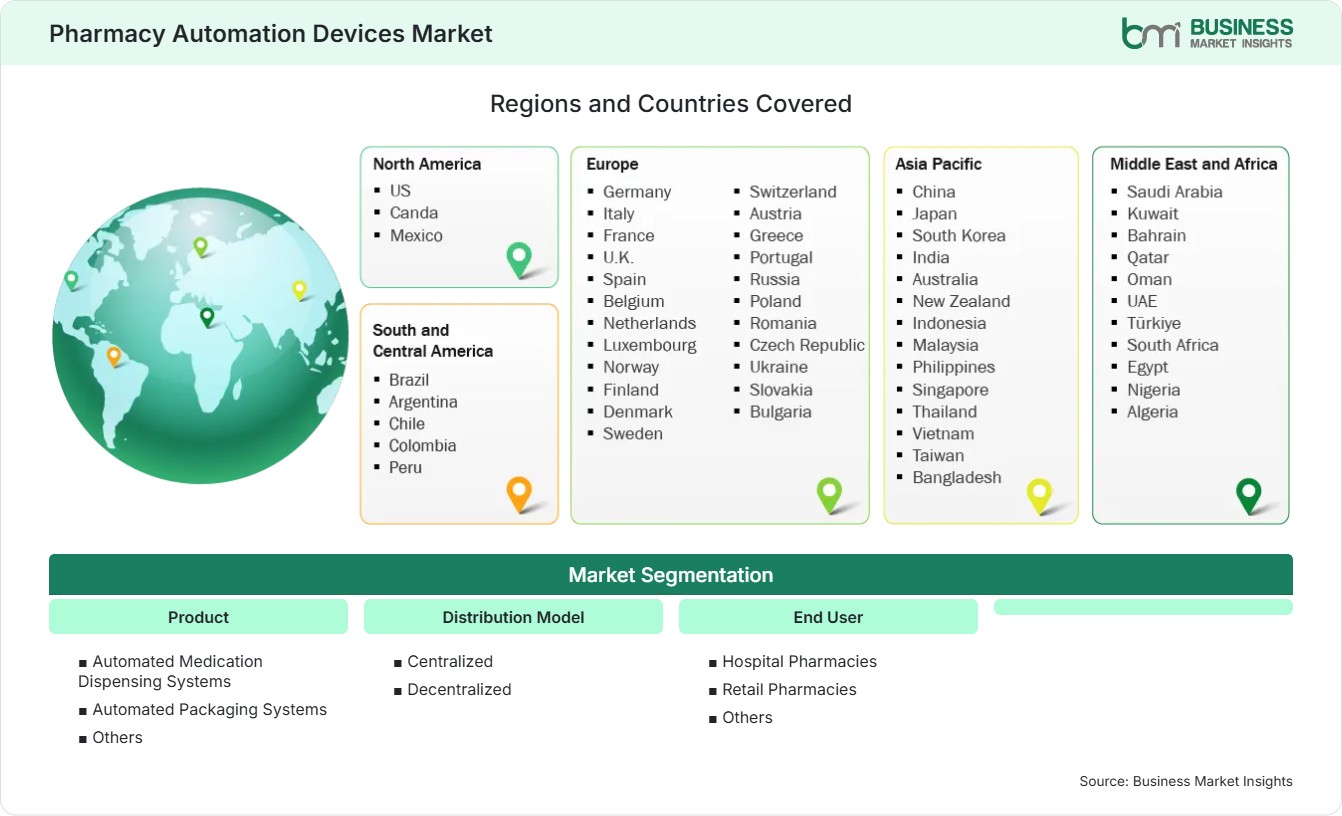
Pharmacy Automation Devices Market Regional Highlights
North America Pharmacy Automation Devices Market
North America accounts for 39%–42% share in 2025, expanding at a CAGR of 11.8%–12.3%. The pharmacy automation devices market share remains dominant due to advanced healthcare infrastructure, widespread adoption of automation technologies, and strong investments in medication safety initiatives. Growing demand for efficient pharmacy operations and regulatory compliance continues supporting deployment across hospitals, retail pharmacies, and long-term care facilities.
- Strong reimbursement systems and increasing healthcare investments enable hospitals to implement advanced pharmacy automation solutions, improving medication accuracy, operational efficiency, and patient safety while reducing dispensing-related errors.
- Large integrated healthcare networks continue investing in centralized pharmacy automation platforms to streamline prescription management, inventory control, and medication distribution across multiple healthcare facilities.
- Technological innovation in robotics, artificial intelligence, and barcode verification systems enables continuous improvements in pharmacy workflow automation and compliance with stringent healthcare regulations.
- Growing emphasis on minimizing medication errors and optimizing workforce productivity encourages healthcare providers to replace manual dispensing processes with automated pharmacy solutions.
US Pharmacy Automation Devices Market
The US holds 31%–34% share in 2025, growing at a CAGR of 12.0%–12.5%. The pharmacy automation devices market growth is supported by advanced hospital infrastructure, increasing prescription volumes, widespread healthcare digitization, and continuous investment in intelligent medication management technologies across healthcare organizations.
- Large hospital systems continue implementing fully integrated pharmacy automation platforms to improve dispensing accuracy, inventory visibility, and medication traceability across inpatient and outpatient settings.
- Increasing adoption of electronic health records and digital pharmacy management software strengthens interoperability between automated dispensing systems and hospital information infrastructure.
- Rising healthcare labor shortages encourage hospitals to automate repetitive pharmacy workflows, allowing pharmacists to focus on patient-centered clinical services.
- Continuous product innovation by domestic and international manufacturers strengthens the availability of advanced pharmacy automation technologies throughout the United States.
Europe Pharmacy Automation Devices Market
Europe captures 26%–29% share in 2025, expanding at a CAGR of 11.4%–11.9%. The pharmacy automation devices market share is supported by mature healthcare systems, increasing investment in digital hospitals, and stringent medication safety regulations. Germany and the UK lead regional adoption, while Eastern Europe demonstrates faster expansion with a CAGR of 12.2%–12.8% due to healthcare infrastructure modernization and growing pharmaceutical automation investments.
- Strong regulatory frameworks across the European Union encourage hospitals and pharmacies to adopt automated medication dispensing systems that improve patient safety, operational efficiency, and compliance with pharmaceutical quality standards.
- Germany remains the leading regional market owing to advanced healthcare infrastructure, widespread implementation of hospital automation, and increasing investment in intelligent pharmacy management technologies.
- The UK continues expanding pharmacy automation through digital healthcare initiatives, centralized medication management, and growing deployment of robotic dispensing systems across NHS facilities.
- Eastern European countries are witnessing accelerated growth driven by healthcare modernization programs, increasing pharmaceutical investments, and expanding adoption of automated pharmacy solutions.
Asia Pacific Pharmacy Automation Devices Market
Asia Pacific accounts for 24%–27% share in 2025 and is projected to grow at a CAGR of 13.8%–14.4%. The pharmacy automation devices market growth is fueled by expanding healthcare infrastructure, increasing pharmaceutical production, rising prescription volumes, and government initiatives promoting hospital digitalization across China, India, Japan, and Southeast Asia.
- China leads regional revenue generation through rapid hospital expansion, increasing healthcare expenditure, and widespread investment in pharmacy automation technologies to improve operational efficiency.
- India records the fastest regional growth with a CAGR of 14.5%–15.1%, supported by expanding private healthcare networks, increasing digital health adoption, and modernization of hospital pharmacy operations.
- Japan continues adopting highly advanced robotic dispensing and automated medication storage systems to address workforce shortages and improve medication accuracy.
- Growing pharmaceutical manufacturing activities and healthcare infrastructure investments across Southeast Asia continue creating favorable opportunities for automation solution providers.
Rest of World Pharmacy Automation Devices Market
Rest of World represents 8%–10% share in 2025, growing at a CAGR of 12.0%–12.6%. South & Central America and the Middle East & Africa continue expanding steadily due to improving healthcare infrastructure, rising pharmaceutical investments, and increasing awareness regarding medication safety and digital pharmacy operations.
Brazil remains the leading South American market, while Saudi Arabia demonstrates the fastest regional growth through substantial healthcare modernization initiatives and smart hospital investments.
- Increasing government investment in healthcare infrastructure across the Middle East supports wider deployment of automated pharmacy technologies in hospitals and specialty healthcare facilities.
- Brazil leads regional adoption owing to expanding hospital networks, increasing pharmaceutical consumption, and growing investment in healthcare digital transformation.
- Private healthcare providers across developing economies are increasingly implementing pharmacy automation systems to improve workflow efficiency, reduce medication errors, and enhance patient safety.
- Growing awareness regarding intelligent medication management and hospital automation continues supporting long-term market penetration across emerging healthcare systems.