
Insulin Market Outlook: Size, Share, Trends, Growth Analysis, Competitive Landscape & Forecast, 2026-2033

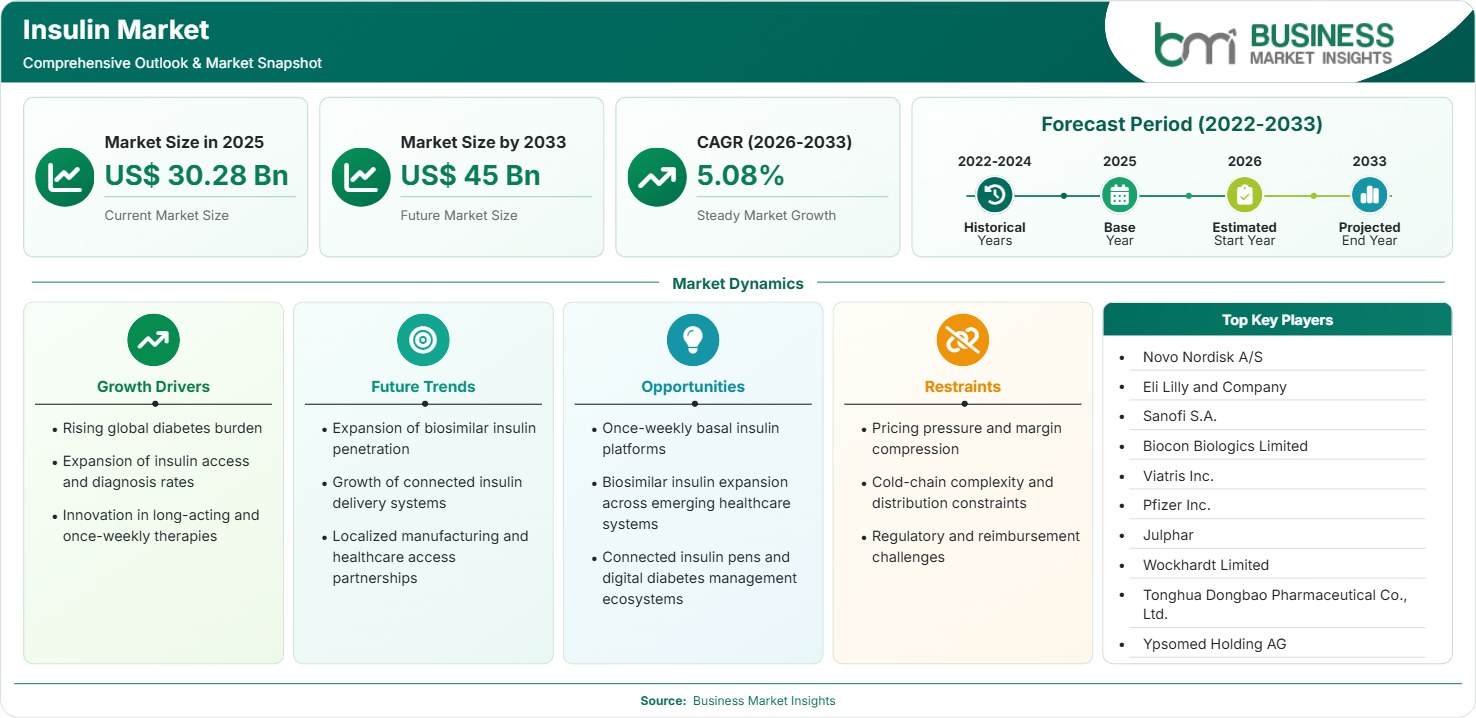
The Insulin Market size was valued at US$ 30.28 Billion in 2025 and is projected to reach US$ 45 Billion by 2033, growing at a CAGR of 5.08% during 2026–2033. Rising diabetes prevalence, expanding access programs, biosimilar adoption, advanced delivery systems, and next-generation long-acting formulations continue creating substantial revenue opportunities across developed and emerging healthcare markets.

Report Coverage
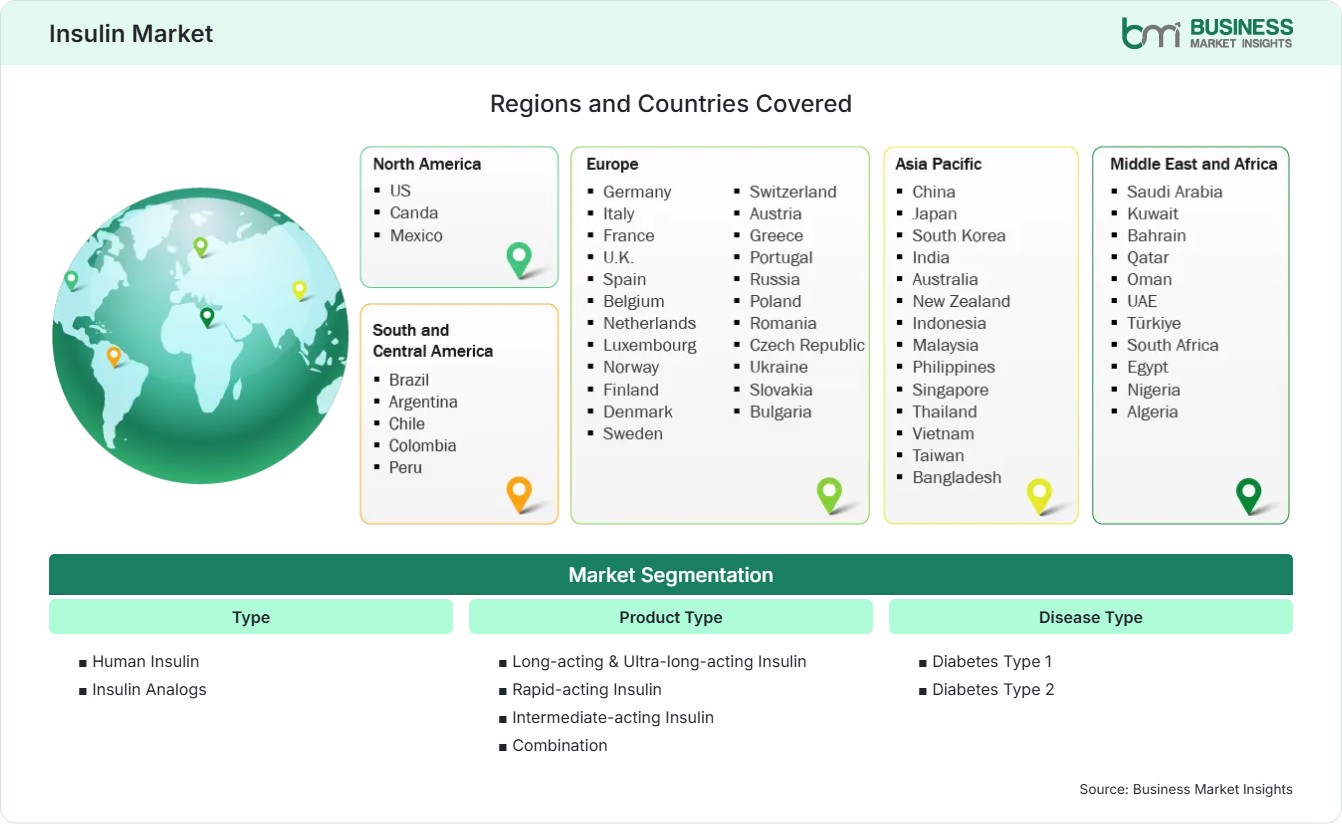
  • Type: Human Insulin, Insulin Analogs
  • Product Type: Long-acting & Ultra-long-acting Insulin, Rapid-acting Insulin, Intermediate-acting Insulin, Combination
  • Disease Type: Diabetes Type 1, Diabetes Type 2
US$ 30.28 Bn Market size in 2025
US$ 45 Bn Market Size by 2033
5.08% CAGR, 2026 - 2033
2026-2033 Forecast Period

AI Overview

Insulin Market Summary

  • North America Region: Holds a market share of 35%–38% in 2025, growing at a CAGR of 4.2%–4.8% during 2026–2033. Growth is supported by high insulin utilization, reimbursement coverage, premium analog products, expanding diabetes burden, increasing biosimilar penetration, improved patient monitoring technologies, and integrated diabetes management programs. US market benefits from broad innovation pipelines, payer reforms, and a CAGR of 4.3%–4.9%.
  • Fastest Growing Region: Asia Pacific accounts for 24%–27% share in 2025 and advances at 6.1%–6.8% CAGR. Urbanization, increasing diabetes diagnosis, public healthcare investments, domestic manufacturing expansion, wider insurance coverage, digital health adoption, and affordability initiatives support strong regional demand growth.
  • Leading Segment: Long-acting & Ultra-long-acting Insulin represents 31%–34% share in 2025 and grows at 5.0%–5.6% CAGR. Demand is driven by convenient dosing schedules, superior glycemic control, physician preference, adherence improvements, expanding adult diabetes populations, and ongoing formulation innovation.
  • High Growth Segment: Biosimilar insulin products account for 17%–20% share in 2025 and record 7.0%–7.8% CAGR. Increased affordability, government procurement programs, regulatory support, healthcare cost pressures, emerging-market access initiatives, and competitive pricing accelerate adoption globally.
  • Key Market Opportunity: Once-weekly insulin formulations, connected delivery devices, biosimilar expansion, and untapped populations in middle-income economies are creating new pathways for treatment accessibility, adherence improvement, healthcare efficiency, and long-term manufacturer differentiation.
  • Major Market Players: Novo Nordisk A/S, Eli Lilly and Company, Sanofi S.A., Biocon Biologics Limited, Viatris Inc., Pfizer Inc., Julphar, Wockhardt Limited, Tonghua Dongbao Pharmaceutical Co., Ltd., and Ypsomed Holding AG.
Strategic Insights

Insulin Market: Strategic Insights

Insulin Market Strategic Framework
FREE PDF
Request your free sample
Request free sample
Stakeholder View

Key Takeaways

  • The industry remains concentrated around a small group of multinational manufacturers controlling advanced biologics production, global distribution networks, and premium analog portfolios.
  • Biosimilar expansion and underserved patients across emerging economies represent the strongest commercial upside, particularly where diabetes diagnosis rates continue improving.
  • Innovation is shifting toward ultra-long-acting therapies, once-weekly formulations, connected pens, and integrated digital management platforms.
  • Asia Pacific offers an attractive investment case due to rapid patient growth, healthcare modernization, and rising reimbursement coverage in China and India.
  • Strategic licensing agreements, manufacturing partnerships, and regional capacity expansion programs are increasingly shaping competitive positioning.
  • Value-based healthcare models are encouraging manufacturers to demonstrate treatment outcomes alongside product affordability and accessibility.
Geographic Outlook

Insulin Market Regional Highlights

North America Insulin Market

North America accounted for 35%–38% of Insulin Market share in 2025 and is projected to expand at 4.2%–4.8% CAGR through 2033. Strong reimbursement systems, extensive adoption of analog therapies, and high diabetes prevalence sustain demand. The region benefits from advanced healthcare infrastructure and widespread use of glucose monitoring technologies. Pricing reforms and biosimilar availability are improving patient access while supporting competitive dynamics. Research investments and commercialization of next-generation basal formulations continue strengthening regional leadership.

  • High penetration of premium analog products supports revenue generation despite pricing pressures.
  • Integration of continuous glucose monitoring enhances treatment optimization and long-term disease management.
  • Biosimilar adoption accelerates through formulary inclusion and payer-driven affordability strategies.
  • Major manufacturers maintain strong clinical development pipelines targeting reduced dosing frequency.
  • Expanding obesity prevalence contributes to growing insulin utilization requirements.

US Insulin Market

The United States represents approximately 78%–82% of North American revenue and is expected to achieve 4.3%–4.9% CAGR. Strong innovation ecosystems, biosimilar competition, and reimbursement modernization support market development. Commercial availability of next-generation insulin formulations improves treatment convenience. Healthcare providers increasingly deploy digital diabetes management tools, supporting adherence and outcome improvement. Large patient pools and advanced specialty pharmacy networks reinforce the country's strategic importance.

  • FDA support for innovative biologics strengthens commercialization opportunities.
  • Growth of value-based reimbursement encourages outcome-focused treatment approaches.
  • Rising adoption of connected insulin delivery systems improves therapy management.
  • Significant investment in diabetes care infrastructure supports continued demand expansion.

Europe Insulin Market

Europe maintained 27%–30% market share in 2025 and is forecast to grow at 4.6%–5.2% CAGR. Comprehensive healthcare coverage, strong biosimilar acceptance, and organized diabetes management programs support market stability. Germany remains the leading country, while Eastern European markets demonstrate comparatively stronger expansion. Regulatory frameworks encourage competition and affordability while maintaining quality standards. Public spending on chronic disease management sustains treatment demand across the region.

  • Germany leads regional revenue generation through broad treatment access.
  • Poland and Romania rank among faster-growing markets with CAGR exceeding regional averages.
  • Biosimilars gain acceptance through national procurement and reimbursement programs.
  • Digital health integration strengthens patient monitoring and therapy optimization.
  • Aging populations support continued insulin demand growth.

Asia Pacific Insulin Market

Asia Pacific held 24%–27% share in 2025 and represents the fastest-growing region with 6.1%–6.8% CAGR. The combination of large diabetic populations, urbanization, and improving healthcare infrastructure supports sustained expansion. China remains the dominant market, while India records among the strongest growth rates. Domestic manufacturing capabilities and government access initiatives improve affordability. Expanding insurance programs and patient awareness campaigns strengthen long-term demand fundamentals.

  • China benefits from large-scale procurement and expanding diabetes diagnosis rates.
  • India demonstrates robust growth supported by healthcare access improvements.
  • Regional manufacturers enhance supply security and cost competitiveness.
  • Digital healthcare adoption accelerates disease monitoring and therapy compliance.
  • Public health initiatives promote earlier diagnosis and treatment intervention.

Rest of World Insulin Market

Rest of World contributes 10%–13% Insulin Market share in 2025 and is anticipated to grow at 5.4%–6.0% CAGR. South and Central America benefit from increasing healthcare expenditure and broader treatment access. In the Middle East and Africa, rising diabetes prevalence and government awareness initiatives support demand growth. Brazil leads regional revenue generation, while Saudi Arabia and the United Arab Emirates record notable momentum. Access expansion remains a central development theme.

  • Brazil remains the largest market through structured public procurement.
  • Gulf countries invest heavily in diabetes management infrastructure.
  • Affordability programs enhance patient access across developing economies.
  • International partnerships support supply-chain development and product availability.
  • Increasing disease awareness contributes to treatment uptake.
Global Market Geography
FREE PDF
Request your free sample
Request free sample
Segment Analysis

Insulin Market Segmentation

Type

Human Insulin accounts for approximately 28%–31% share, while Insulin Analogs dominate adoption. This segment advances at 4.8%–5.4% CAGR as healthcare systems increasingly prioritize efficacy, adherence, and patient convenience. The Insulin Market size continues expanding through broad utilization across diabetes management pathways and growing access in emerging economies.

  • Human Insulin: Cost-effective therapy widely used in price-sensitive markets and public healthcare programs.
  • Insulin Analogs: Advanced formulations offering improved pharmacokinetics, flexibility, and glycemic control.

Product Type

The product landscape is led by Long-acting & Ultra-long-acting Insulin with 31%–34% share and 5.0%–5.6% CAGR. Adoption increases as physicians seek improved treatment adherence and reduced administration burden. The Insulin Market scope continues broadening through innovation across basal and prandial therapies.

  • Long-acting & Ultra-long-acting Insulin: Strong demand driven by stable glucose management and patient convenience.
  • Rapid-acting Insulin: Essential in mealtime glucose control and intensive treatment regimens.
  • Intermediate-acting Insulin: Maintains relevance in selected treatment protocols and cost-focused settings.
  • Combination: Supports comprehensive glycemic management through simplified dosing schedules.

Drug Type

Branded products continue generating major revenues, while biosimilars represent the fastest-growing category with 17%–20% Insulin Market share and 7.0%–7.8% CAGR. Cost-efficiency objectives, reimbursement reforms, and competition strengthen segment expansion.

  • Branded: Supported by innovation pipelines, physician familiarity, and premium product positioning.
  • Biosimilar: Gains momentum through affordability advantages and regulatory encouragement.

Disease Type

Type 2 diabetes represents the largest demand base because of its significantly higher patient population globally. Rising obesity rates and sedentary lifestyles continue supporting segment expansion through 2033.

  • Diabetes Type 1: Lifelong insulin dependence sustains consistent treatment demand.
  • Diabetes Type 2: Large patient pool drives volume consumption and commercial opportunities.

Age Group

Adults constitute the dominant user group, reflecting disease prevalence patterns and aging populations. Expanding access to advanced therapies contributes to positive demand trends worldwide.

  • Pediatrics: Requires precision dosing and specialized clinical management approaches.
  • Adults: Benefits from broad therapy availability and increasing diagnosis rates.

Route of Administration

Subcutaneous administration remains the industry standard because of effectiveness, familiarity, and extensive product availability. Emerging alternatives are improving patient choice and convenience.

  • Subcutaneous: Dominant administration route across healthcare settings globally.
  • Inhaled: Supports needle-free treatment preferences and differentiated therapy offerings.

Distribution Channel

Retail pharmacies remain the primary channel due to accessibility and recurring prescription fulfillment. E-commerce growth is gradually transforming patient purchasing behavior.

  • Hospital Pharmacies: Important for acute care, initiation, and specialist supervision.
  • Retail Pharmacies & Drug Stores: Largest channel supported by extensive distribution networks.
  • Online Pharmacies: Expanding through convenience, digital prescriptions, and home delivery.
Market Forces

Insulin Market Dynamics

Key Market Drivers

Rising Global Diabetes Burden

According to the International Diabetes Federation, more than 500 million adults live with diabetes, creating substantial treatment demand. Expanding diagnosis rates and longer patient survival increase therapy duration. Emerging economies are witnessing sharp growth in Type 2 diabetes linked to urbanization and obesity. These are factors that directly influence the continued use of insulin on a sustained basis. The health care system remains focused on diabetes management due to the increased risk of complications such as heart disease, kidney disease, and eye problems associated with the untreated disease. Increased medical attention and earlier detection contribute to the continued enrollment of patients in the treatment process. Furthermore, greater availability of testing for diabetes means that more people are being detected early enough and require treatment.

Innovation in Long-Acting and Once-Weekly Therapies

Advanced formulations are being introduced that aim to ensure adherence and stabilize glycemic levels. Longer duration therapy means lower injection times and convenience for patients. The current development projects concentrate on enhancing the duration of pharmacologic action. These innovations improve healthcare outcomes and strengthen premium product demand. The industry continues to move towards differentiation of biologics that add value to the products, rather than just relying on pricing competitiveness. Continued research investments continue to be an important component of commercialization. In addition to this, the pharmaceutical companies have also been looking at developing formulations that can deliver better glucose control and lower the frequency of the treatments administered to the patients. With increasing focus on patient convenience by the healthcare practitioners, it is possible that there will be wider acceptance of long acting and once a week insulin formulations.

Expansion of Digital Diabetes Management Ecosystems

The connected pens, glucose monitors, and analytical platforms contribute to improved treatment optimization. Doctors today make more use of the information from real-time monitoring when making their dosing decisions. These devices help patients adhere to treatments better and lower the risk of complications. Improved interoperability of monitoring systems and insulin delivery devices contributes to better engagement of patients. There are also new opportunities for developing treatment based on outcomes, which contributes to healthcare efficiency. This trend contributes to sustainable demand growth for such innovations around the world. Moreover, mobile apps and cloud computing platforms help patients and healthcare providers to better analyze the information about treatments and detect trends in glucose patterns. This will enable a more rapid reaction and enhanced communication between the patient and the treatment team. With the growing availability and affordability of such connected devices, their implementation into insulin treatment programs is expected to be more widespread.

Key Market Opportunities

Biosimilar Penetration Across Emerging Healthcare Systems

Due to rising costs of healthcare, there is more pressure on governments and insurance providers to use less expensive biological drugs. Biosimilars allow for increased access at the same level of quality in terms of treatment. Manufacturers capable of combining affordability with scalable production capacity are positioned favorably. Insulin Market Forecasts indicate promising growth prospects in areas where there is growth in terms of reimbursement coverage and underdiagnosis of diabetes. Growth opportunities are especially pronounced in regions such as Asia, Latin America, and Africa. The usage of biosimilar insulin may allow healthcare systems to cope with rising costs of treatments as the number of diabetics rises. The existence of regulatory environments that facilitate biosimilar approval and physician acceptance may speed up adoption further. Companies that succeed in building strong local distribution channels and maintaining high standards of quality of their products can enhance their market positions.

Expansion of Once-Weekly Basal Insulin Platforms

Future once-weekly products hold promise in changing the adherence paradigm for the better. Lower burden of injections may positively impact patient compliance and effectiveness. Companies that innovate in this platform may create competitive differentiation for themselves. Future Insulin Market Trends show that regulatory backing of innovative drugs and positive physician attitudes would positively influence business opportunities. If market penetration were successful, the protocols used for therapy would change, and premium pricing strategies would be implemented in many healthcare systems. This type of therapy would benefit those patients who struggle to inject themselves each day. Fewer injections would make it easier for patients to follow the treatment protocol. As the evidence keeps being gathered and analyzed, healthcare providers would evaluate these drugs depending on their effectiveness, safety, convenience, and value in comparison to traditional insulin treatments.

Localized Manufacturing and Access Partnerships

Governments are now increasingly focused on pharmaceutical self-reliance and the strength of their supply chains. There are possibilities of technology transfer and licensing deals arising from local production programs. Pharmaceutical manufacturers have improved their market access and logistics costs. Public procurement programs often favor domestic availability, creating additional commercial advantages. Early investment in manufacturing in regional areas can position the company better with greater patient coverage. Manufacturers will also find it easier to adapt their products based on shifts in regional demand and not rely on foreign supply chains. Collaboration with local pharmaceutical firms, health institutions, and government entities will facilitate greater distribution and access to regulations. In developing nations, such cooperation can prove to be highly useful in serving those patients who lack access to the necessary insulin products. As countries try to strengthen their supply chains, the company can enjoy a competitive edge by adopting its manufacturing and collaboration policies.

Market Restraints and Challenges

Pricing Pressure and Margin Compression

Factor: Price reforms, bidding system, reimbursements, and stiff competition from biosimilars are creating consistent pressures that affect the amount of money that companies can make per unit. Healthcare systems are negotiating aggressively with the suppliers in order to cut down costs, while the government is striving to provide insulin in an accessible way. The combination of such factors can affect the flexibility of pricing for manufacturers.

Impact: The effects of persistent cost pressures could translate into margin squeeze and reduce the capital that can be utilized for research, development of new products, expansion of manufacturing plants and other such strategic investments. While low prices could help in ensuring affordability of treatments, the manufacturers would need to find a balance between affordability concerns and the need to sustain their commercial viability. This is especially true in mature markets where healthcare systems have focused on wider availability of treatments without significantly enhancing costs.

Cold-Chain Complexity and Distribution Constraints

Factor: Control over the temperature of insulin preparations is important through the entire process of storing, transporting, and distributing in order to ensure that the quality of the preparation remains high. Controlling the appropriate cold chain can be particularly difficult in areas where there are poor logistical capabilities, electricity supplies, refrigeration equipment, and transport links.

Impact: The constraints associated with the cold chain are capable of causing increased costs, supply disruptions, and inventory losses because of improper storage conditions. This makes it difficult for the market penetration process to happen among populations that lack the required refrigeration and logistical support. Constant efforts have to be made by the manufacturers and distributors, including the health care providers, towards investment in refrigeration, temperature monitoring, power backups, and logistics. The infrastructure deficit is a major barrier to insulin access and market growth in some emerging markets.

Company Analysis

Competitive Landscape

The competitive environment remains concentrated among multinational innovators and emerging biosimilar developers. This Insulin Market analysis highlights key participants shaping product development, manufacturing expansion, and geographic reach.

Company Name

Overview

Products and Services relevant to this market

Novo Nordisk A/S

Global diabetes care leader with extensive insulin portfolio and strong innovation pipeline.

Basal insulin, rapid-acting insulin, analog products, delivery devices, diabetes care solutions.

Eli Lilly and Company

Major insulin innovator with worldwide commercial presence and advanced biologics capabilities.

Humalog, basal insulin products, diabetes therapies, patient support services.

Sanofi S.A.

Diversified pharmaceutical company with strong diabetes treatment franchise.

Toujeo, insulin glargine products, chronic disease management solutions.

Biocon Biologics Limited

Leading biosimilar developer expanding global insulin accessibility.

Biosimilar insulin products, biologics manufacturing, partnered commercialization programs.

Viatris Inc.

Global healthcare company focused on access and affordability.

Biosimilar insulin distribution, commercialization, specialty pharmaceutical services.

Pfizer Inc.

Large pharmaceutical participant supporting biologics development activities.

Biopharmaceutical research, manufacturing capabilities, strategic healthcare partnerships.

Julphar

Middle Eastern pharmaceutical manufacturer with diabetes care focus.

Human insulin manufacturing and regional distribution services.

Wockhardt Limited

Pharmaceutical company with biologics and diabetes product expertise.

Insulin formulations, manufacturing services, healthcare product portfolio.

Tonghua Dongbao Pharmaceutical Co., Ltd.

Major Chinese insulin producer serving large domestic demand.

Human insulin, analog insulin products, regional diabetes therapies.

Ypsomed Holding AG

Specialist developer of drug-delivery technologies.

Insulin pens, injection systems, connected delivery solutions.

Trust & Transparency

Research Methodology

The market analysis combines proprietary research with secondary data from government agencies, company disclosures, regulatory filings, industry databases and expert interviews. Market estimates are validated through data triangulation, cross-market benchmarking and analyst review.

View Full Research Methodology

Questions Answered

Frequently Asked Questions

What does an Insulin Market Report typically evaluate?

An Insulin Market Report generally assesses demand drivers, competitive positioning, product innovation, regulatory developments, regional opportunities, and long-term revenue outlooks.

How are delivery technologies evolving?

Manufacturers are introducing connected pens, integrated monitoring solutions, and longer-acting formulations designed to improve adherence and treatment outcomes.

What role do biosimilars play in industry development?

Biosimilars improve affordability, increase competition, expand patient access, and help healthcare systems manage chronic disease expenditures more effectively.

Which region offers the strongest long-term opportunity?

Asia Pacific offers the strongest long-term opportunity due to large patient populations, healthcare expansion, rising insurance coverage, and increasing treatment adoption.

What factors are most influencing future demand?

Increasing diabetes prevalence, aging populations, obesity trends, broader diagnosis rates, and expanded treatment access programs are the most influential demand drivers.

Access the Full Insulin Market Report

Get segment-level forecasts, regional estimates, competitive benchmarking, company profiles and downloadable Excel datasets.

Access the full Insulin Market Report
350 pages PDF & Excel | 2026-08-31