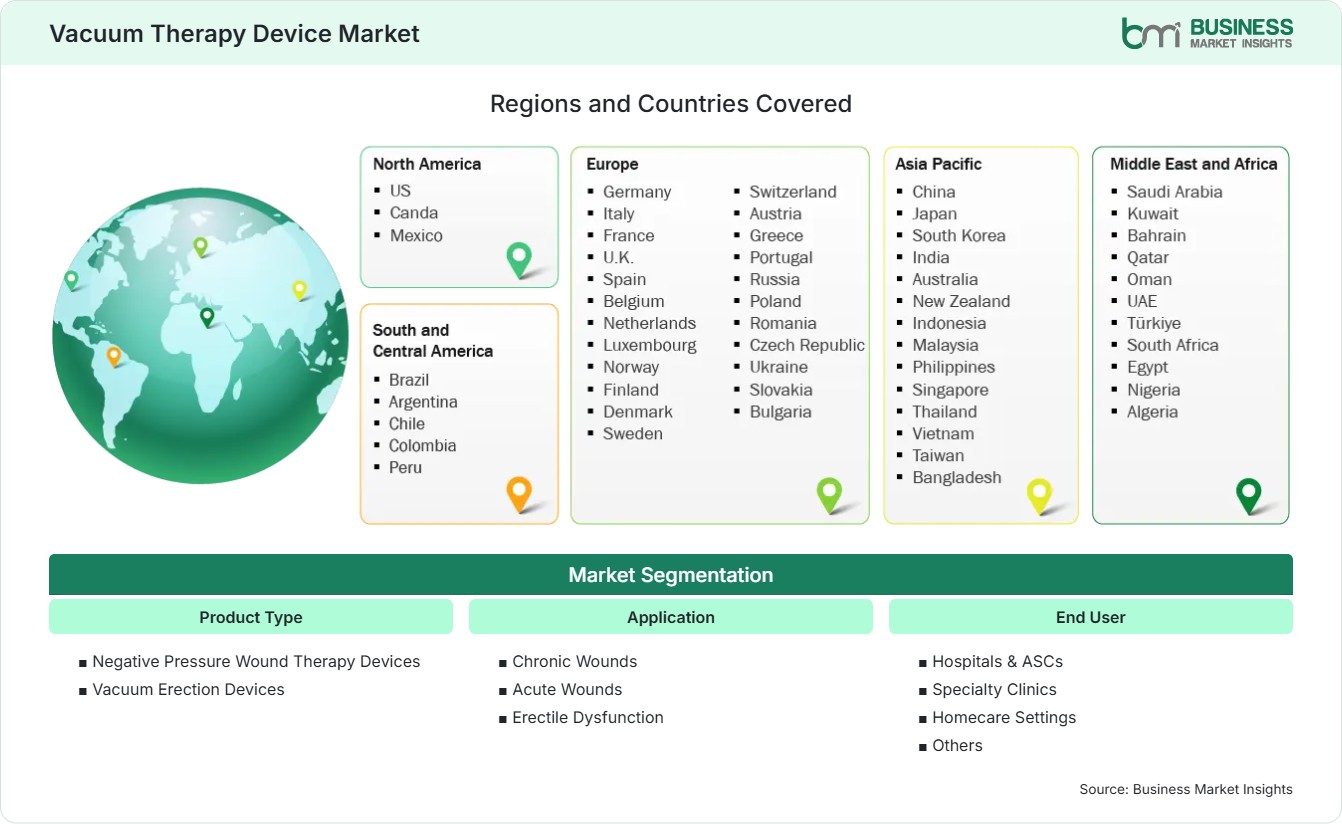
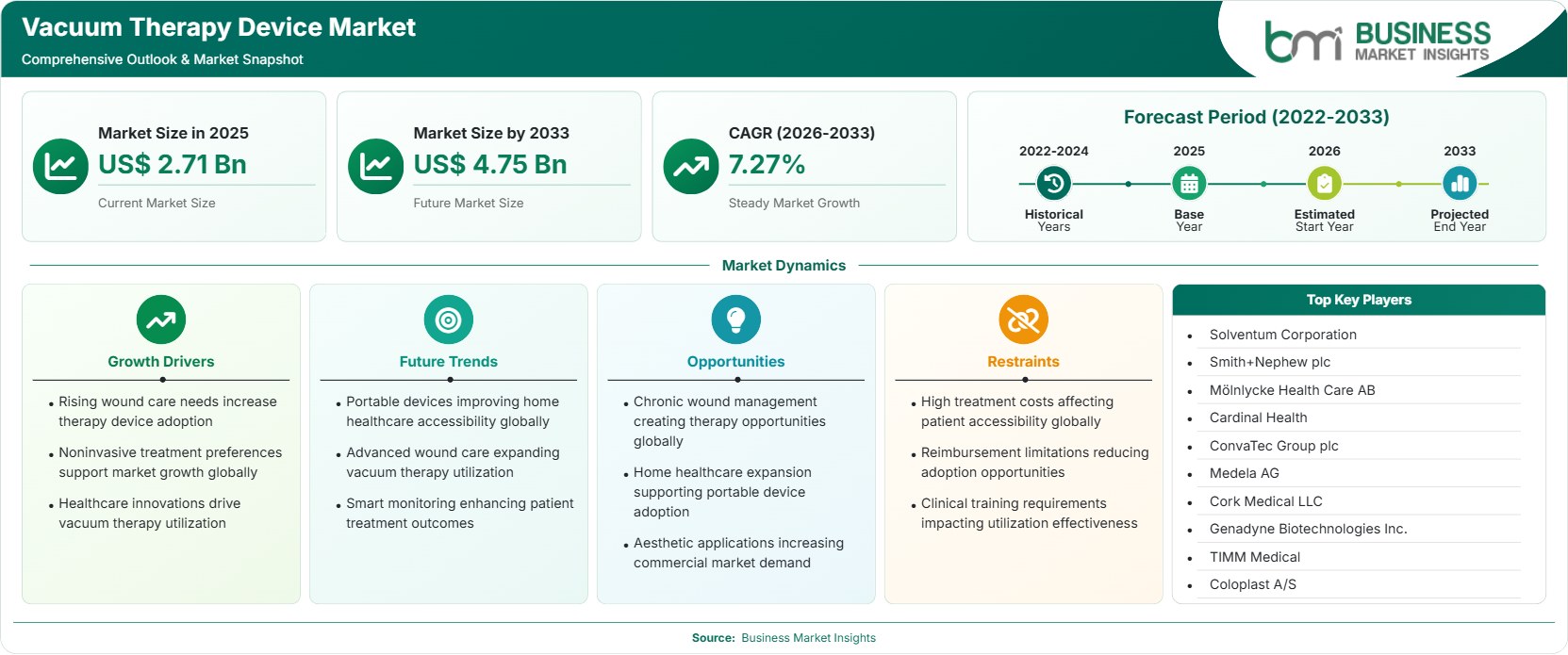
Vacuum Therapy Device Market Regional Highlights
North America Vacuum Therapy Device Market
North America holds a 39%–42% share in 2025 and records a 6.5%–7.0% CAGR through 2033. The region benefits from established advanced wound-care protocols, high penetration of hospital technology, outpatient surgery growth, and extensive homecare distribution. The United States Vacuum Therapy Device Market accounts for 83%–86% of North American revenue, supported by familiarity with reimbursement and specialist networks. Canada adds demand through hospital modernization and chronic-care programs. Product development increasingly emphasizes portable pumps, disposable dressings, simplified interfaces, and reduced clinician workload across acute, post-acute, and home settings.
- Chronic wound management remains a major demand catalyst as diabetes, vascular disease, pressure injuries, and postoperative complications require structured treatment pathways.
- Hospital systems increasingly evaluate devices through clinical effectiveness, workflow efficiency, consumable utilization, rental economics, and transition-of-care requirements.
- The United States remains the principal commercial center, with Canada providing additional demand through hospital procurement and expanding homecare infrastructure.
- Portable and single-use systems are gaining relevance as outpatient procedures and discharge-to-home pathways increase demand for simplified therapy.
US Vacuum Therapy Device Market
The U.S. represents 83%–86% of North American revenue in 2025 and grows at a 6.4%–6.9% CAGR through 2033. Demand is supported by chronic wound management, surgical procedures, home health, and specialist wound clinics. Medicare and private payer requirements influence device selection, documentation, and treatment pathways. Manufacturers benefit from established distribution and rental models. Regulatory activity remains important, including FDA clearances for NPWT accessories and systems. The Vacuum Therapy Device Market favors portable, interoperable, clinically differentiated devices that transition patients between hospitals and homecare.
- Advanced wound-care centers create concentrated demand for conventional NPWT systems used in complex wounds, surgical wounds, traumatic injuries, and difficult-to-heal ulcers.
- Homecare expansion favors compact pumps and disposable systems that reduce equipment logistics and support continued therapy after hospital discharge.
- Urology providers and direct medical-device channels support demand for vacuum erection devices as a non-invasive option for selected patients with erectile dysfunction.
Europe Vacuum Therapy Device Market
Europe Vacuum Therapy Device Market accounts for 27%-30% of market share in 2025 and grows at a 6.7%-7.2% CAGR through 2033. The greatest demand comes from countries such as Germany, the United Kingdom, France, Italy, and Spain, whereas Poland and several other Central European markets are experiencing fast growth. Factors such as an aging population, diabetes treatment, surgeries, and wound clinics drive the need for repeated treatments. Total cost of therapy, user-friendliness, and effectiveness become important criteria during procurement. Localization of production and Pan-European distribution facilitates the presence of advanced wound-healing devices among major healthcare providers.
- Germany benefits from a large hospital network, specialist wound-care capacity, and demand for advanced postoperative and chronic-wound treatment technologies.
- The United Kingdom provides opportunities through centralized healthcare procurement, homecare pathways, and increasing emphasis on efficient management of chronic wounds.
- France, Italy, and Spain maintain established demand supported by aging populations, surgical activity, diabetes management, and specialist clinical services.
- Poland and selected Central European markets provide expansion opportunities as healthcare infrastructure and specialist device availability improve.
Asia Pacific Vacuum Therapy Device Market
Asia-Pacific region is projected to account for 21%–24% of the market share in 2025, experience a CAGR of 8.3%–9.0% through 2033, and be the fastest-growing regional market. The top market drivers include China, Japan, India, South Korea, and Australia. India and China represent markets with greater growth potential due to diabetes management, surgical services, urban healthcare investments, and specialist care. Japan is positively impacted by its developed home healthcare system and the needs of an aging population. Portable devices and training may support quick integration into different settings.
- China combines a large patient base with expanding hospital infrastructure, domestic manufacturing capabilities, and increasing demand for advanced wound-management technologies.
- India offers substantial whitespace because diabetes prevalence, surgical volumes, private healthcare investment, and specialist wound-care capacity are expanding simultaneously.
- Japan provides mature demand for homecare-compatible devices, supported by population aging and established healthcare infrastructure.
- South Korea and Australia provide technologically sophisticated markets where clinical evidence, device usability, and specialist distribution influence purchasing decisions.
Rest of World Vacuum Therapy Device Market
Rest of World holds a 9%–12% Vacuum Therapy Device Market share in 2025 and grows at a 6.9%–7.5% CAGR up to 2033. Unbalanced access and whitespace opportunity for portable treatment are evident in South America, Central America, the Middle East, and Africa. Brazil and Mexico are the leading countries from a regional perspective; on the other hand, opportunities in Saudi Arabia, the UAE, and South Africa are much higher. Investment in surgical facilities, diabetes treatment, and private hospitals fuels the growth. The distributor-driven model is critical when specific wound treatment facilities are available only in urban areas.
- Brazil and Mexico represent major Latin American demand centers because of population scale, diabetes management needs, private healthcare capacity, and surgical activity.
- Saudi Arabia and the United Arab Emirates are developing advanced hospital infrastructure and specialist care centers that can support premium wound-care technologies.
- South Africa provides a regional hub for advanced healthcare services and distribution into neighboring African markets with developing specialist capacity.
- Affordability, reimbursement limitations, clinician training, and after-sales service remain key commercial considerations across emerging markets.