Market Summary
Executive Summary and Global Market Analysis
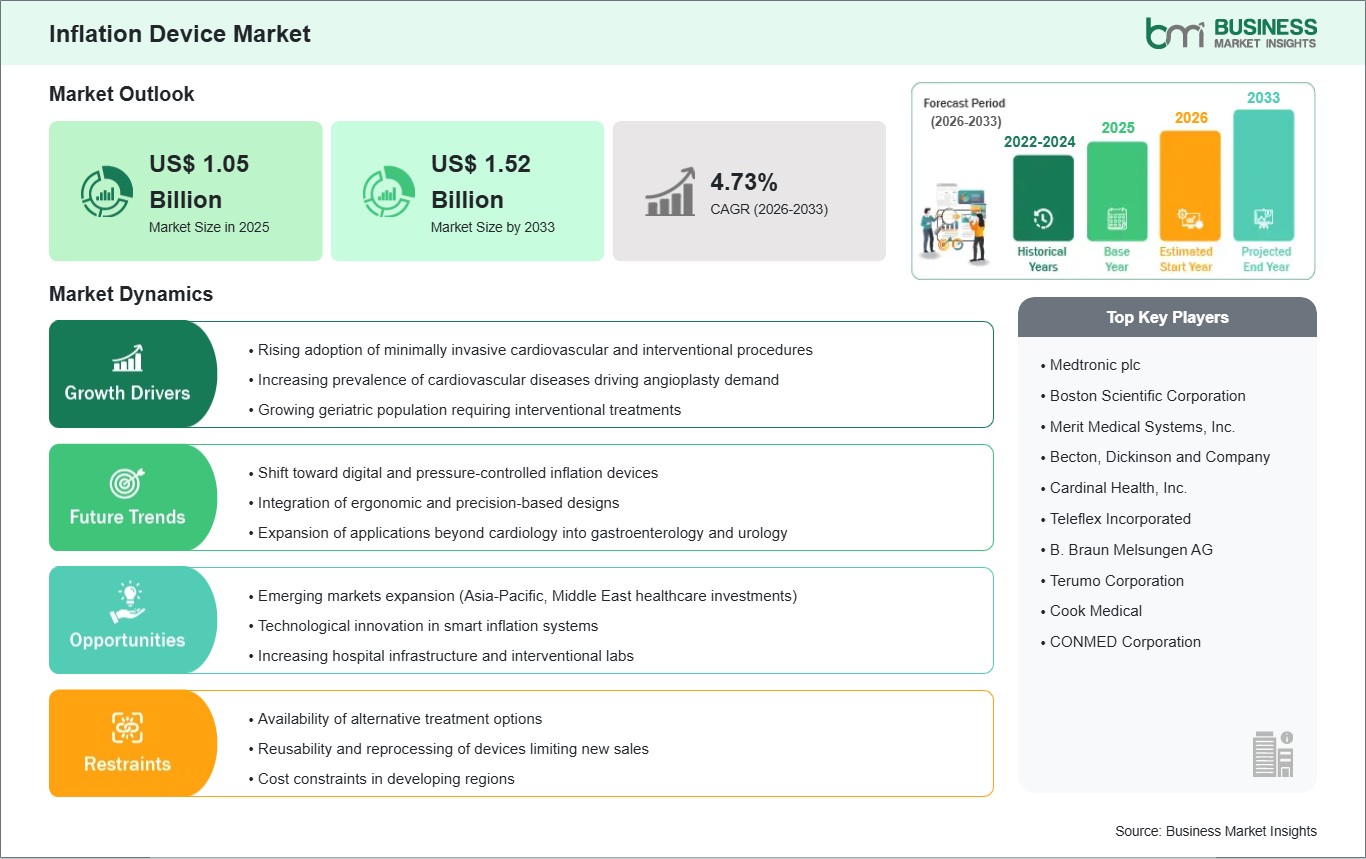
Inflation devices are precision-engineered medical instruments that accurately control, monitor, and maintain the internal pressure of balloon catheters during interventional procedures. These devices provide significant strategic value by enabling safe and precise outcomes in interventional cardiology, urology, and gastroenterology. Market growth is primarily driven by the global increase in cardiovascular and peripheral vascular diseases, the rapid adoption of minimally invasive surgery (MIS), and the rising demand for structural heart interventions. Additionally, the transition to ergonomic, one-handed operation designs, which reduce operator fatigue during complex multi-stent procedures, is improving procedural efficiency and workflow in high-volume hospitals.
Several challenges may restrain market growth. High costs associated with advanced digital models can limit adoption in facilities with restricted capital budgets, leading these institutions to select traditional analog versions. Stringent regulatory approval processes for new materials and high-pressure ratings can delay the introduction of innovative designs. Furthermore, a shortage of specialized interventionalists in certain emerging regions can constrain the number of procedures performed, even when equipment is available.
Despite these challenges, the market presents substantial opportunities. The global expansion of specialized cardiac centers and the increasing deployment of smart inflation systems with integrated digital feedback are expected to drive growth. The development of hybrid devices compatible with contrast media injection, along with the rising use of large-capacity devices for pulmonary and gastric dilations, is anticipated to create significant opportunities for long-term market expansion.
Segment Analysis
Inflation Device Market Segmentation
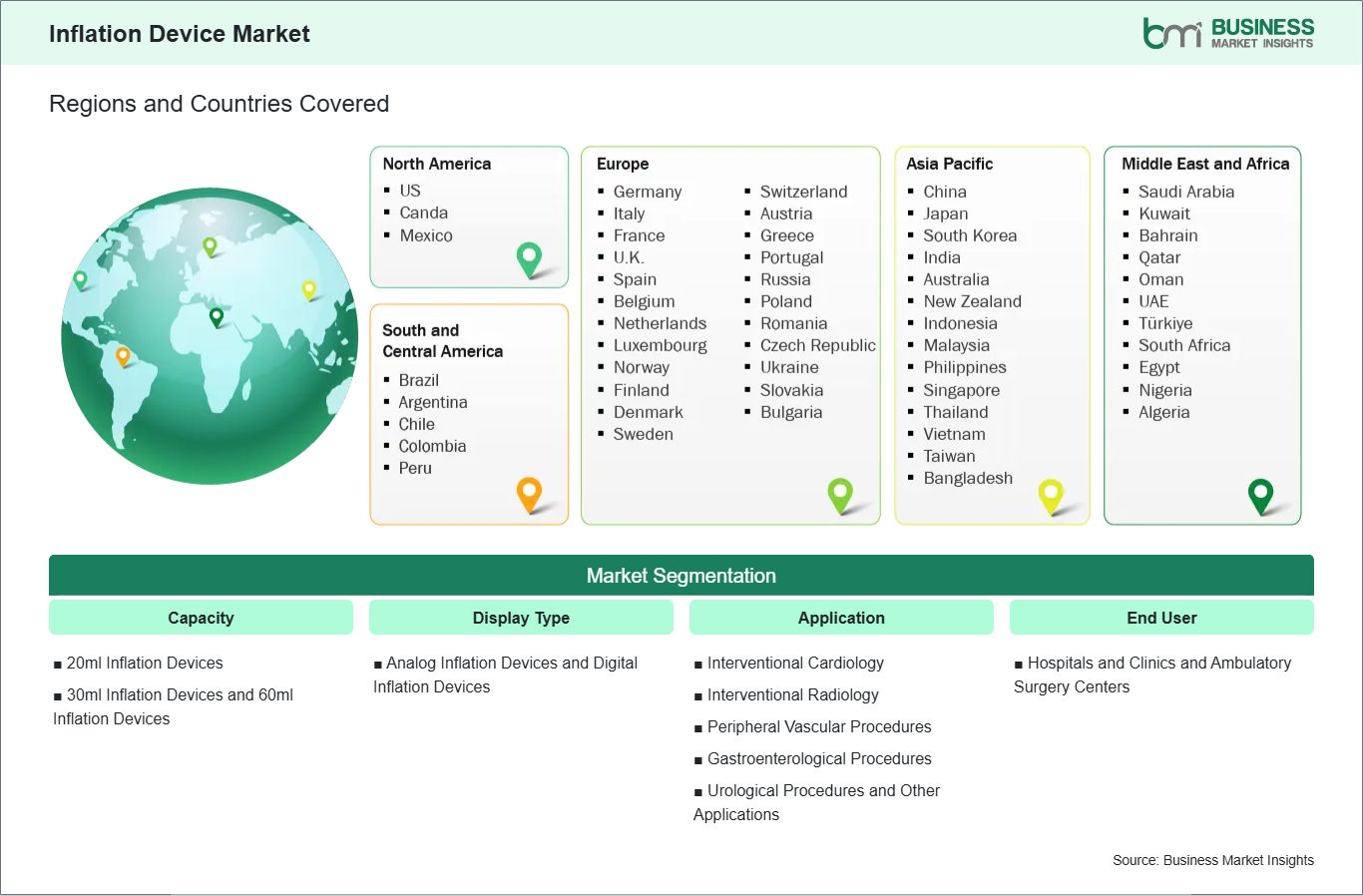
Key segments that contributed to the derivation of the Inflation Device market analysis are capacity, display type, application, and end user.
- By Capacity, the market is segmented into 20ml Inflation Devices, 30ml Inflation Devices and 60ml Inflation Devices.
- By Display Type, the market is divided into Analog Inflation Devices and Digital Inflation Devices.
- By Application, the market is categorized into Interventional Cardiology, Interventional Radiology, Peripheral Vascular Procedures, Gastroenterological Procedures, Urological Procedures and Other Applications.
- By End User, the market is classified into Hospitals and Clinics and Ambulatory Surgery Centers.
Market Forces
Inflation Device Market Drivers and Opportunities
Advancing Minimally Invasive Surgery and Digital Transformation
The Inflation Device Market is primarily driven by a global shift toward Minimally Invasive Procedures (MIS) as the preferred treatment for chronic conditions. Both patients and healthcare systems increasingly prioritize techniques that enable smaller incisions, reduced scarring, and faster recovery, thereby increasing demand for advanced balloon inflation systems. This trend is further reinforced by the rising prevalence of cardiovascular diseases (CVDs). As coronary artery disease rates increase, the need for precise stent deployment and valvuloplasty tools has become a critical clinical requirement. Technological advancements, particularly the digital transformation of pressure gauges, also serve as significant catalysts. Analog systems are being replaced in high-risk settings by digital models that provide real-time data recording, programmable pressure ranges, and auto-locking features.
Additionally, the expansion of healthcare infrastructure in emerging economies, especially in China and India, is generating a substantial new patient population. The growing global geriatric demographic further sustains a high volume of age-related vascular interventions. Collectively, these factors, including the adoption of MIS, increased cardiovascular demand, and advancements in digital accuracy, support a strong growth trajectory for inflation devices within the global medical sector.
AI-Native Pressure Feedback and Hybrid Multifunctional Systems
A significant opportunity exists in the integration of inflation devices with artificial intelligence-based pressure feedback systems. Next-generation devices incorporate intelligent algorithms that automatically adjust inflation rates according to vessel compliance, a capability especially valuable in pediatric and neurovascular procedures where precise micro-pressure control is essential. Another major area of growth is the development of hybrid multifunctional devices that combine balloon inflation with contrast media injection. By reducing the need for multiple instruments, these systems improve surgical workflow efficiency and minimize clutter in sterile interventional environments.
Additionally, the proliferation of ambulatory surgical centers (ASCs) creates demand for compact, portable, and cost-effective inflation tools tailored for high-throughput outpatient procedures. The emergence of sustainability-focused single-use designs represents another important frontier, as manufacturers develop latex-free, recyclable, and antimicrobial-coated materials to enhance sterility and comply with environmental regulations. Companies prioritizing ergonomic one-handed operation and advancing IoT-connected data recall for clinical documentation are well positioned to lead innovation and capture high-margin segments within the Inflation devices market.
Size and Share Analysis
Inflation Device Market Size and Share Analysis
The Inflation Device market demonstrates steady growth, with size and share analysis revealing evolving trends and competitive positioning among key players. The report further examines subsegments categorized within capacity, display type, application, and end user, offering insights into their contribution to overall market performance.
Based on capacity, the 20ml and 30ml Inflation Devices subsegment holds a significant market presence, serving as the industry benchmark for standard angioplasty and stenting procedures. 20ml devices are indispensable for the Interventional Cardiology vertical, providing the fine pressure increments required for delicate coronary interventions. A notable trend is the surge in the 60ml Inflation Devices subsegment, which is registering a higher growth rate. These higher-capacity units are becoming essential for Gastroenterological and Urological Procedures, where larger balloons are utilized for esophageal or urethral dilation, requiring greater volumes of fluid to achieve the necessary therapeutic pressure.
Report Coverage
Inflation Device Market Report Coverage and Deliverables
The "Inflation Device Market Size and Forecast (2022–2033)" report provides a detailed analysis of the market covering below areas:
- Inflation Device market size and forecast at global, regional, and country levels for all the key market segments covered under the scope
- Inflation Device market trends, as well as market dynamics such as drivers, restraints, and key opportunities
- Inflation Device market analysis covering key market trends, global and regional framework, major players, regulations, and recent market developments
- Industry landscape and competition analysis covering market concentration, heat map analysis, prominent players, and recent developments for the Inflation Device market
- Detailed company profiles, including SWOT analysis
Geographic Insights
Inflation Device Market Geographic Insights
The geographical scope of the Inflation Device market report is divided into five regions: North America, Asia Pacific, Europe, Middle East & Africa, and South & Central America.
The Asia-Pacific Inflation Device Market comprises China, Japan, South Korea, India, Australia, and the Rest of Asia Pacific. China leads the regional market, supported by high procedure volumes in advanced catheterization laboratories and a robust presence of both domestic and international manufacturers. India is anticipated to experience the fastest growth in the region, driven by the expansion of tertiary care hospital networks and the rapid adoption of digital surgical technologies. In contrast, the Japanese market remains stable, emphasizing high-precision, ergonomically designed devices that address the needs of an aging population.
Market growth is further supported by a substantial shift toward digital display inflation devices, which enhance pressure visibility and enable real-time monitoring. The rising preference for disposable, single-use devices to reduce hospital-acquired infections (HAIs), combined with the adoption of high-pressure, large-capacity systems for complex vascular interventions, positions the Asia-Pacific region as a key center for innovation and future expansion within the inflation device market.
Industry Activity
Recent Developments
The Inflation Device market is evaluated by gathering qualitative and quantitative data post primary and secondary research, which includes important corporate publications, association data, and databases. A few of the key developments in the Inflation Device market are:
- In March 2025, Aperia Technologies announced an exclusive collaboration with Goodyear to provide automatic tire inflation through the Halo Connect i3™ as part of Goodyear`s Tires-as-a-Service solution. The partnership aims to improve fleet efficiency, reduce downtime, and optimize tire performance, marking a positive development in the Inflation Device Market.
- In January 2025, PCL announced the launch of a new badge for its AIRFORCE® MK4 Tyre Inflator, highlighting decades of innovation from the original MK2. The MK4 offers enhanced accuracy, durability, and longevity, reinforcing PCL`s leadership in the Inflation Device Market.
Trust & Transparency
Research Methodology
The market analysis combines proprietary research with secondary data from government agencies, company disclosures, regulatory filings, industry databases and expert interviews. Market estimates are validated through data triangulation, cross-market benchmarking and analyst
review.
View Full Research Methodology
Key Sources Referred:
World Bank – Global Trade IndicatorsWorld Trade Organization (WTO)(International Monetary Fund )IMFInternational Trade Administration (ITA)Company websiteCompany annual reportsCompany investor presentations