
Compression Therapy Market Outlook: Size, Share, Trends, Growth Analysis, Competitive Landscape & Forecast, 2026-2033

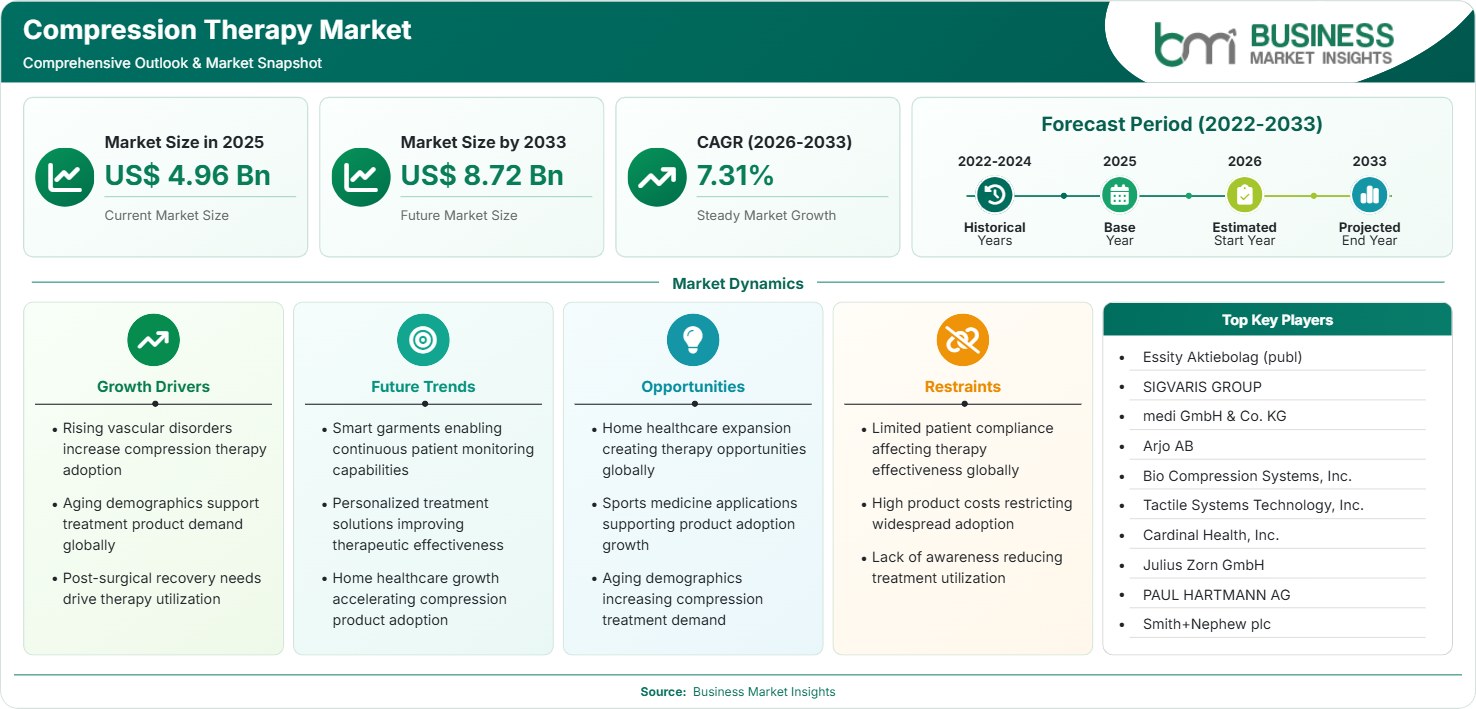
The Compression Therapy Market size was valued at US$ 4.96 Billion in 2025 and is projected to reach US$ 8.72 Billion by 2033, growing at a CAGR of 7.31% during 2026–2033, driven by chronic venous disorders, lymphedema management, home care adoption, product innovation, and expanding access to non-invasive vascular therapies.

Report Coverage
  • Product: Compression Garments , Compression Pumps, Others
  • Application: Venous Leg Ulcer, Deep Vein Thrombosis , Lymphedema, Others
  • End User: Hospitals & Clinics, Nursing Care Centers, Home Care, Others
US$ 4.96 Bn Market size in 2025
US$ 8.72 Bn Market Size by 2033
7.31% CAGR, 2026 - 2033
2026-2033 Forecast Period

AI Overview

Compression Therapy Market Summary

  • North America Region: North America holds a 31%–34% share in 2025, growing at a 6.2%–6.8% CAGR, influenced by reimbursement, aging, chronic venous disease, home treatment, advanced pneumatic devices, clinical evidence, and specialist adoption. The US represents the regional demand center, supported by established vascular clinics and home-based reimbursement pathways.
  • Fastest Growing Region: Asia Pacific holds a 24%–27% share in 2025 and is expanding at an 8.6%–9.4% CAGR, supported by rising healthcare expenditure, aging populations, expanding specialist services, improving diagnosis, urbanization, and increasing adoption of home-based compression technologies.
  • Leading Segment: Compression Garments account for a 46%–50% share in 2025 and are advancing at a 6.9%–7.4% CAGR, supported by established clinical protocols, broad availability, repeat purchasing, improved textiles, better fit, customization, and increasing patient preference for non-invasive management.
  • High Growth Segment: Compression Pumps represent a 17%–21% share in 2025 and are advancing at a 9.0%–9.8% CAGR, driven by pneumatic innovation, programmable therapy, mobility-focused designs, remote care, lymphedema management, improved adherence, and expanding home healthcare applications.
  • Key Market Opportunity: Greater use of wearable, programmable, and mobility-compatible compression systems creates opportunities for manufacturers to combine therapeutic efficacy, patient comfort, remote monitoring, clinical evidence, and simplified home-use workflows.
  • Major Market Players: Essity Aktiebolag (publ), SIGVARIS GROUP, medi GmbH & Co. KG, Arjo AB, Bio Compression Systems, Inc., Tactile Systems Technology, Inc., Cardinal Health, Inc., Julius Zorn GmbH, PAUL HARTMANN AG, and Smith+Nephew plc.
Strategic Insights

Compression Therapy Market: Strategic Insights

Compression Therapy Market Strategic Framework
FREE PDF
Request your free sample
Request free sample
Stakeholder View

Key Takeaways

  • Supply chains are becoming more integrated, with textile engineering, medical-device manufacturing, fitting services, clinical education, and home-care distribution increasingly operating as interconnected value-chain components.
  • The strongest incremental opportunity lies in compression pumps and advanced garments addressing lymphedema, venous leg ulcers, and chronic edema, where adherence and individualized treatment remain important commercial differentiators.
  • Product development is moving toward lighter fabrics, adjustable compression, anatomically optimized designs, programmable pneumatic cycles, wearable formats, and technologies that preserve mobility during treatment.
  • Asia Pacific presents a substantial expansion opportunity because improving vascular-care infrastructure, specialist availability, healthcare expenditure, and awareness can broaden adoption beyond major metropolitan healthcare centers.
  • Investment activity is increasingly directed toward differentiated compression technologies and evidence generation. Koya Medical's US$26 million Series B financing illustrates investor interest in active compression platforms and broader vascular-care applications.
  • Home treatment is becoming a strategic commercial channel because products that reduce caregiver dependence can improve treatment accessibility while creating recurring demand for replacement garments, accessories, fitting services, and device support.
Geographic Outlook

Compression Therapy Market Regional Highlights

North America Compression Therapy Market

North America represented approximately 31%–34% of global Compression Therapy Market demand in 2025, with a 6.2%–6.8% CAGR through 2033. The region benefits from mature vascular-care infrastructure, established reimbursement pathways, specialist clinics, and strong adoption of pneumatic technologies. The US accounts for most regional demand, while Canada contributes through expanding chronic-wound and rehabilitation services.

  • Aging populations and persistent chronic venous conditions support recurring demand for stockings, wraps, bandages, and pneumatic devices across hospitals, clinics, and home-care settings.
  • Lymphedema management is expanding the addressable patient base for advanced pneumatic compression, particularly where treatment can transition from supervised clinical care to structured home therapy.
  • Reimbursement and durable medical equipment pathways influence device adoption, making clinical documentation, evidence generation, fitting support, and patient education important competitive capabilities.
  • Manufacturers are prioritizing lightweight controllers, improved garment interfaces, and simplified application because comfort and independence strongly influence sustained use outside institutional settings.

US Compression Therapy Market

The US accounted for approximately 68%–72% of North American demand in 2025 and is progressing at a 5.8%–6.4% CAGR through 2033. Compression Therapy Market Demand is supported by specialized vascular centers, wound-care networks, durable medical equipment channels, and established reimbursement mechanisms. Home-based lymphedema treatment is creating additional demand for pneumatic systems.

  • Home healthcare expansion is supporting device adoption as patients and providers seek treatment options that reduce repeated clinic visits while maintaining structured therapeutic protocols.
  • Lymphedema following cancer treatment represents an important clinical opportunity, particularly for advanced pneumatic compression supported by prospective evidence and patient-reported outcomes.
  • Commercial strategies increasingly combine devices, garments, fitting services, reimbursement assistance, education, and provider engagement rather than relying exclusively on equipment sales.

Europe Compression Therapy Market

Europe represented approximately 27%–30% of global Compression Therapy Market demand in 2025 and is advancing at a 6.5%–7.0% CAGR through 2033. Germany, the UK, France, Italy, and the Nordic countries provide mature clinical and distribution ecosystems. Germany remains a major center for compression garment manufacturing and medical-device expertise. The UK continues developing wound-care applications, while France and Germany support specialist lymphatic services.

  • Germany benefits from established medical compression expertise and strong specialist distribution, supporting sophisticated garment portfolios across venous and lymphatic indications.
  • The UK provides opportunities in venous leg ulcer management, where intermittent pneumatic compression can complement standard treatment and support home-based care models.
  • France and Italy offer opportunities through specialist lymphology services, rehabilitation networks, and increasing recognition of long-term compression adherence challenges.
  • Central and Eastern European markets can expand faster as healthcare modernization improves access to vascular diagnostics, specialist services, and reimbursed medical compression products.

Asia Pacific Compression Therapy Market

Asia Pacific held approximately 24%–27% of the global Compression Therapy Market demand in 2025 and is expanding at an 8.6%–9.4% CAGR through 2033. China, Japan, South Korea, India, and Australia represent important demand centers, while India and Australia provide attractive growth conditions. Increasing healthcare expenditure, aging populations, urbanization, rising awareness of chronic venous disease, and expanding home healthcare support adoption.

  • China combines a large addressable population with expanding hospital capacity, creating opportunities for locally adapted garments, pneumatic systems, and specialist vascular-care solutions.
  • India offers strong potential as vascular clinics, wound-care services, rehabilitation centers, and home healthcare networks expand beyond major metropolitan areas.
  • Australia combines mature healthcare infrastructure with an aging population and increasing demand for home-based treatment, supporting advanced garments and portable compression devices.
  • Southeast Asian markets can accelerate adoption as private hospitals, specialist clinics, medical distributors, and rehabilitation providers broaden access to chronic edema management.

Rest of World Compression Therapy Market

South and Central America represented approximately 8%–10% of global Compression Therapy Market demand in 2025, while Brazil and Mexico remain important regional markets. Adoption is supported by expanding private healthcare, wound-care awareness, and growing availability of specialist compression products.

Middle East and Africa represented approximately 5%–7% of global demand, with Saudi Arabia, the UAE, and South Africa serving as important hubs. The region is developing through private healthcare investment, specialist hospitals, and medical tourism.

  • Brazil and Mexico provide relatively mature commercial platforms for specialist compression products, although affordability and reimbursement remain important determinants of product mix.
  • Gulf healthcare investment supports adoption of advanced pneumatic equipment and premium garments in tertiary hospitals, rehabilitation centers, and specialist vascular facilities.
  • South Africa provides a regional gateway for advanced compression solutions, with opportunities linked to private healthcare, wound-care services, and specialist rehabilitation.
  • Distributor partnerships remain essential in smaller markets because product availability, fitting expertise, clinician education, and after-sales support strongly affect adoption.
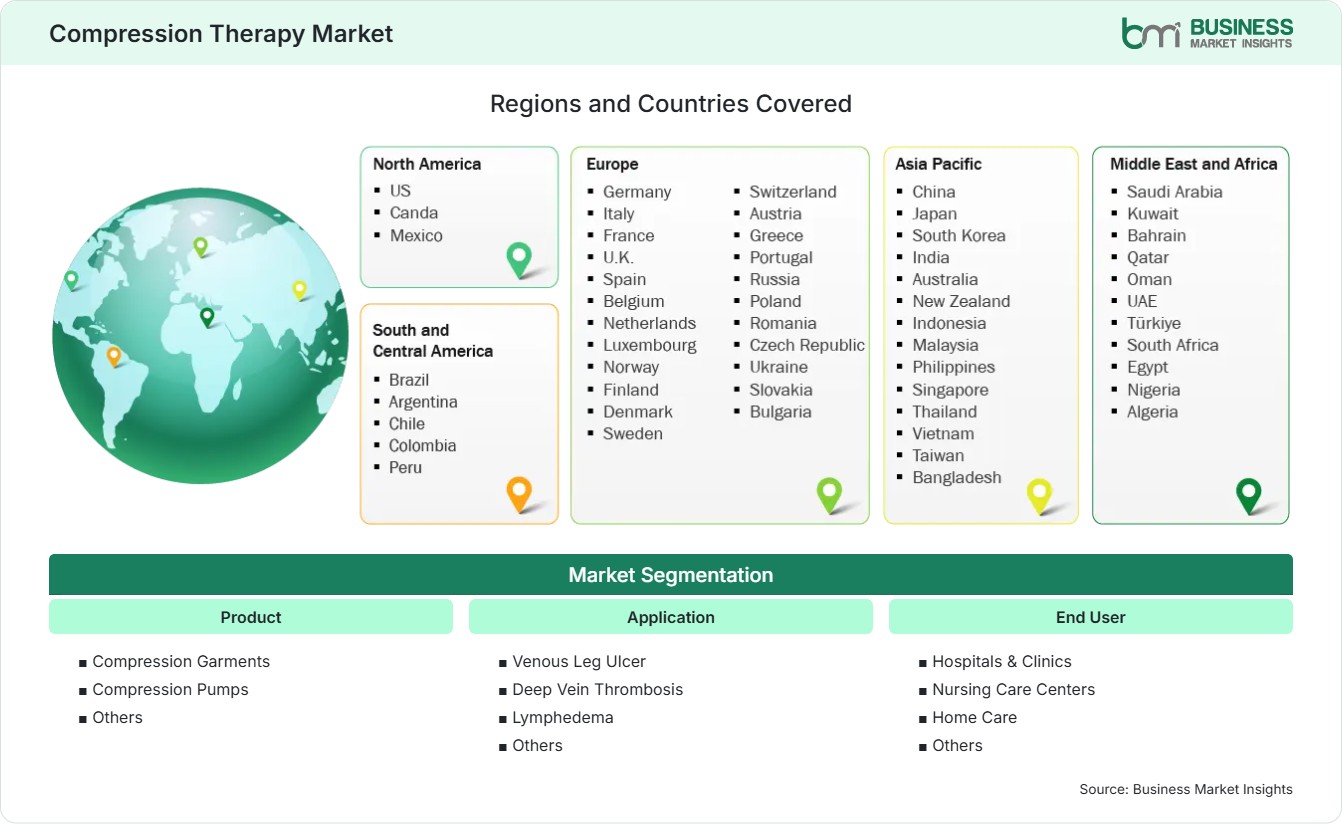
Global Market Geography
FREE PDF
Request your free sample
Request free sample
Segment Analysis

Compression Therapy Market Segmentation

Product

The Product segment remains central to adoption, with Compression Garments representing approximately 46%–50% Compression Therapy Market share in 2025 and advancing at a 6.9%–7.4% CAGR during 2026–2034. Demand reflects recurring replacement, clinical familiarity, customization, and broad use across venous and lymphatic disorders. The segment benefits from textile innovation and improved fitting.

  • Compression Garments: Compression garments support sustained edema control and venous return across chronic conditions. Improved textiles, anatomical fitting, breathable materials, and easier donning are strengthening adherence and replacement demand.
  • Compression Bandages: Compression bandages remain important for wound management and initial decongestion, particularly when limb dimensions change rapidly. Multilayer systems and adjustable designs can simplify clinical application and improve treatment consistency.
  • Compression Stockings: Compression stockings remain widely used for venous insufficiency and edema management. Graduated pressure, improved aesthetics, and broader size ranges support continued adoption among ambulatory and long-term users.
  • Compression Pumps: Compression pumps represent a faster-growing product category, supported by programmable pressure cycles, home treatment, mobility-focused systems, and expanding lymphedema management requirements across chronic-care populations.

Application

The Application segment is increasingly shaped by chronic vascular and lymphatic disorders, with lymphedema and venous leg ulcer management creating sustained demand for both garments and pneumatic systems. Clinical pathways emphasize individualized compression intensity, adherence, fitting, monitoring, and long-term self-management across care settings.

  • Venous Leg Ulcer: Compression remains foundational in venous leg ulcer management, creating demand for bandages, stockings, wraps, and adjunctive pneumatic systems designed to improve circulation and treatment adherence.
  • Deep Vein Thrombosis (DVT): DVT-related compression applications focus on edema control and post-thrombotic complications. Adoption depends on clinical assessment, appropriate pressure selection, patient monitoring, and integration with broader vascular management.
  • Lymphedema: Lymphedema is an important demand generator for advanced garments and pneumatic systems because treatment often requires long-term management, individualized fitting, mobility support, and structured home-care routines.

End User

The End User segment is diversifying as treatment moves beyond institutional settings. Hospitals and clinics remain important for diagnosis, fitting, acute management, and specialist intervention, while home care is gaining strategic importance because chronic compression frequently requires prolonged treatment and patient-led routines.

  • Hospitals & Clinics: Hospitals and clinics remain major adoption points because vascular assessment, wound management, fitting, and specialist supervision are concentrated within institutional care pathways.
  • Nursing Care Centers: Nursing care centers require practical compression systems that minimize application complexity and support consistent treatment for elderly patients with chronic venous and lymphatic conditions.
  • Home Care: Home care is expanding rapidly as portable pumps, easier garments, digital education, and simplified fitting allow patients to continue compression routines with reduced dependence on repeated facility visits.
Market Forces

Compression Therapy Market Dynamics

Key Market Drivers

Rising burden of chronic venous and lymphatic disorders

Growing occurrences of chronic venous insufficiency, edema, lymphedema, and venous ulcers make the continuous need for compression products likely among acute, chronic, and rehabilitation treatments. Growing aging populations will prolong exposure because vascular or lymphatic conditions often require prolonged treatment rather than short courses of therapy. Compression Therapy Market growth will thus be connected with the need for repeat garment replacement, fitting services, and the use of pneumatic devices. Greater emphasis is being placed on adherence in clinical practice because treatment efficacy depends on it. Increased interest in user-friendly products for the elderly and less mobile patients can be seen in market trends.

Expansion of home-based chronic care

The changing dynamics in home-based care indicate that the buying behavior in compression therapy products is gradually moving towards those that the patient can control himself in the absence of constant professional supervision. Portable pneumatic pumps, simpler garments, adjustable wraps, and educational material based on digital technology help to lower practical difficulties with prolonged treatment. For instance, evidence provided by Tactile Medical in its 2025 trial of Flexitouch Plus is an example of how clinical evidence can boost the argument about advanced home therapy in specific cases of lymphedema. Compression Therapy Market trends increasingly favor mobility, convenience, and adherence rather than maximum device complexity.

Product innovation and improved patient adherence

Innovation in compression is currently geared towards solving the problem of discomfort, poor fit, heat retention, and reduced movement. Textiles, anatomically correct designs, adjustability of tension, lightweight pumps, and the design of the product itself can enhance the experience of people who wear them. Essity keeps its capacity for compression therapy research and commercialization in JOBST products. This is an indication of the continuous development of products in the industry. The improvement of patient adherence translates into commercial success through clinical success and regular replacements. Compression Therapy Market growth therefore increasingly depends on usability engineering alongside pressure performance.

Key Market Opportunities

Smart and mobility-compatible compression platforms

Advanced compression systems open up possibilities to combine pressure regulation, use measurement, remote monitoring, and customized treatment within wearable devices. Mobility-friendly solutions might be a way to overcome one of the major drawbacks of traditional pneumatic treatments, namely, making it possible to move while using a device. An example of commercial interest in mobile, non-pneumatic compression is Dayspring platform developed by Koya Medical. Compression Therapy Market Forecasts therefore extend beyond conventional garments toward connected and active platforms capable of supporting personalized treatment.

Emerging-market expansion and localized product portfolios

Market opportunities exist for those manufacturers that can blend their offering of inexpensive products with education and distribution. Markets in India, China, Southeast Asia, Latin America, and Gulf Countries are developing a framework of specialist healthcare facilities, where there is underdiagnosis of vascular and lymphatic conditions among populations. Entry strategies could focus on size adaptability, ease of use garments, distributor training, and a tiered pricing system instead of importing a premium product portfolio without any localization. Regional manufacturing and assembly can help minimize the logistics cost as well as the availability of the product.

Integrated wound-care and lymphatic treatment pathways

There is scope for integrating compression therapy with wound care, rehabilitation, vascular diagnostics, and chronic disease management using integrated care delivery models. Venous leg ulcers are particularly well suited for integration since compression needs to be provided simultaneously with wound care and diagnostic services. The Arjo WoundExpress offers one way of integrating intermittent pneumatic compression as an add-on to traditional wound care services that does not require its use close to the site of the wound. Such approaches may help move the business of compression providers beyond just products.

Market Restraints and Challenges

Factor: Patient discomfort and adherence barriers

Factors: Discomfort, heat, difficulty putting on, poor fit, and decreased dexterity could hamper wearing the garment for prolonged periods.

Impact: Inconsistency in using compression therapy would result in inefficiency of treatment and would discourage re-use of the garment by those patients who have difficulties with the traditional compression garments. This is important in cases where patients are old, have restricted movement, or need high compression garments.

Factor: reimbursement variability and clinical complexity

Factor: The disparity in reimbursement, prescription requirements, cost of fitting, and differences in clinical practices may hinder the use of more efficient compression system devices.

Impact: Both the patients and health care providers will prefer to use conventional products over advanced technology, despite the benefits offered by the more efficient device, due to cost considerations.

Company Analysis

Competitive Landscape

The competitive landscape is characterized by established compression garment specialists, diversified healthcare companies, wound-care providers, and manufacturers of advanced pneumatic systems. Compression Therapy Market analysis indicates that differentiation increasingly depends on clinical evidence, product comfort, fitting capabilities, home-care integration, and technology rather than product availability alone.

Company Name

Overview

Products and Services relevant to this market

Essity Aktiebolag (publ)

Swedish health and medical company with a broad compression, wound-care, and orthopedics portfolio supported by global distribution.

JOBST compression garments, medical legwear, lymphatic compression solutions, fitting support, and professional education.

SIGVARIS GROUP

Global specialist focused on medical compression with extensive experience in venous and lymphatic care applications.

Compression stockings, socks, wraps, liners, and specialized compression solutions for venous and lymphatic disorders.

medi GmbH & Co. KG

German medical technology company with established expertise in compression, vascular care, and orthopedic products.

Medical compression stockings, garments, lymphology products, and solutions supporting chronic edema and venous management.

Arjo AB

Swedish healthcare technology company serving hospitals, long-term care, rehabilitation, and vascular treatment applications.

WoundExpress intermittent pneumatic compression technology and vascular-care solutions for venous leg ulcer management.

Bio Compression Systems, Inc.

US medical-device specialist focused on pneumatic compression technologies for lymphatic and vascular conditions.

Pneumatic compression pumps and garments designed for lymphedema, edema, and related circulatory conditions.

Tactile Systems Technology, Inc.

US medical technology company specializing in home-based therapies for chronic lymphatic and vascular disorders.

Flexitouch Plus and other pneumatic compression systems supporting lymphedema and chronic edema management.

Cardinal Health, Inc.

Diversified healthcare company with extensive medical-product distribution and access to institutional and home-care channels.

Compression products and related medical supplies distributed through healthcare-provider and home-care networks.

Julius Zorn GmbH

German specialist known for customized medical compression and lymphology-oriented product development.

Compression stockings, garments, sleeves, custom solutions, and products for venous and lymphatic conditions.

PAUL HARTMANN AG

European healthcare company with strong wound-care capabilities and complementary compression solutions.

Compression bandages, wraps, wound-care products, and integrated solutions for venous leg ulcer management.

Smith+Nephew plc

Global medical technology company serving wound management, advanced care, and surgical markets.

Wound-care products and complementary compression-related solutions supporting lower-limb wound management pathways.

Trust & Transparency

Research Methodology

The market analysis combines proprietary research with secondary data from government agencies, company disclosures, regulatory filings, industry databases and expert interviews. Market estimates are validated through data triangulation, cross-market benchmarking and analyst review.

View Full Research Methodology

Questions Answered

Frequently Asked Questions

What role does clinical evidence play in purchasing decisions?

The Compression Therapy Market Report highlights that Clinical evidence helps healthcare providers evaluate therapeutic outcomes, patient adherence, safety, and economic value. Evidence can also support reimbursement discussions and differentiate advanced devices from conventional compression products.

Why is fitting important for compression products?

Correct fitting helps achieve the intended pressure distribution while reducing excessive constriction, discomfort, slippage, and poor adherence. Accurate measurements are particularly important for customized garments and limbs with irregular shapes.

How are pneumatic compression devices different from garments?

Garments generally provide sustained external pressure, while pneumatic devices deliver programmed intermittent pressure through inflatable chambers. Pneumatic systems can provide an additional treatment option for selected patients requiring more structured compression therapy.

Why are compression garments frequently replaced?

Compression garments gradually lose elasticity through repeated wear, washing, stretching, and mechanical stress. Replacement intervals depend on product construction, usage frequency, care practices, clinical requirements, and manufacturer guidance.

What factors determine the selection of compression pressure?

Pressure selection depends on the patient's vascular condition, edema severity, clinical assessment, treatment objective, tolerance, and contraindications. Medical professionals may use vascular screening and individualized fitting before selecting an appropriate compression class.

Access the Full Compression Therapy Market Report

Get segment-level forecasts, regional estimates, competitive benchmarking, company profiles and downloadable Excel datasets.

Access the full Compression Therapy Market Report
350 pages PDF & Excel | 2026-10-26
Similar Research

Related Market Reports