
Compression Bandages Market Outlook: Size, Share, Trends, Growth Analysis, Competitive Landscape & Forecast, 2026–2033

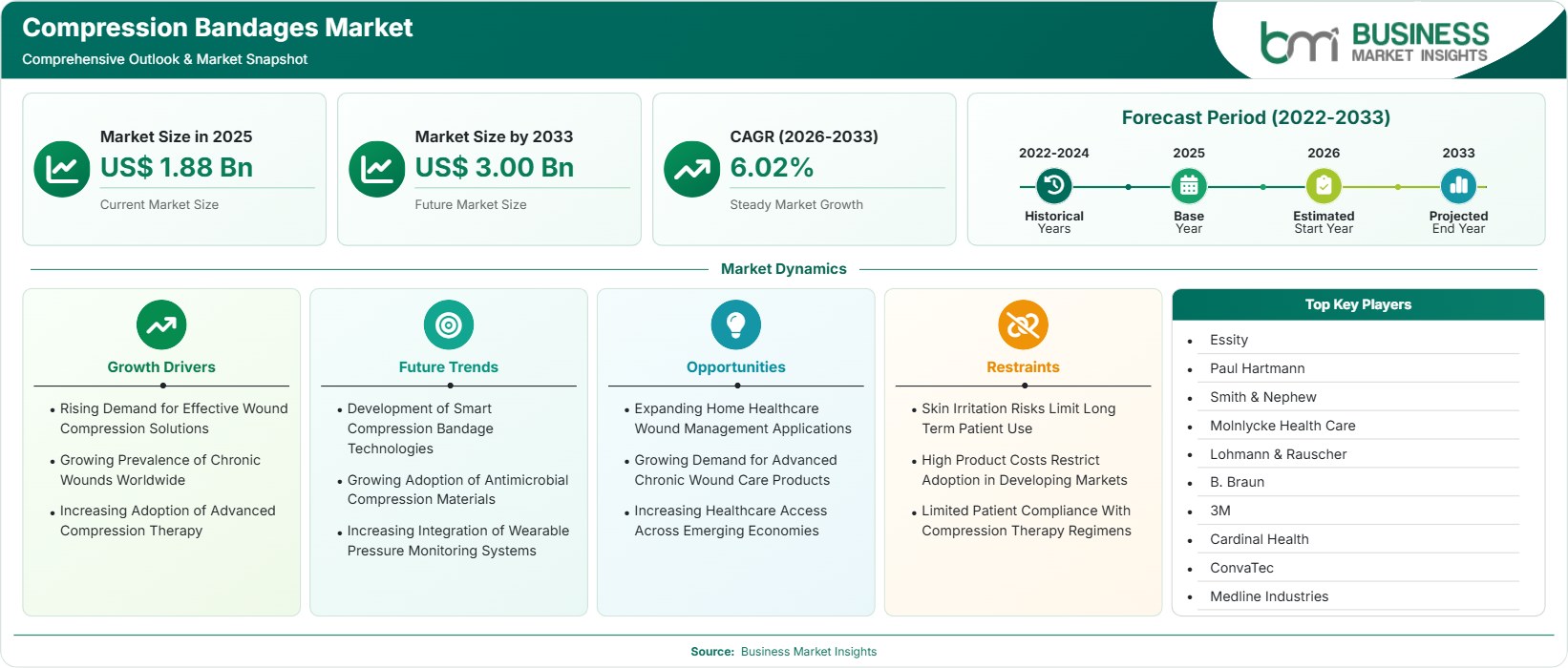
The Compression Bandages Market size was valued at US$ 1.88 billion in 2025 and is projected to reach US$ 3.00 billion by 2033, growing at a CAGR of 6.02% during 2026–2033, driven by chronic wound prevalence, compression therapy adoption, home care expansion, and improved healthcare access.

Report Coverage
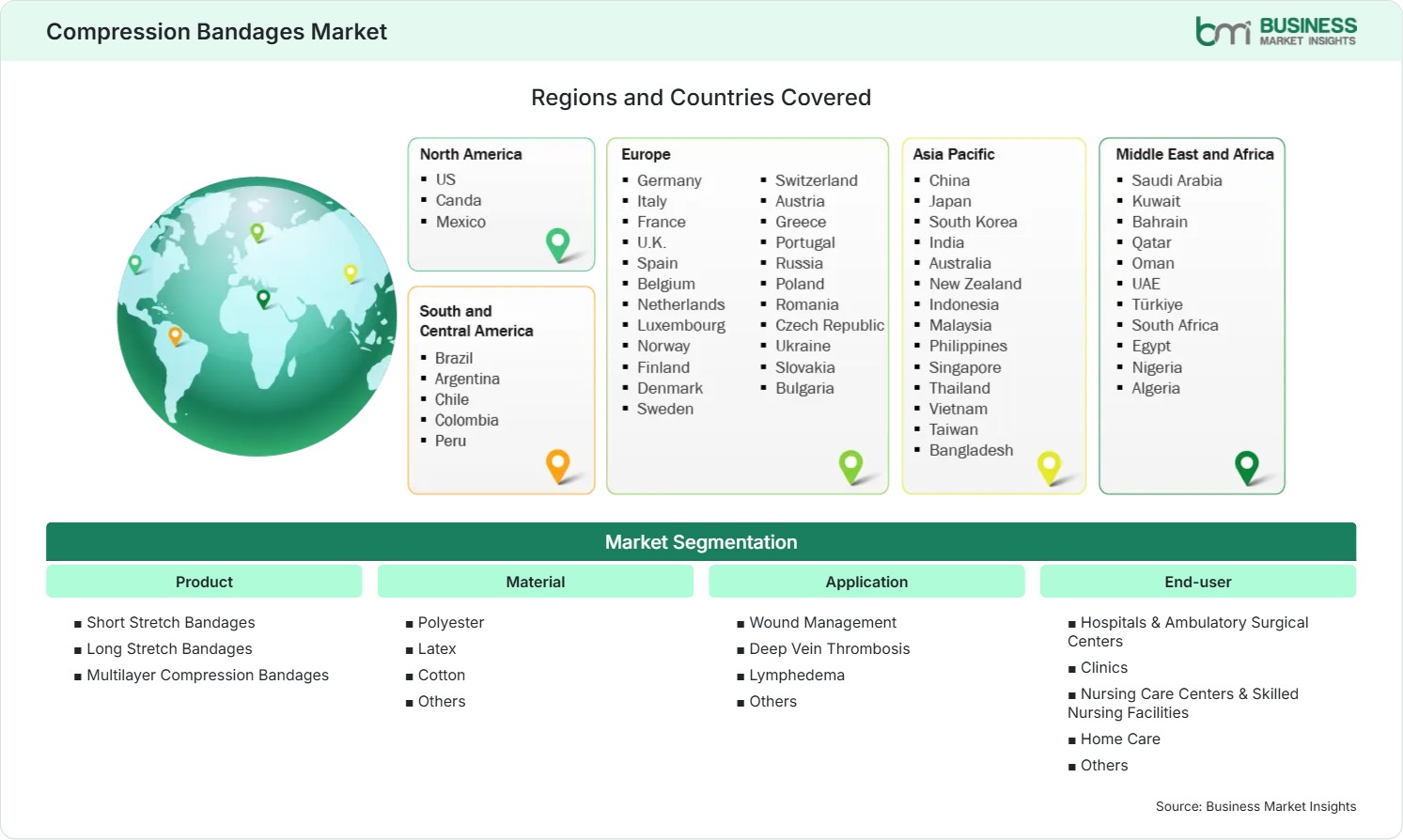
  • Product: Short Stretch Bandages, Long Stretch Bandages, Multilayer Compression Bandages
  • Material: Polyester, Latex, Cotton, Others
  • Application: Wound Management, Deep Vein Thrombosis, Lymphedema, Others
  • End-user: Hospitals & Ambulatory Surgical Centers, Clinics, Nursing Care Centers & Skilled Nursing Facilities, Home Care, Others
US$ 1.88 Bn Market size in 2025
US$ 3.00 Bn Market Size by 2033
6.02% CAGR, 2026 - 2033
2026-2033 Forecast Period

01 AI Overview

Compression Bandages Market Summary

  • North America Region: North America holds a 32%–35% share in 2025 and is projected to grow at a 5.5%–6.0% CAGR through 2033, supported by chronic wound management, established reimbursement structures, home healthcare expansion, and advanced compression therapy adoption.
  • Fastest Growing Region: Asia Pacific holds a 22%–25% share in 2025 and is projected to expand at a 7.2%–7.8% CAGR, supported by improving healthcare access, expanding clinical infrastructure, rising chronic disease burden, and growing awareness of compression-based wound management.
  • Leading Segment: Multilayer Compression Bandages hold a 38%–42% share in 2025 and are projected to grow at a 6.3%–6.8% CAGR, supported by clinical use in complex wounds, edema management, venous conditions, and structured compression therapy.
  • High Growth Segment: Home Care holds a 15%–18% share in 2025 and is projected to grow at a 7.0%–7.6% CAGR, supported by outpatient treatment, aging populations, caregiver involvement, and demand for convenient chronic wound management.
  • Key Market Opportunity: Home-based wound care, advanced multilayer systems, emerging-market healthcare access, chronic disease management, and patient-focused compression products create opportunities for scalable manufacturers.
  • Major Market Players: Essity, Paul Hartmann, Smith & Nephew, Molnlycke Health Care, Lohmann & Rauscher, B. Braun, 3M, Cardinal Health, ConvaTec, and Medline Industries.
02 Strategic Insights

Compression Bandages Market: Strategic Insights

Compression Bandages Market Strategic Framework
FREE PDF
Request your free sample
Request free sample
03 Stakeholder View

Key Takeaways

  • The value chain is shifting toward integrated compression therapy portfolios that combine bandages, wound dressings, fixation products, compression garments, and clinical support services.
  • Multilayer systems offer strong commercial potential because they address complex wound and edema-management requirements while supporting structured compression protocols across professional care settings.
  • Product innovation is increasingly centered on pressure consistency, breathable materials, skin comfort, easier application, reduced slippage, and designs suitable for extended treatment periods.
  • Asia Pacific provides an attractive expansion opportunity as healthcare infrastructure develops, chronic disease management improves, and awareness of evidence-based wound care increases.
  • Home-based treatment is creating additional demand for products that caregivers and patients can apply safely, consistently, and conveniently with appropriate professional guidance.
  • Manufacturers with broad distribution networks, diversified wound-care portfolios, and strong clinical relationships can improve resilience as purchasing increasingly considers outcomes, usability, and lifecycle economics.
04 Geographic Outlook

Compression Bandages Market Regional Highlights

North America Compression Bandages Market

North America held a 32%–35% share in 2025 and is projected to grow at a 5.5%–6.0% CAGR through 2033. Mature wound-care infrastructure, chronic disease management, home healthcare, and established clinical awareness support demand. The U.S. represents the primary regional Compression Bandages Market, with Canada providing additional opportunities.

  • Chronic wound treatment pathways increasingly emphasize consistent compression and continuity between hospitals, outpatient clinics, skilled nursing facilities, and home-based care.
  • Home healthcare expansion is supporting demand for compression products that can be incorporated into longer treatment programs under professional supervision.
  • Providers increasingly assess product comfort, application efficiency, pressure control, and patient adherence alongside purchase price.
  • Established distribution channels allow manufacturers to serve hospitals, clinics, nursing facilities, and home-care providers through diversified procurement models.

US Compression Bandages Market

The U.S. accounted for an estimated 27%–30% global share in 2025 and is projected to record a 5.4%–5.9% CAGR through 2033. Demand is supported by chronic wound treatment, venous disease management, outpatient care, home healthcare, and established adoption of advanced compression protocols.

  • Healthcare providers increasingly prioritize products that support continuity of care between clinical facilities and home-based treatment environments.
  • Growing outpatient treatment models create opportunities for compression solutions that are practical for repeated application and monitoring.
  • Product selection increasingly considers patient comfort, clinician usability, pressure consistency, and compatibility with broader wound-management protocols.

Europe Compression Bandages Market

Europe held an estimated 29%–32% Compression Bandages Market share in 2025 and is projected to expand at a 5.8%–6.3% CAGR. Germany, the U.K., France, and Italy represent major markets, while Central and Eastern Europe provide additional expansion opportunities. Germany is projected at 6.0%–6.5% CAGR and the U.K. at 5.9%–6.4%.

  • Germany benefits from established wound-care infrastructure and strong utilization of structured compression approaches for chronic venous conditions.
  • The U.K. provides opportunities through community-based wound management, outpatient treatment, and increasing emphasis on care closer to patients.
  • France and Italy support demand through hospital, clinic, and community-care channels serving chronic wound and edema-management needs.
  • Central and Eastern European markets provide longer-term opportunities as healthcare access and professional awareness of advanced wound management improve.

Asia Pacific Compression Bandages Market

Asia Pacific held a 22%–25% share in 2025 and is projected to achieve a 7.2%–7.8% CAGR, making it the fastest-growing region. Healthcare infrastructure development, chronic disease management, expanding clinical services, and increasing awareness of compression therapy are broadening adoption across major markets.

  • China provides substantial opportunity as healthcare facilities expand wound-care capacity and improve access to specialized chronic disease management.
  • India offers growth potential through expanding hospitals, clinics, home healthcare, and awareness of structured approaches to chronic wound treatment.
  • Japan and South Korea have mature healthcare systems where aging populations and chronic condition management support continued demand.
  • Southeast Asian markets are developing opportunities as private healthcare investment and clinical infrastructure expand beyond major urban centers.

Rest of World Compression Bandages Market

Rest of World represented an estimated 11%–14% share in 2025 and is projected to grow at a 5.8%–6.5% CAGR. Latin America, the Middle East, and Africa offer varied opportunities as healthcare access, wound-care awareness, and distribution infrastructure improve.

Brazil is projected at a 6.1%–6.7% CAGR, while selected Middle Eastern markets are estimated at 6.3%–7.0%. Affordability, professional training, and product availability remain important adoption considerations.

  • Brazil provides opportunities through expanding private healthcare capacity and increasing demand for chronic wound and vascular condition management.
  • Gulf Compression Bandages Markets offer potential where healthcare modernization and specialist treatment facilities support adoption of advanced wound-care products.
  • African markets present longer-term opportunities as diagnostic and treatment access expands, although affordability and distribution remain critical considerations.
  • Latin American providers increasingly seek products that balance clinical performance, patient comfort, ease of application, and treatment economics.
Global Market Geography
FREE PDF
Request your free sample
Request free sample
05 Segment Analysis

Compression Bandages Market Segmentation

Product

Multilayer Compression Bandages lead the product category, holding a 38%–42% share in 2025 and projected to grow at a 6.3%–6.8% CAGR through 2034. Their clinical versatility, pressure management, and suitability for complex wound and edema care support continued adoption across professional treatment settings.

  • Short Stretch Bandages: Short stretch systems provide controlled compression with limited extensibility, supporting edema management and therapeutic applications where sustained pressure control and reduced resting pressure are clinically relevant.
  • Long Stretch Bandages: Long stretch systems offer greater extensibility and adaptability around body contours, supporting applications requiring flexible compression, secure wrapping, and convenient clinical handling.
  • Multilayer Compression Bandages: Multilayer systems combine complementary materials and compression characteristics to support sustained therapy for complex wounds, edema, and venous conditions requiring structured treatment approaches.

Material

Cotton-based and synthetic materials remain important across compression products, with manufacturers balancing elasticity, breathability, durability, moisture handling, and patient comfort. Material selection increasingly influences application performance and long-duration tolerance across clinical and home-care environments.

  • Polyester: Polyester supports durable, lightweight compression constructions and can improve dimensional stability, making it useful in products designed for repeated clinical handling.
  • Latex: Latex provides elasticity and recovery characteristics that support compression performance, although sensitivity considerations encourage manufacturers to offer suitable alternatives for affected patients.
  • Cotton: Cotton contributes softness, breathability, and skin comfort, making it valuable where compression products require prolonged contact with sensitive or vulnerable skin.
  • Others: Alternative materials allow manufacturers to tailor elasticity, moisture management, durability, and skin-contact characteristics for specialized compression and wound-management requirements.

Application

Wound Management remains the leading application area, while lymphedema and deep vein thrombosis management create additional demand. Compression products support diverse treatment pathways, with adoption influenced by clinical protocols, disease severity, patient tolerance, and continuity of care.

  • Wound Management: Compression supports treatment of selected chronic wounds where edema and venous factors influence healing, creating sustained demand across hospitals, clinics, and community care.
  • Deep Vein Thrombosis: Compression applications can support selected patient-management pathways under appropriate clinical guidance, with demand influenced by vascular care protocols and treatment settings.
  • Lymphedema: Lymphedema management requires sustained control of swelling, supporting demand for compression products designed for therapeutic pressure, comfort, and repeated use.

End-user

Hospitals and Ambulatory Surgical Centers represent the leading end-user group, while home care is positioned for faster expansion. Shifting treatment toward outpatient and community settings is increasing demand for products that support continuity and practical application beyond hospital environments.

  • Hospitals & Ambulatory Surgical Centers: These facilities require reliable compression products across wound management, postoperative care, vascular treatment, and multidisciplinary clinical pathways.
  • Clinics: Clinics provide recurring compression therapy for chronic wounds and edema, creating demand for easy-to-apply products compatible with outpatient treatment workflows.
  • Nursing Care Centers & Skilled Nursing Facilities: These settings manage patients requiring ongoing wound and edema care, supporting demand for products that balance therapeutic performance with caregiver usability.
  • Home Care: Home-based treatment is expanding as patients receive longer-duration wound management outside hospitals, increasing demand for comfortable, practical, and caregiver-friendly compression products.
06 Market Forces

Compression Bandages Market Dynamics

Key Market Drivers

Rising Demand for Effective Wound Compression Solutions

Compression continues to play a critical role in the treatment of certain types of wounds and edema-based disorders, especially when venous factors are responsible for poor healing. There is a rising trend among professionals to find compression products that offer effective pressure while still being comfortable to wear. This factor will lead to an increase in the adoption of compression therapy systems by hospitals, clinics, nursing homes, and even in-home settings. The Compression Bandages Market growth can also be attributed to a greater shift towards evidence-based wound care, which entails choosing appropriate products based on patient compliance and uniformity in treatment. Manufacturing firms have reacted to this by creating better materials and multi-layered garments, and garments that can be easily applied.

Growing Prevalence of Chronic Wounds Worldwide

Chronic wounds give rise to a continuing requirement for products that will help support prolonged treatment regimens and repeated clinical treatments. An aging population, diabetes, venous issues, immobility, and other chronic illnesses could raise the requirement for specialized wound care. Compression becomes especially important if edema and venous insufficiency are responsible for the development of wounds or impeded wound healing. Such requirements make manufacturers pay more attention to creating products that can become part of standardized protocols. Hence, the Compression Bandages Market trend is closely associated with chronic disease management and the development of wound care practices. Companies can capitalize on this opportunity by designing products that enhance comfort, ease of application, durability, and compatibility with other dressings and wound care products.

Increasing Adoption of Advanced Compression Therapy

Next-generation compression therapy is evolving from mere basic bandaging into compression systems that offer better assured therapeutic effectiveness. Multiple-layer design, superior elastic and non-elastic materials, moisture management, and application facilitators can all enhance the ease of use across a range of patient groups. Modern health care practitioners are becoming more concerned about the consistency of applied pressure, slippage of bandages, patient skin sensitivity, and compliance with the treatment regimen. Such factors give room to product differentiation on the basis of material technology and practical design. The Compression Bandages Market forecast will be increasingly influenced by innovative solutions that enhance compression effectiveness, improve patient comfort, and enable sustained therapy.

Key Market Opportunities

Expanding Home Healthcare Wound Management Applications

Opportunities have emerged for compression products that will assist in the delivery of long-term therapy outside hospital settings. Opportunities to move wound care procedures close to patients arise as aging populations, limited hospitalization capacities, and increased use of care at community settings motivate the move. Application ease, comfort, positioning security, and the provision of caregiver assistance would enhance their suitability in home settings. The Compression Bandages Market scope would thus move from institutional purchases to products designed for continuity of care. Such an opportunity could be achieved through design simplicity and clear instructions complemented by wound care products. They can partner with distribution companies specializing in home healthcare or pharmacies.

Growing Demand for Advanced Chronic Wound Care Products

The treatment of chronic wounds is becoming increasingly reliant on a combination of dressings, compression, skin protection, infection management, and monitoring technologies. This opens up chances for companies to build portfolios that cater to wound care in its entirety and not merely offer compression as a separate product line. Advanced materials can help make products more comfortable and moisture-friendly while ensuring proper performance in terms of compression. In addition, companies able to streamline the process of procurement of different treatments by providers might attract their attention. Companies that provide advantages in terms of ease of application, better adherence, less slippage, and complementing other treatments have the potential to enhance clinician and home care provider acceptance.

Increasing Healthcare Access Across Emerging Economies

Expansion of healthcare in emerging countries has presented a new opportunity for compression products because of increasing treatment facilities in hospitals and clinics, and community care centers. Better diagnostics of chronic diseases would lead to a greater number of patients with the need for long-term wound and edema treatment. Nevertheless, to effectively develop such a market, manufacturers should meet certain conditions, such as cost, distribution, education of healthcare professionals, and product availability. Such needs can be met by a tiered portfolio, partnering locally, good packaging design, and training programs. Another advantage that emerging markets could receive is the product that has reliable performance, along with simple use and less logistics. Growth of specialized wound-care solutions can also help in driving the demand by virtue of their adoption into chronic disease care pathways.

Market Restraints and Challenges

Skin Irritation Risks Limit Long Term Patient Use

Factor: prolonged compression therapy might have an effect through heat, moisture, friction, pressure, or reaction to certain materials, which could cause skin irritation among some patients. Impact: skin irritation may result in reduced compliance with the treatment, difficulty in wound care, and changes in the course of treatment as clinicians might change their approach. This challenge is being met by manufacturers by using more comfortable materials and interfaces, moisture control, and options for patients allergic to some materials. Assessment and proper application are crucial in order to take into account the different needs of each patient for compression. In this way, product design will have to incorporate the tension between therapy and comfort/skin compatibility. Engineering better materials will help to lower the constraint, but patient tolerance will continue to be an important factor in limiting its application.

High Product Costs Restrict Adoption in Developing Markets

Factor: Advanced compression devices may use special materials, a multilayered structure, clinical training, and delivery systems, making their costs of acquisition higher. Impact: Healthcare institutions and patients in such markets may prefer less complicated devices or postpone timely compression treatment due to price sensitivity. Consequently, adoption will become limited despite growing clinical needs. Solution: Manufacturers should overcome the difficulty by optimizing production costs, creating product lines, locally sourcing components, packing devices effectively, and cooperating with distributors. More durable designs could be an option for cost reduction when suitable. Still, affordability should not outweigh the quality, safety, and effectiveness of the medical device. Growth in the market of developing countries will be dependent on the ability to provide reliable devices at affordable prices.

07 Company Analysis

Competitive Landscape

The competitive environment includes diversified wound-care manufacturers, medical-device specialists, healthcare suppliers, and companies with broad compression therapy portfolios. Compression Bandages Market analysis indicates that differentiation increasingly depends on compression performance, material comfort, product usability, clinical support, distribution reach, and portfolio breadth. Suppliers are also positioning complementary wound-care products alongside compression solutions to strengthen customer relationships.

Company Name

Overview

Products and Services relevant to this market

Essity

Global hygiene and healthcare company with extensive expertise in wound care and compression therapy.

Compression bandages, compression therapy products, wound-care solutions, and related healthcare products.

Paul Hartmann

Healthcare products company with a broad wound-management and medical consumables portfolio.

Compression bandages, wound dressings, fixation products, and professional wound-care solutions.

Smith & Nephew

Medical technology company with established expertise in advanced wound management and related clinical products.

Compression solutions, wound dressings, advanced wound-care products, and clinical support technologies.

Molnlycke Health Care

Healthcare company specializing in wound management, surgical products, and patient-care solutions.

Compression products, wound dressings, wound-management solutions, and healthcare products.

Lohmann & Rauscher

Medical-device company with strong expertise in wound care, compression, and orthopedic products.

Compression bandages, multilayer systems, wound dressings, fixation products, and compression therapy solutions.

B. Braun

Global healthcare company providing medical devices, pharmaceuticals, and clinical treatment solutions.

Compression and wound-care products, medical consumables, clinical supplies, and related healthcare technologies.

3M

Diversified technology company with established medical and wound-care product capabilities.

Compression bandages, wound-care products, fixation systems, tapes, and medical consumables.

Cardinal Health

Healthcare services and products company serving hospitals, clinics, and other care settings.

Medical supplies, wound-care products, compression solutions, distribution, and healthcare supply services.

ConvaTec

Medical products company focused strongly on advanced wound care and chronic condition management.

Compression therapy products, wound dressings, skin-care solutions, and chronic wound-management products.

Medline Industries

Healthcare manufacturer and distributor serving institutional and home-care markets.

Compression products, wound-care supplies, medical consumables, home-care products, and clinical solutions.

10 Trust & Transparency

Research Methodology

The market analysis combines proprietary research with secondary data from government agencies, company disclosures, regulatory filings, industry databases and expert interviews. Market estimates are validated through data triangulation, cross-market benchmarking and analyst review.

View Full Research Methodology

11 Questions Answered

Frequently Asked Questions

What does the Compression Bandages Market report indicate about future competition?

The report indicates that competition will focus on pressure consistency, material innovation, patient comfort, application simplicity, clinical usability, distribution reach, and portfolio breadth. Companies combining compression products with broader wound-care solutions can strengthen relationships with healthcare providers and home-care channels.

Why is home healthcare creating new opportunities for compression bandages?

Home healthcare is expanding as providers seek convenient treatment models for chronic conditions and longer-duration wound management. Compression products designed for practical application, caregiver support, comfort, and secure positioning can help extend appropriate therapy beyond hospitals and clinics.

How are advanced materials influencing compression bandage adoption?

Advanced materials can improve elasticity, pressure consistency, breathability, durability, moisture management, and patient comfort. These attributes help manufacturers develop products better suited to prolonged therapy and diverse clinical requirements while addressing common challenges associated with application, slippage, skin tolerance, and treatment adherence.

Which applications present the strongest opportunity in the market?

Wound management, lymphedema care, venous condition management, outpatient treatment, and home healthcare represent strong opportunities. Demand is particularly attractive where compression can support longer treatment pathways and where healthcare providers are shifting appropriate care from hospitals toward clinics, nursing facilities, and patient homes.

What factors are improving Compression Bandages Market return on investment?

Growing chronic wound management needs, increasing adoption of structured compression therapy, home healthcare expansion, and demand for advanced wound-care products are improving return on investment. Products that provide consistent compression, patient comfort, easier application, and compatibility with broader wound-management protocols can generate stronger clinical and commercial value.

Access the Full Compression Bandages Market Report

Get segment-level forecasts, regional estimates, competitive benchmarking, company profiles and downloadable Excel datasets.

Access the full Compression Bandages Market Report
350 pages PDF & Excel | 2026-08-20