
Wound Care Devices Market Outlook: Size, Share, Trends, Growth Analysis, Competitive Landscape & Forecast, 2026-2033

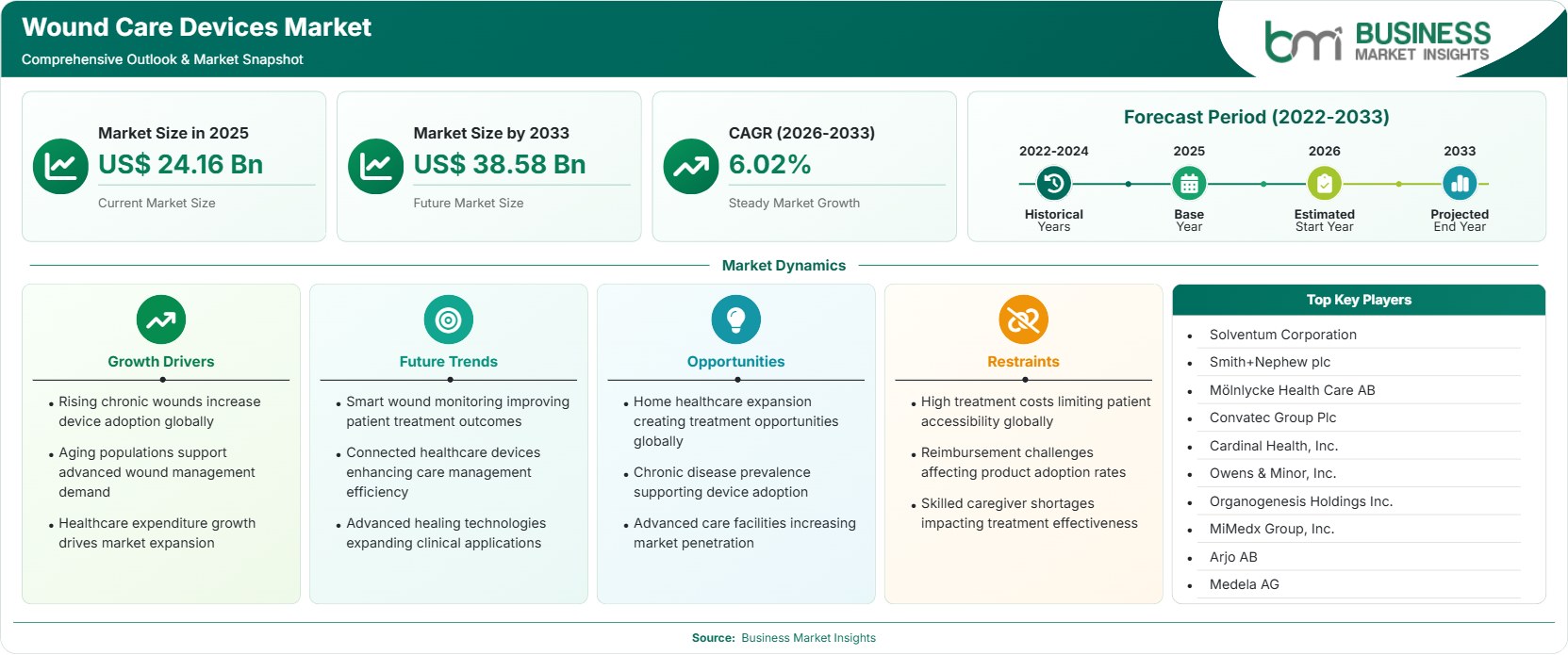
The Wound Care Devices Market size was valued at US$ 24.16 Billion in 2025 and is projected to reach US$ 38.58 Billion by 2033, growing at a CAGR of 6.02% during 2026–2033, driven by chronic wounds, advanced wound therapies, homecare adoption, and technology-led clinical efficiency.

Report Coverage
  • Product Type: Negative Pressure Wound Therapy, Hyperbaric Oxygen Therapy, Extracorporeal Shock Wave Therapy, Others
  • Indication: Diabetic Foot Ulcers, Pressure Ulcers, Surgical Wounds, Others
  • End User: Hospitals, Clinics, Homecare Settings, Others
US$ 24.16 Bn Market size in 2025
US$ 38.58 Bn Market Size by 2033
6.02% CAGR, 2026 - 2033
2026-2033 Forecast Period

AI Overview

Wound Care Devices Market Summary

  • North America Region: North America holds a market share of 34%–37% in 2025, growing at a CAGR of 5.5%–6.0%, influenced by advanced hospitals, reimbursement infrastructure, chronic wound prevalence, established manufacturers, outpatient migration, and home-based therapy adoption. The US accounts for most regional demand, supported by advanced wound centers, NPWT adoption, diabetic wound management, and technology-enabled post-acute care pathways, with a 2026–2033 CAGR of 5.3%–5.8%.
  • Fastest Growing Region: Asia Pacific holds a market share of 23%–26% in 2025, advancing at a CAGR of 6.8%–7.4%, supported by diabetes prevalence, expanding hospitals, improving specialist capacity, medical-device localization, healthcare infrastructure investment, and wider availability of advanced wound technologies.
  • Leading Segment: Negative Pressure Wound Therapy holds a 48%–52% share in 2025, advancing at a CAGR of 6.3%–6.8%, supported by broad clinical indications, established evidence, portable systems, post-surgical applications, and increasing transition from hospitals toward post-acute and home settings.
  • High Growth Segment: Homecare Settings account for a 10%–14% share in 2025, expanding at a CAGR of 7.5%–8.2%, supported by portable pumps, simplified interfaces, remote monitoring, reduced inpatient utilization, caregiver training, and reimbursement models favoring lower-cost care pathways.
  • Key Market Opportunity: Portable NPWT, digitally monitored therapy, pressure-injury prevention, and integrated diabetic wound pathways create opportunities for manufacturers to combine devices, consumables, software, clinical education, and recurring service revenue.
  • Major Market Players: Solventum Corporation, Smith+Nephew plc, Mölnlycke Health Care AB, Convatec Group Plc, Cardinal Health, Inc., Owens & Minor, Inc., Organogenesis Holdings Inc., MiMedx Group, Inc., Arjo AB, and Medela AG.
Strategic Insights

Wound Care Devices Market: Strategic Insights

Wound Care Devices Market Strategic Framework
FREE PDF
Request your free sample
Request free sample
Stakeholder View

Key Takeaways

  • Device manufacturers increasingly operate within broader wound-care ecosystems involving pumps, dressings, tissue technologies, monitoring systems, distributors, clinicians, homecare providers, and reimbursement stakeholders.
  • NPWT remains the principal device category, while homecare delivery offers a distinct expansion pathway as portable systems enable therapy outside conventional inpatient environments.
  • Product development is moving toward lighter pumps, automated pressure control, single-use configurations, digital alerts, improved dressings, and integrated monitoring that reduce clinician workload.
  • Asia Pacific combines a large diabetes population with expanding hospital capacity and improving specialist care, creating room for localized manufacturing, education, and distribution partnerships.
  • Capital is increasingly directed toward differentiated wound technologies, regenerative products, pressure-injury prevention, and manufacturing capacity. Organogenesis, for example, announced plans for a new Rhode Island biomanufacturing facility in 2025.
Geographic Outlook

Wound Care Devices Market Regional Highlights

North America Wound Care Devices Market

North America represented a 34%–37% share in 2025 and is projected to expand at a 5.5%–6.0% CAGR through 2033. The Wound Care Devices Market share reflects strong hospital purchasing, established reimbursement mechanisms, high NPWT penetration, and extensive specialist networks. The US dominates regional demand, while Canada contributes through public healthcare procurement and chronic wound programs. Device suppliers increasingly emphasize portable therapy, post-acute transitions, clinical evidence, and connected support services.

  • Chronic wound management is reinforced by diabetes prevalence, with the US recording approximately 38.5 million adults with diabetes in 2024, sustaining demand for advanced wound interventions.
  • Portable NPWT systems are gaining relevance as providers seek continuity between hospital discharge, skilled nursing, ambulatory care, and home treatment.
  • Manufacturers increasingly compete through clinical evidence, simplified interfaces, consumable availability, and service capabilities rather than pump hardware alone.
  • Pressure-injury prevention is becoming more integrated with wound treatment, creating opportunities for mattresses, monitoring technologies, positioning systems, and digital workflows.

US Wound Care Devices Market

The US accounted for approximately 76%–79% of North American demand in 2025 and is projected to grow at a 5.3%–5.8% CAGR through 2033. The Wound Care Devices Market in the country benefits from sophisticated reimbursement, specialist wound centers, extensive home health infrastructure, and substantial demand for NPWT. IDF estimates 38.5 million US adults had diabetes in 2024, strengthening the clinical need for diabetic-foot management and wound-healing technologies.

  • Hospital systems continue to adopt advanced devices where clinical evidence can demonstrate reductions in complications, treatment burden, length of stay, or repeat procedures.
  • Home-based NPWT benefits from portable systems and patient-support tools, including digital resources that help caregivers manage therapy outside hospitals.
  • Reimbursement changes can materially influence regenerative wound products, device utilization, pricing, and provider purchasing decisions.

Europe Wound Care Devices Market

Europe held a 27%–30% share in 2025 and is estimated to expand at a 5.7%–6.2% CAGR through 2033. Germany, the UK, France, Italy, and Spain form important demand centers, while Germany and the UK provide strong specialist-care ecosystems. The Wound Care Devices Market is shaped by chronic wound management, healthcare efficiency, evidence-based procurement, and movement toward outpatient treatment. Smith+Nephew reported the European rollout of ALLEVYN COMPLETE CARE in 2026, illustrating continuing product expansion.

  • Germany remains a major commercial market, with early traction reported for newly launched advanced wound products during 2026.
  • The UK supports demand through tissue-viability services, community nursing, diabetic-foot pathways, and pressure-injury prevention programs.
  • France and Italy offer opportunities through hospital modernization and increasing adoption of advanced wound-management protocols.
  • Spain presents both opportunity and procurement complexity, with Smith+Nephew citing tender timing and physician strikes as factors affecting 2026 performance.

Asia Pacific Wound Care Devices Market

Asia Pacific held a 23%–26% share in 2025 and is projected to expand at a 6.8%–7.4% CAGR through 2033. China, Japan, India, South Korea, and Australia are key markets, while India and China provide substantial long-term demand because of large diabetic populations. The Wound Care Devices Market growth is supported by hospital expansion, local manufacturing, specialist education, and improving access to advanced technologies. IDF reports 148 million adults with diabetes in China and approximately 90 million in India.

  • China combines large patient volumes with growing domestic medical-device capabilities and increasingly localized healthcare supply chains.
  • India offers substantial opportunities through diabetic-foot care, expanding tertiary hospitals, private healthcare investment, and growing specialist wound-care awareness.
  • Japan and South Korea support premium device adoption through advanced hospitals, aging populations, and established medical technology infrastructure.
  • Australia provides a mature market for evidence-led wound management, community care, pressure-injury prevention, and remote patient support.

Rest of World Wound Care Devices Market

Rest of World represented a 14%–17% share in 2025, with a projected 5.4%–6.0% CAGR through 2033. South and Central America are supported by expanding private healthcare and diabetes management, while Brazil and Mexico provide major regional opportunities. The Middle East and Africa demand is concentrated in urban hospitals, specialty centers, and private healthcare networks, with Gulf markets supporting premium technology adoption and selected African markets emphasizing affordable and durable solutions.

  • Brazil and Mexico provide scalable opportunities through private hospitals, diabetic-foot programs, specialist wound clinics, and distributor-led technology expansion.
  • Gulf markets can support premium NPWT and hyperbaric technologies because investment in tertiary hospitals and specialist medical infrastructure remains comparatively strong.
  • South Africa represents a regional hub for advanced clinical services, while broader African adoption depends heavily on affordability, training, supply reliability, and specialist availability.
  • Latin American providers increasingly evaluate technologies based on total treatment cost, consumable efficiency, and clinical workflow rather than acquisition price alone.
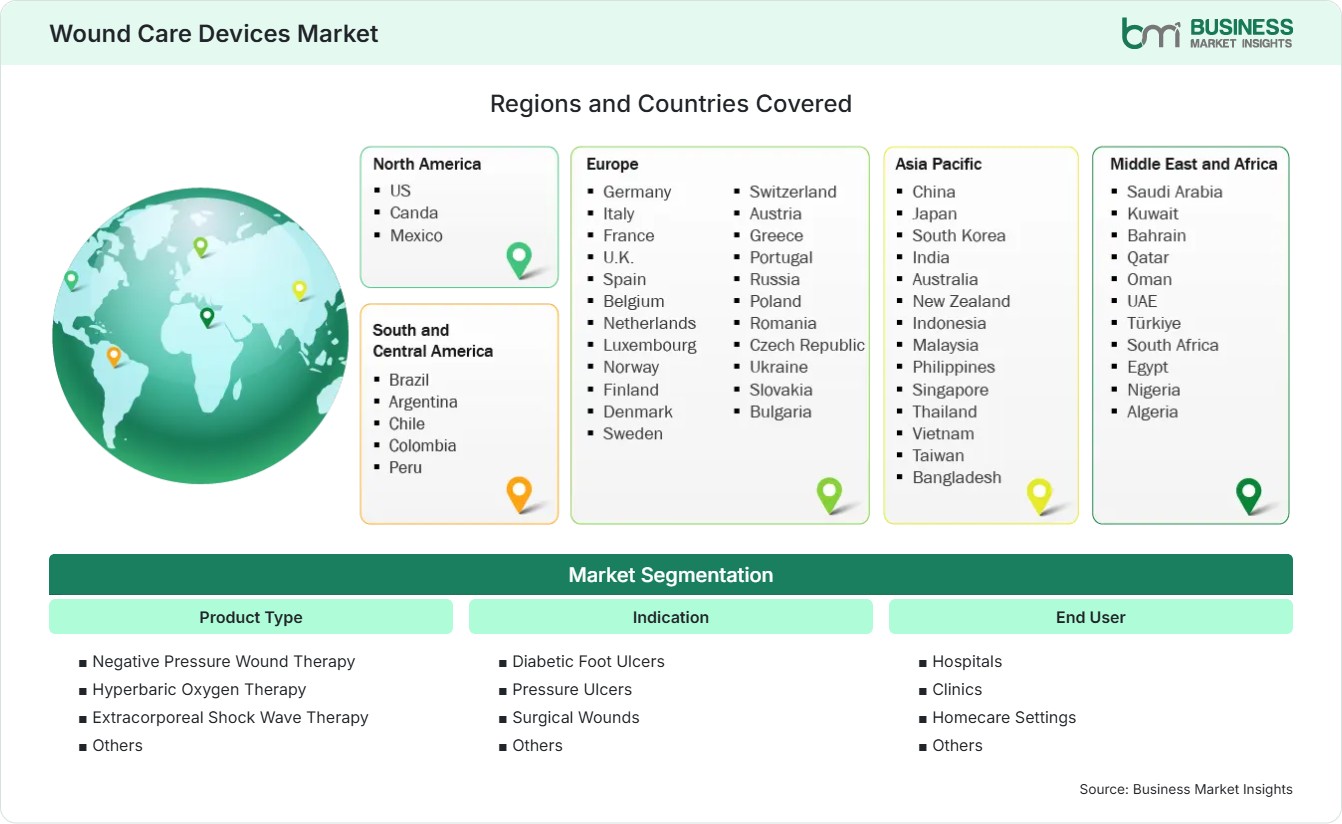
Global Market Geography
FREE PDF
Request your free sample
Request free sample
Segment Analysis

Wound Care Devices Market Segmentation

Product Type

Product Type remains the central technology segmentation, with Negative Pressure Wound Therapy leading at a 48%–52% share in 2025 and a 6.3%–6.8% CAGR through 2033. Adoption is driven by clinical familiarity, broad indications, portable systems, and expanding post-acute use. The Wound Care Devices Market trends increasingly favor integrated pumps and consumables.

  • Negative Pressure Wound Therapy (NPWT): NPWT dominates advanced device utilization because controlled negative pressure supports exudate management, granulation, and wound-bed preparation across acute, surgical, chronic, and post-acute wounds.
  • Hyperbaric Oxygen Therapy (HBOT): HBOT is applied selectively for complex wounds requiring enhanced tissue oxygenation, with utilization influenced by specialist availability, chamber infrastructure, clinical protocols, and reimbursement.
  • Extracorporeal Shock Wave Therapy (ESWT): ESWT provides a non-invasive adjunct for selected difficult-to-heal wounds, attracting interest where providers seek regenerative stimulation without increasing procedural invasiveness.

Indication

Indication demand is led by chronic and difficult-to-heal wounds, with diabetic-foot management receiving increasing attention as diabetes prevalence expands. The Wound Care Devices Market scope includes diabetic-foot ulcers, pressure ulcers, surgical wounds, and other applications, each requiring different therapy intensity, clinical protocols, and device configurations.

  • Diabetic Foot Ulcers: DFUs require prolonged multidisciplinary management, creating demand for advanced wound devices, offloading, infection control, debridement, tissue technologies, and adjunctive therapies.
  • Pressure Ulcers: Pressure-ulcer management combines prevention and treatment, increasing demand for pressure redistribution, monitoring, advanced dressings, and therapeutic devices across hospitals and long-term care.
  • Surgical Wounds: Surgical applications benefit from portable NPWT and specialized incision-management systems that support wound protection, fluid management, and continuity following hospital discharge.

End User

Hospitals continue to be the leading end users due to the complex nature of wounds, which may require more specialized evaluation and equipment. The Homecare Settings have been identified as the fastest-growing end users, thanks to portable treatment methods and less-intensive treatment regimes. Consequently, the Wound Care Devices Market is expanding into inpatient, outpatient, and home care facilities.

  • Hospitals: Hospitals generate substantial demand for NPWT, HBOT, pressure-injury systems, and postoperative wound technologies because of high patient acuity and specialist infrastructure.
  • Clinics: Clinics increasingly adopt compact wound technologies as chronic wound management moves toward outpatient treatment, reducing dependence on hospital-based procedures.
  • Homecare Settings: Homecare adoption is supported by portable pumps, simplified controls, caregiver education, and patient-support applications designed to sustain therapy after discharge.
Market Forces

Wound Care Devices Market Dynamics

Key Market Drivers

Rising Global Diabetes Burden Expands Chronic Wound Demand

According to the International Diabetes Federation, an estimated 589 million adults aged between 20 and 79 had diabetes in 2024, and this number is expected to rise to 853 million by 2050. As the incidence of the disease rises, the number of patients needing diabetic foot monitoring and management will increase. Consequently, the Wound Care Devices Market growth will experience growth as a result of its structural growth drivers, which go beyond short-term procedure cycles. Over 80% of those with diabetes are in developing and middle-income countries, making scalable devices increasingly important. In 2024, India had an estimated 89.8 million adults with diabetes, while China had an estimated 148 million.

Clinical Evidence Strengthens Adoption of Advanced NPWT

NPWT adoption is reinforced by extensive clinical evidence and broad wound indications. Solventum states that V.A.C. Therapy has more than 2,000 peer-reviewed publications and 113 randomized trials supporting the technology. This kind of information allows hospitals and healthcare providers to analyze NPWT vis-à-vis outcomes in wound healing, treatment duration, complications, and hospitalization. Thus, the Wound Care Devices Market trends support the development of solutions that combine clinically proven pressure delivery with reliable dressings, alarms, and consumables. The same strategy is pursued by Smith+Nephew with its PICO and RENASYS lines.

Transition Toward Portable and Lower-Intensity Care

Selected wound care management tasks are being moved from hospitals to ambulatory, post-acute, and home settings. Portable NPWT devices offer a smaller device footprint while maintaining continuity of care after hospital discharge. Smith+Nephew markets the RENASYS GO for use in the post-acute and home settings, while Solventum offers patient support and an app that helps with therapy and supplies management. The move is likely to contribute positively to the Wound Care Devices Market growth by increasing the treatable environment outside hospitals. It also changes the purchase criteria, placing greater emphasis on battery life, ease of use, alarms, dressing, patient mobility, caregiver education, and remote assistance than on the pump itself.

Key Market Opportunities

Connected Wound Therapy Creates a Digital Revenue Layer

Connected technologies have the potential to revolutionize wound care therapy, shifting it from a one-time equipment purchase to a connected, data-enabled wound care service. The ability to track therapy disruptions, manage pressure, receive automatic alerts, capture digital measurements, and use cloud analytics can help identify disruptions and enable remote monitoring. This potential is greatest when there is an established pathway for home care and the need for information on compliance and device status. Connected device vendors can develop solutions that include connected hardware, software services, clinician dashboards, caregiver education and training, and consumables. Wound Care Devices Market Forecasts thus increasingly depend on manufacturers' ability to translate digital capabilities into clinical value.

Asia Pacific Localization Can Lower Adoption Barriers

Equipment manufacturers see many opportunities in Asia Pacific for manufacturing localization, clinician training, distribution, and service. The presence of a large number of diabetics will create demand, but a high price tag, lack of specialization, and a poor distribution network may be barriers. Issues may be solved by localizing manufacturing, establishing regional supply agreements, conducting educational programs for clinicians, and using simple systems. Countries such as India and China should be prioritized due to large populations of diabetics. Also, manufacturers can tailor consumables configuration to the local hospital purchasing process and set up regional service centers. This is not limited to equipment sales since local partners can provide additional services.

Integrated Pressure Injury Prevention Can Broaden Device Portfolios

There is an adjacent market opportunity for wound-care device manufacturers in preventing pressure injuries. Arjo provides alternating-pressure mattresses and continuous low-pressure mattresses, which are examples of the ecosystem that ties prevention, positioning, pressure management, and wound care together. A combination of products could incorporate support surfaces, monitoring, positioning, and clinical guidelines to address the problem of wound development before advanced treatment is required. By incorporating prevention technologies into their wound management platforms, manufacturers will have the opportunity to negotiate comprehensive agreements across the entire facility rather than for individual devices.

Market Restraints and Challenges

Reimbursement Complexity Can Slow Adoption of Premium Technologies

Factor: Reimbursement varies widely based on therapy, indication, setting, and geography, and may change as policies evolve. Impact: Manufacturers cannot be sure about pricing, purchasing, or availability. Smith+Nephew explained in 2026 that changes in reimbursement for skin substitutes had resulted in reductions in both volume and prices for non-surgical use cases, showing how reimbursement shifts can quickly impact wound care product lines. Even though this factor applies specifically to regenerative medical devices, not all types of devices, it shows how sensitive wound care economics can be to payer policy.

Specialist Skill Requirements Limit Utilization in Underserved Settings

Factor: Sophisticated wound devices necessitate proper patient selection, wound evaluation, application of dressings, configuration of the device, monitoring, and escalation. Impact: A shortage of specialists can limit the adoption of technology and weaken the business case for advanced technologies in small facilities and developing markets. While negative-pressure wound therapy (NPWT) is relatively easy to transport, its treatment efficacy depends on properly trained health care providers and caregivers. Manufacturers can overcome this barrier through simpler user interfaces, standardized procedures, multilingual education, remote assistance, and distributor training. This problem will be most prominent in rural and low-resourced settings where equipment availability will outstrip specialist availability.

Company Analysis

Competitive Landscape

The Wound Care Devices Market analysis indicates competition across NPWT, advanced wound technologies, pressure-injury prevention, regenerative products, and care-delivery services. Major companies differentiate through clinical evidence, consumables, product breadth, geographic reach, reimbursement expertise, and technology integration.

Company Name

Overview

Products and Services relevant to this market

Solventum Corporation

Global healthcare technology company with a major advanced wound-care franchise and extensive NPWT evidence base.

V.A.C. Therapy, Veraflo Therapy, NPWT pumps, dressings, clinical guidelines, patient support, and wound-management resources.

Smith+Nephew plc

Global medical technology company with advanced wound management spanning dressings, bioactives, devices, and pressure-injury prevention.

PICO single-use NPWT, RENASYS systems, ALLEVYN dressings, SANTYL, LEAF monitoring, and related wound technologies.

Mölnlycke Health Care AB

Wound-care specialist focused on prevention, advanced dressings, surgical care, and clinical workflow improvement.

Mepilex, Exufiber, incision dressings, pressure-injury prevention, NPWT, wound cleansing, and digital solutions.

Convatec Group Plc

Global chronic-care company with an extensive advanced wound-care portfolio.

AQUACEL Hydrofiber dressings, Avelle NPWT, antimicrobial products, surgical dressings, hydrocolloids, and wound-bed preparation technologies.

Cardinal Health, Inc.

A healthcare services and products company serving providers through medical products, distribution, and clinical supply capabilities.

Wound-care supplies, medical products, distribution services, clinical support, and healthcare supply-chain solutions.

Owens & Minor, Inc.

Global healthcare logistics and products provider with self-manufactured and sourced medical-product portfolios.

HALYARD, MediChoice, Medical Action products, clinical supplies, distribution, and supply-chain services supporting wound care.

Organogenesis Holdings Inc.

Regenerative medicine company specializing in advanced wound-care products and biologic technologies.

Apligraf, PuraPly, Affinity, NuShield, CYGNUS, reimbursement support, and regenerative wound-care services.

MiMedx Group, Inc.

Regenerative medicine company developing placental tissue products for wound and surgical applications.

AMNIOFIX and related placental allograft technologies are compatible with selected wound-care pathways.

Arjo AB

Medical technology company specializing in patient mobility, pressure injury prevention, and care-environment solutions.

Alternating-pressure mattresses, continuous-low-pressure systems, pressure redistribution technologies, and prevention solutions.

Medela AG

Healthcare technology company with a wound-therapy portfolio focused on portable negative-pressure systems.

Invia NPWT systems, wound therapy pumps, dressings, accessories, and related clinical support solutions.

Trust & Transparency

Research Methodology

The market analysis combines proprietary research with secondary data from government agencies, company disclosures, regulatory filings, industry databases and expert interviews. Market estimates are validated through data triangulation, cross-market benchmarking and analyst review.

View Full Research Methodology

Questions Answered

Frequently Asked Questions

What makes the Wound Care Devices Market Report useful for investors?

The report connects device technologies with indications, end users, regional demand, competitive strategies, innovation themes, reimbursement considerations, and emerging opportunities across hospital and homecare pathways.

How are manufacturers differentiating wound-care devices?

Differentiation increasingly centers on clinical evidence, therapy reliability, portability, dressing design, digital monitoring, consumable ecosystems, clinician education, and reimbursement support.

Which wound indication has strong structural demand?

Diabetic foot ulcers have a substantial long-term demand base because diabetes prevalence continues to increase globally. IDF estimates 589 million adults were living with diabetes in 2024.

Why is homecare becoming important for advanced wound therapy?

Portable pumps, simplified controls, patient-support applications, and post-discharge clinical pathways allow selected wound treatments to continue outside hospitals, supporting lower-intensity care and greater patient mobility.

What technologies are included in the Wound Care Devices Market Report?

The scope covers Negative Pressure Wound Therapy, Hyperbaric Oxygen Therapy, Extracorporeal Shock Wave Therapy, and other wound-care devices, segmented by indication and end user.

Access the Full Wound Care Devices Market Report

Get segment-level forecasts, regional estimates, competitive benchmarking, company profiles and downloadable Excel datasets.

Access the full Wound Care Devices Market Report
350 pages PDF & Excel | 2026-10-26
Similar Research

Related Market Reports