Market Summary
Executive Summary and Global Market Analysis
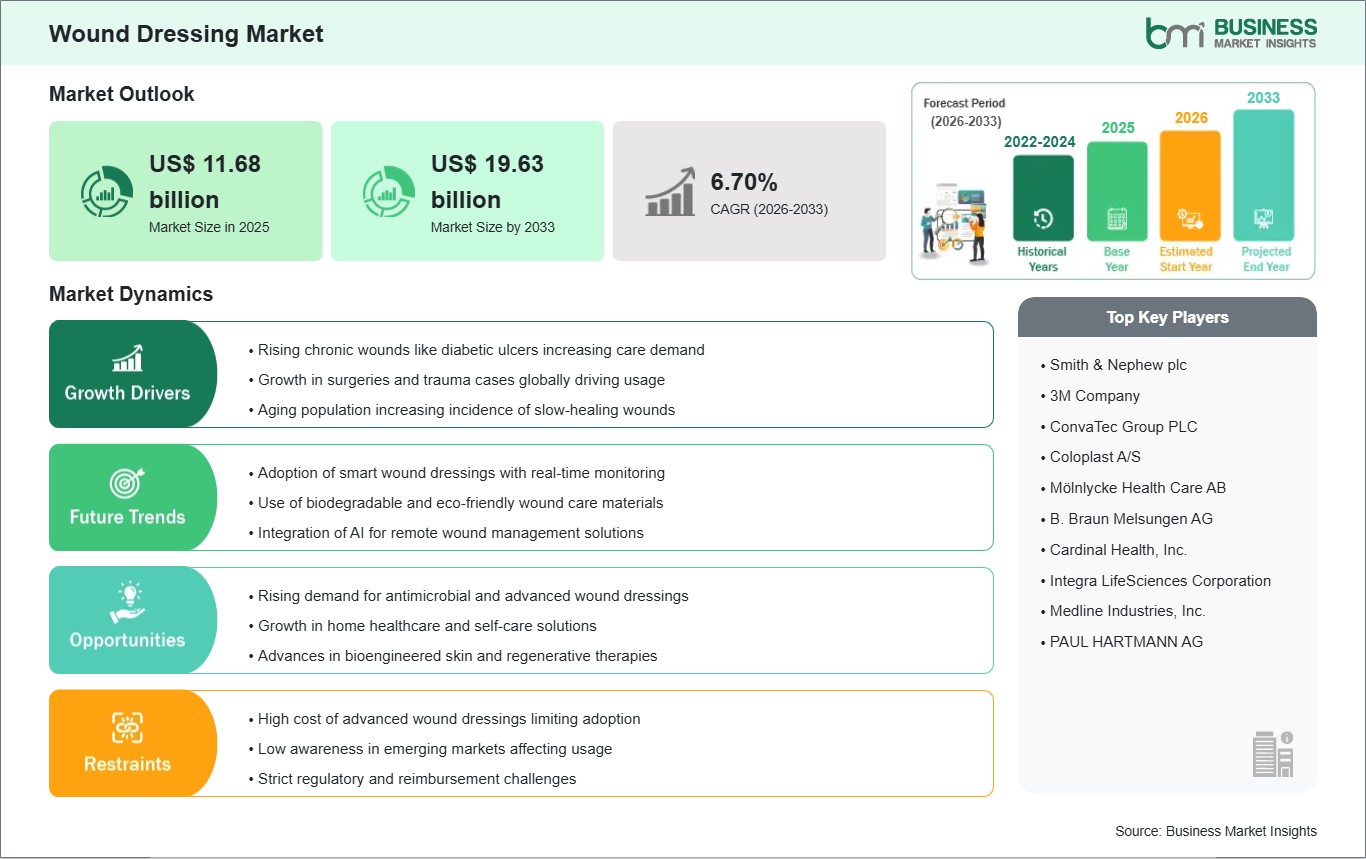
Wound dressing refers to a sterile covering or pad applied directly to a wound to promote healing and protect the injury from further harm. These products provide critical strategic value by reducing healing times and preventing costly complications such as surgical site infections across hospitals, specialized wound clinics, and home healthcare settings. Market expansion is primarily attributed to the global increase in chronic lifestyle diseases, particularly diabetes and obesity, which lead to hard-to-heal ulcers. Furthermore, the shift toward outpatient and home-based care is substantially increasing the demand for user-friendly, long-wear dressings that minimize the frequency of professional clinical intervention.
However, several factors can restrain market growth. High price premiums for advanced and smart dressings often limit their adoption in resource-constrained environments where traditional gauze remains the standard of care. Strict regulatory scrutiny regarding cumulative exposure to certain antimicrobial ions and the complex clinical evidence required for reimbursement approval can delay the introduction of innovative materials. Additionally, the industry faces constraints due to a lack of specialized training for clinicians and caregivers in emerging markets, leading to improper dressing selection and suboptimal patient outcomes.
Despite these hurdles, the market finds immense opportunities in the development of smart dressings equipped with sensors to monitor pH and temperature levels in real-time. The rise of decentralized tele-wound-care and the expansion of bio-derived, compostable materials to meet hospital sustainability targets are expected to support long-term development within the sector.
Segment Analysis
Wound Dressing Market Segmentation
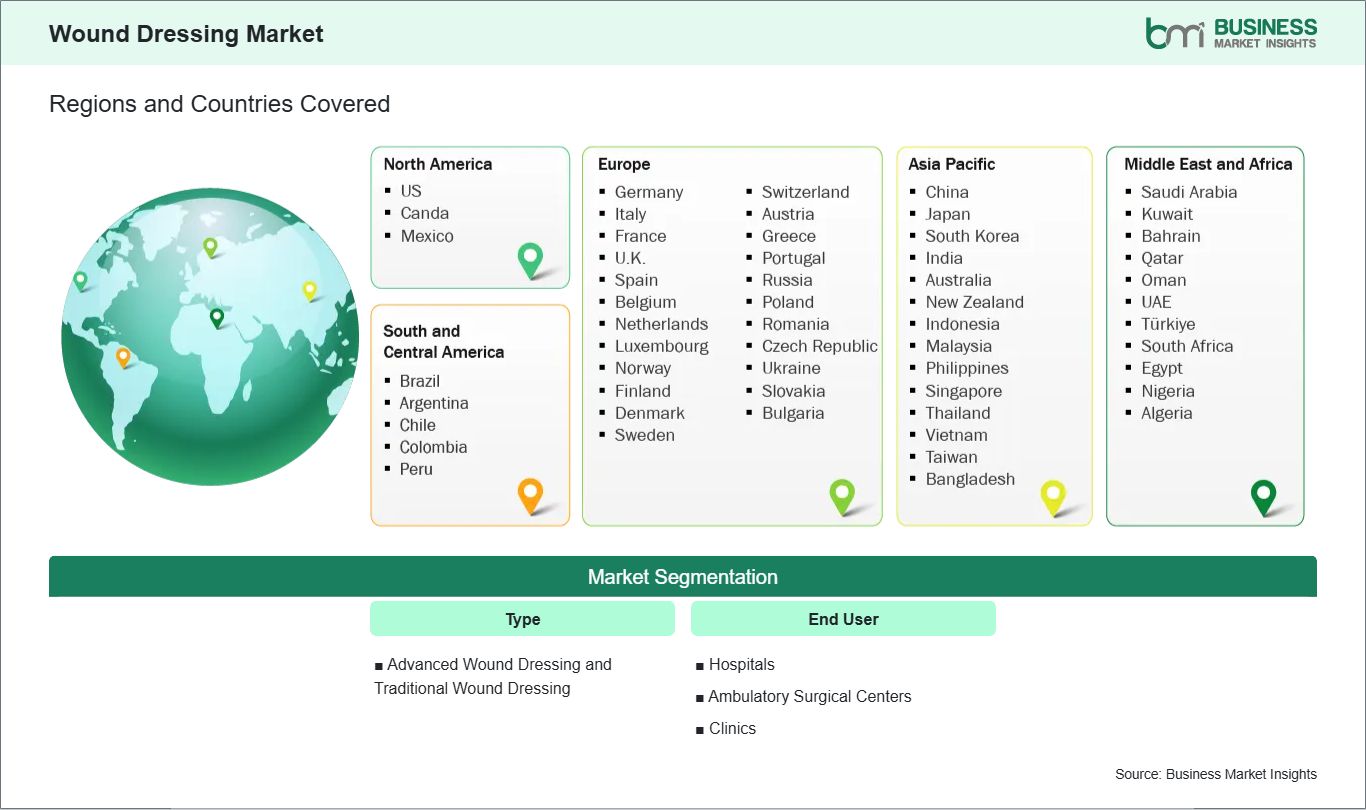
Key segments that contributed to the derivation of the Wound Dressing market analysis are type, application, and end user.
- By Type, the market is segmented into Advanced Wound Dressing and Traditional Wound Dressing.
- By Application, the market is divided into Chronic Wound and Acute Wound.
- By End User, the market is categorized into Hospitals, Ambulatory Surgical Centers, and Clinics.
Market Forces
Wound Dressing Market Drivers and Opportunities
The Chronic Disease Epidemic and the Integration of Smart Monitoring
The primary driver for the Wound Dressing Market is the accelerating global prevalence of chronic conditions that impair natural healing, most notably diabetes and obesity. The Increasing Burden of Diabetic Foot Ulcers, Pressure Ulcers, and Venous Leg Ulcers acts as a dominant catalyst, as these hard-to-heal wounds require long-term, specialized care to prevent infections and amputations. This momentum is further propelled by the Rising Volume of Surgical Procedures and Traumatic Injuries; as medical interventions become more accessible globally, the demand for post-operative dressings that prevent surgical site infections (SSIs) is reaching unprecedented levels. In the technological sphere, the Integration of Artificial Intelligence (AI) and Digital Monitoring serves as a major driver, with new smart dressings utilizing embedded sensors to track pH levels, temperature, and moisture, alerting clinicians to potential infections in real-time. Furthermore, the Expansion of Home Healthcare and Decentralized Care Models is encouraging the development of user-friendly, high-performance dressings that patients or non-specialized caregivers can manage outside of traditional hospital settings. Together, these factors, the chronic wound crisis, surgical growth, and digital connectivity, ensure a robust and technologically sophisticated growth path for the global wound care landscape.
Bioactive Regenerative Materials and AI-Native Assessment
A significant high-value opportunity lies in the convergence of Wound Dressings with Bioactive and Regenerative Medicine. Next-generation active dressings are being developed with growth factors, stem cells, and extracellular matrices that do more than just protect; they actively stimulate cell proliferation and angiogenesis to restart the healing process in stagnant chronic wounds. There is also a major growth frontier in the development of Sustainable and Biodegradable Dressing Solutions; as healthcare systems prioritize green procurement, there is a lucrative opening for antimicrobial dressings made from marine biopolymers and other eco-friendly materials that reduce medical waste. Furthermore, the expansion of AI-Powered Remote Assessment Tools presents a unique opportunity, where smartphone-based imaging can analyze wound progression and recommend specific dressing protocols, bridging the gap between home care and specialist expertise. Beyond basic materials, the rise of 3D-Printed, Patient-Specific Dressings offers a significant frontier, allowing for the creation of custom-shaped interfaces that conform perfectly to irregular wound geometries, such as deep traumatic injuries or complex burns. Manufacturers who focus on Manuka Honey-Based Antimicrobials and those pioneering Non-Invasive Oxygen-Enhancing Interfaces are positioned to lead the most innovative and high-margin segments of the global wound dressing market.
Size and Share Analysis
Wound Dressing Market Size and Share Analysis
The Wound Dressing market demonstrates steady growth, with size and share analysis revealing evolving trends and competitive positioning among key players. The report examines subsegments categorized within type, application, and end user, offering insights into their contribution to overall market performance.
Based on type, the Advanced Wound Dressing and Traditional Wound Dressing subsegments hold distinct market presence, reflecting the spectrum from basic trauma care to complex chronic management. Advanced Wound Dressing is indispensable for the Modern Clinical vertical, as products like foams, alginates, and hydrocolloids offer superior moisture balance and gas exchange, which are critical for closing difficult wounds. A notable trend is the surge in the Antimicrobial and Bioactive subsegments, which are registering a higher pace of adoption. These dressings are becoming essential for Infection-Prone Environments, utilizing silver, honey, or growth-factor coatings to disrupt biofilms and accelerate the cellular repair process, effectively reducing the total cost of care by shortening hospital stays.
Report Coverage
Wound Dressing Market Report Coverage and Deliverables
The "Wound Dressing Market Size and Forecast (2022–2033)" report provides a detailed analysis of the market covering below areas:
- Wound Dressing market size and forecast at global, regional, and country levels for all market segments covered under the scope
- Wound Dressing market trends, as well as drivers, restraints, and opportunities
- Wound Dressing market analysis covering key trends, global and regional framework, major players, regulations, and recent developments
- Industry landscape and competition analysis covering market concentration, heat map analysis, prominent players, and recent developments for the Wound Dressing market
- Detailed company profiles, including SWOT analysis
Geographic Insights
Wound Dressing Market Geographic Insights
The geographical scope of the Wound Dressing market report is divided into five regions: North America, Asia Pacific, Europe, Middle East & Africa, and South & Central America.
North America maintains the leading position within the global industry, supported by a highly developed healthcare infrastructure and a substantial prevalence of chronic conditions such as diabetic foot ulcers and pressure injuries. Europe represents a sophisticated market segment characterized by intensive research into bioactive materials and a robust regulatory framework that emphasizes clinical efficacy and patient safety. Asia Pacific is identified as the most rapidly expanding region, propelled by accelerating urbanization, a growing geriatric demographic, and significant public and private investments in surgical and diagnostic facilities.
The Asia-Pacific Wound Dressing Market is segmented into China, Japan, South Korea, India, Australia, and the Rest of Asia Pacific. China is a primary driver of regional volume, benefiting from a large patient population and the expansion of domestic manufacturing capabilities for advanced dressings. India is witnessing a transition toward specialized wound care as healthcare expenditure rises and the incidence of lifestyle-related chronic wounds increases. Japan continues to lead in the integration of high-technology solutions, particularly in the development of moisture-retentive and antimicrobial dressings tailored for an aging workforce, while Australia shows steady growth in the adoption of negative pressure wound therapy and skin substitutes.
Industry Activity
Recent Developments
The Wound Dressing market is evaluated by gathering qualitative and quantitative data post primary and secondary research, which includes important corporate publications, association data, and databases. A few of the key developments in the Wound Dressing market are:
- In Jan 2026, Tiger BioSciences acquired Platelet-Rich Fibrin Matrix (PRFM) technology and advanced wound dressing platform from Bahia Medical. This acquisition expands Tiger BioSciences’ autologous wound care capabilities, enhances treatment options for chronic and complex wounds, and strengthens innovation in the wound dressing market.
- In July 2025, MIMEDX partnered with Vaporox to co-promote and co-market Vaporox`s Vaporous Hyperoxia Therapy (VHT) device alongside MIMEDX`s placental allografts. This collaboration expands advanced wound care options, supports adoption of innovative therapies for chronic and hard-to-heal wounds, and positively influences the wound dressing market.
Trust & Transparency
Research Methodology
The market analysis combines proprietary research with secondary data from government agencies, company disclosures, regulatory filings, industry databases and expert interviews. Market estimates are validated through data triangulation, cross-market benchmarking and analyst
review.
View Full Research Methodology
Key Sources Referred:
World Bank – Global Trade IndicatorsWorld Trade Organization (WTO)(International Monetary Fund )IMFInternational Trade Administration (ITA)Company websiteCompany annual reportsCompany investor presentations