Market Summary
Executive Summary and Global Market Analysis
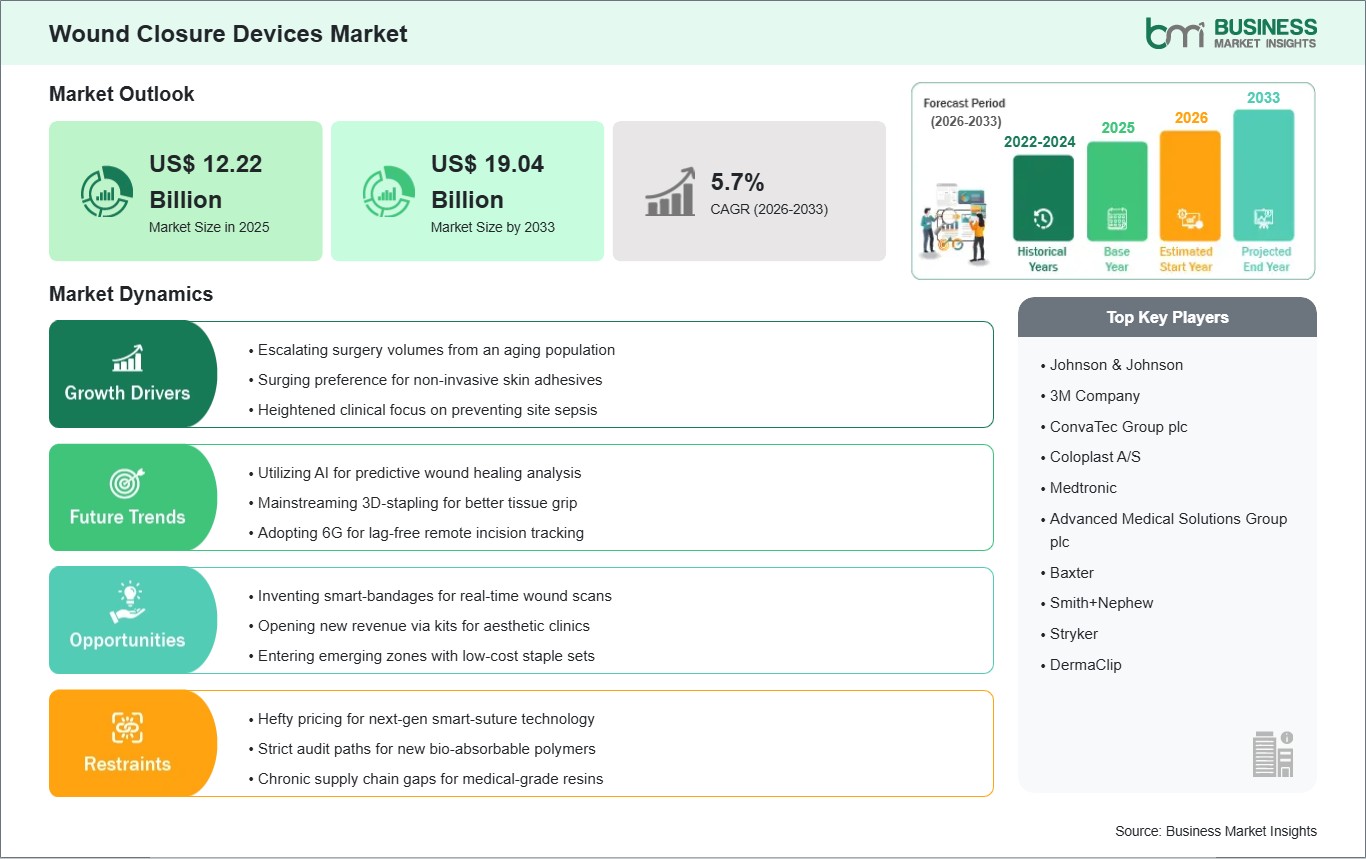
Wound closure devices are specialized medical instruments and materials, such as sutures, staples, and adhesives, used to join tissue edges together following surgery or injury. Their primary function is to secure the wound site, minimize the risk of infection, and facilitate the natural healing process by maintaining tissue approximation. The Wound Closure Devices Market provides the essential surgical and trauma-care hardware necessary for tissue repair and post-operative recovery. It encompasses key equipment and services: surgical sutures (absorbable and non-absorbable), mechanical staplers, tissue adhesives and sealants, and wound closure strips. These devices have several key benefits. They provide strong support for deep tissue, lower the risk of surgical site infections (SSIs), and help reduce scarring for better cosmetic results. The market is growing as more surgeries are being performed worldwide, chronic wounds such as diabetic foot ulcers are becoming more common, and injuries from accidents. The move to advanced bio-based sealants is further making tissue bonding safer and faster.
However, several challenges can restrain market growth: the high initial capital expenditure and complexity associated with advanced mechanical stapling and automated closure systems can be substantial for rural healthcare facilities. Intensifying pricing pressure due to a crowded competitive landscape and the high cost of specialized hemostatic agents pose a constant margin hurdle for manufacturers. Furthermore, the industry faces constraints due to stringent regulatory approval cycles for new biomaterials and a persistent technical knowledge gap among practitioners regarding the application of next-generation adhesives versus traditional suturing. Despite these hurdles, the market holds immense opportunities as a result of the universal mandate for minimally invasive surgery, the accelerating deployment of smart sutures with integrated sensors for real-time infection monitoring, and the increasing reliance on 3D bioprinting for personalized skin substitutes. The transition toward nanotechnology-enhanced antimicrobial coatings and AI-driven surgical planning for optimal closure tension is expected to create significant opportunities for market growth.
Segment Analysis
Wound Closure Devices Market Segmentation
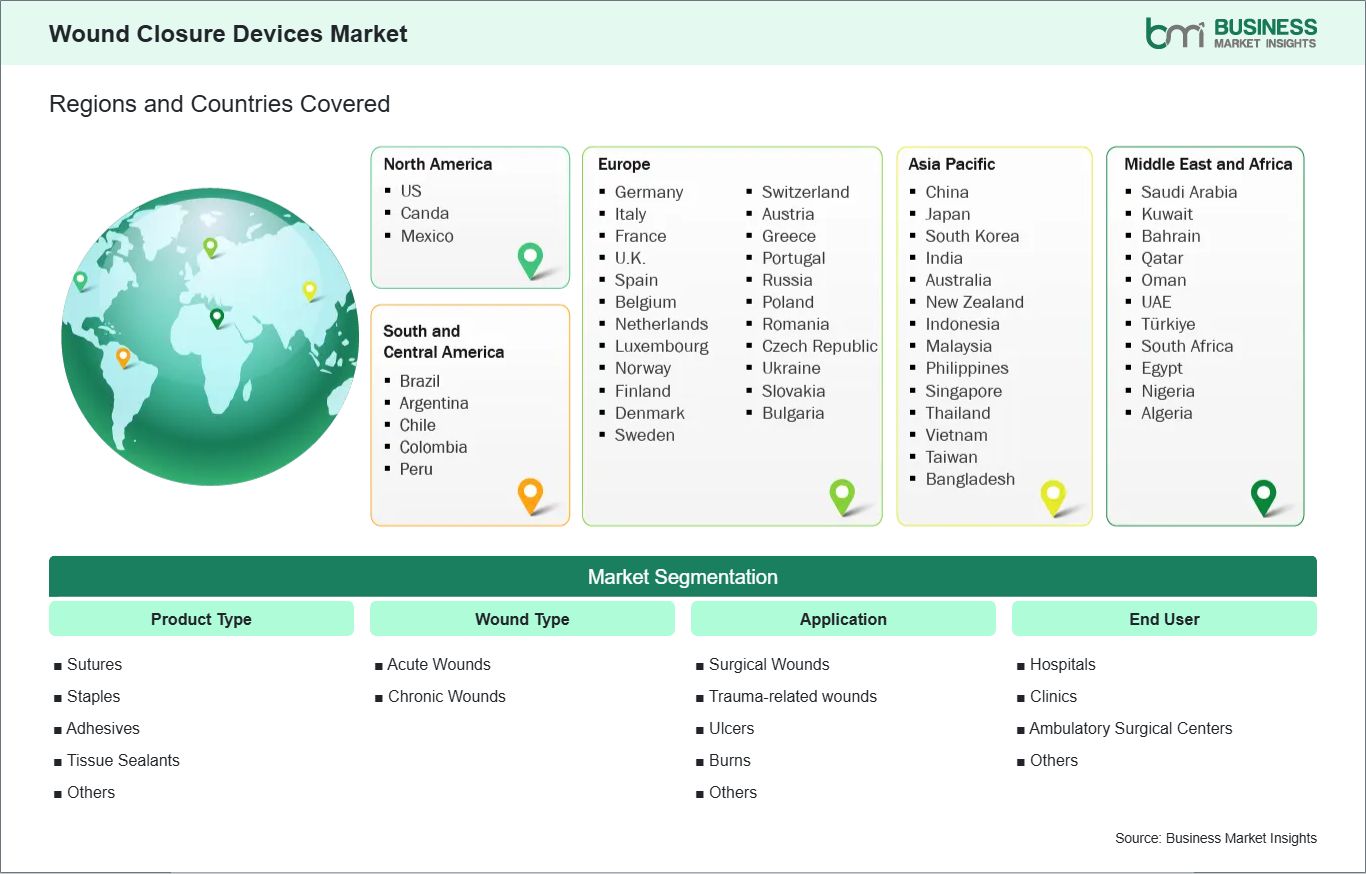
Key segments that contributed to the derivation of the Wound Closure Devices market analysis are product type, wound type, application, and end user.
- By Product Type, the market is segmented into Sutures, Staples, Adhesives, Tissue Sealants, and Others.
- By Wound Type, the market is segmented into Acute Wounds and Chronic Wounds.
- By Application, the market is segmented into Surgical Wounds, Trauma-related wounds, Ulcers, Burns, and Others.
- By End User, the market is segmented into Hospitals, Clinics, Ambulatory Surgical Centers, and Others.
Market Forces
Wound Closure Devices Market Drivers and Opportunities
Escalating Surgical Volumes and Cosmetic Procedures
The primary driver for the Wound Closure Devices market is the global surge in surgical procedures, from cardiovascular and orthopedic operations to cosmetic and plastic surgeries. As healthcare access expands and the geriatric population grows, the number of incisions needing secure and efficient closure has reached new levels. Surgeons now prioritize devices that minimize table time and reduce post-operative complications like dehiscence or site infections. This has led to strong demand for advanced sutures, mechanical staplers, and high-performance hemostats. In addition, growing consumer focus on aesthetic outcomes is driving the adoption of specialized closure tools that minimize scarring, especially in reconstructive and aesthetic surgery.
Advancements in Bio-Regenerative
A major opportunity exists in the development of intelligent, bio-absorbable closure solutions that can improve healing. The industry is moving away from traditional mechanical fasteners toward bioactive sealants and tissue adhesives that work like the body’s own clotting system. Several new products include antimicrobial-coated sutures to reduce hospital-acquired infections and smart closure systems that monitor wound temperature or pH, alerting clinicians to early signs of inflammation. Additionally, the rise of minimally invasive and robotic-assisted surgeries provides a fertile ground for the development of specialized, low-profile closure devices and automated suturing tools. By integrating these advanced materials into user-friendly, portable formats, manufacturers can tap into the rapidly expanding ambulatory surgical center (ASC) and home healthcare segments, where speed and ease of use are paramount.
Size and Share Analysis
Wound Closure Devices Market Size and Share Analysis
The Wound Closure Devices market demonstrates steady growth, with size and share analysis revealing evolving trends and competitive positioning among key players. The report further examines subsegments categorized within product type, wound type, application, and end user, offering insights into their contribution to overall market performance.
For instance, the Sutures segment remains a cornerstone of the market, frequently utilized for Acute Wounds in both Hospitals and Clinics. This is due to their versatility in handling various tissue depths and the continuous innovation in bioabsorbable and antimicrobial-coated materials. These advancements help reduce the risk of surgical site infections (SSIs) in Surgical Wounds, making them a preferred choice for traditional open surgeries where high tensile strength and secure closure are paramount.
Report Coverage
Wound Closure Devices Market Report Coverage and Deliverables
The "Wound Closure Devices Market Size and Forecast (2022 - 2033)" report provides a detailed analysis of the market covering below areas:
- Wound Closure Devices market size and forecast at global, regional, and country levels for all the key market segments covered under the scope
- Wound Closure Devices market trends, as well as market dynamics such as drivers, restraints, and key opportunities
- Wound Closure Devices market analysis covering key market trends, global and regional framework, major players, regulations, and recent market developments
- Industry landscape and competition analysis covering market concentration, heat map analysis, prominent players, and recent developments for the Wound Closure Devices market
- Detailed company profiles, including SWOT analysis
Geographic Insights
Wound Closure Devices Market Geographic Insights
The geographical scope of the Wound Closure Devices market report is divided into five regions: North America, Asia Pacific, Europe, Middle East & Africa, and South & Central America.
The Asia-Pacific Wound Closure Devices Market is segmented into China, Japan, South Korea, India, Australia, New Zealand, Indonesia, Malaysia, the Philippines, Singapore, Thailand, Vietnam, Taiwan, Bangladesh, and the Rest of Asia. The market is primarily driven by a sharp rise in surgical procedures and the region's rapidly aging population.
Growth is further bolstered by the rising demand for minimally invasive surgeries and the adoption of next-generation technologies such as tissue adhesives and bioabsorbable sutures. The expansion of private healthcare facilities and government initiatives to improve medical accessibility solidifies Asia-Pacific as the critical global hub for wound closure device consumption and market expansion.
Industry Activity
Recent Developments
The Wound Closure Devices market is evaluated by gathering qualitative and quantitative data post primary and secondary research, which includes important corporate publications, association data, and databases. A few of the key developments in the Wound Closure Devices market are:
- In Nov 2025, Xtant Medical Holdings, Inc. (NYSE American: XTNT), a global medical technology company focused on surgical solutions for the treatment of spinal, orthopedic, and wound care disorders, announced the commercial launch of CollagenX™, its bovine collagen particulate product for surgical wound closure designed to promote healing, prevent dehiscence, and help mitigate concerns related to surgical site infections.
- In December 2024, H.B. Fuller Company (NYSE: FUL), the largest pureplay adhesives company in the world, announced that it had signed agreements to acquire two leading medical adhesive technology companies: GEM S.r.l. and Medifill Ltd Medifill Ltd. is an Irish formulator and producer of medical-grade cyanoacrylate adhesives with a state-of-the-art clean room and manufacturing capabilities. Medifill produces advanced technology that is specifically tailored for the wound closure market. The next-generation formulations enable fast, safe, and effective wound closure.
Trust & Transparency
Research Methodology
The market analysis combines proprietary research with secondary data from government agencies, company disclosures, regulatory filings, industry databases and expert interviews. Market estimates are validated through data triangulation, cross-market benchmarking and analyst
review.
View Full Research Methodology
Key Sources Referred:
World Bank - Global Trade IndicatorsWorld Trade Organization (WTO)International Monetary Fund (IMF)International Trade Administration (ITA)Company WebsitesCompany Annual ReportsCompany Investor Presentations