The Advanced Wound Care Dressing Market size is expected to reach US$ 7.10 billion by 2033 from US$ 4.91 billion in 2025. The market is estimated to record a CAGR of 5.50% from 2026 to 2033.
Advanced wound care dressings are highly specialized medical devices that are developed to assist and accelerate the natural wound healing process of the body. The main functions of these dressings include keeping the wound moist, managing exudate, protecting the wound from infection, and often using materials such as hydrocolloids, foams, hydrogels, alginates, collagen, or antimicrobial agents to improve the healing of chronic wounds as well as surgical sites, burns, and traumatic injuries. Their main purpose is to hasten the healing process, prevent complications, and, through this, improve not only patient comfort but also the overall clinical outcome of acute, chronic, and complex wound types.
The global advanced wound care dressing market is steadily expanding, and this is being driven by various factors. A major part of the market demand comes from the increasing incidence of chronic diseases like diabetes and obesity, an aging world population that is more susceptible to wounds that heal slowly, and the rising number of surgical operations. Besides, innovations in technology—such as bioactive, antimicrobial, and smart sensor-equipped dressings—are stealing the show in terms of getting more hospitals, specialty clinics, and home healthcare settings to adopt them. There is a remarkable migration from conventional to high-tech wound care items on account of their higher clinical efficiency and decreased infection risks. In terms of regions, North America is the leader in terms of market share owing to its strong healthcare infrastructure and reimbursement policies, while Asia-Pacific, in contrast, is the fastest-growing region due to improved healthcare spending and consumer education. The race for market dominance through the use of clinical trials, product development, and offering personalized, eco-friendly solutions continues to define the competition and future market chances.

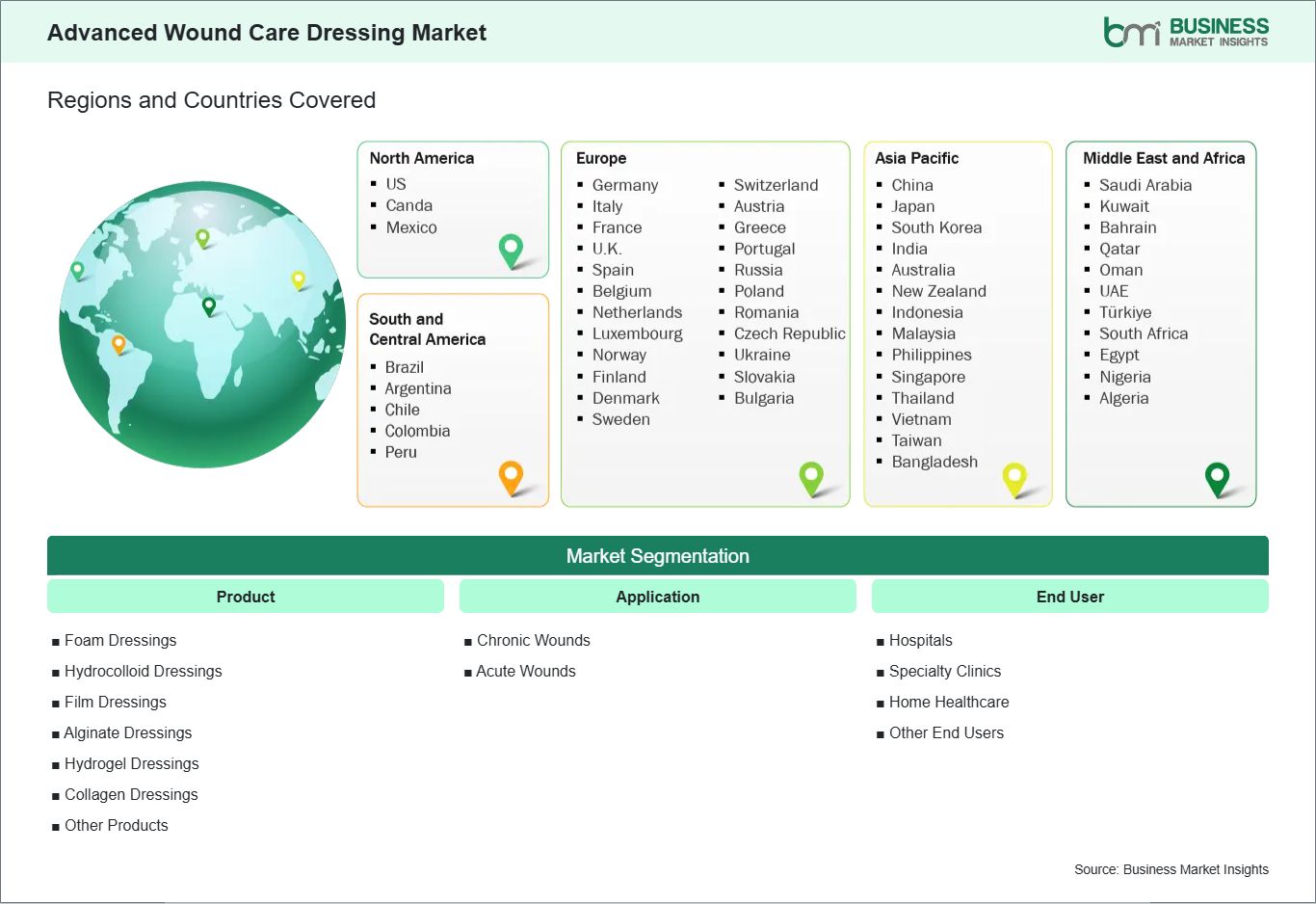
Key segments that contributed to the derivation of the advanced wound care dressing market analysis are product, application, and end user.
The growing number of chronic wounds around the planet is the main reason that the advanced wound care dressing market is growing, and these wounds are mainly caused by the global increase in chronic diseases like diabetes, vascular disorders, and obesity. About 100 million people worldwide suffer from chronic wounds, which include diabetic foot ulcers, pressure injuries, and venous leg ulcers, and the number of cases is expected to rise every year because of the aging population and health issues related to lifestyle. The rise in chronic wound cases is the reason why the demand for advanced dressings that are capable of faster healing, infection control, and complication reduction, compared to traditional wound care products, is increasing. Besides, the medical professionals are always looking for advanced dressings that have antimicrobial, moisture-balanced, or bioactive properties in order to enhance the patient's health and shorten the duration of hospitalization. For instance, newer antimicrobial and smart sensor dressings are being used more widely in hospitals to take care of complicated wounds while reducing dressing changes and infection risks.
There is a considerable market opportunity in the area of technological innovation and product development, particularly in the field of smart and next-generation wound care products. Among the recent developments are the systems for monitoring wounds with AI integrated into them, skin substitutes made using bioengineering, and sensor-enabled dressings that have the capability of increasing healing precision and remote care. To give an example, the smart dressings that permit the doctors to monitor the condition of the wounds (for instance, check for moisture and infection) without the need for frequent dressing changes are becoming popular, and thus, the clinical outcomes and patient comfort are being improved. The combination of digital technologies like AI and telemedicine allows for the assessment of wounds to be done remotely, which in turn helps to relieve the pressure on the workforce and results in more effective home care. Moreover, the companies are coming up with sustainability-focused products and combinations of antimicrobials that have high efficacy in dressing and are thus meeting the needs of both the environment and the clinic. This pipeline of innovation is expected to generate substantial growth in the patient care settings of hospitals, outpatient facilities, and home healthcare.
By product, the advanced wound care dressing market is categorized into foam dressings, hydrocolloid dressings, film dressings, alginate dressings, hydrogel dressings, collagen dressings, other products. The foam dressings segment held the largest share of the market in 2025. Foam dressings hold the largest share due to their exceptional absorption and versatility across wound types, especially moderate to high exudate wounds. Their ability to maintain a moist healing environment, reduce infection risk, and minimize dressing changes makes them preferred in hospital and clinical protocols. Foam products are widely adopted in surgical, chronic ulcer, and trauma care settings, driving strong volume demand and clinical reliance.
By application, the market is bifurcated into chronic wounds, acute wounds. The chronic wounds segment held a larger share of the market in 2025. The chronic wounds segment dominates owing to the growing global prevalence of diabetes, pressure ulcers, and venous leg ulcers. Chronic wounds require prolonged, specialized management where advanced dressings significantly improve healing outcomes and reduce complications. Aging populations and rising lifestyle disease burdens further sustain this demand compared to shorter-duration acute wound care.
By end user, the advanced wound care dressing market is segmented into hospitals, specialty clinics, home healthcare, other end users. The hospitals segment dominated the market in 2025. Hospitals remain the primary end user because they treat the highest volume of complex wound cases, including post-surgical, chronic, and trauma wounds requiring advanced care. Their robust infrastructure, specialist clinicians, and established procurement systems support the adoption of a broad range of advanced dressing technologies, complemented by reimbursement frameworks favoring institutional care.
| Report Attribute | Details |
|---|---|
| Market size in 2025 | US$ 4.91 Billion |
| Market Size by 2033 | US$ 7.1 Billion |
| Global CAGR (2026 - 2033) | 5.5% |
| Historical Data | 2022 - 2024 |
| Forecast period | 2026-2033 |
| Segments Covered | By Product
|
|
Regions and Countries Covered
| |
| North America | US, Canada, Mexico |
| Europe | Belgium, Austria, Finland, Denmark, Greece, Poland, Romania, Russia, Ukraine, Czech Republic, Slovakia, Bulgaria, Italy, Luxembourg, Germany, Switzerland, France, Netherlands, Norway, Portugal, Spain, Sweden, United Kingdom |
| Asia-Pacific | Australia, China, India, Japan, South Korea, Indonesia, Malaysia, Philippines, Singapore, Thailand, Vietnam, Bangladesh, New Zealand, Taiwan |
| South and Central America | Brazil, Argentina, Peru, Chile, Colombia |
| Middle East and Africa | Bahrain, Kuwait, Oman, Qatar, Saudi Arabia, United Arab Emirates, Turkiye, South Africa, Egypt, Algeria, Nigeria |
| Market leaders and key company profiles |
|
The " Advanced Wound Care Dressing Market Size and Forecast (2022–2033)" report provides a detailed analysis of the market covering below areas:
The geographical scope of the advanced wound care dressing market report is divided into five regions: North America, Asia Pacific, Europe, Middle East & Africa, and South & Central America. The advanced wound care dressing market in Asia Pacific is expected to grow significantly during the forecast period.
The Asia-Pacific advanced wound care dressing market is segmented into China, Japan, South Korea, India, Australia, New Zealand, Indonesia, Malaysia, the Philippines, Singapore, Thailand, Vietnam, Taiwan, Bangladesh, and the Rest of Asia. The Asia-Pacific advanced wound care dressing market is experiencing robust growth, due to the increase in chronic diseases along with the aging population, which consequently raises the number of chronic wounds like diabetic foot ulcers, pressure sores, and venous ulcers needing advanced care. For illustration, the Asia-Pacific has the largest elderly population. By 2023, around 697 million people aged 60 years or older will live in the region, which accounts for nearly 60% of the global elderly population, so the demand for advanced wound care treatments is very high.
Moreover, countries like India and China have a fast-growing and large diabetic patient population with non-healing wounds as a complication, thereby triggering the use of new wound care technologies such as advanced dressings that accelerate healing and reduce complications.
One of the reasons for the growth of the market is also the rapid development of healthcare infrastructure and surgical service availability because, in turn, more surgeries require better post-operative wound care. Moreover, the launch of new products such as dressings and therapies for chronic wounds is helping to increase the uptake by doctors and hospitals in the region.

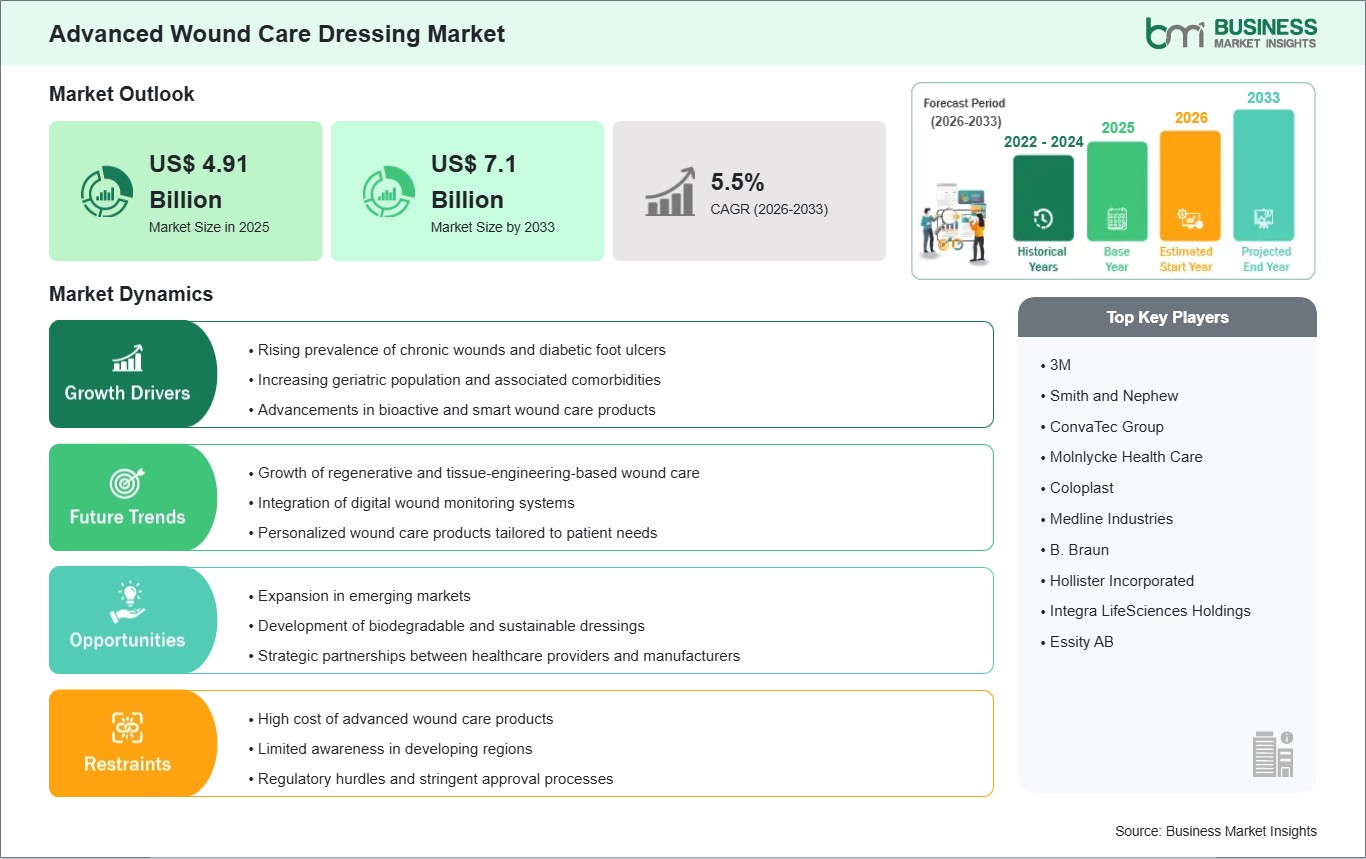
The advanced wound care dressing market is evaluated by gathering qualitative and quantitative data post primary and secondary research, which includes important corporate publications, association data, and databases. A few of the key developments in the advanced wound care dressing market are:
The Advanced Wound Care Dressing Market is valued at US$ 4.91 Billion in 2025, it is projected to reach US$ 7.1 Billion by 2033.
As per our report Advanced Wound Care Dressing Market, the market size is valued at US$ 4.91 Billion in 2025, projecting it to reach US$ 7.1 Billion by 2033. This translates to a CAGR of approximately 5.5% during the forecast period.
The Advanced Wound Care Dressing Market report typically cover these key segments-
The historic period, base year, and forecast period can vary slightly depending on the specific market research report. However, for the Advanced Wound Care Dressing Market report:
The Advanced Wound Care Dressing Market is populated by several key players, each contributing to its growth and innovation. Some of the major players include:
The Advanced Wound Care Dressing Market report is valuable for diverse stakeholders, including:
Essentially, anyone involved in or considering involvement in the Advanced Wound Care Dressing Market value chain can benefit from the information contained in a comprehensive market report.
Please tell us your area of interest
(Market Segments/ Regions and Countries/ Companies)