Market Summary
Executive Summary and Global Market Analysis
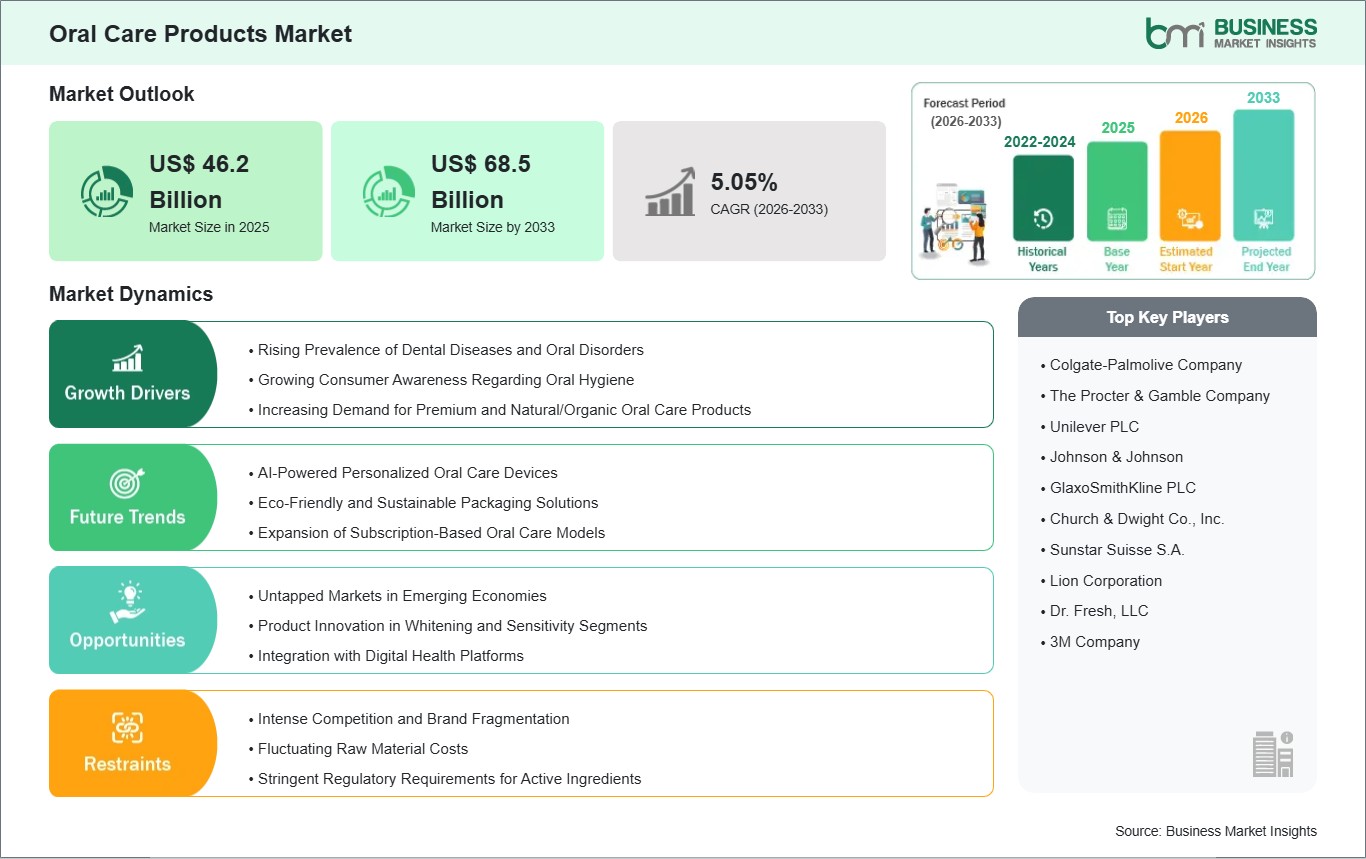
Oral care products include a wide range of essential and cosmetic items that support the hygiene of the mouth, teeth, and gums. These products play a key role in preventive healthcare by reducing the risk of systemic conditions linked to poor oral hygiene, such as heart disease and diabetes. Market growth is driven by increased awareness of the oral-systemic health connection, the rise of premium toothpaste options like hydroxyapatite and herbal lines, and growing demand for subscription-based dental care. In addition, the move toward sustainable, plastic-free packaging, such as bamboo brushes and toothpaste tablets, is strengthening brand loyalty among environmentally conscious Gen Z and Millennial consumers.
However, several challenges may limit market growth. High price sensitivity in emerging economies can slow the adoption of electric toothbrushes and premium whitening kits. Strict regulatory scrutiny of therapeutic claims, such as instant whitening or gum regrowth, can delay product launches and require costly clinical trials. In developed regions, market saturation forces companies to focus on incremental innovation to maintain profit margins.
Despite these challenges, the market offers strong opportunities. Growth in professional-grade at-home dental kits and the adoption of teledentistry-enabled smart devices are expanding. Increased focus on geriatric oral care, such as products for dry mouth and denture stability, and the development of personalized, DNA-based oral microbiome treatments are expected to drive long-term growth.
Segment Analysis
Oral Care Products Market Segmentation
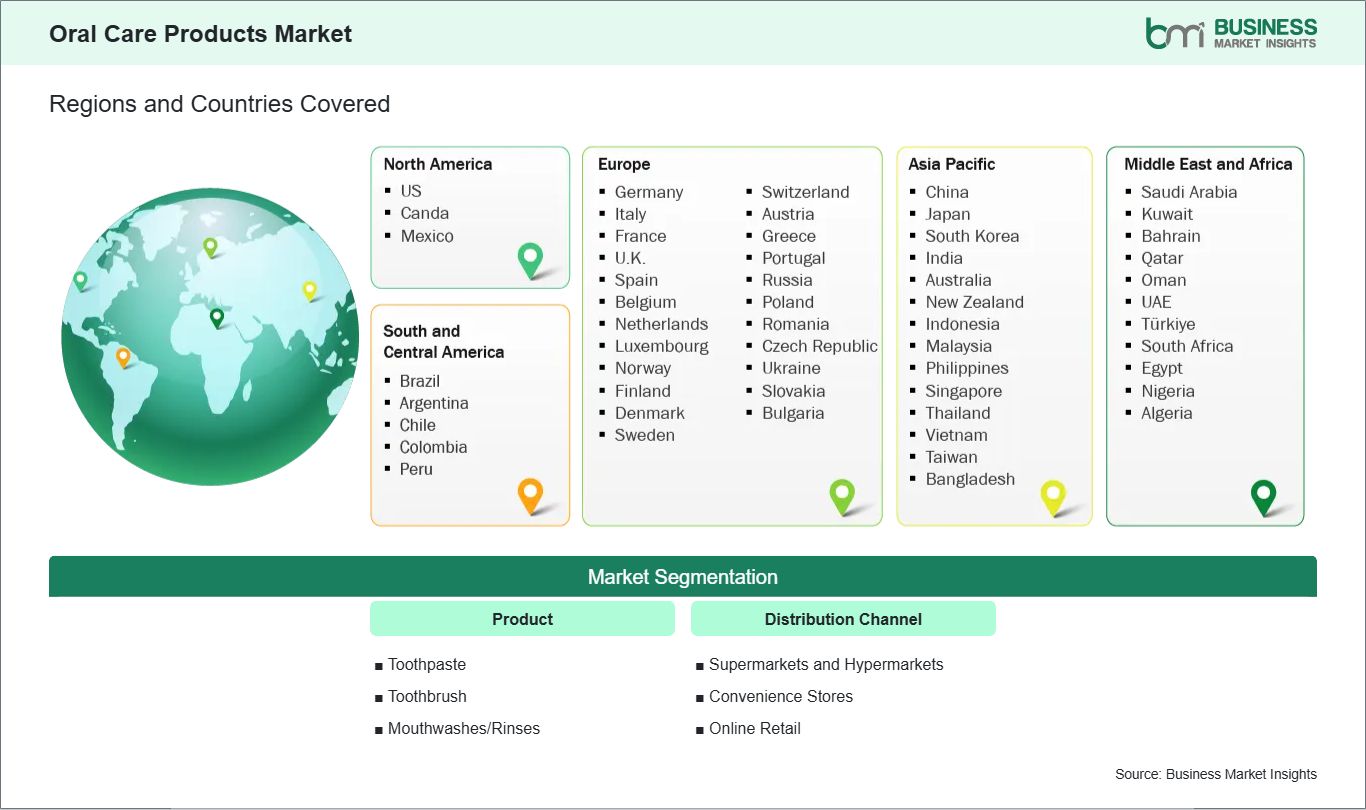
Key segments that contributed to the derivation of the Oral Care Products market analysis are product and distribution channel.
- By Product, the market is segmented into Toothpaste, Toothbrush, and Mouthwashes/Rinses.
- By Distribution Channel, the market is divided into Supermarkets and Hypermarkets, Convenience Stores, and Online Retail.
Market Forces
Oral Care Products Market Drivers and Opportunities
Holistic Longevity and the Rise of AI-Guided Prevention
The primary driver of the oral care products market is the global shift toward preventive healthcare and holistic wellness. Consumers increasingly prioritize proactive longevity, seeking formulations that optimize the oral microbiome and facilitate tissue repair at the molecular level. This trend is further accelerated by the rapid adoption of smart and connected devices. For example, AI-powered electric toothbrushes equipped with bone-conduction technology and pressure sensors now deliver real-time feedback, transforming routine oral hygiene into a data-driven health practice. Additionally, demand for natural, clean-label, and Ayurvedic formulations serves as a significant catalyst, as concerns regarding synthetic chemicals contribute to increased interest in fluoride-free, plant-based, and sustainably packaged products.
Additionally, increasing aesthetic concerns among Millennials and Generation Z have positioned oral care as a means of personal expression, driving growth in cosmetic dentistry, teeth whitening, and emerging trends such as tooth gems. Collectively, these factors, including holistic health integration, technological advancements, and the premiumization of clean ingredients, are expected to support robust and high-margin growth within the global oral care products market.
Microbiome Optimization and Eco-Conscious Innovation
A significant opportunity exists at the intersection of oral care, microbiome science, and probiotic therapy. Emerging mouthwashes and toothpastes are formulated to rebalance bacterial ecosystems instead of eliminating them indiscriminately, creating a promising market for pro-bacterial products that address bad breath and gum disease at their biological origins. Additionally, the development of sustainable and plastic-free delivery formats represents a major growth area. As consumers increasingly reject single-use plastics, manufacturers can gain a competitive advantage by introducing compostable toothbrush handles, waterless toothpaste tablets, and refillable aluminum dispensers.
The expansion of e-commerce subscription models and direct-to-consumer personalization provides brands with opportunities to offer custom-mixed toothpastes tailored to individual DNA profiles or lifestyle requirements, delivered directly to consumers. In addition to traditional hardware, the emergence of mobile-integrated diagnostic applications enables the development of hardware-software bundles that facilitate basic oral health screenings at home using smartphone cameras. Manufacturers investing in cellular-level enamel remineralization and developing edible, dessert-inspired, guilt-free flavors are positioned to lead the most innovative and high-margin segments of the global oral care products market.
Size and Share Analysis
Oral Care Products Market Size and Share Analysis
The Oral Care Products market demonstrates steady growth, with size and share analysis revealing evolving trends and competitive positioning among key players. The report further examines subsegments categorized within product and distribution channel, offering insights into their contribution to overall market performance.
Based on product, the Toothpaste and Toothbrushes subsegments hold the dominant market presence, collectively accounting for the vast majority of category revenue. Toothpaste remains essential in households as a daily necessity. Electric toothbrushes and mouthwashes are experiencing the fastest growth. Electric toothbrushes are now key to smart hygiene routines, offering AI tracking and pressure sensors for real-time feedback. Mouthwashes are shifting from optional products to therapeutic essentials, with alcohol-free and probiotic formulas gaining popularity for supporting oral microbiome balance.
Report Coverage
Oral Care Products Market Report Coverage and Deliverables
The "Oral Care Products Market Size and Forecast (2022–2033)" report provides a detailed analysis of the market covering below areas:
- Oral Care Products market size and forecast at global, regional, and country levels for all the key market segments covered under the scope
- Oral Care Products market trends, as well as market dynamics such as drivers, restraints, and key opportunities
- Oral Care Products market analysis covering key market trends, global and regional framework, major players, regulations, and recent market developments
- Industry landscape and competition analysis covering market concentration, heat map analysis, prominent players, and recent developments for the Oral Care Products market
- Detailed company profiles, including SWOT analysis
Geographic Insights
Oral Care Products Market Geographic Insights
The geographical scope of the Oral Care Products market report is divided into five regions: North America, Asia Pacific, Europe, Middle East & Africa, and South & Central America.
North America continues to serve as a key market, marked by a swift shift toward premiumization and the adoption of AI-enabled smart brushes. Europe demonstrates similar momentum, driven by regulatory initiatives promoting sustainable packaging and the elimination of certain chemical whitening agents, which support the growth of environmentally friendly oral care solutions. The Asia Pacific region exhibits the most rapid growth, as its large population and increasing middle-class disposable incomes drive a transition in consumer preferences from basic hygiene to comprehensive, multi-step oral beauty routines.
The Asia-Pacific Oral Care Products Market is divided into China, Japan, South Korea, India, Australia, and the Rest of Asia Pacific. China acts as a primary growth driver, where live-stream shopping and e-commerce platforms have increased the popularity of high-end whitening serums and sonic toothbrushes among younger consumers. In India, a strong preference for natural products is evident, as consumer trust in Ayurvedic ingredients such as neem and clove supports the success of herbal toothpaste variants. In Japan and South Korea, market growth is fueled by specialized geriatric care, with rising demand for denture cleaners and sensitivity-relief products designed for an aging population.
Industry Activity
Recent Developments
The Oral Care Products market is evaluated by gathering qualitative and quantitative data post primary and secondary research, which includes important corporate publications, association data, and databases. A few of the key developments in the Oral Care Products market are:
- In Feb 2026, Nobel Biocare announced the acquisition of Versah, a leader in dental osteotomy and bone densification solutions, strengthening its regenerative and implant portfolio. The addition of Versah`s Densah® Bur technology expands clinical capabilities and supports improved outcomes in dental implant procedures, marking a positive development in the oral care products market.
- In September 2025, Clove Oral Care launched a dentist-crafted range of toothpaste and toothbrushes in India, featuring clinically tested, problem-specific solutions for sensitivity, enamel erosion, dry mouth, and pediatric oral hygiene, available online and via major e-commerce portals.
Trust & Transparency
Research Methodology
The market analysis combines proprietary research with secondary data from government agencies, company disclosures, regulatory filings, industry databases and expert interviews. Market estimates are validated through data triangulation, cross-market benchmarking and analyst
review.
View Full Research Methodology
Key Sources Referred:
World Bank – Global Trade IndicatorsWorld Trade Organization (WTO)(International Monetary Fund )IMFInternational Trade Administration (ITA)Company websiteCompany annual reportsCompany investor presentations