Market Summary
Executive Summary and Global Market Analysis
Incontinence care products function as hygienic medical products which help users with both urinary and fecal accidents while delivering comfort and skin protection and supporting user dignity across all age ranges with special focus on elderly people and those who suffer from ongoing health problems. These products include all home care and clinical applications through their complete range of absorbent briefs and pads and liners and catheters and collection devices.
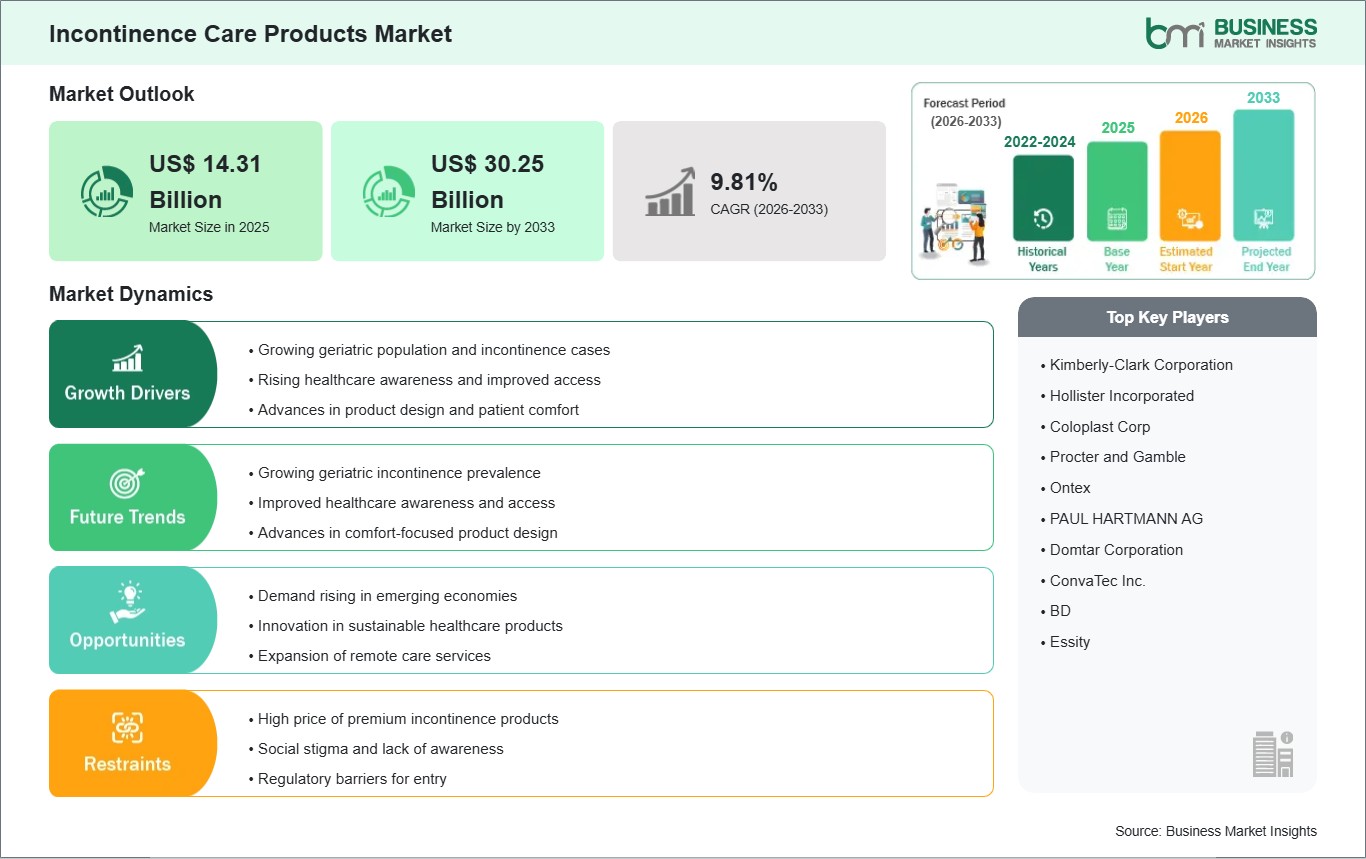
The global Incontinence care products market has been expanding steadily. Global demographic changes drive demand for products because the population grows older and people develop more chronic diseases like diabetes and neurological disorders while they become more aware of personal hygiene and quality of life. The combination of advanced superabsorbent polymers and odor control technologies and slim discreet designs and new smart sensor integrations is creating new patterns of user adoption and product expectations. The North American and European markets possess established healthcare systems and payment frameworks which lead to market stability while the Asia Pacific region will experience rapid development because people become more aware of healthcare services and urbanization spreads throughout the region. Manufacturers explore biodegradable and eco‑friendly solutions to address sustainability issues although the environmental effects of disposable products continue to present difficulties. Competitive dynamics feature major global personal care and medical device companies emphasizing product differentiation, direct‑to‑consumer channels, and partnerships to foster innovation, expand reach, and address the evolving needs of caregivers and end users worldwide.
Segment Analysis
Incontinence Care Products Market Segmentation
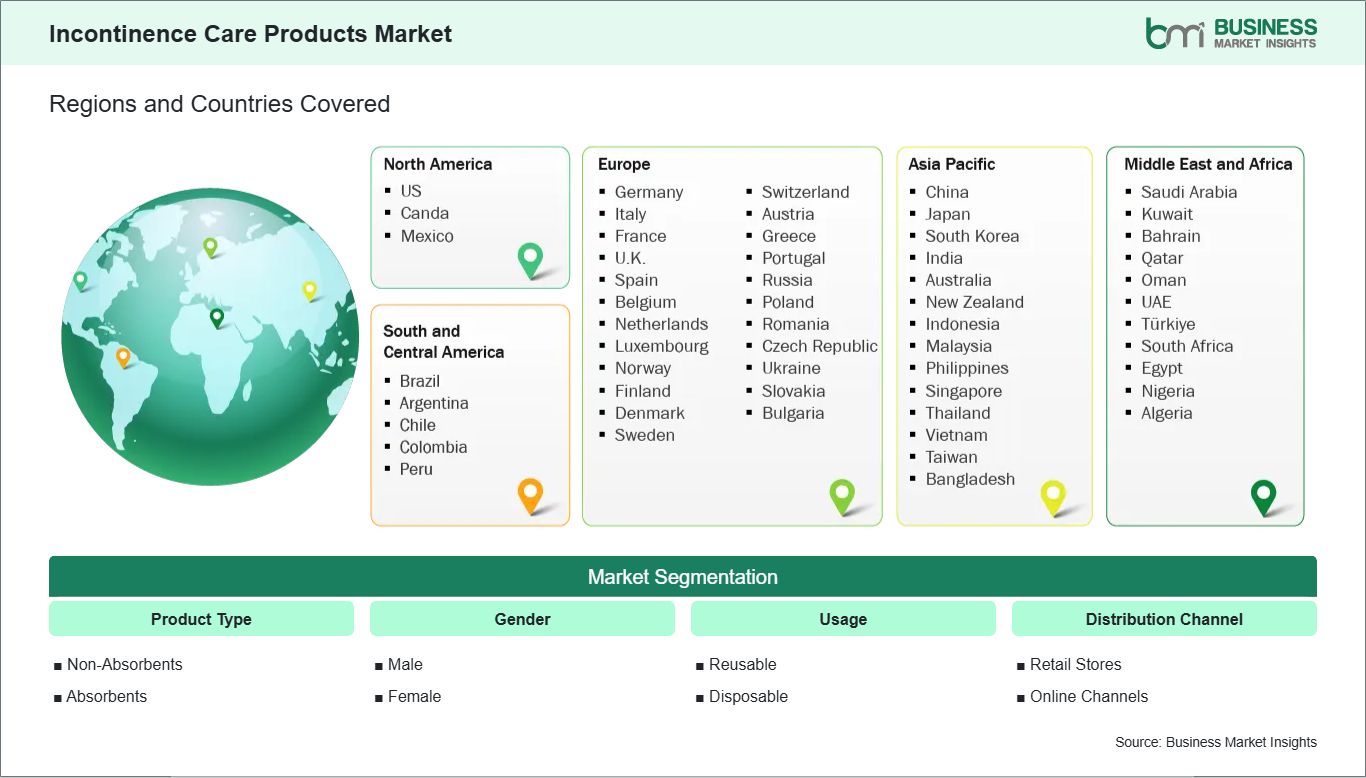
Key segments that contributed to the derivation of the incontinence care products market analysis are product type, gender, usage, and distribution channel.
- By product type, the incontinence care products market is bifurcated into non-absorbents, absorbents. The absorbents segment dominated the market in 2025.
- By gender, the market is categorized into male, female. The female segment held a larger share of the market in 2025.
- By usage, the market is bifurcated into reusable, disposable. The disposable segment held a larger share of the market in 2025.
- By distribution channel, the incontinence care products market is segmented into retail stores, online channels. The retail stores segment dominated the market in 2025.
Market Forces
Incontinence Care Products Market Drivers and Opportunities
Aging Population and Rising Chronic Conditions
The incontinence care products market experiences its primary growth because the global population currently undergoes rapid aging while more people develop chronic health conditions. Aging causes people to experience physiological changes which result in pelvic muscle weakness and bladder control loss, thus creating a need for effective management solutions to treat urinary and fecal incontinence. The recent industry analysis shows that people aged 65 and older represent a major portion of incontinence product usage, which continues to grow because life expectancy among this demographic increases. The demand for high-performance comfortable absorbent products and supportive devices increases because age-related chronic conditions such as diabetes and obesity and arthritis and neurological disorders lead to incontinence. Health systems currently focus on home-based and long-term care, which results in caregivers and patients needing to use these products repeatedly. This driver creates consistent demand while it promotes the development of new solutions and the wider acceptance of incontinence care solutions among various age groups.
Technological and Sustainable Innovations
The incontinence care product market presents a major opportunity through the combined impact of technological progress and environmentally sustainable product innovation. The adult briefs and pads now include moisture and saturation sensors which manufacturers use to create smart technologies that send alerts to caregivers through mobile applications, which improves care delivery and user experience. Smart sensor technology has become popular in institutional care environments because it allows facilities to link wearable devices with electronic health record systems, which results in better adherence to treatment plans and positive health results. Environmental concerns have led to increased funding for biodegradable materials and plant-based superabsorbent polymers and reusable product development because consumers want environmentally friendly products and regulations require medical waste reduction. Essity and Kimberly-Clark have developed biodegradable product lines while expanding their smart care product range, and startups pursue both digitalization and sustainable development research. The developments create brand differentiation while allowing companies to enter new markets through direct consumer sales and telehealth platforms which will help the market grow over time.
Size and Share Analysis
Incontinence Care Products Market Size and Share Analysis
By product type, the incontinence care products market is bifurcated into non-absorbents, absorbents. The absorbents segment dominated the market in 2025. The absorbents segment leads because products like adult diapers, pads, and briefs offer superior moisture retention, comfort, and odor control, making them the most widely used solutions in both home and clinical settings. Their broad applicability across mild to severe incontinence cases, plus continuous innovation in materials (e.g., superabsorbent polymers), drives significant adoption globally.
By gender, the market is categorized into male, female. The female segment held a larger share of the market in 2025. The female segment holds the largest share due to a higher prevalence of urinary incontinence among women, particularly related to childbirth, pregnancy, and menopause. Increased awareness, targeted product designs, and women`s focus on personal hygiene further reinforce demand for female oriented incontinence products.
By usage, the market is bifurcated into reusable, disposable. The disposable segment held a larger share of the market in 2025. Disposable products dominate because they offer convenience, improved hygiene, and ease of disposal compared with reusable options especially important in hospital, long term care, and domestic contexts. Innovations boosting absorbency and skin protection continue to strengthen their preference.
By distribution channel, the incontinence care products market is segmented into retail stores, online channels. The retail stores segment dominated the market in 2025. Retail stores remain the leading distribution channel, as pharmacies and large retail outlets provide easy access, immediate availability, and a wide range of brands and sizes, making purchases convenient for consumers and caregivers alike.
Report Coverage
Incontinence Care Products Market Report Coverage and Deliverables
The " Incontinence Care Products Market Size and Forecast (2022–2033)" report provides a detailed analysis of the market covering below areas:
- Incontinence care products market size and forecast at global, regional, and country levels for all the key market segments covered under the scope
- Incontinence care products market trends, as well as market dynamics such as drivers, restraints, and key opportunities
- Incontinence care products market analysis covering key market trends, global and regional framework, major players, regulations, and recent market developments
- Industry landscape and competition analysis covering market concentration, heat map analysis, prominent players, and recent developments for the incontinence care products market
- Detailed company profiles, including SWOT analysis
Geographic Insights
Incontinence Care Products Market Geographic Insights
The geographical scope of the incontinence care products market report is divided into five regions: North America, Asia Pacific, Europe, Middle East and Africa, and South and Central America. The incontinence care products market in Asia Pacific is expected to grow significantly during the forecast period.
The Asia-Pacific incontinence care products market is segmented into China, Japan, South Korea, India, Australia, New Zealand, Indonesia, Malaysia, the Philippines, Singapore, Thailand, Vietnam, Taiwan, Bangladesh, and the Rest of Asia. The Asia-Pacific incontinence care products market is experiencing robust growth, due to multiple factors that create new demand patterns which transform how people consume products across China India Japan and Australia. The primary force driving the market exists because people aged 60 and above require long-term care solutions which lead to increased cases of age-related incontinence and product demand for its management. The combination of urban development and higher income levels enables people to access modern healthcare services which leads them to choose hygienic incontinence products instead of traditional methods. More people and their caregivers search for effective comfortable solutions because they have greater knowledge about health and life quality and because incontinence has become less socially unacceptable. Healthcare infrastructure improvements enable better product access through pharmacies and retail outlets and online platforms because expanded coverage and enhanced distribution networks serve both urban and semi-urban regions. Younger caregivers who prefer easy access to multiple products which arrive in private packages have driven e-commerce growth to new heights. Local manufacturers create new products which match local market demands by using breathable materials and various size options which help the Asia-Pacific market grow while satisfying customer needs.
Industry Activity
Recent Developments
The incontinence care products market is evaluated by gathering qualitative and quantitative data post primary and secondary research, which includes important corporate publications, association data, and databases. A few of the key developments in the incontinence care products market are:
- In June 2024, ConvaTec Group received a patent for an innovative urine collection bag featuring a unique notch for catheter insertion, webbing sections, and a one-way valve. The design enables better usability because it provides users with comfortable functionality for collecting urine. The bag's design includes sealed external layers and tear-free regions which create both structural strength and user-friendly operation. The company can use this development to expand its product reach within one particular category of its offerings.
- In February 2026, Ontex Group NV, a leading international developer and producer of personal care solutions, introduced a new adult incontinence range developed to offer superior protection while being gentle on the skin. The first products –Sensitive Pants, Sensitive Slip and Sensitive Form – will become gradually available for healthcare institutions across Europe.
Trust & Transparency
Research Methodology
The market analysis combines proprietary research with secondary data from government agencies, company disclosures, regulatory filings, industry databases and expert interviews. Market estimates are validated through data triangulation, cross-market benchmarking and analyst
review.
View Full Research Methodology
Key Sources Referred:
World Health Organization (WHO)Centers for Disease Control and PreventionInstitute for Health Metrics and EvaluationUNICEF DataInternational Diabetes FederationCompany websitesCompany annual reportsCompany investor presentations