Market Summary
Executive Summary and Global Market Analysis
Critical care ventilators are high-tech machines that are usually found in intensive care units (ICUs) and emergency rooms. They are mainly used to support or completely take over the breathing process of patients suffering from severe conditions such as respiratory failure, ARDS, and any other critical conditions where natural breathing is absent or impaired. The breathing patients are receiving controlled oxygen during the process and carbon dioxide is being removed, through invasive or non-invasive methods. The whole thing is done using advanced software, closed-loop control, and up-to-date hospital information systems which are connected in order to make the ventilation strategies patient-specific and more efficient.
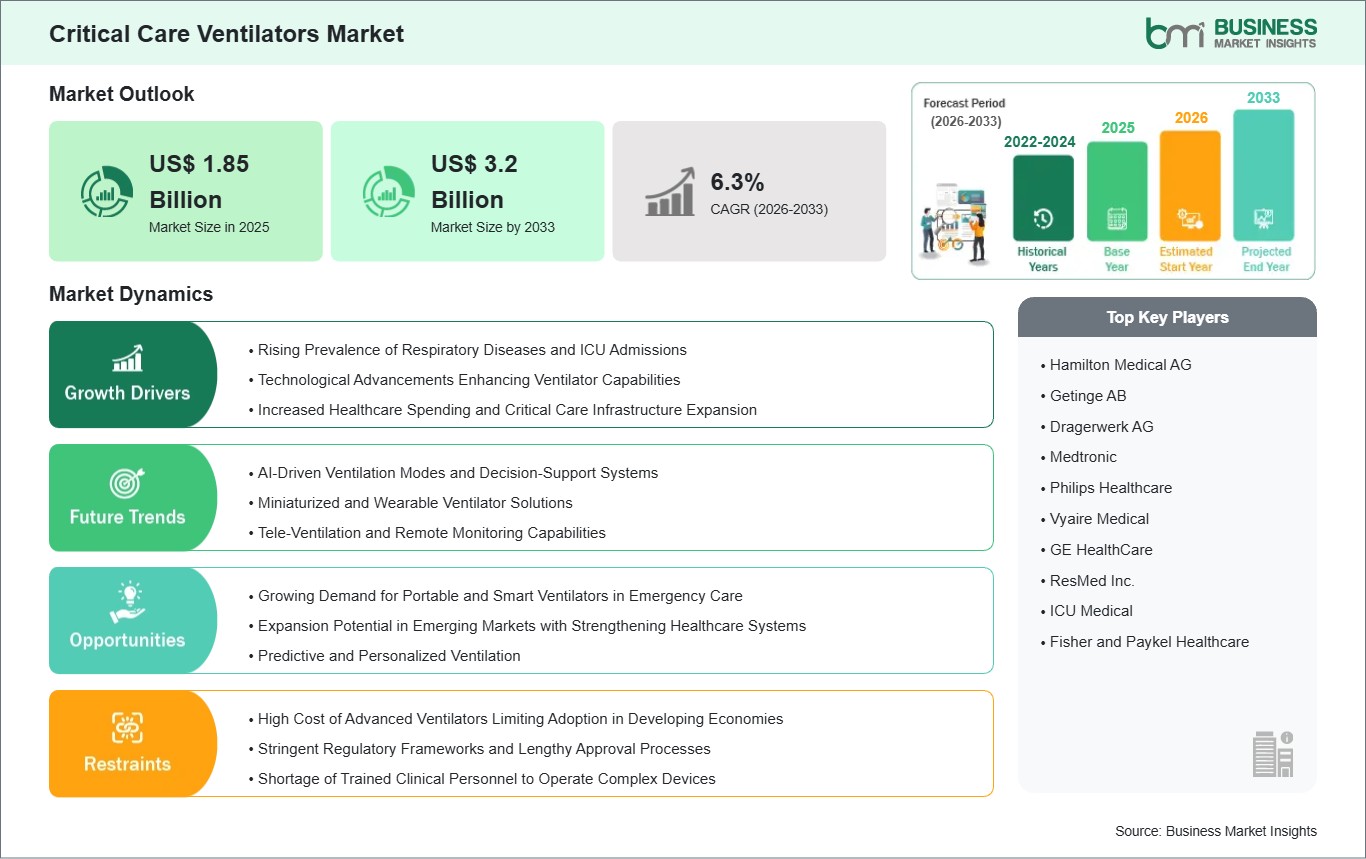
The global critical care ventilators market comprises of a gradual growth that is being driven by ICU modernization, rise in the incidence of chronic and acute respiratory disorders, aging population and continuous investments in healthcare facilities across region. The doctors and purchasing departments are increasingly placing a lot of emphasis on the cutting-edge features like AI-powered ventilation, predictive monitoring and improved interoperability which are the main factors influencing their buying choice towards high-acuity, software-integrated systems. North America, Europe, and the Asia-Pacific regions that are rapidly growing with a rising healthcare spending and ICU bed capacity are the major markets. The competition is getting tougher, and leading medical tech companies are trying to differentiate their products through innovation, geographical expansion, and customer service ecosystems. Moreover, the companies have to adopt a flexible production approach due to problems like high device costs and the need for specific clinical training. The market trend is showing that the demand for ventilators has shifted from pandemic-induced spikes to a permanent maturation that is backed by the long-term need for critical care facilities and technology adoption.
Segment Analysis
Critical Care Ventilators Market Segmentation
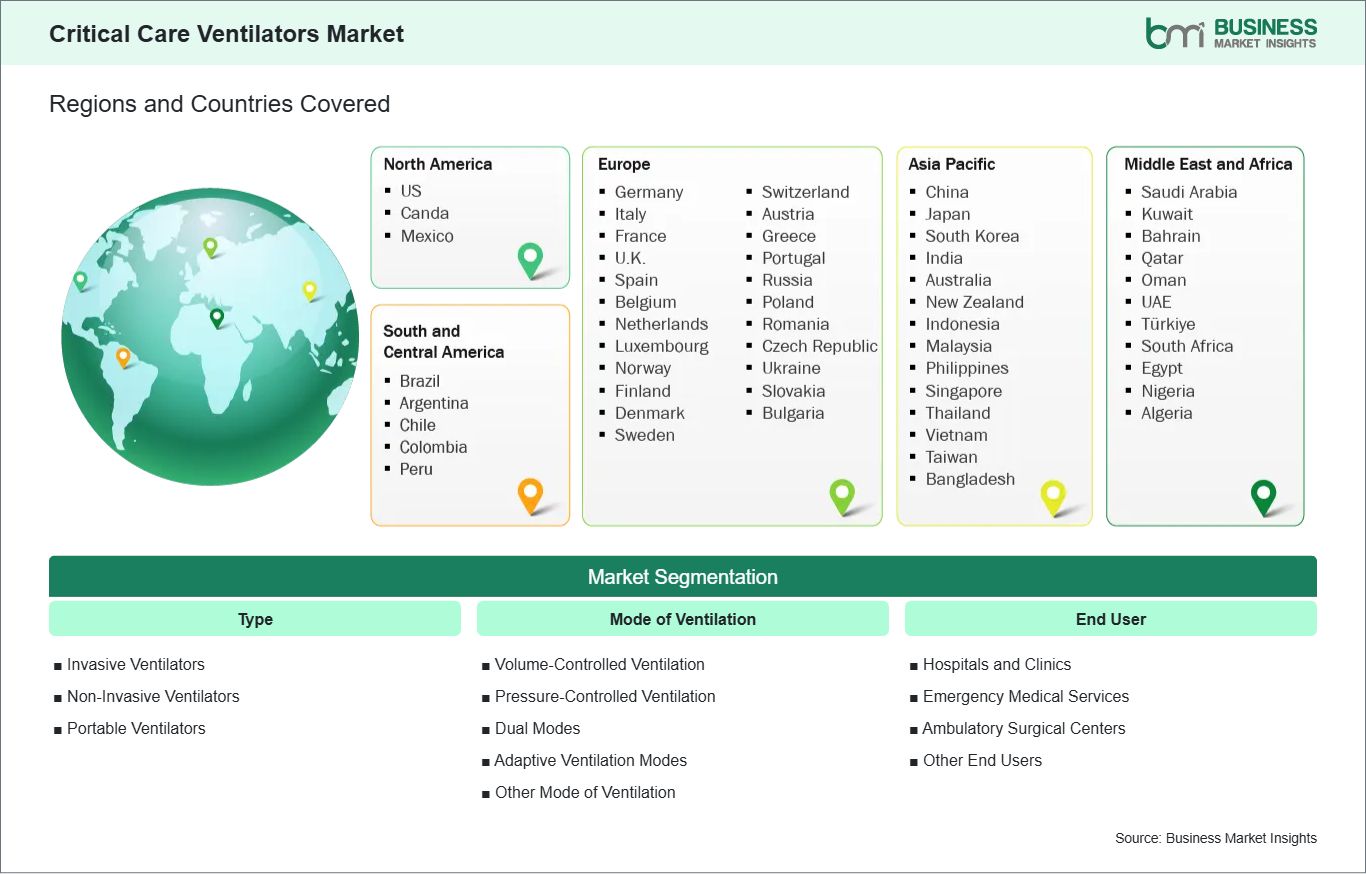
Key segments that contributed to the derivation of the critical care ventilators market analysis are type, mode of ventilation, end user.
- By type, the critical care ventilators market is categorized into invasive ventilators, non-invasive ventilators, portable ventilators. The invasive ventilators segment held the largest share of the market in 2025.
- By mode of ventilation, the market is segmented into volume-controlled ventilation, pressure-controlled ventilation, dual modes, adaptive ventilation modes, other mode of ventilation. The pressure-controlled ventilation segment held the largest share of the market in 2025.
- By end user, the critical care ventilators market is segmented into hospitals and clinics, emergency medical services, ambulatory surgical centers, other end users. The hospitals and clinics segment dominated the market in 2025.
Market Forces
Critical Care Ventilators Market Drivers and Opportunities
Rising Prevalence of Respiratory Disorders and Aging Population
One of the major factors that influence the growth of the market for critical care ventilators is the worldwide rising trend of chronic and acute respiratory diseases like chronic obstructive pulmonary disease (COPD), acute respiratory distress syndrome (ARDS), pneumonia, and other life-threatening respiratory disorders. These diseases greatly increase the need for mechanical respiratory support in the intensive care units, where ventilators are of utmost importance for the patient's survival and recovery. Various industry reports estimate that chronic respiratory diseases are responsible for millions of deaths every year and are the main cause of continued ventilator usage in hospitals across the globe. Moreover, the quickly growing elderly population—who are more prone to having serious respiratory complications—is a further factor that increases the demand for critical care ventilators. Health care systems are gradually updating the infrastructure of their ICUs and increasing the number of beds in the critical care unit, which leads to an uninterrupted demand for the purchasing of high-tech ventilators equipped with advanced monitoring and control features to boost treatment results and lessen complications.
Integration of Advanced Technologies and Tele-ICU Capabilities
One of the critical care ventilators market big chances to grow is by bringing in the newest technologies like artificial intelligence (AI), Internet of Things (IoT) and tele-ICU platforms to the ventilator systems. The contemporary ventilators come with predictive analytics, real-time patient monitoring, automated ventilation adjustments, and continuous connectivity with hospital information systems among others which allow the clinicians to not only support respiratory function but also make informed decisions based on the data. For instance, leading companies are presenting AI-enabled ventilators that make use of sophisticated software to assist clinical workflows and foresee patient-ventilator asynchrony. The same pattern can be seen in the increase of adoption of remote management capabilities that bring doctors closer to the patients by allowing them to monitor ventilator performance and patient metrics through the networks which ultimately leads to better critical care delivery especially in decentralized or resource-limited areas. The rise of digital health and telemedicine after the pandemic has further pushed this trend and now smart ventilator systems can not only improve care efficiency but also provide operational resilience.
Size and Share Analysis
Critical Care Ventilators Market Size and Share Analysis
By type, the critical care ventilators market is categorized into invasive ventilators, non-invasive ventilators, portable ventilators. The invasive ventilators segment held the largest share of the market in 2025. Invasive ventilators lead globally because they are the standard for managing severe respiratory failure in intensive care units, providing precise control over ventilation parameters essential for critically ill patients. Their broad clinical applicability in ARDS, trauma, post-operative care, and complex respiratory cases makes them indispensable in hospitals and ICUs.
By mode of ventilation, the market is segmented into volume-controlled ventilation, pressure-controlled ventilation, dual modes, adaptive ventilation modes, other mode of ventilation. The pressure-controlled ventilation segment held the largest share of the market in 2025. Pressure-controlled ventilation often leads the market since it enhances patient comfort, reduces lung injury risk and offers better lung protection compared to other modes. These clinical advantages make it a preferred choice in critical care settings, driving higher adoption in advanced ventilators.
By end user, the critical care ventilators market is segmented into hospitals and clinics, emergency medical services, ambulatory surgical centers, other end users. The hospitals and clinics segment dominated the market in 2025. Hospitals and clinics dominate because they have the highest concentration of intensive care units, emergency departments, and surgical units that require continuous, sophisticated ventilatory support. Their infrastructure, higher patient volumes, and regulatory procurement make them the primary buyers of critical care ventilators worldwide.
Report Coverage
Critical Care Ventilators Market Report Coverage and Deliverables
The " Critical Care Ventilators Market Size and Forecast (2022 - 2033)" report provides a detailed analysis of the market covering below areas:
- Critical care ventilators market size and forecast at global, regional, and country levels for all the key market segments covered under the scope
- Critical care ventilators market trends, as well as market dynamics such as drivers, restraints, and key opportunities
- Critical care ventilators market analysis covering key market trends, global and regional framework, major players, regulations, and recent market developments
- Industry landscape and competition analysis covering market concentration, heat map analysis, prominent players, and recent developments for the critical care ventilators market
- Detailed company profiles, including SWOT analysis
Geographic Insights
Critical Care Ventilators Market Geographic Insights
The geographical scope of the critical care ventilators market report is divided into five regions: North America, Asia Pacific, Europe, Middle East and Africa, and South and Central America. The critical care ventilators market in Asia Pacific is expected to grow significantly during the forecast period.
The Asia-Pacific critical care ventilators market is segmented into China, Japan, South Korea, India, Australia, New Zealand, Indonesia, Malaysia, the Philippines, Singapore, Thailand, Vietnam, Taiwan, Bangladesh, and the Rest of Asia. The Asia-Pacific critical care ventilators market is experiencing robust growth, due to a variety of factors such as demographic, healthcare infrastructure, and disease burden which together would always keep the demand for advanced respiratory support high. The huge and aged population in regions such as China, India, Japan, and Southeast Asia leads to the high incidence of chronic respiratory diseases and age-related comorbidities that usually need ventilatory support. Both governments and private healthcare providers are increasing ICU capacity and upgrading facilities, which results in more ventilator installations in both urban and semi-urban areas. The rise in healthcare expenditure and insurance coverage is enhancing critical care access while the respiratory health awareness among clinicians and patients is also contributing to the adoption of new ventilator technologies.
Moreover, some countries' local manufacturing and supportive policies are making ventilators cheaper and easier to get, thus pushing the market growth further. Urbanization, high smoking rates, and pollution are among the environmental factors that also add to the respiratory illnesses and thereby the demand for critical care ventilators in the region is further supported.
Industry Activity
Recent Developments
The critical care ventilators market is evaluated by gathering qualitative and quantitative data post primary and secondary research, which includes important corporate publications, association data, and databases. A few of the key developments in the critical care ventilators market are:
- In July 2025, Drager’s groundbreaking development in respiratory devices was acknowledged when the 2025 Global Company of the Year Award was bestowed upon them by Frost & Sullivan. The company was recognized for its significant innovations in smart ventilator technology, workflow integration, and educator training platforms like Dräger Virtuo, as well as secure, high-performing ventilation solutions.
- In November 2025, Mindray presented its new SV900/SV700 ventilator series at ESICM 2025, which was equipped with high-grade patient monitoring, detection of patient-ventilator asynchrony in real-time, and smart weaning tools. Furthermore, the systems can connect effortlessly with central monitoring platforms and facilitate remote control to enhance clinician efficiency and patient outcomes.
Trust & Transparency
Research Methodology
The market analysis combines proprietary research with secondary data from government agencies, company disclosures, regulatory filings, industry databases and expert interviews. Market estimates are validated through data triangulation, cross-market benchmarking and analyst
review.
View Full Research Methodology
Key Sources Referred:
World Health Organization (WHO)Centers for Disease Control and Prevention (CDC)Global Health ObservatoryOECD Health StatisticsProgram for Monitoring Emerging DiseasesCompany websitesCompany annual reportsCompany investor presentations