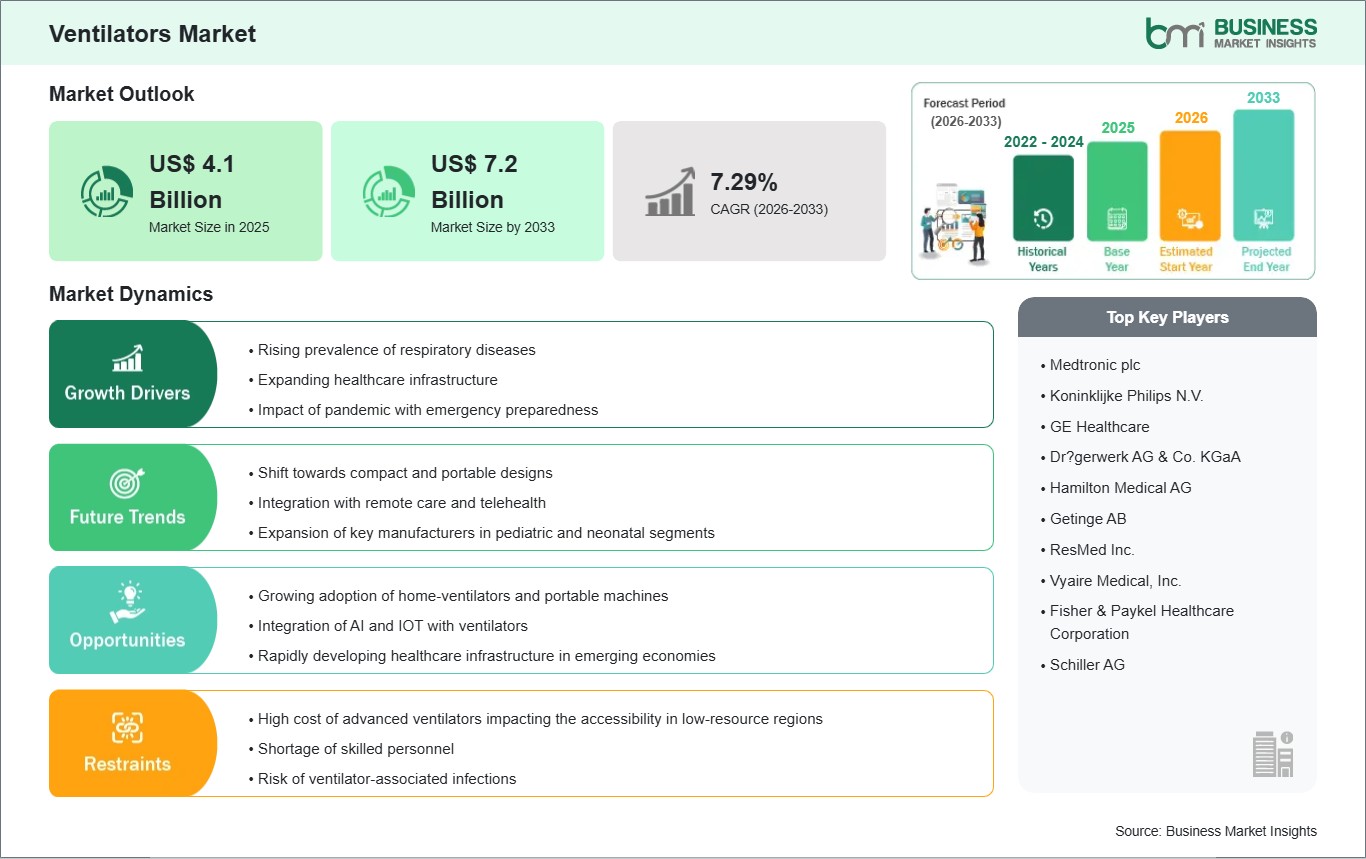
The Ventilators market size is expected to reach US$ 7.2 Billion by 2033 from US$ 4.1 Billion in 2025. The market is estimated to record a CAGR of 7.29% from 2026 to 2033.
Ventilators are used in hospitals, urgent care units, and in the home. The global ventilator market is driven by the increasing prevalence of chronic respiratory diseases such as asthma, chronic obstructive pulmonary disease (COPD), and pneumonia, as well as an increasing elderly population who are vulnerable to respiratory failure. During past global healthcare issues an increased demand was placed on the need for advanced critical care infrastructure. Consequently, advanced ventilatory support systems have seen greater usage and growth due to their portability, non-invasive nature, and ability to be used at-home; highlighting a shifting trend towards home health care and long-term disease management.
Major trends in the ventilator market include continued advancement of technology (Smart Ventilators), enhanced patient-ventilator synchrony, and incorporation of digital health into remote monitoring. Patient convenience, reduced product size, and improved comfort are all major contributors to the development of new products. Many manufacturers are now focusing on making ventilators energy efficient, quieter, and equipped with infection control capabilities. The large manufacturers, such as GE Healthcare, Philips, and Medtronic have continued to develop new products, providing an array of choices to meet all clinical needs, resulting in improved outcomes for all patients.

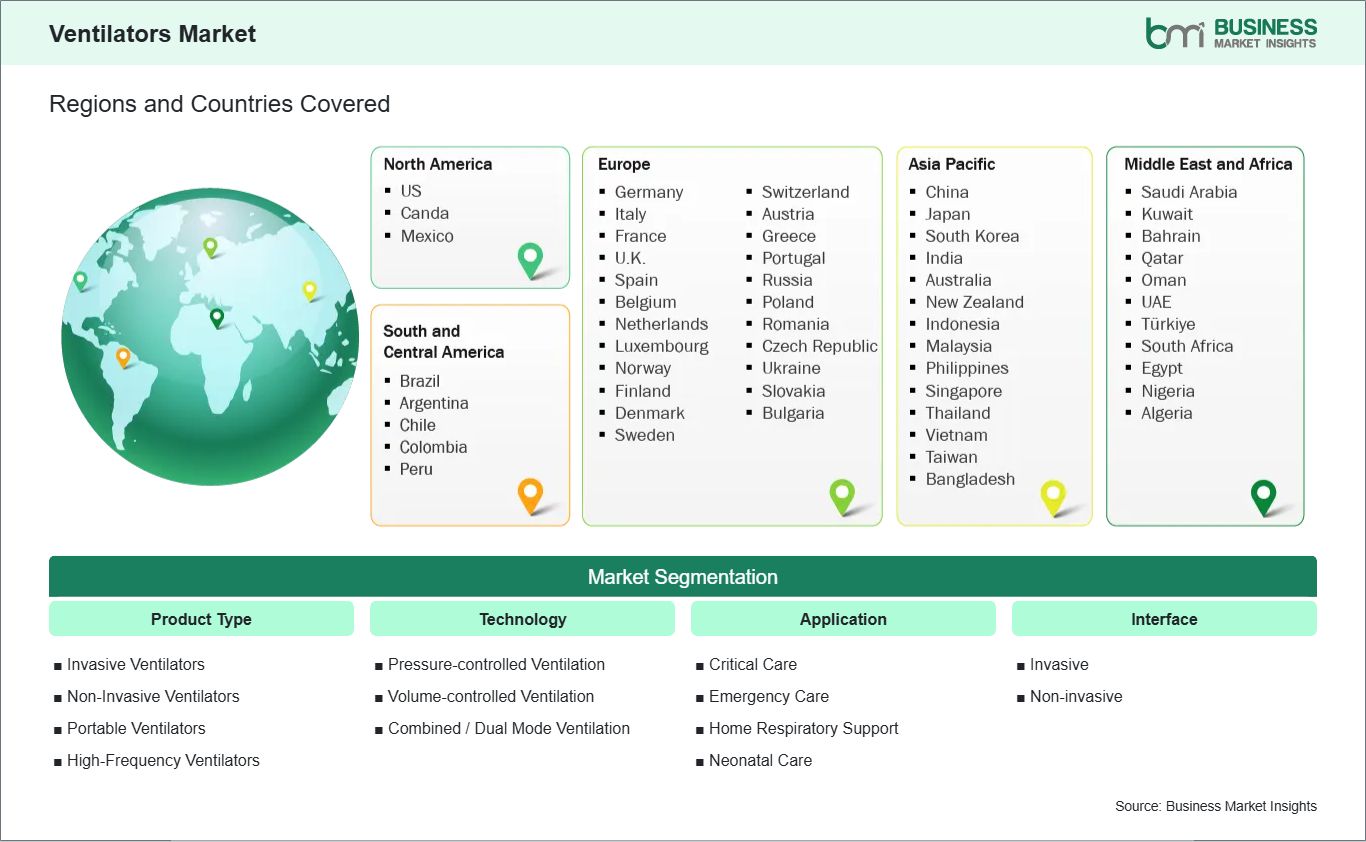
Key segments that contributed to the derivation of the Ventilators market analysis are product type, technology, interface, application, and end user.
The demand for ventilators is mainly influenced by the rising global trend of chronic respiratory diseases such as Chronic Obstructive Pulmonary Disease (COPD), asthma, pneumonia, and acute respiratory distress syndrome (ARDS), which require mechanical ventilation in the intensive care unit. COPD is estimated to be one of the main causes of death globally by 2030. The trend is attributed to air pollution, smoking, and urbanization, among other factors, thus resulting in a higher number of ICU admissions and an increase in ventilator demand. Besides that, the aging population at a fast rate, especially in areas such as North America, Europe, and Asia, Pacific, is a major contributor as the elderly are more prone to respiratory failures and other health conditions that will require them to have a long, term ventilatory support. This change in population has forced governments and healthcare providers to increase the number of beds available in the ICU and invest in modern ventilator equipment, which also includes AI, integrated systems for efficient patient monitoring. The COVID, 19 pandemic, which is now over, has been the main reason for the increase in demand for ventilators, hence, the need to be prepared for respiratory pandemics in the future. Therefore, ongoing healthcare infrastructure improvements and an increased burden of chronic diseases is expected to contribute the market growth.
The ventilator market holds substantial possibilities in developing markets, notably in Asia, Pacific, Latin America, and the Middle East & Africa, where the healthcare infrastructure is being modernized at a fast pace and the governments are making investments in the expansion of the critical care sector. The high growth potential is mainly due to the increasing number of ICU beds being added, the rising of disposable incomes, and the growing awareness of respiratory health caused by pollution and urbanization. The decentralization of healthcare, which also includes the shift towards home, based ventilation for chronic conditions, has some untapped potential; portable and non, invasive ventilators are becoming popular due to their cost, effectiveness, patient comfort, and ability to shorten hospital stays.
Innovations in technology such as miniaturized, AI, enabled, and IoT, connected devices that permit remote monitoring and predictive maintenance are great for home care and areas that are less developed. This development is in line with the post, pandemic focus on decentralized care, thus opening money, making possibilities to manufacturers to create affordable, battery, operated models. Strategic partnerships, mergers, and product innovations in these regions could take a considerable portion of the market, with emerging economies being forecasted to lead the way in terms of growth rate faster than mature markets until 2031.

The ventilator market holds substantial possibilities in developing markets, notably in Asia, Pacific, Latin America, and the Middle East & Africa, where the healthcare infrastructure is being modernized at a fast pace and the governments are making investments in the expansion of the critical care sector. The high growth potential is mainly due to the increasing number of ICU beds being added, the rising of disposable incomes, and the growing awareness of respiratory health caused by pollution and urbanization. The decentralization of healthcare, which also includes the shift towards home, based ventilation for chronic conditions, has some untapped potential; portable and non, invasive ventilators are becoming popular due to their cost, effectiveness, patient comfort, and ability to shorten hospital stays.
Innovations in technology such as miniaturized, AI, enabled, and IoT, connected devices that permit remote monitoring and predictive maintenance are great for home care and areas that are less developed. This development is in line with the post, pandemic focus on decentralized care, thus opening money, making possibilities to manufacturers to create affordable, battery, operated models. Strategic partnerships, mergers, and product innovations in these regions could take a considerable portion of the market, with emerging economies being forecasted to lead the way in terms of growth rate faster than mature markets until 2031.
| Report Attribute | Details |
|---|---|
| Market size in 2025 | US$ 4.1 Billion |
| Market Size by 2033 | US$ 7.2 Billion |
| Global CAGR (2026 - 2033) | 7.29% |
| Historical Data | 2022 - 2024 |
| Forecast period | 2026-2033 |
| Segments Covered | By Product Type
|
| Regions and Countries Covered | North America
|
| Market leaders and key company profiles |
|
By product type, the ventilators market is segmented into invasive ventilators, non-invasive ventilators, portable ventilators, high-frequency ventilators. The invasive ventilators segment dominated the market in 2025. They are widely employed in intensive care units, mainly for patients suffering from severe respiratory failure, complications after surgery, trauma, and acute infections. These respirators provide exact regulation of the ventilation parameters, thereby, they are indispensable in the intensive care units, which require close supervision and advanced respiratory support.
By technology, the market is segmented into pressure-controlled ventilation, volume-controlled ventilation, combined / dual mode ventilation. The pressure-controlled ventilation segment held the largest share of the market in 2025. This segment owes its success mostly to its risk, reduction capability by keeping the airway pressure consistent. Thus, it is a device that can be used in patients with reduced lung compliance, for instance, those suffering from ARDS and COPD. This is the source to which the powers concerned have turned increasingly for responding to the improved patient, ventilator synchrony and safety.
By interface, the ventilators market is bifurcated into invasive and non-invasive. The invasive segment dominated the market in 2025. It is mainly responsible for patients in need of emergency situations where they have to breathe on their own for a short time only.
By application, the market is segmented into critical care (ICU), emergency care, home respiratory support, neonatal care. The critical care (ICU) segment held the largest share of the market in 2025. The high prevalence of severe respiratory conditions, increasing ICU admissions, and the need for continuous mechanical ventilation in life-threatening situations are key factors supporting this segment’s dominance.
By end user, the market is segmented into hospitals & clinics, home care settings, ambulatory surgical centers, and others. The hospitals & clinics segment held the largest share of the market in 2025. This leadership is primarily motivated by the presence of a state, of, the, art healthcare system, skilled medical professionals, and a large number of patients coming to the hospital for emergency and intensive respiratory care.
The Ventilators Market Size and Forecast (2025-2033) report provides a detailed analysis of the market covering below areas:

The Ventilators market is evaluated by gathering qualitative and quantitative data post primary and secondary research, which includes important corporate publications, association data, and databases. A few of the key developments in the ventilators market are:
The Ventilators Market is valued at US$ 4.1 Billion in 2025, it is projected to reach US$ 7.2 Billion by 2033.
As per our report Ventilators Market, the market size is valued at US$ 4.1 Billion in 2025, projecting it to reach US$ 7.2 Billion by 2033. This translates to a CAGR of approximately 7.29% during the forecast period.
The Ventilators Market report typically cover these key segments-
The historic period, base year, and forecast period can vary slightly depending on the specific market research report. However, for the Ventilators Market report:
The Ventilators Market is populated by several key players, each contributing to its growth and innovation. Some of the major players include:
The Ventilators Market report is valuable for diverse stakeholders, including:
Essentially, anyone involved in or considering involvement in the Ventilators Market value chain can benefit from the information contained in a comprehensive market report.
Please tell us your area of interest
(Market Segments/ Regions and Countries/ Companies)