Market Summary
Executive Summary and Global Market Analysis
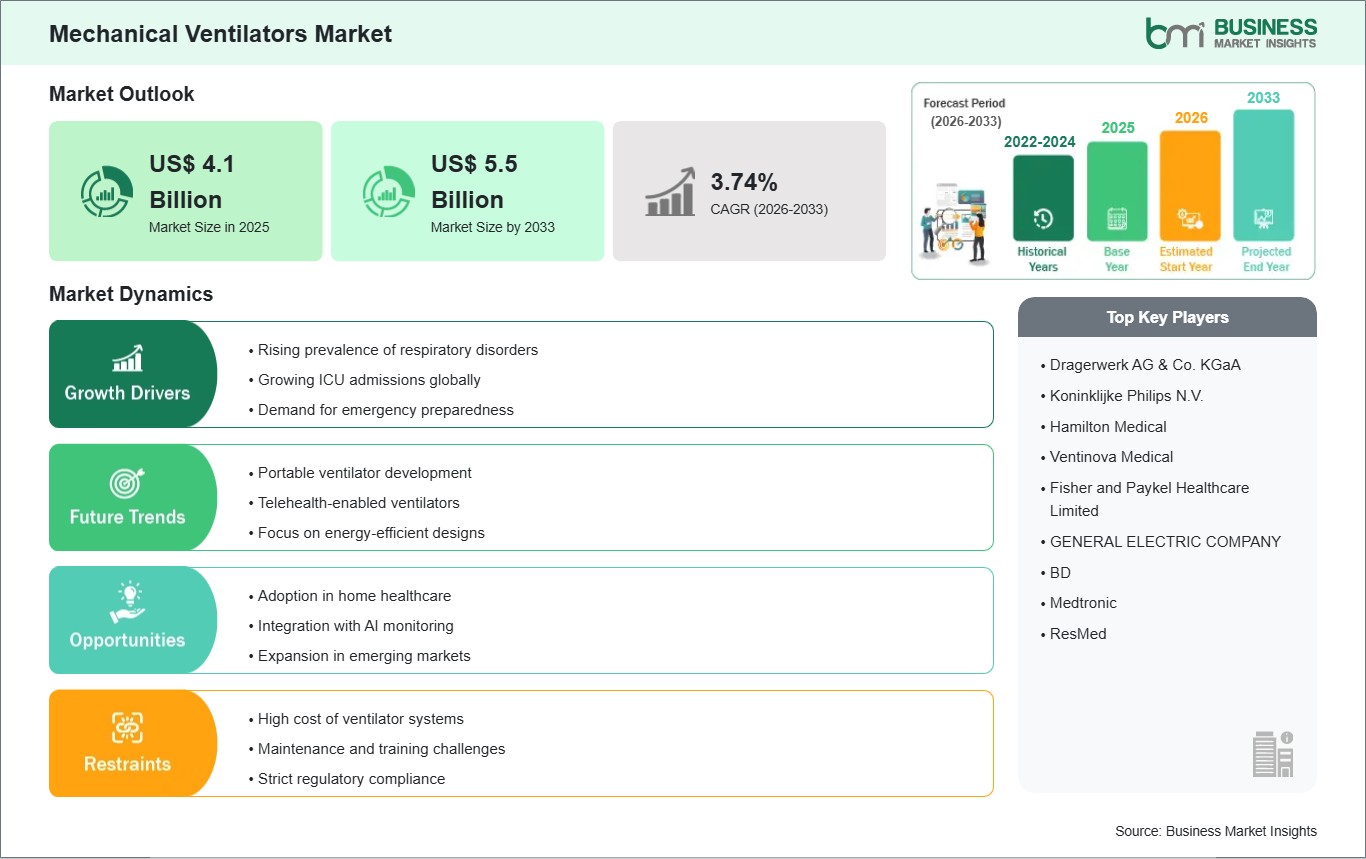
Mechanical ventilators are indispensable medical devices designed to provide respiratory support for patients who cannot breathe adequately on their own due to conditions such as trauma, surgical complications, or chronic respiratory illnesses. Post-pandemic, the market has transitioned from emergency-driven procurement to a strategic focus on long-term respiratory care and technology integration. This evolution reflects a broader healthcare trend toward smarter, more efficient systems that reduce clinician workload and improve patient outcomes.
However, the market faces notable challenges. High capital expenditure for advanced ICU-grade ventilators remains a significant barrier for healthcare providers, particularly in resource-constrained settings. Additionally, ventilator-associated pneumonia (VAP) continues to pose clinical and financial risks, increasing hospital stays and treatment costs. These factors can slow adoption rates and strain budgets, especially in emerging economies.
Despite these restraints, the mechanical ventilators market offers compelling opportunities. The rising global prevalence of chronic respiratory diseases such as COPD, now the third leading cause of death worldwide, combined with an aging population susceptible to acute respiratory distress syndrome (ARDS), ensures sustained demand. Furthermore, technological advancements are reshaping the competitive landscape. AI-powered ventilators capable of real-time patient-ventilator synchronization, closed-loop automation, and cloud-based remote monitoring are gaining traction, particularly in home healthcare settings. Compact, portable devices designed for domiciliary care and telehealth integration are opening new revenue streams, making this segment one of the most promising growth areas for manufacturers and investors.
Segment Analysis
Mechanical Ventilators Market Segmentation
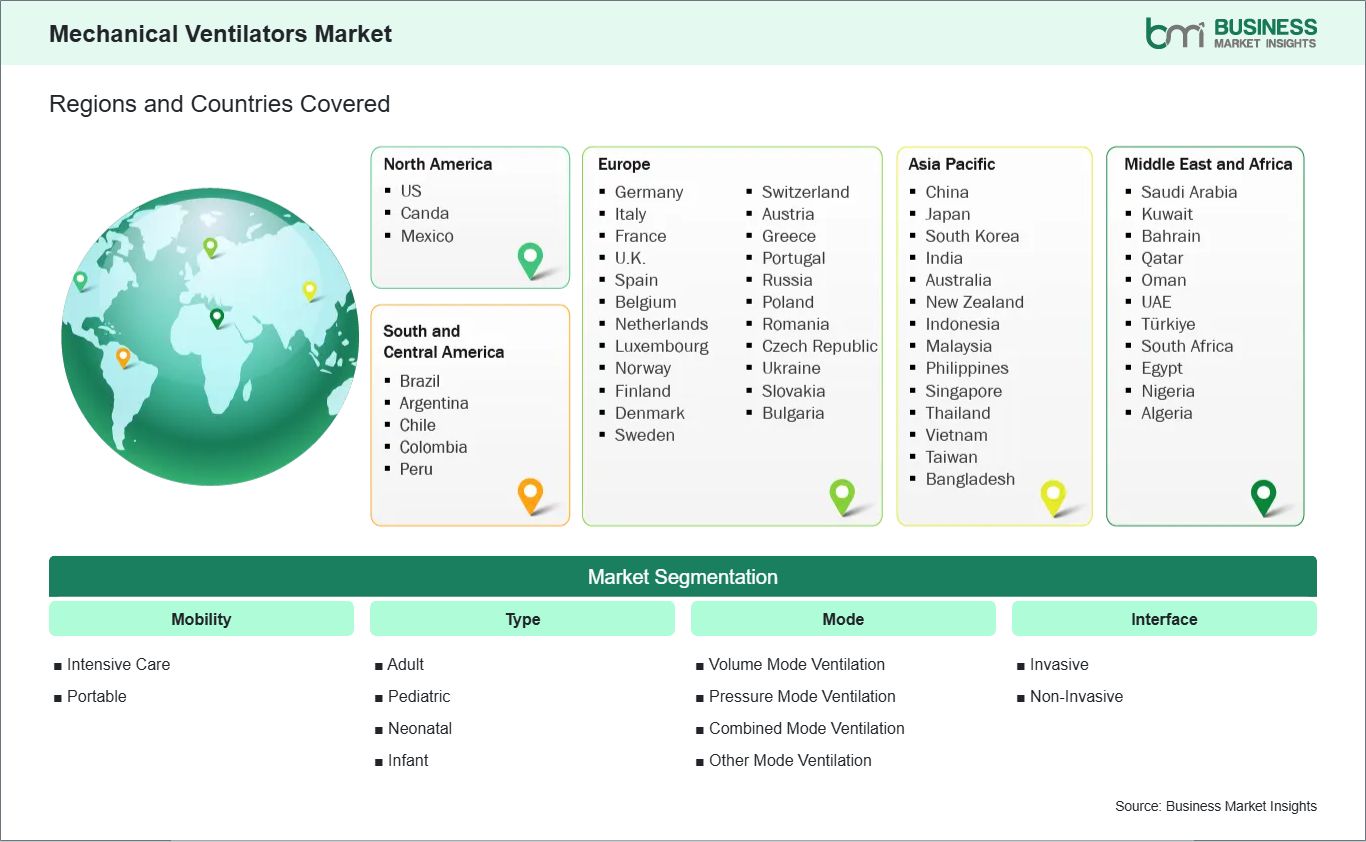
Key segments that contributed to the derivation of the Mechanical Ventilators Market analysis are mobility, type, mode, and interface.
- By Mobility, the market is segmented into Intensive Care and Portable.
- By Type, the market is segmented into Adult, Pediatric, Neonatal, and Infant.
- By Mode, the market is segmented into Volume Mode Ventilation, Pressure Mode Ventilation, Combined Mode Ventilation, and Other Mode Ventilation.
- By Interface, the market is bifurcated into Invasive and Non-Invasive.
Market Forces
Mechanical Ventilators Market Drivers and Opportunities
Surge in Chronic Respiratory Ailments
The rising global incidence of chronic respiratory diseases has become a fundamental driver of sustained demand within the ventilatory support market. Chronic Obstructive Pulmonary Disease (COPD) remains one of the most prevalent conditions, with the World Health Organization estimating that nearly 390 million people worldwide are affected. This enormous patient population creates continuous and long-term requirements for both acute-care ventilators used in hospitals during exacerbations and advanced domiciliary solutions that support patients in managing chronic symptoms at home.
Lifestyle and environmental factors further intensify this need. Increasing levels of air pollution, particularly in rapidly urbanizing regions, are contributing to higher rates of respiratory impairment across diverse age groups. At the same time, persistent smoking rates and exposure to biomass fuels in low-resource settings continue to expand the pool of individuals at risk of developing COPD and related disorders.
Together, these trends create a robust and growing demand for ventilatory technologies that are reliable, adaptable, and capable of supporting patients across different stages of disease progression, from emergency stabilization to long-term home-based therapy.
Technological Integration and AI-Driven Monitoring
The growing adoption of AI-enhanced ventilatory systems presents a major technological and commercial opportunity in respiratory care. These next-generation devices are designed to recognize patient-ventilator asynchrony in real time, an issue that can significantly compromise ventilation efficiency and patient comfort if left unaddressed. By continuously analyzing breathing patterns and physiological signals, these smart ventilators can automatically fine-tune parameters such as pressure support, tidal volume, and cycling thresholds. This capability not only reduces the clinical workload for respiratory therapists and nurses but also helps minimize the risk of ventilator-induced lung injury by ensuring gentler and more personalized ventilation strategies.
In parallel, the incorporation of cloud-based connectivity is transforming long-term respiratory management outside the hospital. Remote monitoring platforms allow physicians to track home-care patients’ respiratory metrics, adherence, and device performance through integrated tele-health systems. Early identification of deteriorating conditions enables timely interventions, reducing hospital readmissions and improving patient outcomes. These advancements are gaining strong traction in North America and Europe, where healthcare systems are prioritizing digital integration, predictive analytics, and proactive chronic-disease management.
Size and Share Analysis
Mechanical Ventilators Market Size and Share Analysis
The Mechanical Ventilators Market demonstrates steady growth, with size and share analysis revealing evolving trends and competitive positioning among key players. The report further examines subsegments categorized within mobility, type, mode, and interface, offering insights into their contribution to overall market performance.
For instance, the Portable mobility subsegment is surging, driven by urgent needs in emergency transport and home care environments. In the Neonatal type category, tailored, lung-protective ventilators are attracting increased R&D and investment. The Non-Invasive interface continues to gain traction as a preferred option for lower-risk ventilation support outside the ICU.
Report Coverage
Mechanical Ventilators Market Report Coverage and Deliverables
The Mechanical Ventilators Market Size and Forecast (2022–2033) report provides a detailed analysis of the market covering below areas:
- Mechanical Ventilators Market size and forecast at global, regional, and country levels for all the key market segments covered under the scope
- Mechanical Ventilators Market trends, as well as market dynamics such as drivers, restraints, and key opportunities
- Mechanical Ventilators Market analysis covering key market trends, global and regional framework, major players, regulations, and recent market developments
- Industry landscape and competition analysis covering market concentration, heat map analysis, prominent players, and recent developments for the Mechanical Ventilators Market
- Detailed company profiles, including SWOT analysis
Geographic Insights
Mechanical Ventilators Market Geographic Insights
The geographical scope of the Mechanical Ventilators Market report is divided into five regions: North America, Asia Pacific, Europe, the Middle East & Africa, and South & Central America.
North America continues to advance ventilator technology through strong healthcare infrastructure and innovation in critical care systems. Europe emphasizes non-invasive and home-care solutions, with Germany and the UK leading in research and development. Asia Pacific is witnessing rapid adoption fueled by hospital expansion and government initiatives in countries like China and India. The Middle East & Africa are investing heavily in trauma and critical care facilities, particularly across GCC nations. Meanwhile, South & Central America are modernizing public health systems, with Brazil spearheading efforts to improve respiratory care accessibility.
Industry Activity
Recent Developments
The Mechanical Ventilators Market is evaluated by gathering qualitative and quantitative data post-primary and secondary research, which includes important corporate publications, association data, and databases. A few of the key developments in the Mechanical Ventilators Market are:
- In November 2025, Cleveland EMS has added portable ventilators to all 25 frontline ambulances, a move leaders call a “game changer”. All 25 of Cleveland’s frontline ambulances will now carry an advanced device, officials say will save lives.
- In February 2025, Dräger, an international leader in medical and safety technologies, announced that its Evita V800/V600 and Babylog VN800 family of mechanical ventilators received Authority to Operate (ATO) certification under the Department of Defense's (DoD) Risk Management Framework (RMF). In addition, the Savina 300 series of mechanical ventilators received ATO certification under the DoD's RMF.
- In January 2025, Shvabe holding will bring to market the first Russian portable mechanical ventilator, AIVL-D, that can be used at home. The product weighs 5 kg and is able to run in standalone mode during several hours due to a built-in battery. The ventilator has been registered with the Federal Service for Supervision in Healthcare to confirm its full fitness for use.
Trust & Transparency
Research Methodology
The market analysis combines proprietary research with secondary data from government agencies, company disclosures, regulatory filings, industry databases and expert interviews. Market estimates are validated through data triangulation, cross-market benchmarking and analyst
review.
View Full Research Methodology
Key Sources Referred:
World Bank – Global Trade IndicatorsWorld Trade Organization (WTO)International Monetary Fund (IMF)International Trade Administration (ITA)Company WebsitesCompany Annual ReportsCompany Investor Presentations