Diabetes Care Devices Market Outlook (2022-2033)

Historic Data: 2022-2024   |   Base Year: 2025   |   Forecast Period: 2026-2033
Report Content: Market Scope, Market Segmentation, Market Dynamics, and Competitive Analysis

Report Coverage:
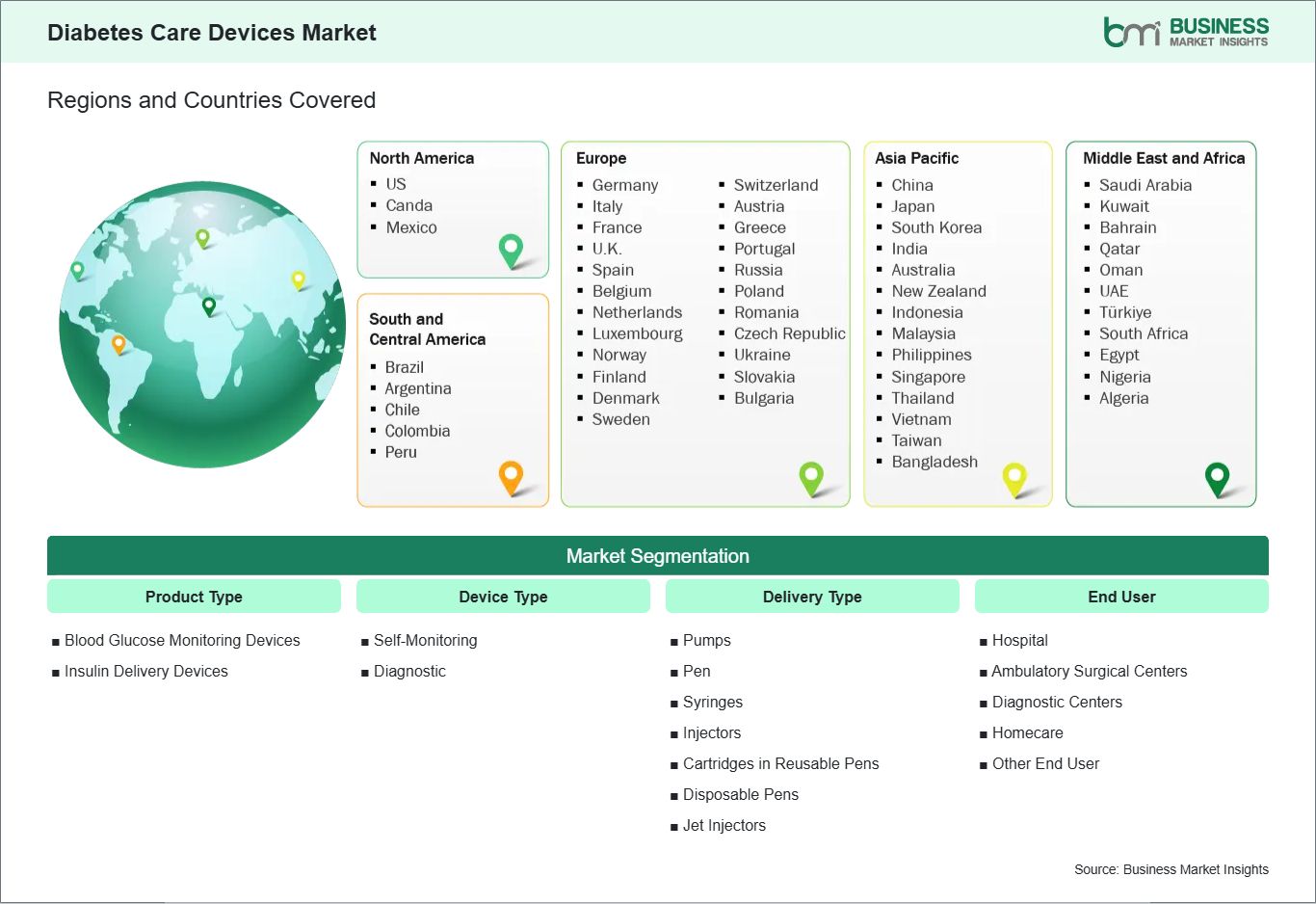
  • Product Type (Blood Glucose Monitoring Devices, Insulin Delivery Devices)
  • Device Type (Self-Monitoring, Diagnostic)
  • Delivery Type (Pumps, Pen, Syringes, Injectors, Cartridges in Reusable Pens, Disposable Pens, Jet Injectors)
  • End User (Hospital, Ambulatory Surgical Centers, Diagnostic Centers, Homecare, Other End User)

No. of Pages: 400
Report Code: BMIPUB00033418
Category: Life Sciences
Diabetes Care Devices Market

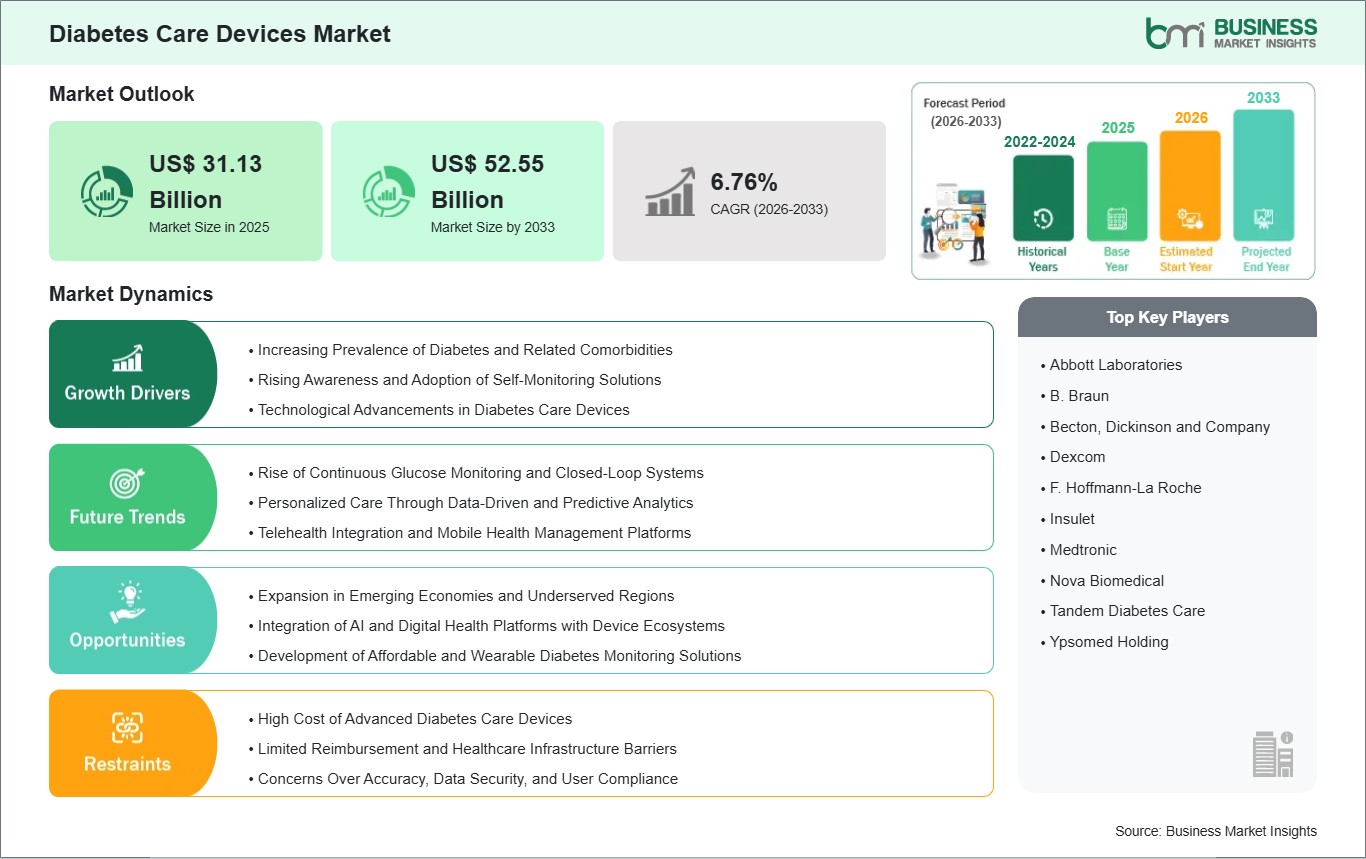
The Diabetes Care Devices Market size is expected to reach US$ 52.55 Billion by 2033 from US$ 31.13 Billion in 2025. The market is estimated to record a CAGR of 6.76% from 2026 to 2033.

Executive Summary and Global Market Analysis:

Diabetes care devices function as medical devices which enable diabetes patients to monitor their blood sugar levels and administer their insulin medication correctly. The system consists of blood glucose meters and continuous glucose monitoring (CGM) systems and insulin delivery devices which include insulin pens and pumps, together with digital management platforms that assist patients and clinicians in tracking their daytime and nighttime blood sugar levels throughout both home and clinical environments.

The diabetes care devices market expansion occurs because more people worldwide develop diabetes, more people reach old age, and more people want management solutions which connect to their devices and provide them with real-time data while also helping them achieve better clinical results and improved daily functioning. The current innovation trends develop advanced technologies which combine AI and Bluetooth and smartphone integration and automated insulin delivery systems to provide users with more accurate and simpler and tailored healthcare solutions. CGM systems have become more popular because patients want better blood sugar monitoring methods while insulin delivery devices now include advanced systems which replicate natural insulin distribution through their closed-loop functionality. North America maintains a large market presence because its healthcare system provides advanced medical services, while Asia Pacific emerges as a rapidly expanding market area. Diabetes management now requires continuous data collection, which includes predictive analytics, because the market trends show increased demand for remote patient monitoring and digital health systems.

Diabetes Care Devices Market - Strategic Insights:

global-market-strategic-framework
Get more information on this report

Diabetes Care Devices Market Segmentation Analysis:

Key segments that contributed to the derivation of the diabetes care devices market analysis are product type, device type, delivery type, and end user.

  • By product type, the diabetes care devices market is categorized into blood glucose monitoring devices, insulin delivery devices. The blood glucose monitoring devices segment held the largest share of the market in 2025.
  • By device type, the market is bifurcated into self-monitoring, diagnostic. The self-monitoring segment held a larger share of the market in 2025.
  • By delivery type, the market is segmented into pumps, pen, syringes, injectors, cartridges in reusable pens, disposable pens, jet injectors. The pen segment held the largest share of the market in 2025.
  • By end user, the diabetes care devices market is segmented into hospital, ambulatory surgical centers, diagnostic centers, homecare, other end user. The hospital segment dominated the market in 2025.

Diabetes Care Devices Market Drivers and Opportunities:

Rising Global Diabetes Prevalence and Real‑Time Monitoring Demand

The diabetes care devices market experiences its strongest growth through the worldwide diabetes epidemic, which creates a need for modern monitoring and treatment systems. Recent data show the global diabetic population exceeded 540 million in 2024, with more than 61 % of those patients requiring daily glucose monitoring to maintain glycemic control and prevent complications. The increased utilization of continuous glucose monitoring systems has reached 27 percent because the system enables users to track their glucose levels in real time, which leads to improved stability and fewer emergency medical situations. The combination of real-time data and connectivity functions allows for both remote patient management and customized healthcare solutions, which have led to a 18 percent increase in remote monitoring programs during 2024. The diabetes device market requires manufacturers to develop predictive analytics and connectivity solutions, which has resulted in manufacturers making diabetes devices essential for both medical facilities and residential use.

Technological Innovation and Connected Diabetes Care

The diabetes care devices market has a major opportunity because technology-based innovations create new applications that help people with diabetes. Advanced CGM devices, such as those integrating AI and predictive analytics, provide users with proactive glucose monitoring capabilities that extend beyond standard glucose measurement by delivering solutions which identify upcoming high or low glucose trends. The industry demonstrates this pattern through its approval of next-generation CGM products which receive authorization for extended wear and improved smart device connectivity capabilities. Digital health platforms and wearable companies are forming partnerships through their joint efforts to combine CGM data with other health metrics to develop complete metabolic health assessments. The digital systems enable clinical work reduction through their remote patient monitoring capabilities which establish customized treatment plans that benefit different patient groups.

Diabetes Care Devices Market Size and Share Analysis:

By product type, the diabetes care devices market is categorized into blood glucose monitoring devices, insulin delivery devices. The blood glucose monitoring devices segment held the largest share of the market in 2025. Blood glucose monitoring devices lead the market because they are essential for daily diabetes management and used far more frequently than insulin delivery systems. Devices like self-monitoring meters and continuous glucose monitoring (CGM) systems offer real-time, user-friendly glucose readings, empowering patients to adjust diet and therapy immediately. Their broad accessibility, lower cost, and compatibility with digital health platforms drive higher adoption globally across all patient types.

By device type, the market is bifurcated into self-monitoring, diagnostic. The self-monitoring segment held a larger share of the market in 2025. Self-monitoring devices dominate compared with diagnostic devices because diabetes management requires frequent and ongoing glucose checks by patients themselves. Self-monitoring tools, including SMBG meters and wearable CGMs, provide immediate actionable data that supports daily treatment decisions and reduces clinic visits. This convenience, coupled with technology improvements and mobile connectivity for remote care, makes self-monitoring the primary choice for long-term management of both Type 1 and Type 2 diabetes.

By delivery type, the market is segmented into pumps, pen, syringes, injectors, cartridges in reusable pens, disposable pens, jet injectors. The pen segment held the largest share of the market in 2025. Among delivery modes, pens often lead due to their ease of use, portability, and patient preference over more complex pumps or traditional syringes. Pens simplify dosing (especially disposable and smart pens with dose tracking), making them popular with both insulin-dependent Type 2 and Type 1 populations. Their balance of convenience, affordability, and accuracy drives sustained volume share globally, particularly in self-administered home care settings.

By end user, the diabetes care devices market is segmented into hospital, ambulatory surgical centers, diagnostic centers, homecare, other end user. The hospital segment dominated the market in 2025. Hospitals remain the largest end-user segment as they are the primary point of diagnosis, treatment initiation, and advanced device deployment (like professional CGM systems and pumps). They centralize multidisciplinary diabetes care, handle severe or complex cases, and integrate device use within broader inpatient and outpatient programs. Insurance coverage and institutional purchasing power further anchor hospitals as the leading end-user globally.

Diabetes Care Devices Market Report Highlights:

Report Attribute Details
Market size in 2025 US$ 31.13 Billion
Market Size by 2033 US$ 52.55 Billion
Global CAGR (2026 - 2033)6.76%
Historical Data 2022-2024
Forecast period 2026-2033
Segments Covered By Product Type
  • Blood Glucose Monitoring Devices
  • Insulin Delivery Devices
By Device Type
  • Self-Monitoring
  • Diagnostic
By Delivery Type
  • Pumps
  • Pen
  • Syringes
  • Injectors
  • Cartridges in Reusable Pens
  • Disposable Pens
  • Jet Injectors
By End User
  • Hospital
  • Ambulatory Surgical Centers
  • Diagnostic Centers
  • Homecare
  • Other End User
Regions and Countries Covered
North America US, Canada, Mexico
Europe Belgium, Austria, Finland, Denmark, Greece, Poland, Romania, Russia, Ukraine, Czech Republic, Slovakia, Bulgaria, Italy, Luxembourg, Germany, Switzerland, France, Netherlands, Norway, Portugal, Spain, Sweden, United Kingdom
Asia-Pacific Australia, China, India, Japan, South Korea, Indonesia, Malaysia, Philippines, Singapore, Thailand, Vietnam, Bangladesh, New Zealand, Taiwan
South and Central America Brazil, Argentina, Peru, Chile, Colombia
Middle East and Africa Bahrain, Kuwait, Oman, Qatar, Saudi Arabia, United Arab Emirates, Turkiye, South Africa, Egypt, Algeria, Nigeria
Market leaders and key company profiles
  • Abbott Laboratories
  • B. Braun
  • Becton, Dickinson and Company
  • Dexcom
  • F. Hoffmann-La Roche
  • Insulet
  • Medtronic
  • Nova Biomedical
  • Tandem Diabetes Care
  • Ypsomed Holding
Get more information on this report

Diabetes Care Devices Market Report Coverage and Deliverables:

The " Diabetes Care Devices Market Size and Forecast (2022-2033)" report provides a detailed analysis of the market covering below areas:

  • Diabetes care devices market size and forecast at global, regional, and country levels for all the key market segments covered under the scope
  • Diabetes care devices market trends, as well as market dynamics such as drivers, restraints, and key opportunities
  • Diabetes care devices market analysis covering key market trends, global and regional framework, major players, regulations, and recent market developments
  • Industry landscape and competition analysis covering market concentration, heat map analysis, prominent players, and recent developments for the diabetes care devices market
  • Detailed company profiles, including SWOT analysis

Diabetes Care Devices Market Geographic Insights:

The geographical scope of the diabetes care devices market report is divided into five regions: North America, Asia Pacific, Europe, Middle East and Africa, and South and Central America. The diabetes care devices market in Asia Pacific is expected to grow significantly during the forecast period.

The Asia-Pacific diabetes care devices market is segmented into China, Japan, South Korea, India, Australia, New Zealand, Indonesia, Malaysia, the Philippines, Singapore, Thailand, Vietnam, Taiwan, Bangladesh, and the Rest of Asia. The Asia-Pacific diabetes care devices market is experiencing robust growth, due to multiple converging factors. The rapid urbanization and changing lifestyle patterns, which two countries and Indonesia now face, have caused diabetes rates to increase sharply, especially Type 2 diabetes, thus creating a large patient base that needs permanent monitoring and medical care. The public now recognizes diabetes complications, and people understand that early detection can help them control their condition better, which has led to increased usage of home monitoring devices that include glucometers and continuous glucose monitoring systems. The regional governments by developing healthcare systems and public health programs, which enable better access to advanced diabetes treatment systems, now provide better healthcare services to both urban and semi-urban regions.

The development of smart insulin pens and AI-enabled glucose monitoring devices has resulted in affordable technology solutions, which tech-savvy users now find easy to obtain. The distribution channels, which now include online pharmacies and e-commerce platforms, have expanded their reach to remote areas, thus making their products more accessible to customers. The diabetes care devices market across Asia-Pacific continues to experience strong expansion because multiple present factors, which include rising disease rates and increasing public knowledge, along with better system development and new technological breakthroughs and improved system access.

global-market-geography
Get more information on this report

Diabetes Care Devices Market Research Report Guidance:

  • The report includes qualitative and quantitative data in the diabetes care devices market across product type, device type, delivery type, end user, and geography.
  • The report starts with the key takeaways (chapter 2), highlighting the key trends and outlook of the diabetes care devices market.
  • Chapter 3 includes the research methodology of the study.
  • Chapter 4 further includes ecosystem analysis.
  • Chapter 5 highlights the major industry dynamics in the diabetes care devices market, including factors that are driving the market, prevailing deterrents, potential opportunities, as well as future trends. Impact analysis of these drivers and restraints is also covered in this section.
  • Chapter 6 discusses the diabetes care devices market scenario, in terms of historical market revenues, and forecast till the year 2031.
  • Chapters 7 to 11 cover diabetes care devices market segments by product type, device type, delivery type, end user, and geography across North America, Europe, Asia Pacific, Middle East and Africa, and South and Central America. They cover the market revenue forecast and factors driving the market.
  • Chapter 12 describes the competitive analysis along with the heat map analysis for the key players operating in the market.
  • Chapter 13 describes the industry landscape analysis. It provides detailed descriptions of business activities such as market initiatives, new developments, mergers, and joint ventures globally, along with a competitive landscape.
  • Chapter 14 provides detailed profiles of the major companies operating in the diabetes care devices market. Companies have been profiled on the basis of their key facts, business descriptions, products and services, financial overview, SWOT analysis, and key developments.
  • Chapter 15, i.e., the appendix is inclusive of a brief overview of the company, list of abbreviations, and disclaimer.

Diabetes Care Devices Market News and Key Development:

The diabetes care devices market is evaluated by gathering qualitative and quantitative data post primary and secondary research, which includes important corporate publications, association data, and databases. A few of the key developments in the diabetes care devices market are:

  • In January 2024, the CE Mark certification for the MiniMed 780G system with Simplera Sync which includes a disposable continuously operating glucose monitoring device requires no fingerstick tests or taped application according to Medtronic plc. Simplera Sync offers users better functionality through its two-step process which allows for easier insertion while being smaller than all previous Medtronic sensors. The MiniMed 780G system represents Medtronic's finest insulin delivery system which provides automatic glucose level corrections at five-minute intervals.
  • In September 2024, Senseonics Holdings, Inc. which develops and produces long-lasting implantable CGM systems for diabetics together with Ascensia Diabetes Care announced that the U.S. Food and Drug Administration (FDA) has granted approval for the next-generation Eversense 365 CGM system which monitors Type 1 and Type 2 diabetes in patients aged 18 and older. Eversense 365 is the world's first One Year CGM system, representing a significant breakthrough in diabetes technology and management.

Key Sources Referred:

  • World Health Organization (WHO)
  • Centers for Disease Control and Prevention
  • International Diabetes Federation
  • Organisation for Economic Co‑operation and Development Health Statistics
  • Institute for Health Metrics and Evaluation
  • Company websites
  • Company annual reports
  • Company investor presentations
The List of Companies - Diabetes Care Devices Market
Frequently Asked Questions
How big is the Diabetes Care Devices Market?

The Diabetes Care Devices Market is valued at US$ 31.13 Billion in 2025, it is projected to reach US$ 52.55 Billion by 2033.

What is the CAGR for Diabetes Care Devices Market by (2026 - 2033)?

As per our report Diabetes Care Devices Market, the market size is valued at US$ 31.13 Billion in 2025, projecting it to reach US$ 52.55 Billion by 2033. This translates to a CAGR of approximately 6.76% during the forecast period.

What segments are covered in this report?

The Diabetes Care Devices Market report typically cover these key segments-

  • Product Type (Blood Glucose Monitoring Devices, Insulin Delivery Devices)
  • Device Type (Self-Monitoring, Diagnostic)
  • Delivery Type (Pumps, Pen, Syringes, Injectors, Cartridges in Reusable Pens, Disposable Pens, Jet Injectors)
  • End User (Hospital, Ambulatory Surgical Centers, Diagnostic Centers, Homecare, Other End User)

What is the historic period, base year, and forecast period taken for Diabetes Care Devices Market?

The historic period, base year, and forecast period can vary slightly depending on the specific market research report. However, for the Diabetes Care Devices Market report:

  • Historic Period : 2022-2024
  • Base Year : 2025
  • Forecast Period : 2026-2033
  • Who are the major players in Diabetes Care Devices Market?

    The Diabetes Care Devices Market is populated by several key players, each contributing to its growth and innovation. Some of the major players include:

  • Abbott Laboratories
  • B. Braun
  • Becton, Dickinson and Company
  • Dexcom
  • F. Hoffmann-La Roche
  • Insulet
  • Medtronic
  • Nova Biomedical
  • Tandem Diabetes Care
  • Ypsomed Holding
  • Who should buy this report?

    The Diabetes Care Devices Market report is valuable for diverse stakeholders, including:

    • Investors: Provides insights for investment decisions pertaining to market growth, companies, or industry insights. Helps assess market attractiveness and potential returns.
    • Industry Players: Offers competitive intelligence, market sizing, and trend analysis to inform strategic planning, product development, and sales strategies.
    • Suppliers and Manufacturers: Helps understand market demand for components, materials, and services related to concerned industry.
    • Researchers and Consultants: Provides data and analysis for academic research, consulting projects, and market studies.
    • Financial Institutions: Helps assess risks and opportunities associated with financing or investing in the concerned market.

    Essentially, anyone involved in or considering involvement in the Diabetes Care Devices Market value chain can benefit from the information contained in a comprehensive market report.

    Available Report Formats

    pdf-format excel-format pptx-format
    Buy Now
    Sales Assistance
    +1 646 791 7070 (US & UK)
    Customization Form

    Please tell us your area of interest
    (Market Segments/ Regions and Countries/ Companies)