Biomaterial wound dressings Market Outlook (2022-2033)

Historic Data: 2022-2024   |   Base Year: 2025   |   Forecast Period: 2026-2033
Report Content: Market Scope, Market Segmentation, Market Dynamics, and Competitive Analysis

Report Coverage:
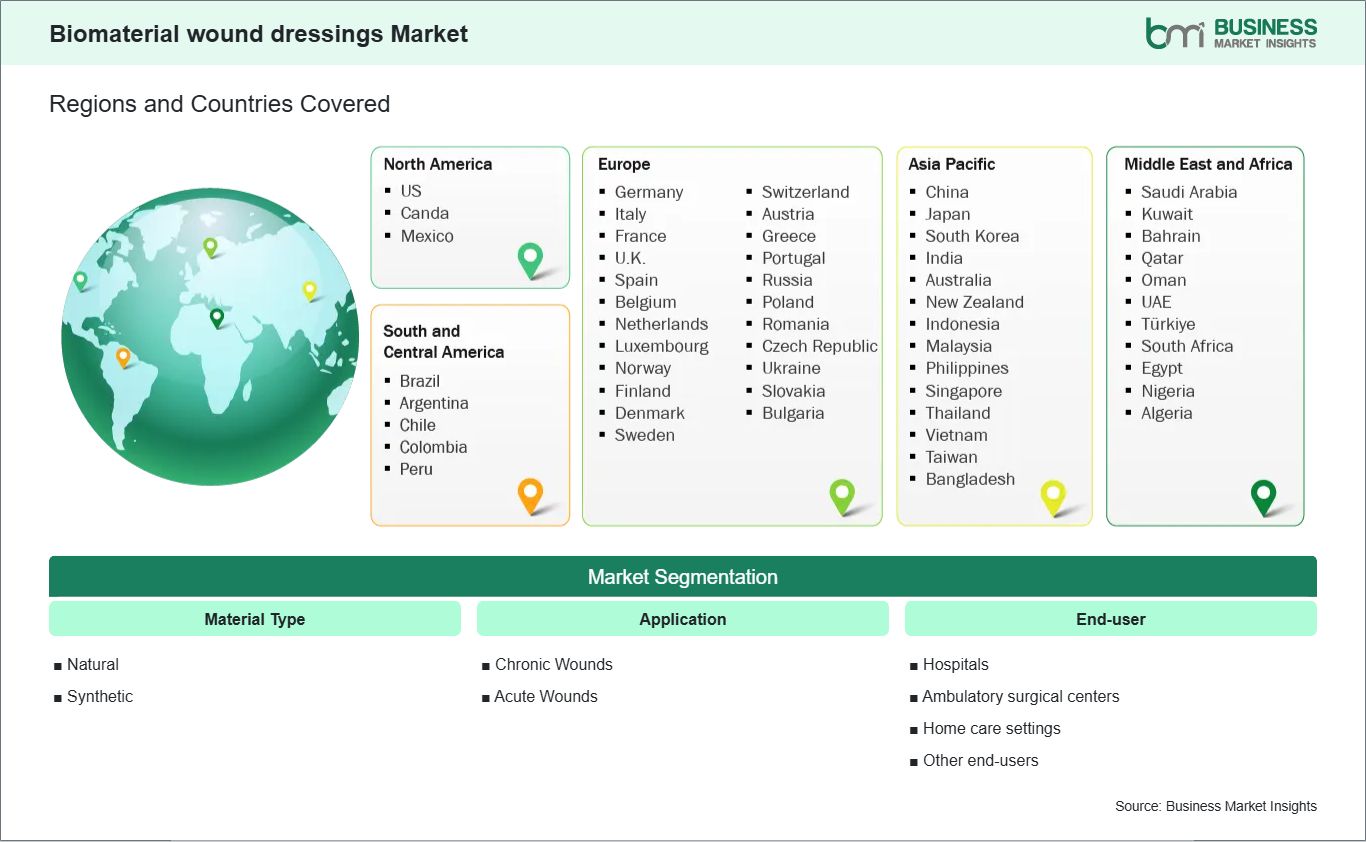
  • Material Type (Natural [Alginate, Collagen, Chitosan, Carboxymethyl Cellulose (CMC), Other natural materials], Synthetic [Polyurethane, Silicon, Polyvinyl alcohol, Other Synthetic Materials])
  • Application (Chronic Wounds [Pressure ulcers, Diabetic foot ulcers, Venous leg ulcers, Other Chronic Wounds], Acute Wounds [Surgical & traumatic wounds, Burns, Others])
  • End-user (Hospitals, Ambulatory surgical centers, Home care settings, Other end-users)

No. of Pages: 400
Report Code: BMIPUB00032566
Category: Life Sciences
Biomaterial wound dressings Market
Buy Now

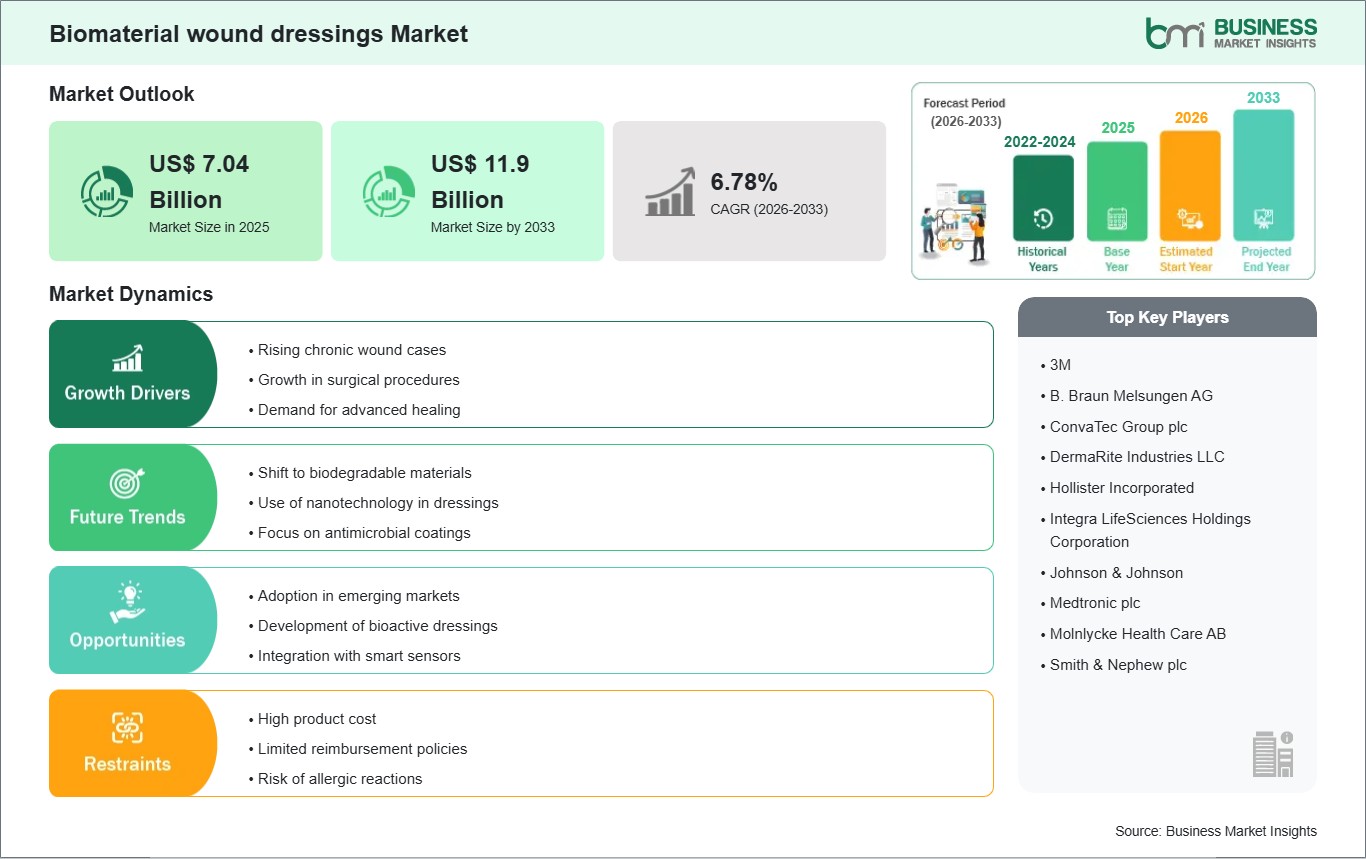
The Biomaterial Wound Dressings market size is expected to reach US$ 11.9 billion by 2033 from US$ 7.04 billion in 2025. The market is estimated to record a CAGR of 6.78% from 2026 to 2033.

Executive Summary and Global Market Analysis:

Biomaterial wound dressings are advanced, biocompatible materials, natural (e.g., collagen, alginates, chitosan) and synthetic/composite polymers, engineered to maintain moisture balance, manage exudate, prevent infection, and stimulate tissue regeneration by mimicking elements of the extracellular matrix. Their clinical value spans chronic and acute wounds, including diabetic foot ulcers (DFUs), venous leg ulcers (VLUs), pressure injuries, surgical/traumatic wounds, and burns. Growth is underpinned by aging populations, rising diabetes prevalence, and shifts to outpatient/home-based care.

Manufacturers face stringent and evolving regulatory requirements for clinical-grade evidence and quality systems, which elevate cost and time-to-market; payer variability and reimbursement uncertainties for biologics/skin substitutes add commercial complexity. Supply-chain dependencies for natural biomaterials (e.g., alginate sourcing) and the need for robust in-house biocompatibility testing further raise barriers.

Opportunities concentrate in bioactive and "intelligent" dressings (antimicrobial/antibiofilm, oxygen- or growth factor-enhanced) that shorten healing cycles. Second, platform innovations (nanofiber scaffolds, composite matrices) that blend moisture control with infection prevention. Third, procedural and setting shifts supported by clearer reimbursement pathways for skin substitutes and biologics in major markets. Vendors investing in nitric-oxide-powered technologies, PRP/biologic adjuncts, and digitally enabled wound pathways are positioned to capture value across hospital, outpatient, and home care segments.

Biomaterial wound dressings Market - Strategic Insights:

global-market-strategic-framework
Get more information on this report

Biomaterial wound dressings Market Segmentation Analysis:

Key segments that contributed to the derivation of the Biomaterial Wound Dressings market analysis are material type, application, and end user.

  • By Material Type, the market is segmented into Natural (Alginate, Collagen, Chitosan, Carboxymethyl Cellulose, and Other Natural Materials) and Synthetic (Polyurethane, Silicon, Polyvinyl Alcohol, and Other Synthetic Materials).
  • By Application, the market is segmented into Chronic Wounds (Pressure Ulcers, Diabetic Foot Ulcers, Venous Leg Ulcers, and Other Chronic Wounds) and Acute Wounds (Surgical & Traumatic Wounds, Burns, and Others).
  • By End User, the market is segmented into Hospitals, Ambulatory Surgical Centers, Home Care Settings, and Other End Users.

Biomaterial wound dressings Market Drivers and Opportunities:

Rising Prevalence of Chronic Wounds and Aging Population

The global rise in chronic wounds (including diabetic foot ulcers, venous leg ulcers, and pressure injuries) continues to serve as a major catalyst for growth within the advanced wound care sector. As the prevalence of diabetes, peripheral vascular diseases, and obesity steadily increases worldwide, more individuals are developing slow-healing or non-healing wounds that require long-term management. This trend is further intensified by growing aging population, since older adults are more susceptible to impaired circulation, reduced skin integrity, and comorbidities that hinder natural wound healing.

In response to these challenges, healthcare providers are increasingly turning toward advanced wound care technologies that can accelerate tissue repair, minimize infection risks, and improve patient quality of life. Biomaterial-based dressings have emerged as a preferred solution due to their ability to maintain optimal moisture balance, promote cellular regeneration, and create a protective barrier against pathogens. Compared with traditional gauze, these innovative dressings not only enhance clinical outcomes but also offer greater cost-effectiveness, especially in chronic care settings where prolonged healing times can drive up medical expenses. As a result, biomaterial dressings are becoming integral to modern wound management strategies across hospitals, clinics, and home-care environments. 

Favorable Reimbursement and Policy Support for Advanced Therapies

Regulatory bodies and healthcare payers are increasingly acknowledging the strong clinical and economic value associated with advanced wound care technologies, particularly those based on biomaterials. As the burden of chronic wounds continues to escalate, policymakers are placing greater emphasis on interventions that not only improve healing outcomes but also reduce long-term healthcare expenditure. This recognition is reflected in a series of recent policy updates across major markets, where reimbursement frameworks are being adjusted to support the use of innovative wound management solutions.

In the United States, for example, new reimbursement provisions from the Centers for Medicare & Medicaid Services (CMS) for skin substitutes, cellular and tissue-based products (CTPs), and various biologic dressings have significantly enhanced accessibility for both clinicians and patients. By easing financial barriers, these updates encourage broader adoption of advanced therapies in both hospital and outpatient environments, where cost considerations often influence treatment decisions.

Manufacturers and vendors that effectively align their product portfolios, clinical evidence, and coding strategies with these evolving reimbursement structures stand to benefit the most. Doing so enables them to accelerate market penetration, strengthen relationships with healthcare providers, and improve competitive positioning in a rapidly advancing segment of the wound care industry.

Biomaterial wound dressings Market Size and Share Analysis:

The Biomaterial Wound Dressings market demonstrates steady growth, with size and share analysis revealing evolving trends and competitive positioning among key players. The report further examines subsegments categorized within material type, application, and end user, offering insights into their contribution to overall market performance.

For instance, within material type, natural biomaterials, particularly collagen-based dressings, continue to dominate clinical adoption due to their proven biocompatibility and ability to accelerate tissue regeneration, making them a preferred choice for complex wounds. In application, diabetic foot ulcers stand out as the most significant driver of demand among chronic wounds, given their high prevalence and the need for advanced solutions to prevent infection and amputation. In terms of end users, hospitals remain the primary setting for biomaterial dressing utilization, driven by the complexity of cases and the availability of reimbursement pathways, though outpatient and homecare segments are gradually gaining traction as care models shift toward cost efficiency and patient convenience.

Biomaterial wound dressings Market Report Highlights:

Report Attribute Details
Market size in 2025 US$ 7.04 Billion
Market Size by 2033 US$ 11.9 Billion
Global CAGR (2026 - 2033)6.78%
Historical Data 2022-2024
Forecast period 2026-2033
Segments Covered By Material Type
  • Natural
  • Synthetic
By Application
  • Chronic Wounds
  • Acute Wounds
By End-user
  • Hospitals
  • Ambulatory surgical centers
  • Home care settings
  • Other end-users
Regions and Countries Covered North America
  • US
  • Canada
  • Mexico
Europe
  • Belgium
  • Austria
  • Finland
  • Denmark
  • Greece
  • Poland
  • Romania
  • Russia
  • Ukraine
  • Czech Republic
  • Slovakia
  • Bulgaria
  • Italy
  • Luxembourg
  • Germany
  • Switzerland
  • France
  • Netherlands
  • Norway
  • Portugal
  • Spain
  • Sweden
  • United Kingdom
Asia-Pacific
  • Australia
  • China
  • India
  • Japan
  • South Korea
  • Indonesia
  • Malaysia
  • Philippines
  • Singapore
  • Thailand
  • Vietnam
  • Bangladesh
  • New Zealand
  • Taiwan
South and Central America
  • Brazil
  • Argentina
  • Peru
  • Chile
  • Colombia
Middle East and Africa
  • Bahrain
  • Kuwait
  • Oman
  • Qatar
  • Saudi Arabia
  • United Arab Emirates
  • Turkiye
  • South Africa
  • Egypt
  • Algeria
  • Nigeria
Market leaders and key company profiles
  • 3M
  • B. Braun Melsungen AG
  • ConvaTec Group plc
  • DermaRite Industries LLC
  • Hollister Incorporated
  • Integra LifeSciences Holdings Corporation
  • Johnson & Johnson
  • Medtronic plc
  • Molnlycke Health Care AB
  • Smith & Nephew plc
Get more information on this report

Biomaterial wound dressings Market Report Coverage and Deliverables:

The Biomaterial Wound Dressings Market Size and Forecast (2022–2033) report provides a detailed analysis of the market covering below areas:

  • Biomaterial Wound Dressings market size and forecast at global, regional, and country levels for all the key market segments covered under the scope
  • Biomaterial Wound Dressings market trends, as well as market dynamics such as drivers, restraints, and key opportunities
  • Biomaterial Wound Dressings market analysis covering key market trends, global and regional framework, major players, regulations, and recent market developments
  • Industry landscape and competition analysis covering market concentration, heat map analysis, prominent players, and recent developments for the Biomaterial Wound Dressings market
  • Detailed company profiles, including SWOT analysis

Biomaterial wound dressings Market Geographic Insights:

The geographical scope of the Biomaterial Wound Dressings market report is divided into five regions: North America, Asia Pacific, Europe, the Middle East & Africa, and South & Central America. 

North America emphasizes reimbursement-supported adoption of bioactive/skin substitute technologies across hospital and physician office settings; Europe advances clinical use under robust quality/regulatory frameworks with active launches in nitric-oxide powered dressings; Asia Pacific scales cost-efficient manufacturing and widens access via emerging wound-care programs; Middle East & Africa build capability through clinician training and essential advanced dressing access; South & Central America modernize wound services with selective biologics uptake aligned to public and private payer pathways.

global-market-geography
Get more information on this report

Biomaterial wound dressings Market Research Report Guidance:

  • The report includes qualitative and quantitative data in the Biomaterial Wound Dressings market across type, application, end user, and geography.
  • The report starts with the key takeaways (chapter 2), highlighting the key trends and outlook of the Biomaterial Wound Dressings market.
  • Chapter 3 includes the research methodology of the study.
  • Chapter 4 further includes ecosystem analysis.
  • Chapter 5 highlights the major industry dynamics in the Biomaterial Wound Dressings market, including factors that are driving the market, prevailing deterrents, potential opportunities, as well as future trends. Impact analysis of these drivers and restraints is also covered in this section.
  • Chapter 6 discusses the Biomaterial Wound Dressings market scenario, in terms of historical market revenues, and forecast till the year 2033.
  • Chapters 7 to 10 cover the Biomaterial Wound Dressings market segments by type, application, end user, and geography across North America, Europe, Asia Pacific, the Middle East and Africa, and South and Central America. They cover the market volume, revenue forecast, and factors driving the market.
  • Chapter 11 describes the competitive analysis along with the heat map analysis for the key players operating in the market.
  • Chapter 12 describes the industry landscape analysis. It provides detailed descriptions of business activities such as market initiatives, new developments, mergers, and joint ventures globally, along with a competitive landscape.
  • Chapter 13 provides detailed profiles of the major companies operating in the Biomaterial Wound Dressings market. Companies have been profiled on the basis of their key facts, business descriptions, products and services, financial overview, SWOT analysis, and key developments.
  • Chapter 14, i.e., the appendix, is inclusive of a brief overview of the company, a list of abbreviations, and a disclaimer.

Biomaterial wound dressings Market News and Key Development:

The Biomaterial Wound Dressings market is evaluated by gathering qualitative and quantitative data post primary and secondary research, which includes important corporate publications, association data, and databases. A few of the key developments in the Biomaterial Wound Dressings market are:

  • In April 2025, Solventum became an independent global healthcare company after completing its spin-off from 3M. Solventum's portfolio includes wound treatment products.
  • In July 2025, ConvaTec received regulatory clearance in the UK, EU, Australia, and the US for its next-generation Aquacel ConvaFiber wound dressing, designed for a wide range of chronic and acute wounds.

Key Sources Referred:

  • World Bank – Global Trade Indicators
  • World Trade Organization (WTO)
  • International Monetary Fund (IMF)
  • International Trade Administration (ITA)
  • Company Websites
  • Company Annual Reports
  • Company Investor Presentations

The List of Companies - Biomaterial wound dressings Market

  • 3M
  • B. Braun Melsungen AG
  • ConvaTec Group plc
  • DermaRite Industries LLC
  • Hollister Incorporated
  • Integra LifeSciences Holdings Corporation
  • Johnson & Johnson
  • Medtronic plc
  • Molnlycke Health Care AB
  • Smith & Nephew plc
Frequently Asked Questions
How big is the Biomaterial wound dressings Market?

The Biomaterial wound dressings Market is valued at US$ 7.04 Billion in 2025, it is projected to reach US$ 11.9 Billion by 2033.

What is the CAGR for Biomaterial wound dressings Market by (2026 - 2033)?

As per our report Biomaterial wound dressings Market, the market size is valued at US$ 7.04 Billion in 2025, projecting it to reach US$ 11.9 Billion by 2033. This translates to a CAGR of approximately 6.78% during the forecast period.

What segments are covered in this report?

The Biomaterial wound dressings Market report typically cover these key segments-

  • Material Type (Natural [Alginate, Collagen, Chitosan, Carboxymethyl Cellulose (CMC), Other natural materials], Synthetic [Polyurethane, Silicon, Polyvinyl alcohol, Other Synthetic Materials])
  • Application (Chronic Wounds [Pressure ulcers, Diabetic foot ulcers, Venous leg ulcers, Other Chronic Wounds], Acute Wounds [Surgical & traumatic wounds, Burns, Others])
  • End-user (Hospitals, Ambulatory surgical centers, Home care settings, Other end-users)

What is the historic period, base year, and forecast period taken for Biomaterial wound dressings Market?

The historic period, base year, and forecast period can vary slightly depending on the specific market research report. However, for the Biomaterial wound dressings Market report:

  • Historic Period : 2022-2024
  • Base Year : 2025
  • Forecast Period : 2026-2033
  • Who are the major players in Biomaterial wound dressings Market?

    The Biomaterial wound dressings Market is populated by several key players, each contributing to its growth and innovation. Some of the major players include:

  • 3M
  • B. Braun Melsungen AG
  • ConvaTec Group plc
  • DermaRite Industries LLC
  • Hollister Incorporated
  • Integra LifeSciences Holdings Corporation
  • Johnson & Johnson
  • Medtronic plc
  • Molnlycke Health Care AB
  • Smith & Nephew plc
  • Who should buy this report?

    The Biomaterial wound dressings Market report is valuable for diverse stakeholders, including:

    • Investors: Provides insights for investment decisions pertaining to market growth, companies, or industry insights. Helps assess market attractiveness and potential returns.
    • Industry Players: Offers competitive intelligence, market sizing, and trend analysis to inform strategic planning, product development, and sales strategies.
    • Suppliers and Manufacturers: Helps understand market demand for components, materials, and services related to concerned industry.
    • Researchers and Consultants: Provides data and analysis for academic research, consulting projects, and market studies.
    • Financial Institutions: Helps assess risks and opportunities associated with financing or investing in the concerned market.

    Essentially, anyone involved in or considering involvement in the Biomaterial wound dressings Market value chain can benefit from the information contained in a comprehensive market report.

    Available Report Formats

    pdf-format excel-format pptx-format
    Buy Now

    Customization Form

    Please tell us your area of interest
    (Market Segments/ Regions and Countries/ Companies)