Magnetic Resonance Imaging Equipment Market Regional Highlights
North America Magnetic Resonance Imaging Equipment Market
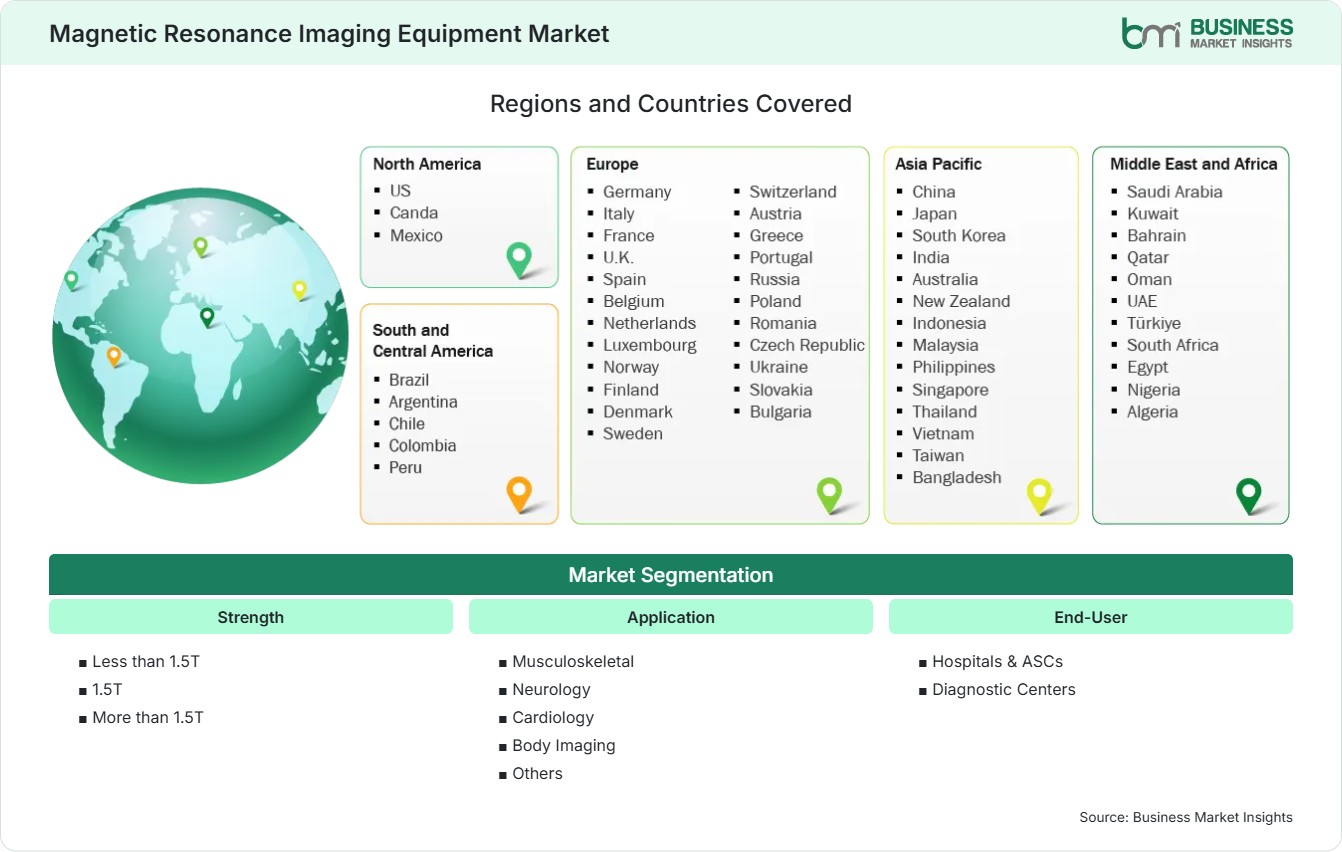
North America accounts for 34%–38% of the Magnetic Resonance Imaging Equipment Market share in 2025 and is projected to expand at a 6.6%–7.2% CAGR through 2033. The region benefits from mature installed capacity, replacement requirements, advanced clinical applications, outpatient imaging growth, and strong adoption of AI-enabled workflow technologies. The US remains the principal demand center, while Canada supports replacement-led procurement and capacity modernization. MRI share remains supported by high procedure volumes and sophisticated provider networks. MRI growth is increasingly tied to productivity, sustainability, and equipment modernization rather than first-time access alone. OECD data also show substantial MRI availability across leading North American healthcare systems.
- Replacement programs are supporting demand as hospitals modernize aging scanners and seek improved throughput, image quality, patient comfort, and lower operating requirements.
- AI reconstruction and workflow automation are becoming procurement priorities because radiology departments face pressure to manage examination volumes with constrained specialist capacity.
- Outpatient imaging networks are increasing the utilization of MRI equipment by shifting suitable examinations away from high-cost hospital environments toward dedicated diagnostic facilities.
- Advanced 3T systems are gaining attention for neurological, oncology, cardiovascular, and research applications where higher signal performance supports specialized clinical protocols.
US Magnetic Resonance Imaging Equipment Market
The US Magnetic Resonance Imaging Equipment Market accounts for a 27%–31% share of global demand and is projected to grow at a 6.7%–7.3% CAGR during 2026–2033. The market combines a large installed base, recurring replacement demand, and strong outpatient diagnostic activity. Hospitals, academic centers, and independent imaging providers increasingly evaluate productivity, service availability, software capabilities, and installation requirements alongside image quality. The US also remains an important launch market for new MRI platforms, with manufacturers introducing AI-enabled and helium-efficient technologies through FDA regulatory pathways. Recent product clearances demonstrate continuing innovation in both 1.5T and 3T systems.
- Large provider networks continue replacing older scanners with systems designed for higher throughput, improved patient access, reduced downtime, and greater compatibility with contemporary digital workflows.
- AI-based reconstruction is being incorporated into MRI platforms to accelerate scanning while preserving diagnostic image quality across routine and specialized examinations.
- Outpatient imaging expansion creates demand for systems with predictable installation requirements, broad clinical coverage, efficient staffing models, and flexible financing structures.
Europe Magnetic Resonance Imaging Equipment Market
The Europe Magnetic Resonance Imaging Equipment Market constitutes a market share of 25%-29% in 2025 and is expected to witness growth at a rate of 6.5%-7.1% CAGR from 2026 to 2033. Countries such as Germany, France, the United Kingdom, Italy, and Spain are mature markets, and there is scope for equipment growth in markets like Poland, Türkiye, and a few other Central European nations. Germany is one of the countries with high equipment density, and European procurement has become more focused on sustainability, energy savings, installation flexibility, and workflow optimization. Germany's combined CT, MRI, and PET equipment density was reported at 74 units per million population in OECD 2025 data.
- Germany remains a major European procurement center, supported by substantial diagnostic infrastructure and demand for advanced clinical imaging across hospital and specialist networks.
- France and the United Kingdom provide replacement opportunities as providers balance installed-base modernization with efforts to improve diagnostic access and manage examination backlogs.
- Southern and Central European markets are increasing adoption through hospital modernization, private diagnostic networks, and investments aimed at reducing regional equipment disparities.
- Helium-independent and lower-infrastructure systems can improve installation flexibility where existing radiology departments face architectural, utility, or space constraints.
Asia Pacific Magnetic Resonance Imaging Equipment Market
Asia Pacific accounts for 25%–29% of the Magnetic Resonance Imaging Equipment Market share in 2025 and is projected to expand at an 8.2%–9.0% CAGR through 2033, making it the fastest-growing regional market. China, Japan, South Korea, India, and Australia constitute major demand centers, while India, Southeast Asia, and selected Chinese secondary cities provide strong capacity-expansion opportunities. Japan has exceptionally high diagnostic equipment availability, while developing markets remain focused on increasing access. Public and private hospital investment, expanding diagnostic chains, local manufacturing, and urban healthcare infrastructure are central demand drivers.
- China benefits from domestic imaging manufacturing capabilities, large hospital networks, healthcare infrastructure development, and demand for advanced systems supporting tertiary-care diagnostics.
- India offers expansion potential through private diagnostic centers, hospital chains, urbanization, rising chronic disease burden, and increasing availability of specialist imaging services.
- Japan and South Korea maintain sophisticated MRI ecosystems and provide demand for advanced systems, replacement equipment, clinical research platforms, and productivity-oriented software.
- Southeast Asian markets are gradually expanding MRI capacity as private healthcare investment and urban diagnostic infrastructure improve access to advanced imaging services.
Rest of World Magnetic Resonance Imaging Equipment Market
South and Central America Magnetic Resonance Imaging Equipment Market accounts for approximately 7%–9% of global demand, while Middle East and Africa collectively contribute about 5%–7%. Combined Rest of World demand is projected to expand at a 6.9%–7.8% CAGR through 2033. Brazil, Mexico, Saudi Arabia, the United Arab Emirates, and South Africa are key procurement markets, while Colombia, Chile, Türkiye, and Gulf economies provide additional capacity opportunities. Equipment availability remains uneven, creating opportunities for suppliers offering financing, service, training, and lower-infrastructure systems.
- Brazil and Mexico are expanding private diagnostic capacity while healthcare providers continue balancing advanced imaging investment against capital expenditure constraints and regional access requirements.
- Gulf markets are investing in tertiary hospitals, specialist centers, oncology services, and advanced diagnostics, supporting demand for premium MRI systems and integrated imaging platforms.
- South Africa remains an important regional hub for advanced diagnostic services, while neighboring markets present opportunities for mobile, compact, and service-supported equipment models.
- Financing, maintenance, training, and installation support can materially influence purchasing decisions where technical personnel and MRI infrastructure remain constrained.