Market Summary
Executive Summary and Global Market Analysis
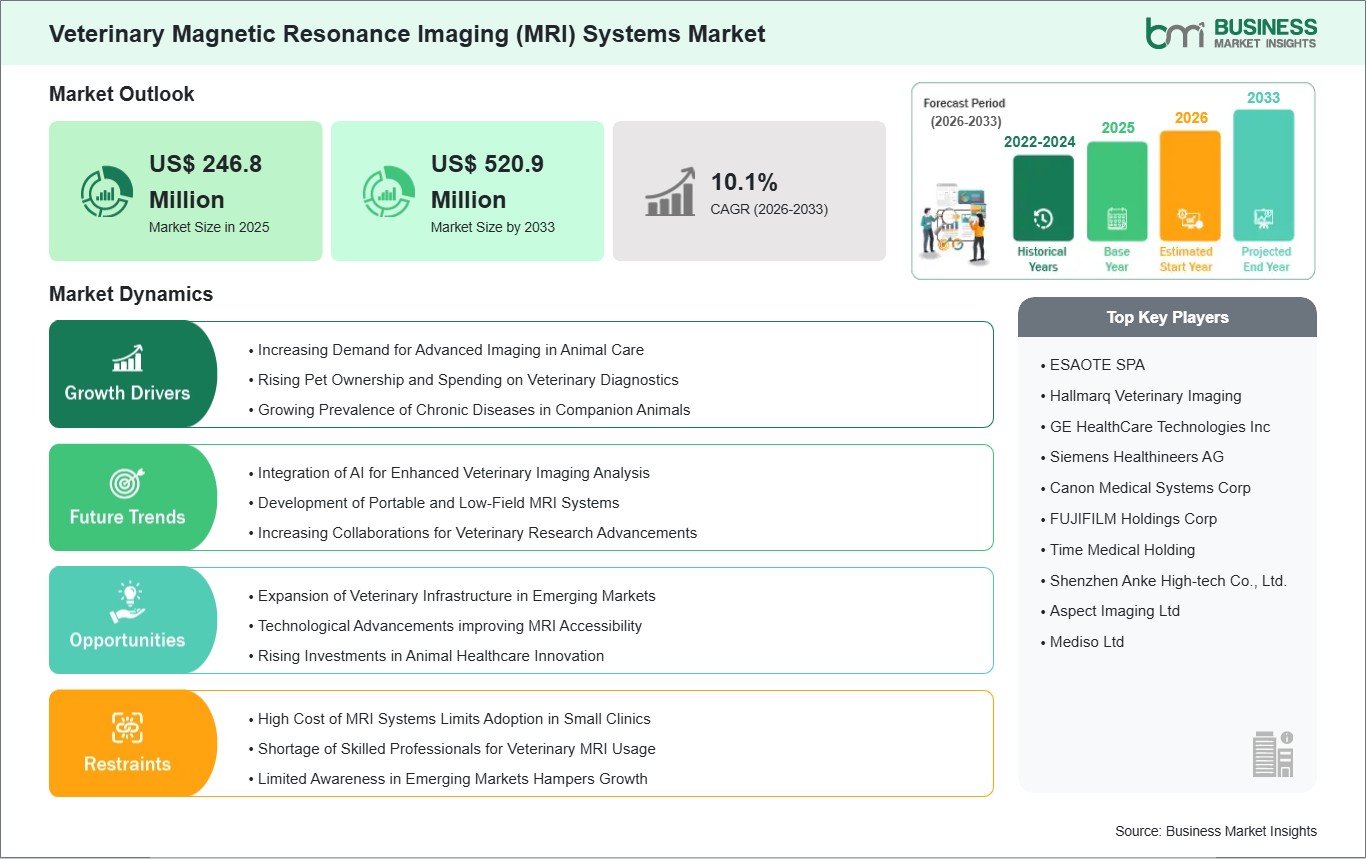
The global veterinary magnetic resonance imaging (MRI) systems market represents a niche yet rapidly advancing segment within the animal healthcare diagnostics landscape. The recognition of MRI systems as tools for delivering high-quality soft tissue imaging results in improved brain and spine, joint and internal organ diagnosis accuracy by veterinarians. The implementation of advanced imaging techniques, which include MRI in veterinary medicine, has become essential for making clinical decisions and developing treatment plans in both developed countries and emerging markets. The market experiences growth because companion animal care continues to grow as the main trend in urban areas, where residents treat their pets as family members. Pet owners now show greater readiness to obtain advanced diagnostic tests that include MRI scans because they want to provide their pets with complete medical treatment. The increasing number of chronic and degenerative disorders that affect animals needs accurate imaging technologies that help with early diagnosis and specific treatment approaches. The global market outlook receives additional support from technological innovation. Veterinary clinics that could not operate traditional systems before have gained access to advanced MRI system design through the creation of compact systems that operate at lower field strengths. The combination of enhanced imaging software and faster scan times, together with digital workflow systems, has resulted in greater operational efficiency, which allows for expanded clinical applications. The new technologies enable veterinary practices to use MRI equipment, which was previously restricted to specialized referral centers. The market continues to experience problems that stem from its fundamental design despite the presence of beneficial developments. Many veterinary providers face financial challenges because they need to spend money on buying MRI systems and covering their ongoing maintenance and operational costs. The requirement for specialized training, together with necessary facility upgrades, creates obstacles that slow down adoption in both cost-sensitive markets and rural areas. The need for anesthesia, together with the requirement for extended imaging times, creates operational limitations through its complex procedural requirements. The global veterinary MRI systems market is positioned for steady growth supported by technological advancements and increasing demands in animal healthcare, yet costs and accessibility issues will determine how widely the system is used.
Segment Analysis
Veterinary Magnetic Resonance Imaging (MRI) Systems Market Segmentation
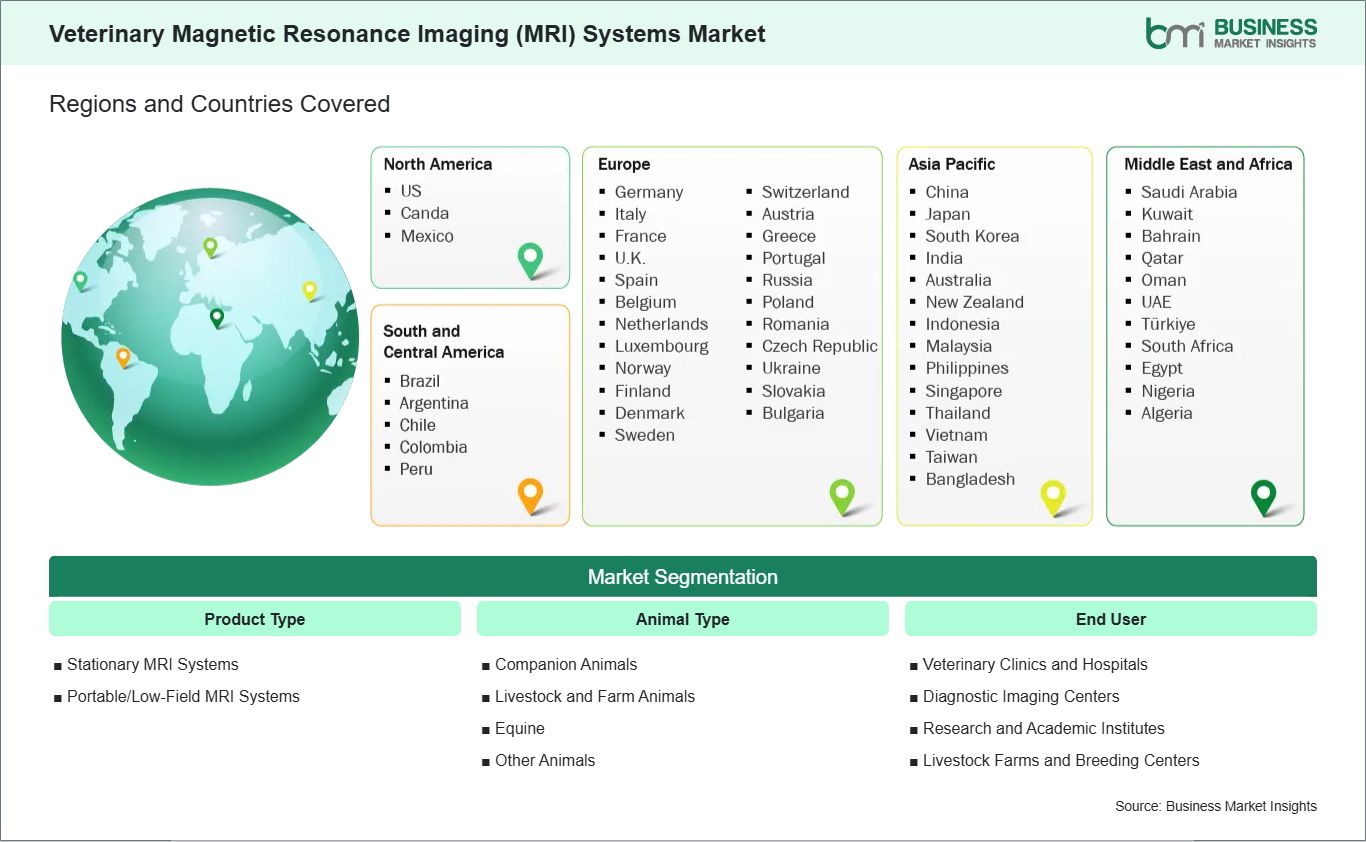
Key segments that contributed to the derivation of the veterinary magnetic resonance imaging (MRI) systems market analysis are product type, animal type, and end user.
- By product type, the veterinary magnetic resonance imaging (MRI) systems market is segmented into stationary MRI systems, portable/low-field MRI systems. The stationary MRI systems segment dominated the market in 2025.
- Based on animal type, the veterinary magnetic resonance imaging (MRI) systems market is categorized into companion animals, livestock and farm animals, equine, others. The companion animals segment dominated the market in 2025.
- In terms of end user, the veterinary magnetic resonance imaging (MRI) systems market is categorized into veterinary clinics and hospitals, diagnostic imaging centers, research and academic institutes, livestock farms and breeding centers. The veterinary clinics and hospitals segment dominated the market in 2025.
Market Forces
Veterinary Magnetic Resonance Imaging (MRI) Systems Market Drivers and Opportunities
Increasing demand for advanced imaging in animal care
The global veterinary MRI systems market is experiencing strong momentum due to the increasing demand for advanced diagnostic imaging in animal healthcare. Veterinarians depend on MRI systems to diagnose companion animal neurological, musculoskeletal and soft tissue conditions with high accuracy. Pet owners in developed regions show a distinct trend of spending large amounts of money on high-quality medical treatments for their pets.
The rising humanization of pets leads people to seek advanced medical equipment used in human medical systems. North America and Europe are experiencing a veterinary specialty clinic expansion, which includes facilities that operate MRI equipment. The trend of veterinary specialty clinics that operate MRI equipment is beginning to spread through the Asia-Pacific regions because of better veterinary facilities and increased knowledge about early disease identification.
The growing rate of chronic diseases, including cancer and spinal disorders in animals, leads to higher rates of MRI system implementation across the world. The systems deliver non-invasive imaging, which includes detailed visualization capabilities, and they function as vital instruments in contemporary veterinary diagnostic processes while driving substantial market expansion.
Expansion of veterinary infrastructure in emerging markets
The global veterinary MRI systems market will grow because emerging markets show fast growth through the development of veterinary infrastructure. The Asia-Pacific region and Latin America and the Middle East region now build modern animal healthcare facilities which will help them adopt advanced imaging technologies. The public health system and food safety system increasingly need veterinary care, which both governments and private organizations now acknowledge.
The demand for superior veterinary services in these regions grows because disposable incomes rise and pet ownership increases. Multi-specialty veterinary hospitals are now open in urban areas, which feature advanced diagnostic systems that include MRI equipment. Pet owners now understand that early diagnosis and precise diagnosis bring them valuable health benefits, which supports this trend.
International partnerships and funding initiatives make essential contributions toward developing veterinary capabilities in developing countries. Global manufacturers use partnerships and distribution networks to extend their market reach, which enables more people to access MRI systems. The veterinary MRI systems market worldwide will experience substantial growth from this expansion, which will establish its long-term development.
Size and Share Analysis
Veterinary Magnetic Resonance Imaging (MRI) Systems Market Size and Share Analysis
The veterinary magnetic resonance imaging (MRI) systems market demonstrates steady growth, with size and share analysis highlighting evolving trends and competitive dynamics among key players. The report examines subsegments categorized within product type, animal type, and end user, offering insights into their contribution to overall market performance.
By product type, the stationary MRI systems subsegment dominated the market in 2025, driven by higher image quality, greater throughput, and widespread adoption in hospitals for comprehensive diagnostic imaging.
Based on animal type, the companion animals subsegment dominated the market in 2025, driven by increasing pet ownership and rising demand for advanced diagnostic imaging in routine veterinary care.
In terms of end user, the veterinary clinics and hospitals subsegment dominated the market in 2025, driven by the widespread adoption of x-ray systems for comprehensive diagnostic and treatment services.
Report Coverage
Veterinary Magnetic Resonance Imaging (MRI) Systems Market Report Coverage and Deliverables
The "Veterinary Magnetic Resonance Imaging (MRI) Systems Market Size and Forecast (2022-2033)" report provides a detailed analysis of the market covering below areas:
- Market size and forecast at global, regional, and country levels for all the key market segments covered under the scope
- Market trends, as well as drivers, restraints, and opportunities
- Market analysis covering key trends, global and regional framework, major players, regulations, and recent developments
- Market concentration, heat map analysis, prominent players, and recent developments for the Market
- Detailed company profiles, including SWOT analysis
Geographic Insights
Veterinary Magnetic Resonance Imaging (MRI) Systems Market Geographic Insights
The geographical scope of the Veterinary Magnetic Resonance Imaging (MRI) Systems Market report is divided into North America, Asia Pacific, Europe, Middle East & Africa, and South & Central America. North America held the largest share in 2025.
North America stands as the primary market leader for veterinary magnetic resonance imaging (MRI) systems because the region possesses a complete veterinary medical system and extensive access to advanced diagnostic equipment and people who spend money on pet healthcare services. The region benefits from a high concentration of specialty veterinary hospitals, the availability of skilled professionals, and continuous investments in imaging innovation, which collectively support widespread MRI adoption. The European market operates at a mature stage, which demonstrates growth through animal welfare regulations and the rising need for precise diagnostic equipment and established veterinary facility networks. Western European clinics demonstrate strong adoption rates because they implement advanced imaging technology into their daily operations, although certain regions face cost-related challenges that may inhibit their expansion. The Asia Pacific region currently experiences its fastest growth rate because more people are moving to cities, their income levels are increasing, and they are becoming more aware of animal health issues. MRI system adoption in urban areas increases because more people acquire pets and veterinary facilities expand their operations, but their ability to pay for specialized services and their access to advanced medical centers create obstacles. The Middle East and Africa region shows early market development because its veterinary services continue to improve, and people show greater interest in pet care, and cities make targeted investments in advanced diagnostic systems. The South and Central American region shows moderate growth potential because its veterinary education programs expand, pet ownership rates increase and diagnostic methods modernize at a slow pace. The region experiences economic challenges, together with infrastructure problems, but private companies and service partnerships are driving the region toward modern imaging technologies. The current regional dynamics demonstrate two separate market conditions, which show established markets with advanced technological penetration and emerging markets where growth comes from better public awareness and infrastructure development.
Industry Activity
Recent Developments
The Veterinary Magnetic Resonance Imaging (MRI) Systems Market is evaluated by gathering qualitative and quantitative data post primary and secondary research, which includes important corporate publications, association data, and databases. A few of the key developments in the veterinary magnetic resonance imaging (MRI) systems market are:
- In July 2025, Esaote Group announced that it presented its next-generation veterinary MRI system, Vet-MR Grande ELITE, at the European College of Veterinary Surgeons (ECVS), highlighting advancements in imaging quality and workflow efficiency for veterinary diagnostics.
- In February 2026, Hallmarq Veterinary Imaging announced that it partnered with OR Technology to form a global multimodality imaging group, combining veterinary MRI expertise with broader imaging technologies to expand global reach and accelerate innovation in diagnostic imaging.
Trust & Transparency
Research Methodology
The market analysis combines proprietary research with secondary data from government agencies, company disclosures, regulatory filings, industry databases and expert interviews. Market estimates are validated through data triangulation, cross-market benchmarking and analyst
review.
View Full Research Methodology
Key Sources Referred:
American College of Veterinary Radiology (ACVR) World Small Animal Veterinary Association (WSAVA) British Veterinary Association (BVA) International Veterinary Radiology Association (IVRA) American Veterinary Medical Association (AVMA) European College of Veterinary Diagnostic Imaging (ECVDI) World Organisation for Animal Health (WOAH / OIE) Veterinary Imaging & Radiation Oncology Society (VIROS)