Market Summary
Executive Summary and Global Market Analysis
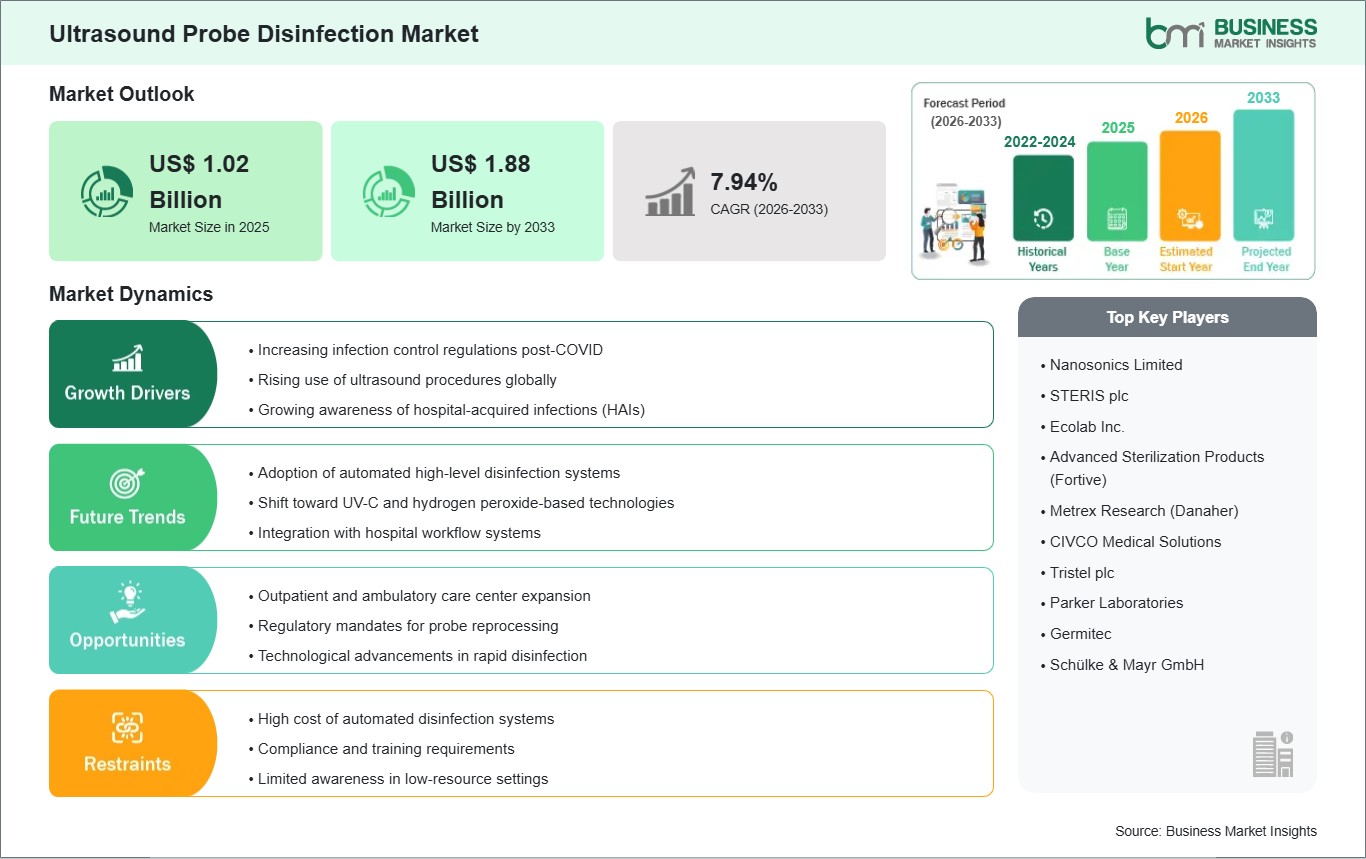
Ultrasound probe disinfection refers to the specialized reprocessing cycle required to eliminate microbial contaminants from ultrasound transducers between patient examinations. The Ultrasound probe disinfection market is a critical sector of the infection prevention industry, providing essential systems for hospitals, diagnostic imaging centers, and maternity clinics. This market delivers strategic value by mitigating the risk of cross-contamination and healthcare-associated infections (HAIs), which can lead to significant clinical complications and institutional liability. Market expansion is driven by the increasing global volume of ultrasound-guided interventional procedures and the rising awareness of the limitations of manual wiping techniques. Furthermore, the shift toward automated high-level disinfection (HLD) systems is improving clinical throughput by providing rapid, time-stamped, and traceable disinfection logs that satisfy stringent auditing requirements.
However, several factors can restrain market growth. The high initial capital expenditure for automated UV-C or hydrogen peroxide mist systems can be a significant barrier for smaller diagnostic practices and facilities in developing regions. Compatibility concerns between aggressive chemical disinfectants and the sensitive materials used in probe construction often necessitate costly repairs or the purchase of specialized, manufacturer-approved consumables. Additionally, the industry faces constraints due to the complexity of varying international guidelines regarding the classification of semi-critical devices, which can lead to inconsistent adoption of high-level disinfection standards.
Despite these hurdles, the market finds opportunities in the growth of Point-of-Care Ultrasound (POCUS) across emergency and intensive care departments. The rise of single-use, chemical-free disinfection technologies and the expansion of cloud-based compliance monitoring are expected to support long-term development within the sector.
Segment Analysis
Ultrasound Probe Disinfection Market Segmentation
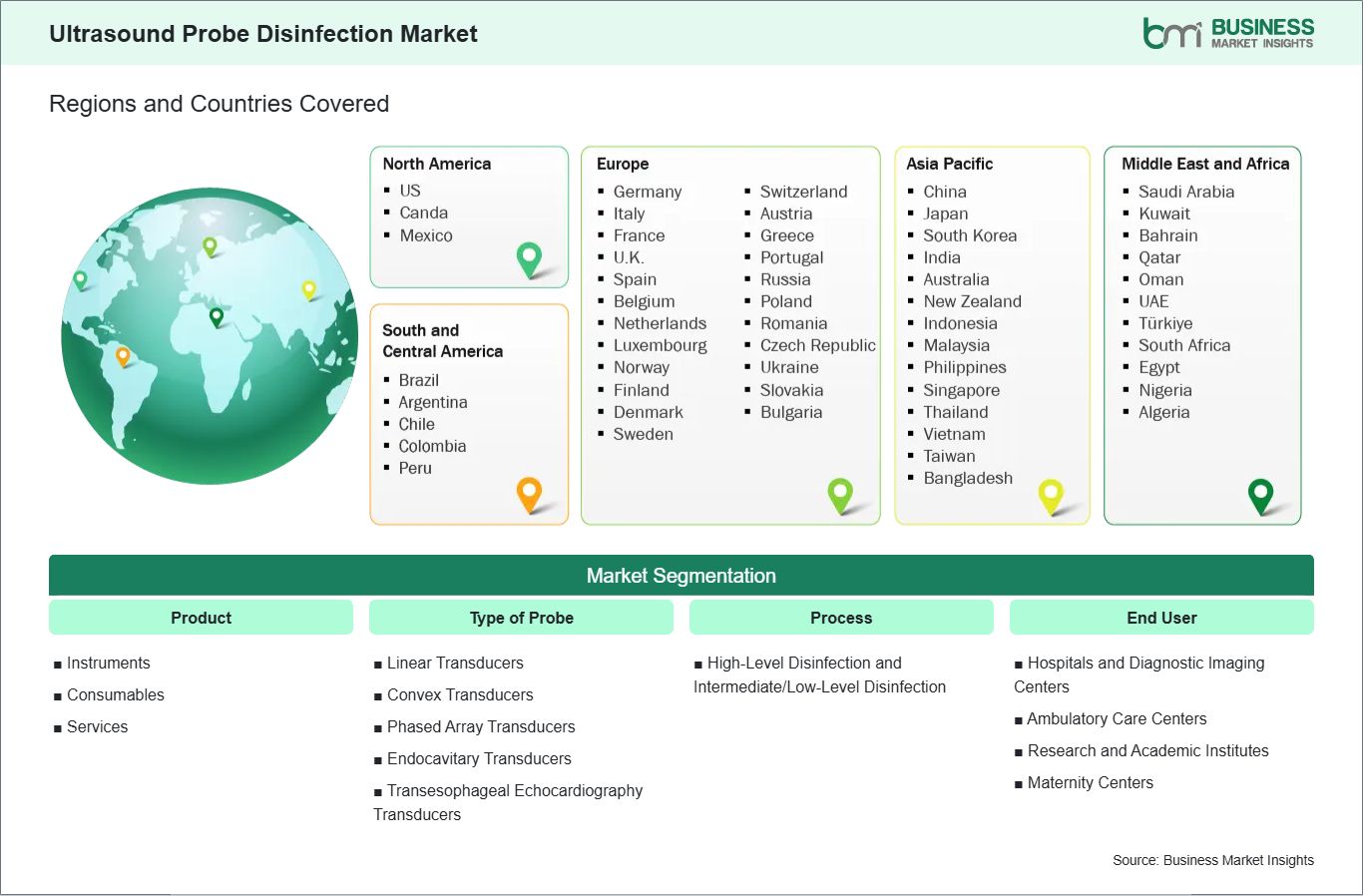
Key segments that contributed to the derivation of the Ultrasound Probe Disinfection market analysis are product, type of probe, process, and end user.
- By Product, the market is segmented into Instruments, Consumables, and Services.
- By Type of Probe, the market is divided into Linear Transducers, Convex Transducers, Phased Array Transducers, Endocavitary Transducers, and Transesophageal Echocardiography Transducers.
- By Process, the market is segmented into High-Level Disinfection and Intermediate/Low-Level Disinfection.
- By End User, the market is categorized into Hospitals and Diagnostic Imaging Centers, Ambulatory Care Centers, Research and Academic Institutes, and Maternity Centers.
Market Forces
Ultrasound Probe Disinfection Market Drivers and Opportunities
Strategic Implementation of Safety Mandates and Point-of-Care Imaging
The primary driver for the Ultrasound Probe Disinfection Market is the global intensification of Infection Control Protocols to Combat Healthcare-Associated Infections (HAIs). Regulatory bodies are increasingly mandating high-level disinfection for any probe that contacts mucous membranes or non-intact skin, driving a shift away from simple low-level wipes in specialized clinical settings. This momentum is further propelled by the Rapid Adoption of Point-of-Care Ultrasound (POCUS); as diagnostic imaging moves from centralized radiology departments to bedside emergency rooms, intensive care units, and ambulances, there is a critical need for rapid, portable disinfection solutions that match the high-speed workflow of acute care. In the technology sphere, the Integration of Digital Traceability and RFID Tracking serves as a significant catalyst, as facilities prioritize automated data logging to meet stringent audit requirements and ensure compliance with Joint Commission standards. Furthermore, the Rising Awareness of High-Risk Pathogens, such as Human Papillomavirus (HPV), which is resistant to many standard disinfectants, is compelling healthcare providers to invest in validated HLD technologies like hydrogen peroxide mist and UV-C light. Together, these factors, regulatory pressure, procedural volume growth, and digital accountability, ensure a sophisticated and non-discretionary growth path for the global disinfection landscape.
Integrated Cloud-Based Compliance and AI-Enhanced Process Validation
A significant high-value opportunity lies in the convergence of Ultrasound Disinfection Systems with AI-Driven Process Monitoring. Next-generation smart reprocessors are being developed to utilize sensors and AI to detect irregularities, such as improper chemical concentrations or incomplete coverage, providing real-time alerts that prevent the use of inadequately cleaned probes. There is also a major growth frontier in the development of Eco-Friendly, Non-Toxic Disinfectant Chemistries; as hospitals seek to reduce their environmental footprint and improve staff safety, there is a lucrative market for biodegradable HLD solutions and energy-efficient UV-C cabinets that eliminate the need for water-intensive rinsing. Furthermore, the expansion of Wireless and Handheld Probe Disinfection Platforms presents a unique opportunity, specifically designed to support the growing market for wireless transducers by offering specialized holders and rapid-cycling reprocessors that maintain the devices' portability. Beyond the hardware, the rise of Managed Disinfection-as-a-Service Models offers a significant frontier, where manufacturers bundle equipment, consumables, and automated compliance reporting into a single operational expense, reducing the capital burden for smaller clinics. Manufacturers who focus on Multi-Probe Simultaneous Processing and those pioneering Hybrid Thermal-Chemical Disinfection Cycles are positioned to lead the most innovative and high-margin segments of the global ultrasound probe disinfection market.
Size and Share Analysis
Ultrasound Probe Disinfection Market Size and Share Analysis
The Ultrasound Probe Disinfection market demonstrates steady growth, with size and share analysis revealing evolving trends and competitive positioning among key players. The report examines subsegments categorized within product, type of probe, process, and end user, offering insights into their contribution to overall market performance.
Based on product, the Consumables, Instruments, and Services subsegments hold distinct market presence, reflecting the ongoing operational needs versus the capital investment cycle. Consumables, including specialized disinfectant wipes, liquids, and high-level disinfectant cartridges, hold the largest market position due to their high-frequency, repeat-purchase nature. A notable trend is the surge in the Instruments and Services subsegments, which are registering a higher pace of adoption. Instruments, such as automated reprocessors and UV-C cabinets, are becoming essential for High-Volume Facilities, as they provide consistent, validated results that manual wipes cannot guarantee. Simultaneously, Services are gaining traction as hospitals outsource the maintenance, calibration, and compliance auditing of these complex systems to ensure they meet increasingly stringent government mandates.
Report Coverage
Ultrasound Probe Disinfection Market Report Coverage and Deliverables
The "Ultrasound Probe Disinfection Market Size and Forecast (2022–2033)" report provides a detailed analysis of the market covering below areas:
- Ultrasound Probe Disinfection market size and forecast at global, regional, and country levels for all market segments covered under the scope
- Ultrasound Probe Disinfection market trends, as well as drivers, restraints, and opportunities
- Ultrasound Probe Disinfection market analysis covering key trends, global and regional framework, major players, regulations, and recent developments
- Industry landscape and competition analysis covering market concentration, heat map analysis, prominent players, and recent developments for the Ultrasound Probe Disinfection market
- Detailed company profiles, including SWOT analysis
Geographic Insights
Ultrasound Probe Disinfection Market Geographic Insights
The geographical scope of the Ultrasound Probe Disinfection market report is divided into five regions: North America, Asia Pacific, Europe, Middle East & Africa, and South & Central America.
North America maintains a prominent market position due to rigorous oversight by occupational health and safety authorities and the substantial presence of the healthcare and pharmaceutical sectors. Europe represents a mature market segment, where demand is sustained by comprehensive industrial safety mandates and an increasing emphasis on sustainable, reusable disinfection solutions. Asia Pacific is identified as the most rapidly advancing region, propelled by extensive industrialization, large-scale healthcare infrastructure projects, and heightened awareness of workplace hazards in emerging economies.
The Asia-Pacific Ultrasound Probe Disinfection Market is segmented into China, Japan, South Korea, India, Australia, and the Rest of Asia Pacific. China serves as a central hub for both production and consumption, driven by significant manufacturing output and evolving safety standards. India is experiencing notable growth in demand as domestic industrial regulations align with international safety benchmarks and the healthcare sector expands. Japan and South Korea continue to prioritize high-specification disinfection devices, focusing on technological integration and specialized protection for aging workforces and advanced electronic manufacturing environments.
Industry Activity
Recent Developments
The Ultrasound Probe Disinfection market is evaluated by gathering qualitative and quantitative data post primary and secondary research, which includes important corporate publications, association data, and databases. A few of the key developments in the Ultrasound Probe Disinfection market are:
- In August 2025, Nanosonics launched the trophon3 system and trophon2 Plus software upgrade in the U.S. and Canada, providing automated high-level disinfection for ultrasound probes. The new solutions enhance workflow efficiency, safety, and digital traceability, reinforcing Nanosonics’ leadership in ultrasound infection prevention.
- In July 2024, GE HealthCare announced that it will acquire Intelligent Ultrasound`s clinical AI software business, bringing real-time AI image recognition to its ultrasound devices. The move aims to improve workflow efficiency, exam accuracy, and ease-of-use, strengthening GE`s AI-enabled ultrasound portfolio.
Trust & Transparency
Research Methodology
The market analysis combines proprietary research with secondary data from government agencies, company disclosures, regulatory filings, industry databases and expert interviews. Market estimates are validated through data triangulation, cross-market benchmarking and analyst
review.
View Full Research Methodology
Key Sources Referred:
World Bank – Global Trade IndicatorsWorld Trade Organization (WTO)(International Monetary Fund )IMFInternational Trade Administration (ITA)Company websiteCompany annual reportsCompany investor presentations