
DNA Synthesis Market Outlook: Size, Share, Trends, Growth Analysis, Competitive Landscape & Forecast, 2026-2033

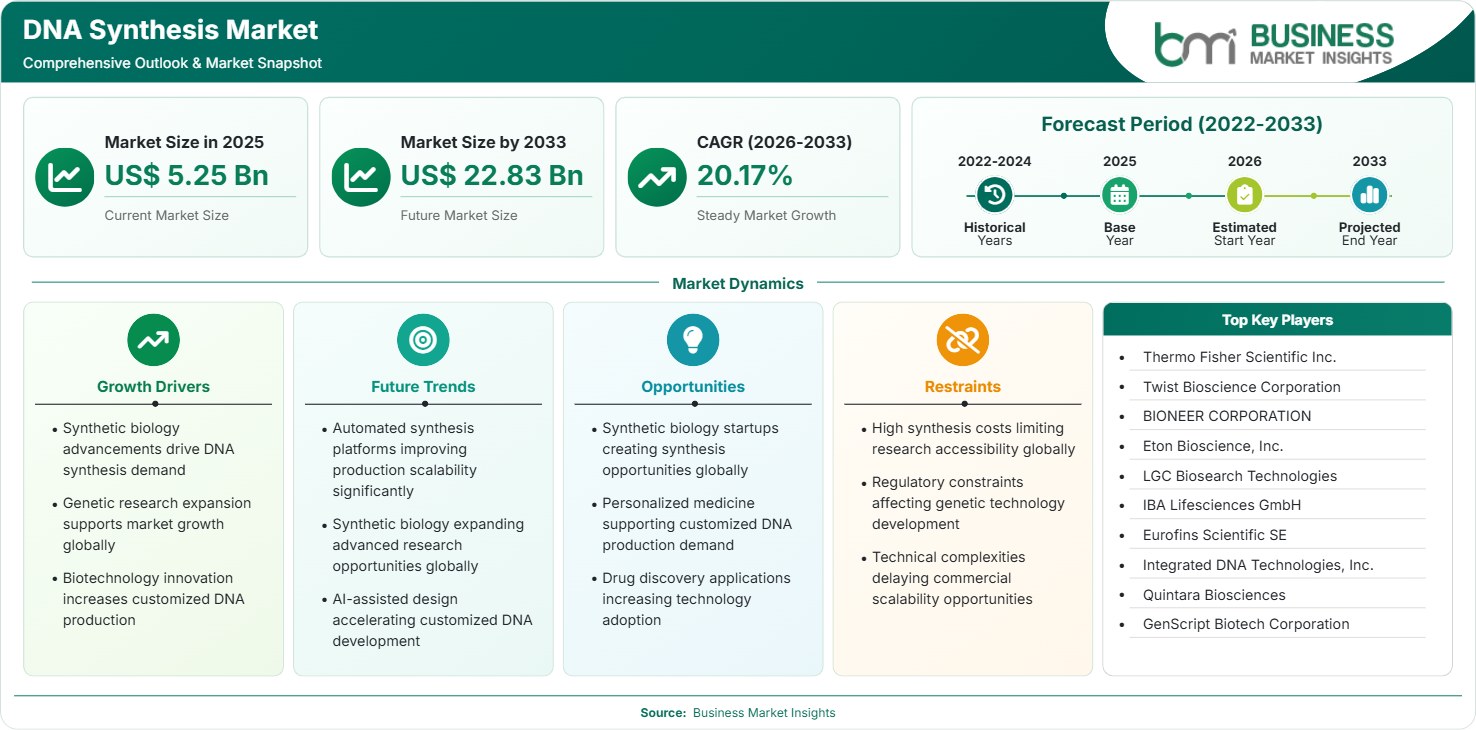
The DNA Synthesis Market size was valued at US$ 5.25 Billion in 2025 and is projected to reach US$ 22.83 Billion by 2033, growing at a CAGR of 20.17% during 2026–2033, driven by synthetic biology, precision medicine, gene editing, automated manufacturing, and expanding therapeutic applications.

Report Coverage
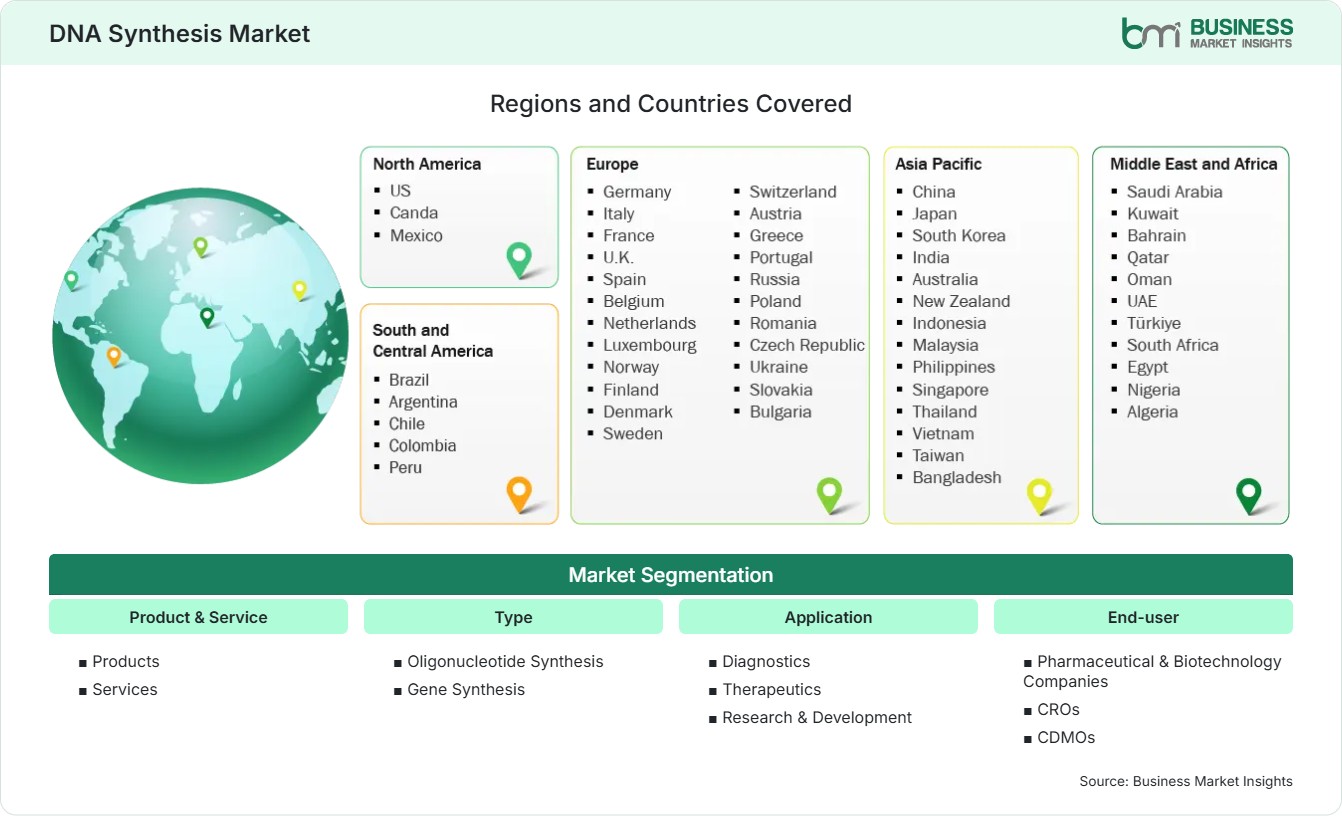
  • Product & Service: Products , Services
  • Type: Oligonucleotide Synthesis, Gene Synthesis
  • Application: Diagnostics , Therapeutics , Research & Development
  • End-user: Pharmaceutical & Biotechnology Companies, CROs, CDMOs
US$ 5.25 Bn Market size in 2025
US$ 22.83 Bn Market Size by 2033
20.17% CAGR, 2026 - 2033
2026-2033 Forecast Period

AI Overview

DNA Synthesis Market Summary

  • North America Region: North America holds a 38%–42% DNA Synthesis Market share in 2025, growing at a 18%–20% CAGR, supported by advanced genomics infrastructure, pharmaceutical R&D, gene-editing investment, clinical translation, and strong demand for customized DNA products. The U.S. market is projected to expand at a 19%–20% CAGR during 2026–2033, supported by biotechnology funding, clinical research, and automation.
  • Fastest Growing Region: Asia Pacific holds a 24%–28% share in 2025 and is expanding at a 23%–26% CAGR, supported by biotechnology manufacturing expansion, genomic research, synthetic biology investment, lower production costs, growing pharmaceutical pipelines, and stronger regional laboratory capabilities.
  • Leading Segment: Research and Development holds a 45%–48% share in 2025, expanding at a 19%–21% CAGR, supported by cloning, gene editing, sequencing, synthetic biology, functional genomics, drug discovery, laboratory automation, and expanding academic and commercial research programs.
  • High Growth Segment: Gene Synthesis holds a 35%–38% DNA Synthesis Market share in 2025 and expands at a 23%–26% CAGR, driven by longer construct requirements, protein engineering, synthetic biology, AI-designed sequences, therapeutic development, automated assembly, and demand for rapid customized DNA production.
  • Key Market Opportunity: Enzymatic synthesis, long DNA construction, decentralized manufacturing, DNA data storage, and AI-assisted sequence design create opportunities for differentiated platforms offering higher accuracy, shorter turnaround times, lower waste, and scalable production.
  • Major Market Players: Thermo Fisher Scientific Inc.; Twist Bioscience Corporation; BIONEER CORPORATION; Eton Bioscience, Inc.; LGC Biosearch Technologies; IBA Lifesciences GmbH; Eurofins Scientific SE; Integrated DNA Technologies, Inc.; Quintara Biosciences; GenScript Biotech Corporation.
Strategic Insights

DNA Synthesis Market: Strategic Insights

DNA Synthesis Market Strategic Framework
FREE PDF
Request your free sample
Request free sample
Stakeholder View

Key Takeaways

  • The supply chain increasingly connects nucleotide chemistry, synthesis hardware, enzymes, purification, quality control, sequence screening, informatics, and fulfillment. Suppliers with integrated workflows can capture more value than vendors competing solely on synthesis price.
  • Gene synthesis and research-driven applications provide substantial upside because customers increasingly require longer, more complex constructs for protein engineering, gene editing, synthetic biology, and therapeutic development.
  • Enzymatic synthesis and semiconductor-enabled architectures are expanding the technical envelope beyond conventional short oligonucleotide production, while automation and sequence-design software improve throughput and reduce manual intervention.
  • Asia Pacific offers an expanding investment case because China, India, Japan, South Korea, and Singapore are developing biotechnology manufacturing, genomic research, and pharmaceutical discovery capabilities.
  • Capital deployment is increasingly focused on manufacturing scale, automation, complex DNA production, and complementary genomics capabilities. Corporate partnerships also provide a route to commercialization without requiring every participant to build an entire platform internally.
Geographic Outlook

DNA Synthesis Market Regional Highlights

North America DNA Synthesis Market

North America accounts for a 38%–42% DNA Synthesis Market share in 2025 and is projected to expand at an 18%–20% CAGR through 2033. The region benefits from concentrated pharmaceutical R&D, mature biotechnology clusters, advanced genomics laboratories, and established custom synthesis suppliers. The United States remains the principal demand center because clinical research and gene-editing programs require increasingly sophisticated DNA inputs. Canada contributes through academic genomics and biotechnology development, while regional CDMOs strengthen translational manufacturing capacity.

  • High pharmaceutical R&D intensity supports demand for customized oligonucleotides, gene fragments, plasmids, libraries, and sequence-verified constructs across discovery and preclinical workflows.
  • Gene-editing adoption is increasing requirements for precise guide sequences, donor templates, screening libraries, and manufacturing-grade nucleic acids, creating recurring demand from translational laboratories.
  • Automated laboratory infrastructure is improving throughput and consistency while reducing manual handling, allowing synthesis providers to serve larger order volumes without proportionate labor increases.
  • Regional companies increasingly differentiate through sequence complexity, turnaround time, purification, quality documentation, and integration with sequencing and bioinformatics workflows.

US DNA Synthesis Market

The U.S. represents approximately 70%–74% of North American revenue in 2025 and is projected to expand at a 19%–20% CAGR through 2033. Its demand base spans biotechnology startups, pharmaceutical companies, academic laboratories, diagnostics developers, CROs, and gene-therapy developers. Federal research support, private biotechnology financing, and sophisticated clinical infrastructure reinforce adoption. The market also benefits from established synthesis manufacturing, advanced automation, and strong commercialization pathways for novel synthetic biology and therapeutic technologies.

  • Pharmaceutical and biotechnology companies increasingly outsource specialized DNA construction to shorten development cycles, particularly where internal synthesis capacity cannot economically support complex or fluctuating requirements.
  • Clinical translation is raising demand for documented manufacturing controls, sequence traceability, quality testing, and scalable production capable of supporting movement from research-grade materials toward regulated applications.
  • Synthetic biology companies are using large DNA libraries and engineered constructs to develop proteins, pathways, biological systems, and platform technologies across healthcare and industrial biotechnology.

Europe DNA Synthesis Market

Europe holds a 24%–27% DNA Synthesis Market share in 2025 and is projected to grow at a 19%–21% CAGR. Germany, the United Kingdom, France, and Switzerland represent leading demand centers, while the United Kingdom and Germany provide strong high-growth opportunities at approximately 20%–22% CAGR. European research institutions, pharmaceutical manufacturers, and biotechnology clusters support demand for synthetic DNA. Regulatory emphasis on traceability, quality, biosafety, and responsible biotechnology is also encouraging investment in controlled and auditable synthesis workflows.

  • Germany combines pharmaceutical manufacturing, academic research, and biotechnology infrastructure, supporting recurring requirements for oligonucleotides, gene synthesis, cloning, and molecular diagnostics.
  • The United Kingdom benefits from strong genomics research, synthetic biology programs, and biotechnology commercialization, creating demand for custom sequences and advanced DNA engineering services.
  • France and Switzerland contribute through pharmaceutical R&D, molecular medicine, and specialized biotechnology, with demand increasingly connected to therapeutic development and translational research.
  • European suppliers are emphasizing sequence screening, quality documentation, data protection, and compliant manufacturing as customers require stronger governance across synthetic DNA workflows.
  • Cross-border research collaborations are expanding demand for standardized sequence specifications and reliable logistics capable of serving distributed laboratories and pharmaceutical development teams.

Asia Pacific DNA Synthesis Market

The Asia Pacific region is estimated to hold a 24%-28% share in 2025 and is the fastest-growing market, with a CAGR of 23%-26%. Major markets for demand in the region include China, Japan, South Korea, India, and Singapore; India and China offer significant growth opportunities at 24%-27% CAGR, respectively. Growth in biotech investments, pharma manufacturing, genomics, and laboratory facilities is driving demand from regional players while leaving room for international players.

  • China is developing extensive biotechnology manufacturing and research capacity, creating demand for high-volume synthesis, gene construction, screening libraries, and synthetic biology workflows.
  • India combines expanding pharmaceutical R&D with growing biotechnology entrepreneurship, creating opportunities for cost-efficient synthesis services, regional fulfillment, and research-focused DNA production.
  • Japan and South Korea provide technologically sophisticated demand from pharmaceutical companies, diagnostics developers, universities, and advanced molecular biology laboratories.
  • Singapore functions as a regional biotechnology hub, supporting high-value research, multinational pharmaceutical activity, and advanced manufacturing partnerships across Southeast Asia.
  • Local production capabilities can reduce delivery times and logistics complexity, particularly for customers requiring repeated custom sequences and region-specific technical support.

Rest of World DNA Synthesis Market

Rest of World is expected to account for 8%–11% market share in 2025 and is forecast to register a CAGR of 18%–21%. South and Central America will be dominated by Brazil and Mexico, with growth in pharmaceutical research, diagnostics, and biotechnology capabilities. The Middle East and Africa are growing markets starting from a low base, with Israel, Saudi Arabia, the United Arab Emirates, and South Africa providing research and specific applications in biotechnology.

The adoption of the regional strategy is increasingly tied to the localization of testing, agritech, infectious disease surveillance, and drug discovery. The demand is more focused than in other regions such as North America, Europe, and Asia-Pacific, creating many opportunities for distribution companies and CROs to collaborate.

  • Brazil and Mexico provide the largest Latin American opportunities through pharmaceutical manufacturing, agricultural biotechnology, diagnostics, and expanding molecular research capabilities.
  • Israel combines biotechnology innovation and advanced research with a strong demand for customized genetic material supporting therapeutics, diagnostics, and synthetic biology development.
  • Gulf biotechnology initiatives are encouraging genomics research and local life-science capabilities, creating emerging requirements for specialized synthesis and laboratory infrastructure.
  • South Africa provides a regional base for genomics, infectious disease research, agricultural science, and biotechnology applications serving wider African markets.
Global Market Geography
FREE PDF
Request your free sample
Request free sample
Segment Analysis

DNA Synthesis Market Segmentation

Product & Service

The Product & Service component remains important in the purchasing process because clients need inputs for the physical synthesis process and have the capacity for production. Products include devices, reagents, and disposables that help in internal processes, while services cover outsourcing needs. This component will account for 46%–50% in 2025 and grow at a 19%–21% CAGR.

  • Instruments: Automated synthesizers, liquid handlers, purification systems, and integrated laboratory platforms support higher throughput, reproducibility, and scalable in-house DNA production.
  • Reagents & Consumables: Nucleotides, enzymes, synthesis reagents, purification materials, plates, cartridges, and associated consumables generate recurring demand across laboratory workflows.
  • Services: Outsourced synthesis enables customers to access specialized sequence construction, purification, cloning, validation, and fulfillment without establishing dedicated manufacturing infrastructure.

Type

The type segment is bifurcated into oligonucleotide synthesis and gene synthesis, which differ in sequence length and complexity. This segment accounts for 100% of the market, and its total demand is driven by factors such as diagnostics, research, gene editing, and therapeutics. Gene synthesis is increasing its market share with time.

  • Oligonucleotide Synthesis: Short custom DNA sequences support PCR, sequencing, diagnostics, CRISPR, hybrid capture, and research applications, generating high-volume recurring orders across laboratories.
  • Gene Synthesis: Longer constructs enable cloning, protein engineering, synthetic biology, gene editing, pathway design, and therapeutic research, with complexity and sequence length increasingly shaping purchasing decisions.

Application

Application demands include diagnostics, therapeutics, and research and development, resulting in varied purchasing behaviors among clinical, pharmaceutical, and laboratory buyers. Research and Development is the dominant application type, accounting for 45%–48% of the DNA Synthesis Market in 2025 and experiencing a 19%–21% CAGR. The demand for therapeutic applications is becoming increasingly strategic as advances in gene and nucleic acid medicines emerge.

  • Diagnostics: Synthetic DNA supports molecular assays, controls, standards, primers, probes, and assay development for infectious diseases, cancer, and other diagnostic applications.
  • Infectious Diseases: Custom oligonucleotides and controls enable pathogen detection, assay validation, surveillance, and molecular diagnostic development across emerging and established infectious threats.
  • Cancer: Synthetic sequences support oncology research, molecular testing, biomarker development, sequencing workflows, and targeted assay design.
  • Therapeutics: DNA synthesis supports gene therapy research, nucleic-acid medicine development, vector engineering, and production of genetic templates.
  • Gene Therapy: Therapeutic research requires highly controlled DNA constructs for vector development, editing strategies, functional validation, and manufacturing process development.
  • Preventive Medicine: Synthetic DNA contributes to vaccine research, molecular surveillance, assay development, and preventive biotechnology programs.
  • Research & Development: Research laboratories remain the major users because synthetic DNA accelerates cloning, gene editing, sequencing, functional genomics, and experimental design.
  • Cloning and Gene Editing: Custom constructs, donor templates, guide sequences, and libraries support increasingly sophisticated genome engineering workflows.
  • Drug Discovery & Development: Synthetic DNA enables target validation, protein engineering, screening libraries, pathway construction, and development of biologically optimized candidates.

End-user

Pharmaceutical and biotech firms, along with CROs and CDMOs, are the main commercial end-users, as they need genetic material in a consistent, quality-controlled manner. This segment is expected to grow at a 20%–22% CAGR due to outsourcing, increased pipeline, gene editing, and increased use of specialty synthesis firms.

  • Pharmaceutical & Biotechnology Companies: These organizations use synthetic DNA throughout discovery, target validation, biologics development, gene therapy research, diagnostics development, and manufacturing process development.
  • Contract Research Organizations (CROs) & Contract Development and Manufacturing Organizations (CDMOs): CROs and CDMOs use synthesis capabilities to deliver outsourced research, development, testing, and manufacturing services for customers lacking specialized internal infrastructure.
Market Forces

DNA Synthesis Market Dynamics

Key Market Drivers

Expansion of Synthetic Biology and Gene Engineering

Synthetic biology is increasing the number and complexity of DNA constructs required by research and industrial users. The DNA Synthesis Market growth is driven by increasing demands for engineered pathways, protein derivatives, microorganisms, gene libraries, and functional genomics. More and more scientists are ordering custom-made sequences and using them alongside natural genetic materials. Such trends increase the technical complexity of processes and create opportunities for suppliers of complex, highly engineered sequences. Market trends include greater integration of design, synthesis, cloning, validation, and further sequence testing. With advances in automation, service providers can handle larger gene libraries and maintain stricter quality controls. Such workflow optimization leads to quicker experimentation and recurring orders from biotech companies, academic labs, and drug discovery researchers.

Growth of Gene Editing and Nucleic-Acid Therapeutics

The need for accurate guide sequences, donor sequences, DNA libraries, and therapeutic-grade nucleic acid inputs is driving demand for gene-editing applications. Accuracy in sequences is essential when using CRISPR because any sequence discrepancies may affect experimental results and further developments in the field. Therapeutic research will also require more documentation, purity, testing, and manufacturing controls than research purposes. The shift towards therapeutics will expand the addressable market by including non-laboratory oligos. Integrated DNA Technologies serves genomics, CRISPR, synthetic biology, PCR, and sequencing applications, and the manufacturing capabilities include GMP and cGMP.

Automation and Higher-Throughput Molecular Workflows

Automation in laboratory applications is transforming the economics of synthesis through fewer manipulations, standardized processing of high-volume orders, and increasing capacity. Synthesis, purification, quality control, and sample logging may become more consistent and productive with automation. Thus, the DNA Synthesis Market trends will depend less on the synthesis chemistry than on automation, equipment utilization, and order management software going forward. Automation is also key for pharmaceutical screening and synthetic biology projects that involve hundreds or thousands of sequences in tight timeframes. Collaboration with companies that integrate synthesis products with automation and sequencing processes is creating new opportunities for this field. In November 2025, Integrated DNA Technologies entered into a partnership with Beckman Colter Life Sciences to automate the IDT sequencing assays using the Biomek i3 system.

Key Market Opportunities

Commercialization of Enzymatic and Long-Sequence Synthesis

Enzymatic synthesis offers an opportunity to address limitations associated with conventional chemical production, particularly for longer or more complex sequences. There is potential to improve sequencing accuracy, reduce chemical use, and simplify the production process as enzymes continue to develop. The demand for long DNA strands continues to grow in areas such as synthetic biology, protein engineering, gene therapy research, and diagnostics. The company DNA Script provides an example of the strategy pursued through enzymatic manufacturing processes, and its 2026 partnership with GE HealthCare and ARPA-H will focus on rapid DNA manufacturing for future therapeutics. The business potential includes not only centralized manufacturers, but also decentralized manufacturing systems, dedicated instruments, and reagents.

AI-Designed Sequences and Complex Gene Construction

Artificial intelligence is generating increasingly sophisticated protein and genetic designs, creating demand for synthesis providers capable of manufacturing sequences that are structurally complex or difficult to produce with conventional workflows. In May 2026, Twist Bioscience enhanced its clonal gene products by introducing Complex Genes, which enable advanced engineering and the use of these gene constructs for AI-driven drug discovery and nucleic acid-based therapies. This presents an opportunity for service providers to offer sequence design, screening, synthesis, cloning, and validation of such sequences. The DNA Synthesis Market Forecasts are thus becoming increasingly dependent on the intersection of computational biology and manufacturing capabilities.

DNA Data Storage and Non-Traditional Synthetic DNA Applications

DNA data storage provides a new demand pathway outside conventional life-science research. Synthetic DNA can encode information at extremely high molecular density and preserve data without continuous electricity once appropriately stored. Despite the continued reliance on synthesis cost, read-write speed, automation, and infrastructure for commercialization, partnerships are slowly emerging to address these challenges. GenScript Biotech Corporation and Mimulus Corp formed a partnership in April 2026 to industrialize DNA data storage infrastructure by 2030. This application could expand synthesis volumes beyond biotechnology customers and create demand for high-throughput encoding, error correction, sequence libraries, and integrated synthesis and sequencing systems.

Market Restraints and Challenges

High Manufacturing Complexity and Capital Requirements

Factor: State-of-the-art DNA synthesis necessitates specific chemistry, precise instrumentation, purification, quality control, sequence screening, environmental control, and specialized technical staff. Longer or more complicated constructs may necessitate additional manufacturing steps. Impact: Increased capital expenditures and operating expenses due to such requirements pose barriers to entry for smaller competitors against large providers of the product. Scale of manufacturing is an important consideration because higher-throughput manufacturing equipment allows one to spread the fixed costs of infrastructure over a greater number of orders. This means that capacity expansion decisions become difficult for providers as they will need to ensure visibility into demand. Poor quality increases the need for rework and reduces margins; thus, process control becomes critical.

Sequence Complexity, Quality Control, and Regulatory Requirements

Factor: Lengthier sequences, repeating sequences, complex secondary structure, and clinically important materials create greater complexity in the process of synthesis and validation. Regulatory issues will become more complicated as the product approaches use for medical purposes, demanding higher levels of traceability, recordkeeping, quality assurance, and manufacturing control. Impact: This could delay product development and increase costs, since producers will have to include verification, purification, testing, and other stages in their production processes. Delayed deliveries may also occur because the desired sequence must be redesigned or verified first. It becomes quite hard to implement new synthesis technologies fast enough until they prove themselves commercially successful.

Company Analysis

Competitive Landscape

The DNA Synthesis Market analysis indicates a moderately concentrated competitive environment combining global life-science companies with specialized synthesis providers. Differentiation centers on throughput, sequence complexity, accuracy, turnaround time, manufacturing scale, service integration, and geographic coverage.

Company Name

Overview

Products and Services relevant to this market

Thermo Fisher Scientific Inc.

Global life-science supplier with broad genomics capabilities and extensive pharmaceutical, academic, and biotechnology customer coverage.

GeneArt gene synthesis, oligonucleotide synthesis, DNA fragments, cloning, sequencing-related products, and custom genetic solutions.

Twist Bioscience Corporation

Synthetic biology company using high-throughput silicon-based technology to produce DNA at scale.

Oligonucleotides, gene fragments, clonal genes, complex genes, libraries, and custom DNA synthesis services.

BIONEER CORPORATION

South Korean biotechnology company providing molecular biology and genomics products to research and clinical customers.

Oligonucleotides, gene synthesis, cloning, RNA products, molecular assays, and associated genomic research solutions.

Eton Bioscience, Inc.

Specialized biotechnology supplier serving researchers requiring customized molecular biology materials and laboratory services.

Custom DNA, oligonucleotide-related products, cloning, recombinant DNA services, and molecular biology support.

LGC Biosearch Technologies

Genomics technology provider supporting research, diagnostics, agriculture, and biotechnology applications worldwide.

Custom oligonucleotides, gene synthesis, probes, primers, DNA libraries, and genomics workflow products.

IBA Lifesciences GmbH

Life-science technology company providing tools for molecular and cellular research workflows.

DNA-related research products, cloning technologies, expression systems, molecular biology reagents, and custom solutions.

Eurofins Scientific SE

Global laboratory and testing group with extensive genomics and custom synthesis capabilities.

Custom oligonucleotides, gene synthesis, sequencing, cloning, molecular testing, and integrated genomics services.

Integrated DNA Technologies, Inc.

Danaher is a genomics company with extensive oligonucleotide manufacturing and advanced nucleic-acid capabilities.

Custom oligonucleotides, gene synthesis, CRISPR products, NGS reagents, gRNA, purification, and therapeutic-grade nucleic acids.

Quintara Biosciences

Specialist biotechnology provider supporting customized molecular biology and genomic research requirements.

Custom DNA and RNA products, oligonucleotides, gene synthesis, cloning, sequencing, and research services.

GenScript Biotech Corporation

Global biotechnology company offering integrated synthetic biology and gene synthesis services.

Gene synthesis, oligonucleotide synthesis, DNA fragments, cloning, gene libraries, and synthetic biology services.

Trust & Transparency

Research Methodology

The market analysis combines proprietary research with secondary data from government agencies, company disclosures, regulatory filings, industry databases and expert interviews. Market estimates are validated through data triangulation, cross-market benchmarking and analyst review.

View Full Research Methodology

Questions Answered

Frequently Asked Questions

Which applications are creating new demand for synthetic DNA?

Demand is expanding across synthetic biology, gene editing, molecular diagnostics, therapeutic development, protein engineering, functional genomics, and emerging DNA data storage. These applications require different combinations of sequence complexity, throughput, accuracy, purification, validation, and manufacturing quality.

What should customers evaluate in a DNA Synthesis Market Report?

Customers should examine synthesis technology, sequence-length capability, turnaround time, quality systems, geographic manufacturing coverage, service integration, application exposure, regulatory readiness, and supplier scalability. These factors determine whether a provider can support requirements ranging from basic research to translational and therapeutic development.

Why is enzymatic DNA synthesis attracting investment?

Enzymatic approaches may offer advantages for longer or more complex DNA, including potentially improved process efficiency and reduced reliance on conventional chemical synthesis steps. Commercial adoption depends on demonstrating accuracy, throughput, cost competitiveness, scalability, and reproducibility across customer applications.

What factors determine the cost of custom DNA synthesis?

Cost is influenced by sequence length, complexity, purification requirements, quantity, quality grade, modifications, cloning requirements, verification, and delivery speed. Long or repetitive sequences can require additional optimization and quality control, increasing production effort compared with straightforward short sequences.

How does DNA synthesis differ between oligonucleotides and genes?

Oligonucleotide synthesis generally produces shorter DNA sequences used for primers, probes, sequencing, diagnostics, and gene editing. Gene synthesis produces longer assembled constructs for cloning, protein engineering, synthetic biology, and therapeutic research. The distinction affects synthesis chemistry, assembly, verification, turnaround time, and production economics.

Access the Full DNA Synthesis Market Report

Get segment-level forecasts, regional estimates, competitive benchmarking, company profiles and downloadable Excel datasets.

Access the full DNA Synthesis Market Report
350 pages PDF & Excel | 2026-10-26
Similar Research

Related Market Reports