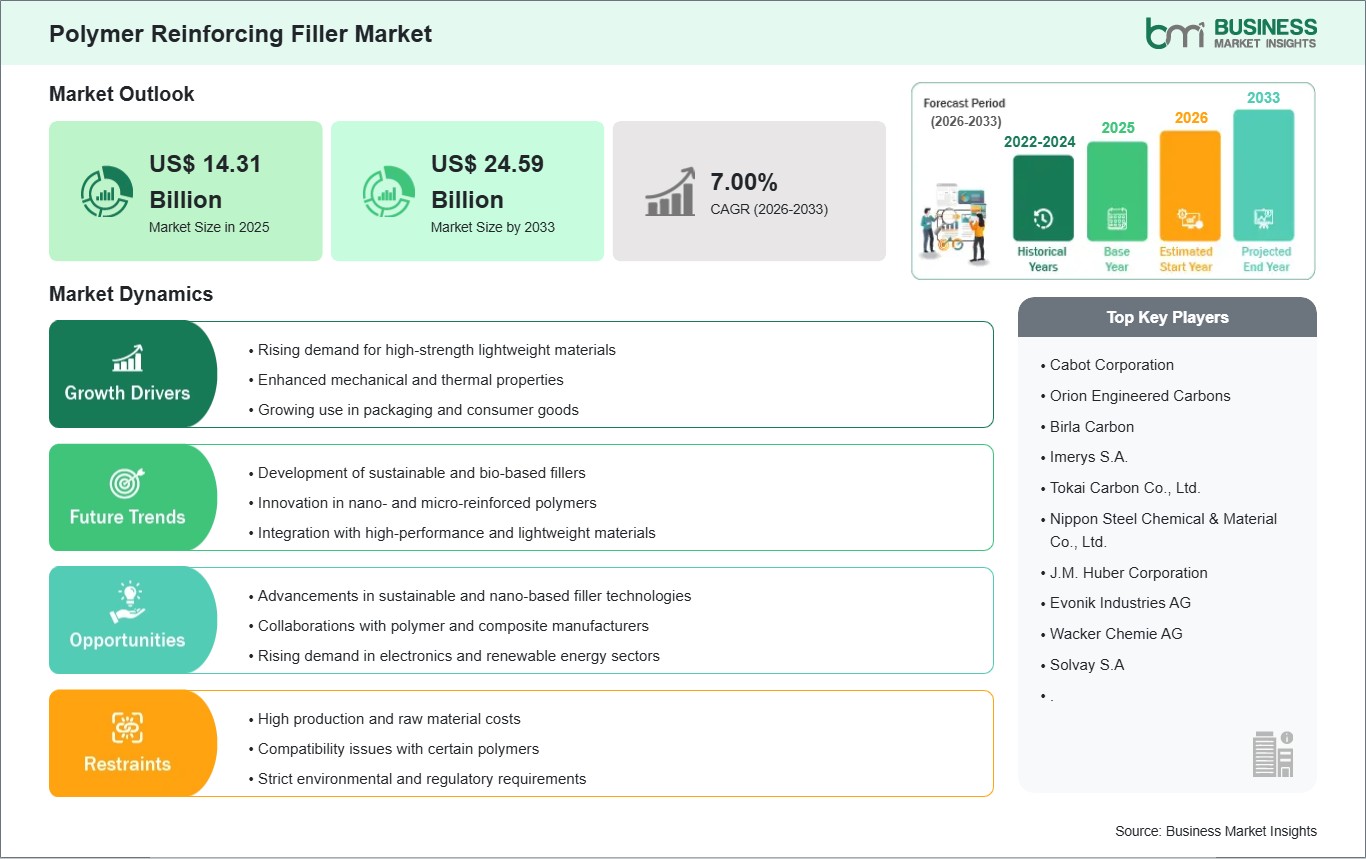
The Polymer Reinforcing Filler Market size is expected to reach US$ 24.59 billion by 2033 from US$ 14.31 billion in 2025. The market is estimated to record a CAGR of 7.00% from 2026 to 2033.
The polymer reinforcing filler market is witnessing steady expansion, driven by the increasing need to enhance the mechanical, thermal, and processing properties of polymer materials across multiple industries. Reinforcing fillers such as carbon black, silica, calcium carbonate, glass fibers, and nanofillers are widely incorporated into polymers to improve tensile strength, stiffness, abrasion resistance, and dimensional stability. These materials play a critical role in automotive components, construction materials, packaging products, and industrial applications, where performance optimization and cost efficiency are essential.
Market dynamics are strongly influenced by advancements in material science and compounding technologies. Manufacturers are focusing on surface treatment techniques, particle size optimization, and dispersion improvements to enhance filler-polymer compatibility and overall composite performance. The growing demand for lightweight and high-strength materials in automotive and aerospace sectors is accelerating the adoption of advanced reinforcing fillers, particularly glass fibers and nanofillers. Additionally, the shift toward high-performance elastomers and thermoplastics in industrial applications is further supporting market growth.
Sustainability and regulatory compliance are emerging as key considerations in the market. Companies are increasingly incorporating eco-friendly and recycled fillers to reduce environmental impact and meet stringent regulations. Bio-based fillers and low-carbon production processes are gaining attention, particularly in regions with strong environmental mandates. Competitive strategies include product innovation, strategic partnerships, and capacity expansion to address rising demand and diversify application areas. The market outlook remains positive, supported by continuous innovation, industrial growth, and the increasing need for high-performance polymer composites across diverse end-use sectors.

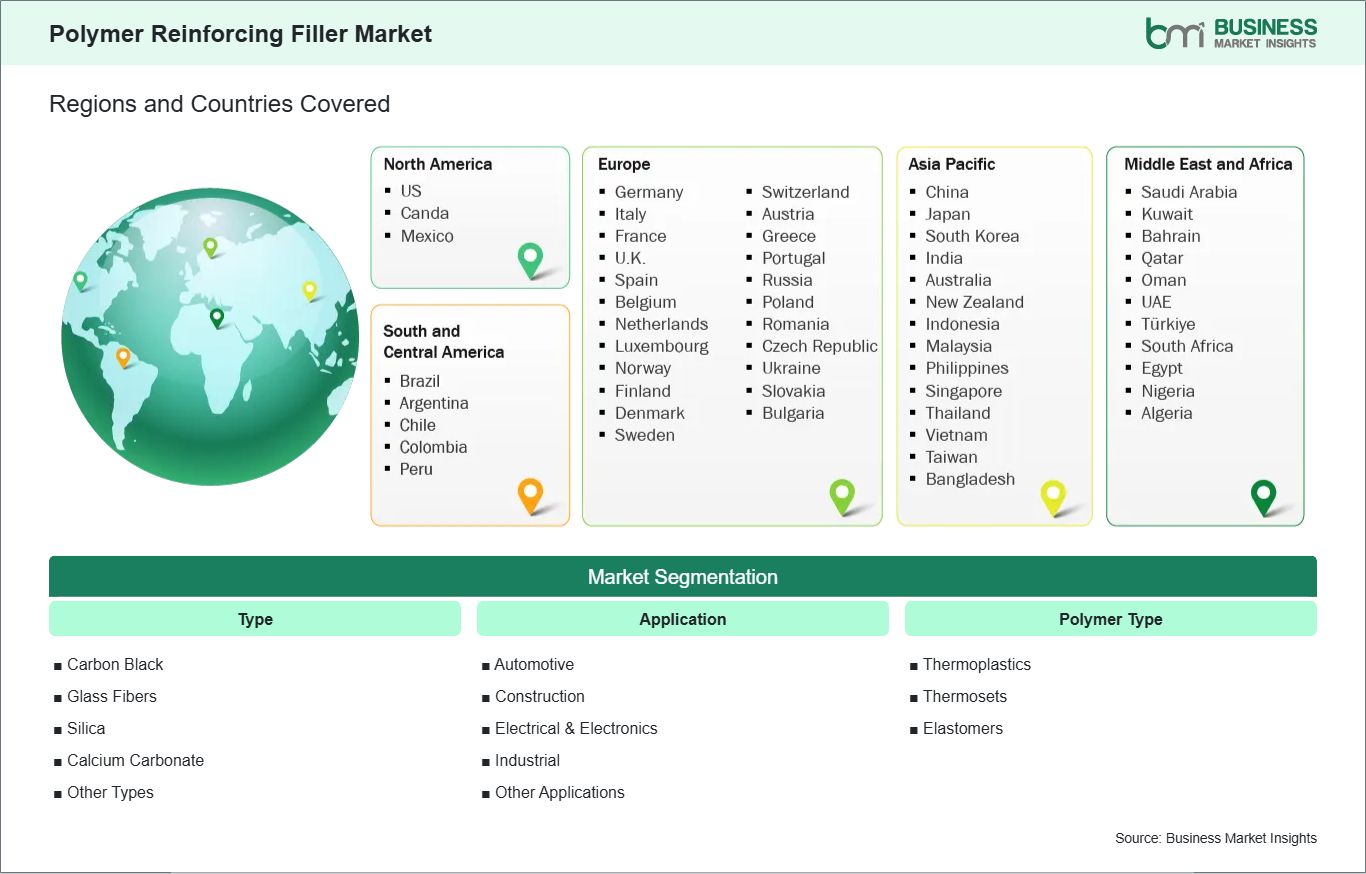
Key segments that contributed to the derivation of the polymer reinforcing filler market analysis are type, application, and polymer type.
The global polymer reinforcing filler market is witnessing growth as companies aim to find materials to make their products stronger without adding any weight to them. These fillers can be combined with polymers to add strength, stiffness, and longevity to the product. They can be used in different sectors, including the automotive, construction, and packaging industries. These fillers can help companies add to the longevity and quality of the product while making it lighter. They can also help companies reduce costs.
In the automotive and industrial sector, composite materials with polymer fillers can be used to replace heavy materials. Using these composite materials can help companies achieve efficiency and reduce costs. These fillers can be used to add to the quality of different polymer-based products. They can be used to add quality to simple as well as complex processes. Companies can aim to add to the longevity of the product. They can aim to add to the longevity of the product without compromising on quality.
The market also benefits from ongoing innovation in filler technology. Improved filler formulations provide better compatibility with polymers, making composites easier to process and more reliable. This allows manufacturers to design products that meet evolving performance requirements across industries. The combination of strength, lightweight design, and durability positions polymer reinforcing fillers as an essential material in modern manufacturing, supporting growth and innovation worldwide.
The market is changing with the increasing importance of sustainability and advanced materials. Bio-based fillers, derived from natural sources, have been considered to be more environmentally friendly compared to conventional inorganic fillers. The advantage of these bio-based fillers lies in their ability to provide reinforcing strength to materials, which can help in achieving the objective of sustainable production. The ability of these fillers to provide strength to materials, combined with the advantage of sustainability, has made composite materials more favorable in the market.
Nano-based fillers have been significantly affecting the market by enhancing the properties of polymers in ways that conventional fillers have not been able to. Nano-based fillers have the ability to provide enhanced strength, thermal, and chemical resistance, and even specialized functions to materials. The advantage of these fillers lies in their ability to help manufacturers design materials that can be lighter, stronger, and more versatile, which can help in innovation in areas where conventional materials have not been able to perform.
Ongoing development in filler technology is expanding the applications of polymer composites across industries. From construction materials to consumer goods, reinforced polymers are used wherever performance, durability, and sustainability are priorities. As companies focus on creating smarter, more efficient, and environmentally conscious products, polymer reinforcing fillers will continue to be a key material enabling innovation, quality, and competitive advantage in global markets.

The polymer reinforcing filler market demonstrates steady growth, with size and share analysis highlighting evolving trends and competitive dynamics among key players. The report examines subsegments categorized within type, application, and polymer type, offering insights into their contribution to overall market performance.
By Type, the carbon black subsegment dominated the market in 2025, driven by its extensive use in enhancing mechanical properties and durability of polymers.
Based on Application, the automotive subsegment dominated the market in 2025, owing to increasing demand for lightweight and high-strength materials.
On the Basis of Polymer Type, the thermoplastics subsegment dominated the market in 2025, supported by its wide usage across automotive, construction, and electronics industries.
| Report Attribute | Details |
|---|---|
| Market size in 2025 | US$ 14.31 Billion |
| Market Size by 2033 | US$ 24.59 Billion |
| Global CAGR (2026 - 2033) | 7.00% |
| Historical Data | 2022-2024 |
| Forecast period | 2026-2033 |
| Segments Covered | By Type
|
|
Regions and Countries Covered
| |
| North America | US, Canada, Mexico |
| Europe | Belgium, Austria, Finland, Denmark, Greece, Poland, Romania, Russia, Ukraine, Czech Republic, Slovakia, Bulgaria, Italy, Luxembourg, Germany, Switzerland, France, Netherlands, Norway, Portugal, Spain, Sweden, United Kingdom |
| Asia-Pacific | Australia, China, India, Japan, South Korea, Indonesia, Malaysia, Philippines, Singapore, Thailand, Vietnam, Bangladesh, New Zealand, Taiwan |
| South and Central America | Brazil, Argentina, Peru, Chile, Colombia |
| Middle East and Africa | Bahrain, Kuwait, Oman, Qatar, Saudi Arabia, United Arab Emirates, Turkiye, South Africa, Egypt, Algeria, Nigeria |
| Market leaders and key company profiles |
|
The "Polymer Reinforcing Filler Market Size and Forecast (2022 - 2033)" report provides a detailed analysis of the market covering below areas:
The geographical scope of the Polymer Reinforcing Filler Market report is divided into North America, Asia Pacific, Europe, Middle East & Africa, and South & Central America. North America held the largest share in 2025.
Regionally, the polymer reinforcing filler market demonstrates varied growth patterns influenced by industrial activity, raw material availability, and application demand. North America dominates the market, driven by strong demand from automotive, construction, and industrial manufacturing sectors. The United States leads in the adoption of high-performance reinforcing fillers, supported by advanced compounding technologies, robust R&D capabilities, and increasing use of lightweight materials in transportation and infrastructure applications. In the Asia Pacific, rapid industrialization, expanding automotive production, and growing construction activities are major growth drivers. China, India, Japan, and South Korea are key markets, with significant production and consumption of reinforcing fillers. The region benefits from abundant raw materials, cost-effective manufacturing, and rising demand for polymer composites in packaging, electronics, and infrastructure development. Europe emphasizes sustainability, regulatory compliance, and advanced material engineering. Countries such as Germany, France, and Italy are focusing on high-performance fillers, including silica and specialty additives, to meet stringent environmental and performance standards. Collaboration between material suppliers and OEMs is driving innovation in reinforced polymer applications. The Middle East & Africa market is emerging, supported by growth in construction, infrastructure, and industrial sectors. Countries such as the UAE, Saudi Arabia, and South Africa are gradually increasing the adoption of reinforcing fillers in polymer applications, driven by investments in manufacturing and urban development projects. South & Central America is developing steadily, with Brazil and Argentina leading the market. Growth is fueled by automotive production, construction activities, and packaging demand. Strategic partnerships with global manufacturers and improvements in local compounding capabilities are supporting the gradual expansion of the polymer reinforcing filler market in the region.

The Polymer Reinforcing Filler Market is evaluated by gathering qualitative and quantitative data post primary and secondary research, which includes important corporate publications, association data, and databases. A few of the key developments in the polymer reinforcing filler market are:
The Polymer Reinforcing Filler Market is valued at US$ 14.31 Billion in 2025, it is projected to reach US$ 24.59 Billion by 2033.
As per our report Polymer Reinforcing Filler Market, the market size is valued at US$ 14.31 Billion in 2025, projecting it to reach US$ 24.59 Billion by 2033. This translates to a CAGR of approximately 7.00% during the forecast period.
The Polymer Reinforcing Filler Market report typically cover these key segments-
The historic period, base year, and forecast period can vary slightly depending on the specific market research report. However, for the Polymer Reinforcing Filler Market report:
The Polymer Reinforcing Filler Market is populated by several key players, each contributing to its growth and innovation. Some of the major players include:
The Polymer Reinforcing Filler Market report is valuable for diverse stakeholders, including:
Essentially, anyone involved in or considering involvement in the Polymer Reinforcing Filler Market value chain can benefit from the information contained in a comprehensive market report.
Please tell us your area of interest
(Market Segments/ Regions and Countries/ Companies)