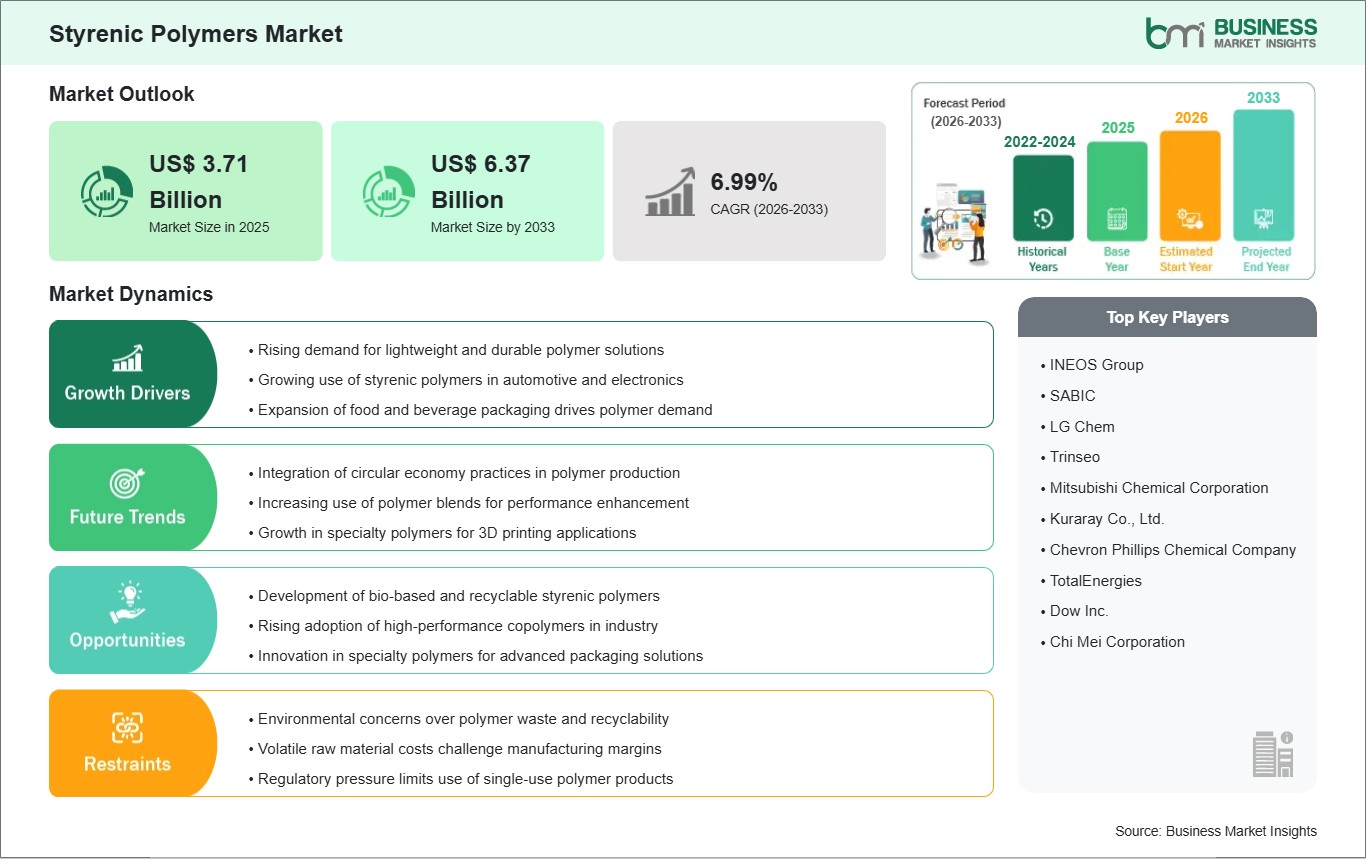
The Styrenic Polymers Market size is expected to reach US$ 6.37 billion by 2033 from US$ 3.71 billion in 2025. The market is estimated to record a CAGR of 6.99% from 2026 to 2033.
The global market for styrenic polymers is influenced by multiple industrial needs, technological developments, and changing sustainability requirements that differ across various regions and industrial applications. Styrenic polymers, which encompass polystyrene and high‑impact polystyrene (HIPS) and acrylonitrile butadiene styrene (ABS) and styrene acrylonitrile (SAN) and their associated copolymers, serve as essential materials for applications that require transparent materials that can be easily processed and provide mechanical strength and multiple functional uses. The materials are used in a wide range of products, which include packaging, consumer electronics, automotive components, appliance housings, construction materials and specialty industrial products.
The global market maintains its strength through multiple industrial sectors which use styrenic polymers that remain crucial for both existing markets and new industrial applications. The global styrenic polymers market experiences growth because customers need lightweight, durable polymer products that help their products work better and last longer. Styrenic grades maintain their position in global consumer goods and protective packaging markets through their capacity to create rigid packaging which delivers excellent surface finish and maintains performance standards. Automotive and transportation industries increasingly select engineered styrenic copolymers for their interior and exterior components, which need impact-resistant properties while maintaining low weight.
The consumer electronics industry and household appliance market experience continuous growth because transparent high-performance styrenic materials meet increasing demand from urbanizing regions. The market operates under significant restrictions, which create challenges for its international markets. The environmental issues which people associate with synthetic polymers follow through all stages of their existence, particularly when manufacturers deal with product disposal, plastic waste disposal and recycling difficulties. The food contact and packaging regulations that different regions now enforce force manufacturers to develop recyclable and bio-based solutions because they intend to decrease their usage of standard styrenic polymers for single-use products.
The system forces production teams to build complex operational systems, which need them to make capital investments for two specific areas, which include backward material reuse systems and technology for joining different materials and using recycled materials. The global market for styrenic polymers maintains a strong position because its products can serve multiple industrial sectors, polymer research creates new materials, and developing nations show higher demand for industrial products. The producers who work on environmental projects and materials development today focus on collaborative methods because they want to achieve performance standards while managing their environmental responsibilities.

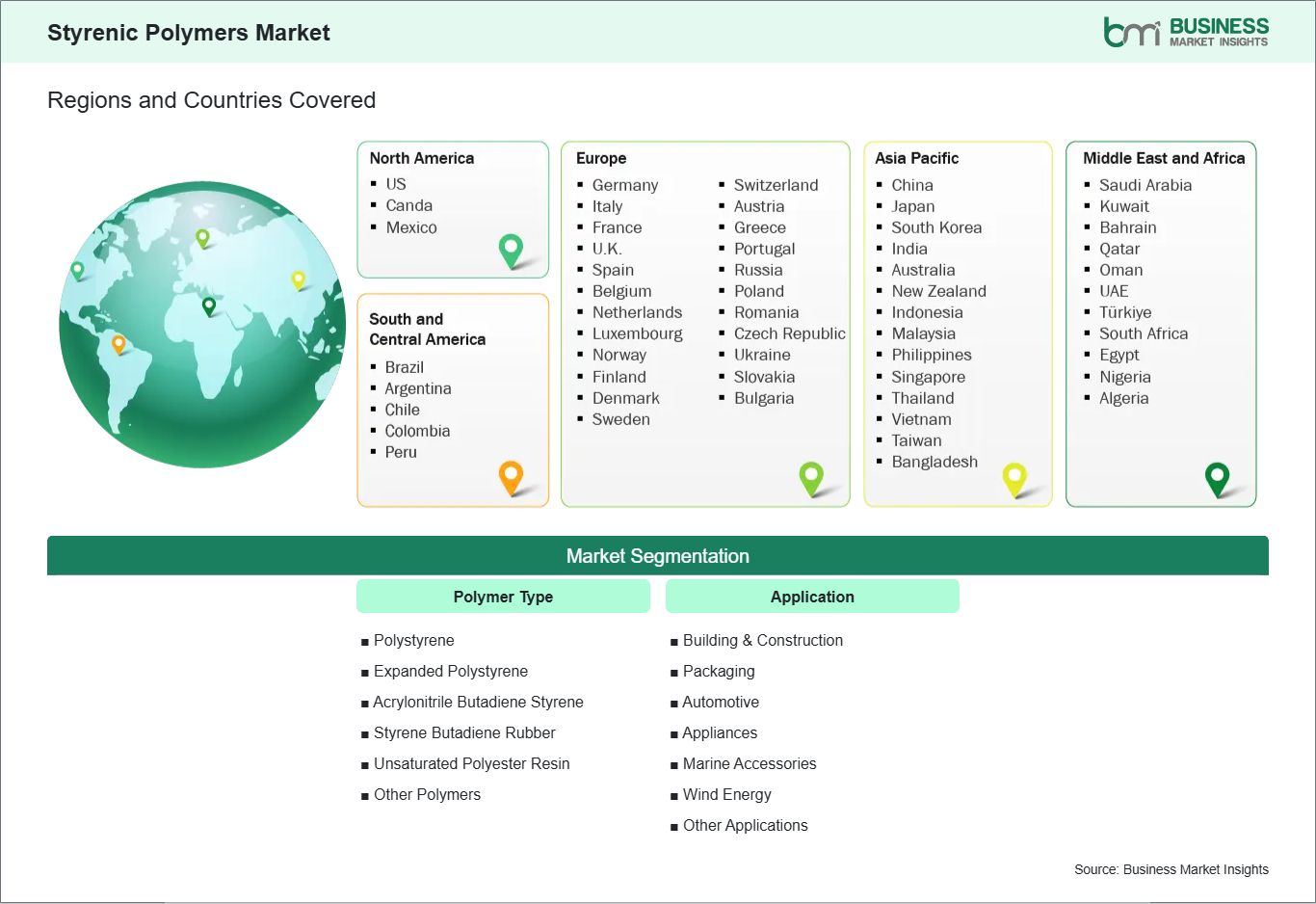
Key segments that contributed to the derivation of the styrenic polymers market analysis are polymer type and application.
The global market for styrenic polymers is increasingly driven by the industrial demand for materials that combine lightweight properties with high durability. The automotive and aerospace industries use ABS and high-impact polystyrene and other styrenic copolymers because these materials help decrease vehicle weight and boost fuel efficiency and strength. Europe and North America are the primary regions driving this development because these areas enforce strict emission regulations while consumers increasingly choose energy-efficient vehicles.
The packaging industry has established styrenic polymers as essential materials for food containers, disposable cups and protective packaging because these polymers deliver high levels of clarity, rigidity and thermal stability. The Asia Pacific region has experienced rapid growth because urbanization and retail sector expansion have occurred across China and India and Japan. The manufacturing industry develops polymers that offer both lightweight properties and strength preservation to create lightweight products.
Styrenic polymers provide both aesthetic finishes and mechanical durability to consumer electronics and household appliances. The ability to create intricate designs, together with protection against wear and heat, has led to their worldwide use. North America serves as the primary market, which utilizes advanced processing technologies to manufacture polymers that fulfill high-performance standards, while other markets develop their production capabilities to match growing industrial demands.
Opportunities in the global styrenic polymers market are emerging from the development of bio-based and recyclable polymer solutions. Manufacturers are investing in sustainable feedstocks and closed-loop recycling systems to reduce reliance on fossil-based materials and align with global environmental initiatives. Europe is particularly active in this space, with countries promoting circular economy practices in packaging and automotive components.
The packaging sector is seeing rapid growth for recycled polystyrene in foodservice and protective packaging applications, especially in North America and Asia Pacific. Companies are exploring compatibilizers and polymer blends to maintain mechanical and thermal performance while incorporating higher recycled content. This allows global players to meet both regulatory standards and consumer demand for sustainable solutions.
Innovation in bio-based styrenic polymers is also supporting specialty applications, such as electronics, consumer goods, and 3D printing. These polymers provide comparable durability and processability to conventional materials, offering manufacturers an opportunity to diversify product offerings while contributing to environmental responsibility. Overall, sustainability-driven polymer innovations are creating new markets and reinforcing the strategic relevance of styrenic polymers worldwide.
The styrenic polymers market demonstrates steady growth, with size and share analysis highlighting evolving trends and competitive dynamics among key players. The report examines subsegments categorized within polymer type and application, offering insights into their contribution to overall market performance.
By polymer type, the polystyrene (PS) subsegment dominated the market in 2025, driven by its wide use in packaging and insulation due to its excellent balance of cost, performance, and manufacturability.
Based on application, the building & construction subsegment dominated the market in 2025, driven by strong infrastructure development and high demand for insulation and structural materials.
| Report Attribute | Details |
|---|---|
| Market size in 2025 | US$ 3.71 Billion |
| Market Size by 2033 | US$ 6.37 Billion |
| Global CAGR (2026 - 2033) | 6.99% |
| Historical Data | 2022-2024 |
| Forecast period | 2026-2033 |
| Segments Covered | By Polymer Type
|
|
Regions and Countries Covered
| |
| North America | US, Canada, Mexico |
| Europe | Belgium, Austria, Finland, Denmark, Greece, Poland, Romania, Russia, Ukraine, Czech Republic, Slovakia, Bulgaria, Italy, Luxembourg, Germany, Switzerland, France, Netherlands, Norway, Portugal, Spain, Sweden, United Kingdom |
| Asia-Pacific | Australia, China, India, Japan, South Korea, Indonesia, Malaysia, Philippines, Singapore, Thailand, Vietnam, Bangladesh, New Zealand, Taiwan |
| South and Central America | Brazil, Argentina, Peru, Chile, Colombia |
| Middle East and Africa | Bahrain, Kuwait, Oman, Qatar, Saudi Arabia, United Arab Emirates, Turkiye, South Africa, Egypt, Algeria, Nigeria |
| Market leaders and key company profiles |
|
The "Styrenic Polymers Market Size and Forecast (2022 - 2033)" report provides a detailed analysis of the market covering below areas:
The geographical scope of the Styrenic Polymers Market report is divided into North America, Asia Pacific, Europe, Middle East & Africa, and South & Central America. North America held the largest share in 2025.
North America holds the leading position in the global styrenic polymers market because of its developed industrial base, established chemical production facilities and the high need for these materials in packaging, automotive, electronics and construction industries. The United States operates as the dominant force in the region through its extensive polymer manufacturing capacities and complete product distribution systems, while Canada and Mexico develop their markets through specialized manufacturing and production of automotive parts and distribution of polymer products for export. North America uses its advanced recycling programs and its development of high-impact polystyrene and ABS products, and continuing demand for lightweight, strong materials in consumer products and industrial uses to support its styrenic polymers industry.
The market in the Asia Pacific experiences fast growth because of industrialization, urban development and increased consumption in China, India and Japan. The region demands styrenic polymers because electronics, automotive and packaging manufacturers recognize these materials as affordable, lightweight and attractive options.
Europe exists as a developed market that demonstrates strong ecological practices and industry compliance with regulations and research on bio-based and recyclable styrenic polymers. The countries of Germany, France and Italy use these polymers to make automotive interiors and packaging products and household appliances while following strict environmental regulations.
The Middle East and Africa market, which relies on infrastructure development, construction, and energy-related applications, uses styrenic polymers for insulation, piping, and protective housings because these materials offer durability and chemical resistance.
The developing market of South and Central America depends on Brazil, Mexico, and Argentina for growth, which results from the growing demand in packaging, construction, and consumer goods markets. The region works to increase its polymer production capacity through imported technology and better material efficiency methods to satisfy the rising demand from urbanization and industrial growth.
The North American region leads in technological development and operational capacity and recycling programs, but each area displays distinct market patterns because of industrial expansion, regulatory systems and end-user requirements and sustainability initiatives, which together drive the worldwide growth of the styrenic polymers industry.

The Styrenic Polymers Market is evaluated by gathering qualitative and quantitative data post primary and secondary research, which includes important corporate publications, association data, and databases. A few of the key developments in the styrenic polymers market are:
The Styrenic Polymers Market is valued at US$ 3.71 Billion in 2025, it is projected to reach US$ 6.37 Billion by 2033.
As per our report Styrenic Polymers Market, the market size is valued at US$ 3.71 Billion in 2025, projecting it to reach US$ 6.37 Billion by 2033. This translates to a CAGR of approximately 6.99% during the forecast period.
The Styrenic Polymers Market report typically cover these key segments-
The historic period, base year, and forecast period can vary slightly depending on the specific market research report. However, for the Styrenic Polymers Market report:
The Styrenic Polymers Market is populated by several key players, each contributing to its growth and innovation. Some of the major players include:
The Styrenic Polymers Market report is valuable for diverse stakeholders, including:
Essentially, anyone involved in or considering involvement in the Styrenic Polymers Market value chain can benefit from the information contained in a comprehensive market report.
Please tell us your area of interest
(Market Segments/ Regions and Countries/ Companies)