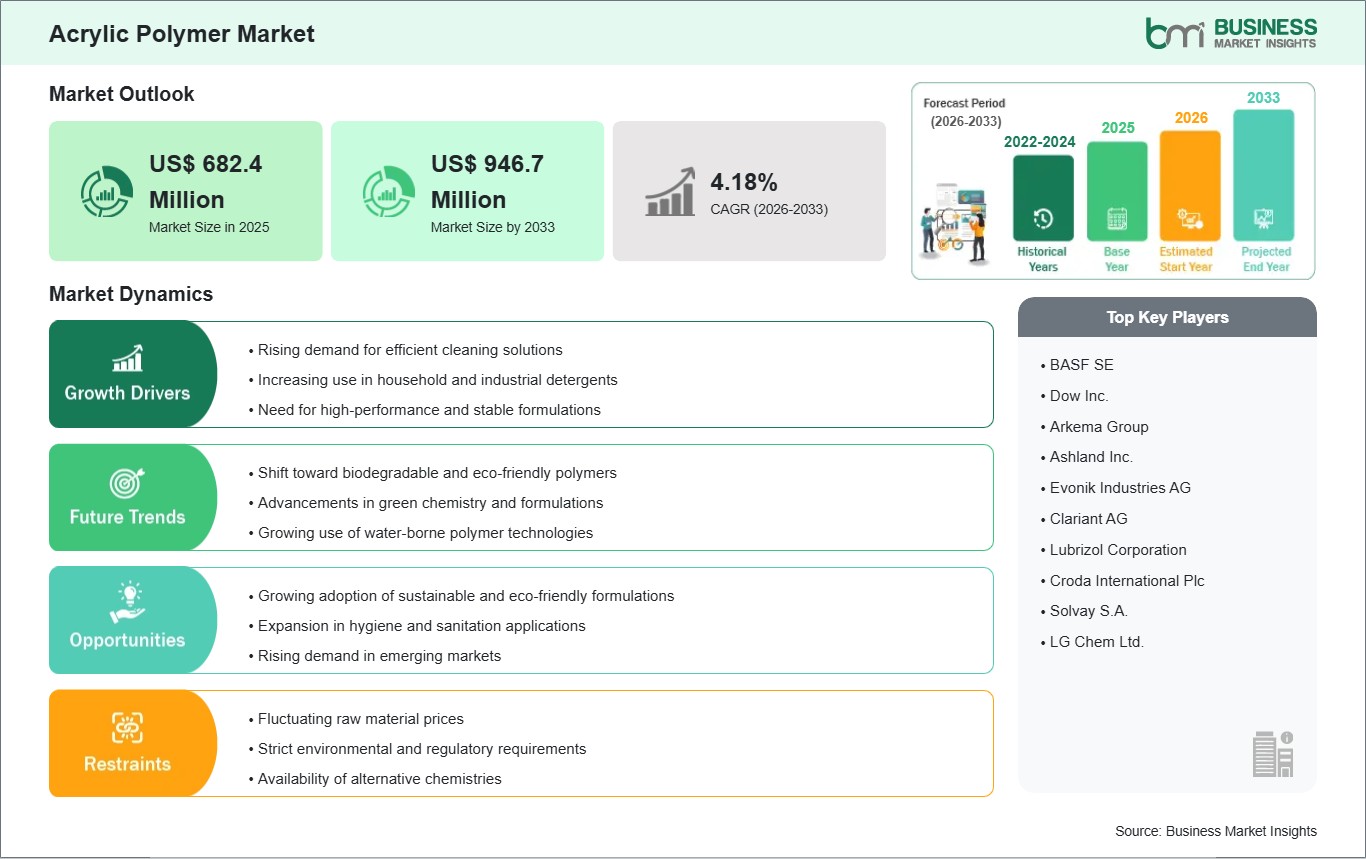
The Acrylic Polymer Market size is expected to reach US$ 946.7 Million by 2033 from US$ 682.4 Million in 2025. The market is estimated to record a CAGR of 4.18% from 2026 to 2033.
The global acrylic polymer market is defined by growing demand for high-performance polymers in cleaning, coatings, and industrial applications. Acrylic polymers—known for their excellent dispersing, thickening, and binding properties—are widely utilized in household and industrial cleaning formulations. Their versatility and compatibility with various formulations make them essential ingredients in detergents, surface cleaners, and specialty chemical products. This shift reflects broader industry priorities: improving cleaning efficiency, enhancing formulation stability, and meeting evolving environmental standards.
Competitive dynamics increasingly center on formulation innovation and sustainability, with emphasis on biodegradable and low-toxicity polymer solutions. Manufacturers are investing in advanced polymer chemistry to enhance performance attributes such as solubility, anti-redeposition, and scale inhibition. Commercial strategies now include customized polymer blends tailored to specific end-use requirements and regulatory compliance.
Meanwhile, regulatory frameworks promoting environmentally friendly cleaning agents are influencing product development and adoption. Industries are shifting toward water-based and eco-friendly formulations, integrating acrylic polymers as key functional ingredients. This evolving landscape positions acrylic polymers as critical components in modern cleaning and industrial chemical formulations.

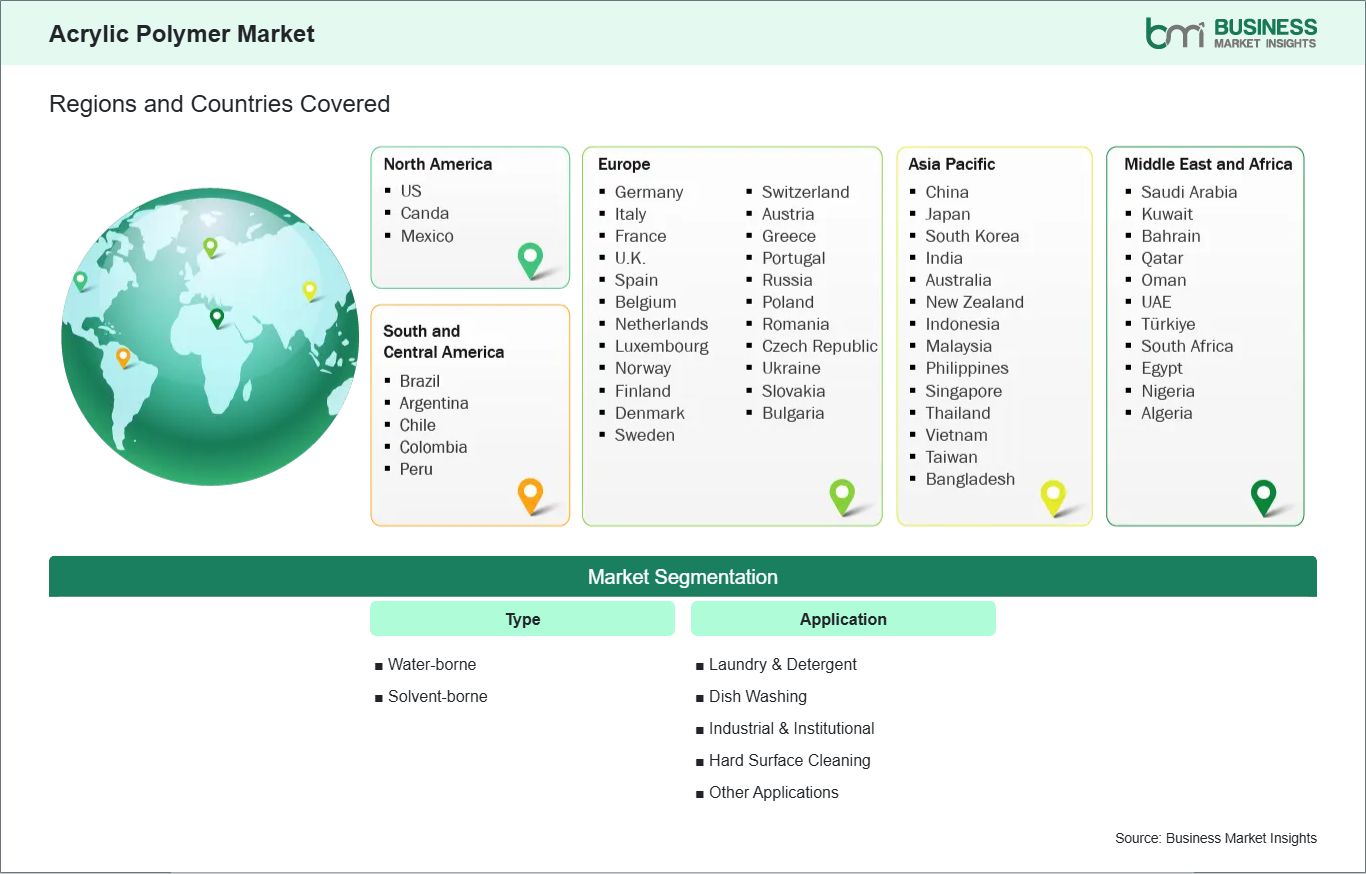
Key segments that contributed to the derivation of the acrylic polymer market analysis are type and application.
The global emphasis on hygiene and cleanliness has never been stronger, and this trend is significantly boosting the demand for acrylic polymers in cleaning applications. Across residential, commercial, and industrial sectors, consumers and businesses alike are seeking cleaning solutions that are not only effective but also reliable under diverse conditions. Acrylic polymers enhance detergents and cleaning agents by improving dispersion, preventing dirt redeposition, and ensuring consistent cleaning efficiency. This makes them indispensable in modern formulations, particularly in regions with hard water where maintaining cleaning performance is challenging.
The rise of urbanization and the expansion of healthcare, hospitality, and food service industries have further intensified the need for high‑performance cleaning products. Acrylic polymers contribute to product stability, longer shelf life, and compatibility with multiple active ingredients, enabling manufacturers to deliver solutions that meet evolving consumer expectations. Moreover, the surge in e‑commerce and packaged goods has heightened the importance of maintaining hygiene standards during storage and transportation, indirectly fueling demand for advanced cleaning agents.
Technological advancements in polymer chemistry are also reshaping the market. Innovations such as multifunctional acrylic polymers with faster curing times, enhanced adhesion, and improved resistance to environmental stressors are enabling the development of next‑generation cleaning products. As global awareness of hygiene continues to rise, acrylic polymers will remain central to the formulation of efficient, durable, and high‑performance cleaning solutions, driving steady market growth.
Sustainability has become a defining trend across industries, and the acrylic polymer market is no exception. Growing environmental concerns and stricter regulatory frameworks are pushing manufacturers to innovate with eco‑friendly formulations. Acrylic polymers are being engineered to be biodegradable, low‑toxicity, and compliant with global sustainability standards, making them increasingly attractive for use in cleaning, coatings, and packaging applications.
Water‑borne acrylic polymers, in particular, are gaining traction as they offer reduced environmental impact compared to solvent‑based alternatives. These formulations minimize volatile organic compound (VOC) emissions, improve workplace safety, and align with consumer preferences for greener products. In cleaning applications, eco‑friendly acrylic polymers enhance biodegradability while maintaining high performance, supporting the transition toward sustainable household and industrial solutions.
Advancements in green chemistry are accelerating this shift. Manufacturers are leveraging renewable raw materials, energy‑efficient production processes, and closed‑loop recycling systems to reduce the carbon footprint of acrylic polymer production. This not only strengthens compliance with environmental regulations but also enhances brand reputation in a market where consumers are increasingly eco‑conscious.
The push toward sustainability is also opening new opportunities in sectors such as packaging, automotive, and construction, where eco‑friendly adhesives and coatings are in high demand. As industries and consumers prioritize environmental responsibility, the adoption of sustainable acrylic polymers is expected to grow rapidly, positioning them as a cornerstone of future innovation in the chemical and materials industry.

The Acrylic Polymer Market demonstrates steady growth, with size and share analysis highlighting evolving trends and competitive dynamics among key players. The report examines subsegments categorized within product, usability, and application, offering insights into their contribution to overall market performance.
By type, the water-borne subsegment dominated the market in 2025, driven by regulatory support for low-VOC and sustainable products.
In terms of application, the laundry & detergent subsegment dominated the market in 2025, driven by widespread use in household and industrial cleaning formulations.
| Report Attribute | Details |
|---|---|
| Market size in 2025 | US$ 682.4 Million |
| Market Size by 2033 | US$ 946.7 Million |
| Global CAGR (2026 - 2033) | 4.18% |
| Historical Data | 2022-2024 |
| Forecast period | 2026-2033 |
| Segments Covered | By Type
|
|
Regions and Countries Covered
| |
| North America | US, Canada, Mexico |
| Europe | Belgium, Austria, Finland, Denmark, Greece, Poland, Romania, Russia, Ukraine, Czech Republic, Slovakia, Bulgaria, Italy, Luxembourg, Germany, Switzerland, France, Netherlands, Norway, Portugal, Spain, Sweden, United Kingdom |
| Asia-Pacific | Australia, China, India, Japan, South Korea, Indonesia, Malaysia, Philippines, Singapore, Thailand, Vietnam, Bangladesh, New Zealand, Taiwan |
| South and Central America | Brazil, Argentina, Peru, Chile, Colombia |
| Middle East and Africa | Bahrain, Kuwait, Oman, Qatar, Saudi Arabia, United Arab Emirates, Turkiye, South Africa, Egypt, Algeria, Nigeria |
| Market leaders and key company profiles |
|
The "Acrylic Polymer Market Size and Forecast (2022 - 2033)" report provides a detailed analysis of the market covering below areas:
The geographical scope of the Acrylic Polymer Market report is divided into North America, Asia Pacific, Europe, Middle East & Africa, and South & Central America. North America held the largest share in 2025.
The adoption and maturity of acrylic polymers vary across regions, influenced by industrial activity, consumer behavior, and regulatory policies. In North America, strong demand for advanced cleaning solutions and well-established chemical manufacturing industries drive market growth. The US and Canada emphasize innovation and sustainability, supporting the adoption of eco-friendly polymers.
In Europe, strict environmental regulations and sustainability initiatives encourage the use of biodegradable and low-emission polymers. Countries such as Germany, the UK, and France lead in adopting green cleaning solutions. Asia Pacific dominates the market due to rapid urbanization, population growth, and increasing demand for household and industrial cleaning products in countries such as China, India, and Southeast Asia. Expanding manufacturing sectors and rising hygiene awareness further contribute to regional growth. The Middle East & Africa and South & Central America regions show steady growth, driven by improving living standards and increasing demand for cleaning products. Across all regions, regulatory frameworks and consumer preferences play a crucial role in shaping market dynamics.

The Acrylic Polymer Market is evaluated by gathering qualitative and quantitative data post primary and secondary research, which includes important corporate publications, association data, and databases. A few of the key developments in the acrylic polymer market are:
The Acrylic Polymer Market is valued at US$ 682.4 Million in 2025, it is projected to reach US$ 946.7 Million by 2033.
As per our report Acrylic Polymer Market, the market size is valued at US$ 682.4 Million in 2025, projecting it to reach US$ 946.7 Million by 2033. This translates to a CAGR of approximately 4.18% during the forecast period.
The Acrylic Polymer Market report typically cover these key segments-
The historic period, base year, and forecast period can vary slightly depending on the specific market research report. However, for the Acrylic Polymer Market report:
The Acrylic Polymer Market is populated by several key players, each contributing to its growth and innovation. Some of the major players include:
The Acrylic Polymer Market report is valuable for diverse stakeholders, including:
Essentially, anyone involved in or considering involvement in the Acrylic Polymer Market value chain can benefit from the information contained in a comprehensive market report.
Please tell us your area of interest
(Market Segments/ Regions and Countries/ Companies)