Market Summary
Executive Summary and Global Market Analysis
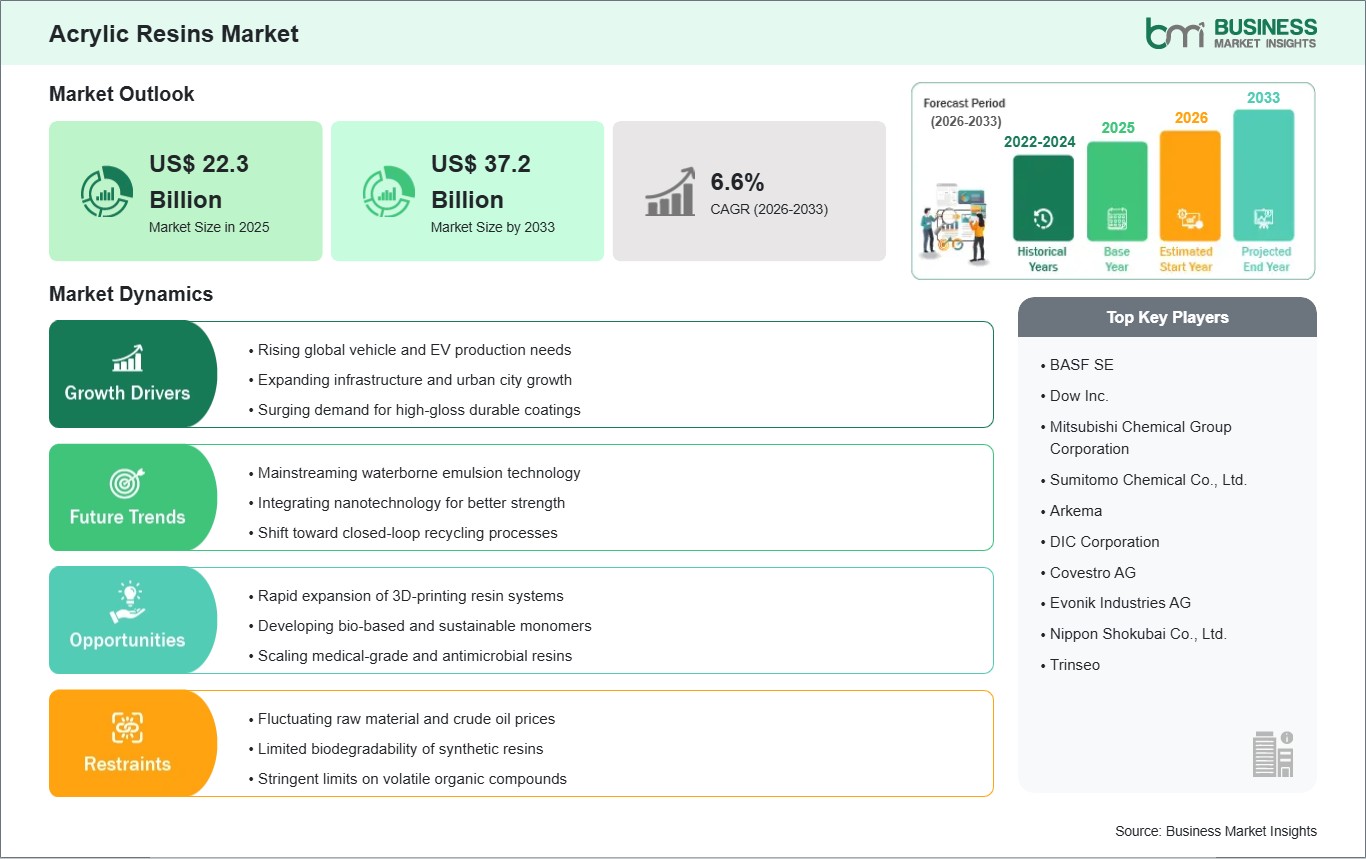
Acrylic Resin is a versatile polymer used as a binder, coating, and adhesive across manufacturing industries. This resin is essential for core sectors: Building & Construction, Automotive, Paints & Coatings, and Packaging. Acrylic resins offer advantages such as high resistance to UV rays, excellent durability, adhesion, and color retention. The market for acrylic resins is driven by rapid urbanization and infrastructural development across the world, rising demand across the world for low-volatile organic compound (VOC) water-based coatings, and increasing usage of high-performance coating in the automobile sector.
Market growth faces certain challenges, such as volatile petrochemical raw material prices, which impact production costs and supply chain stability. Strict environmental regulations on VOC emissions require costly compliance and encourage alternative solutions. The industry also contends with competition from other polymers, including epoxy and polyurethane. However, opportunities exist due to rising demand for bio-based and sustainable acrylics, growth in high-performance applications for electronics and medical devices, and strong expansion in the Asia-Pacific region. Advancements in thermoplastic and thermosetting grades are expected to create new market opportunities.
Market Forces
Acrylic Resins Market Drivers and Opportunities
Versatile Applications in Coatings and Adhesives
The primary driver of the Acrylic Resins Market is their versatility and widespread use in surface coatings and adhesives across major industries. Their weather resistance, UV stability, color retention, and chemical resistance make them preferred for architectural paints, industrial coatings, and high-performance adhesives. Ongoing growth in construction, renovation, and automotive manufacturing sustains strong demand. As the need for durable and attractive finishes increases, acrylic resin consumption remains robust across end-use sectors.
Water-Based Formulations and Sustainable Growth
A major growth opportunity is the shift toward environmentally friendly, water-based acrylic resin formulations and expansion into sustainable, high-performance applications. Global environmental regulations are driving the adoption of low- or zero-VOC coatings and adhesives. Water-based acrylic resins meet these standards and often match the performance of solvent-based products. Advanced acrylics are increasingly used in sustainable technologies such as solar panels, where their durability and UV resistance support specialized, high-margin applications aligned with the energy transition.
Size and Share Analysis
Acrylic Resins Market Size and Share Analysis
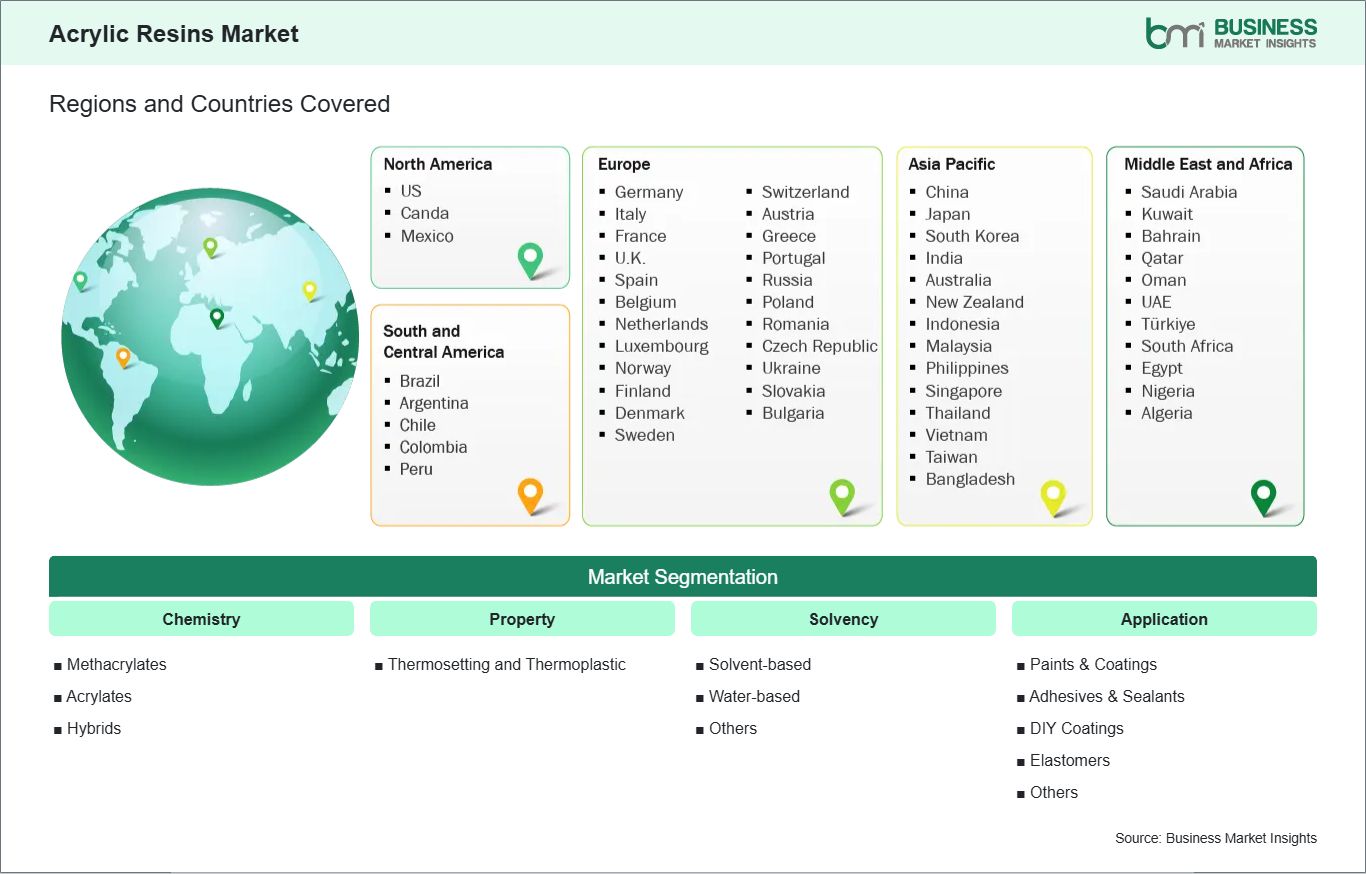
The Acrylic Resins Market demonstrates steady growth, with size and share analysis revealing evolving trends and competitive positioning among key players. The report further examines subsegments categorized within chemistry, property, solvency, application, and end use industry, offering insights into their contribution to overall market performance.
For instance, Methacrylate-based thermosetting resins are used in high-performance industrial applications for their hardness and UV resistance, with strong demand from the Automotive and Electrical & Electronics sectors. Water-based acrylics are increasingly applied in Paints & Coatings for Building & Construction, driven by regulations requiring low-VOC products and demand for eco-friendly finishes.
Thermoplastic acrylates are mainly used in Adhesives & Sealants for Packaging and Consumer Goods, benefiting from high-volume production of lightweight materials and the need for strong, fast-curing adhesives.
Report Coverage
Acrylic Resins Market Report Coverage and Deliverables
The "Acrylic Resins Market Size and Forecast (2022 - 2033)" report provides a detailed analysis of the market covering below areas:
- Acrylic Resins Market size and forecast at global, regional, and country levels for all the key market segments covered under the scope
- Acrylic Resins Market trends, as well as market dynamics such as drivers, restraints, and key opportunities
- Acrylic Resins Market analysis covering key market trends, global and regional framework, major players, regulations, and recent market developments
- Industry landscape and competition analysis covering market concentration, heat map analysis, prominent players, and recent developments for the Acrylic Resins Market
- Detailed company profiles, including SWOT analysis
Geographic Insights
Acrylic Resins Market Geographic Insights
The geographical scope of the Acrylic Resins Market report is divided into five regions: North America, Asia Pacific, Europe, the Middle East & Africa, and South & Central America.
The Asia-Pacific Acrylic Resins Market is segmented into China, Japan, South Korea, India, Australia, New Zealand, Indonesia, Malaysia, the Philippines, Singapore, Thailand, Vietnam, Taiwan, Bangladesh, and the Rest of Asia. The Asia-Pacific acrylic resins market is driven by rapid industrialization and urbanization, leading to massive growth in the Building & Construction sector.
The region's growth is further supported by soaring demand from the automotive industry for lightweight components and high-performance OEM and refinish coatings. Furthermore, the increasing consumer shift toward low-VOC, water-based acrylic formulations, driven by stricter environmental regulations, accelerates market expansion. Asia-Pacific serves as both a major manufacturing hub and a leading consumption center for acrylic resins globally.
Industry Activity
Recent Developments
The Acrylic Resins Market is evaluated by gathering qualitative and quantitative data post-primary and secondary research, which includes important corporate publications, association data, and databases. A few of the key developments in the Acrylic Resins Market are:
- In April 2024, Lubrizol announced a US$20 million investment in its Gastonia, North Carolina facility as part of its strategy to advance innovative resin technologies for coatings, aimed at expanding the production of next?generation acrylic emulsions.
- In March 2025, Sumitomo Chemical announced to initiate the sales of its polymethyl methacrylate (PMMA) produced using methyl methacrylate (MMA) monomer derived through chemical recycling. Leading manufacturers such as LG Display Co., Ltd. of South Korea and Nissan Motor Co., Ltd. of Japan have adopted this chemically recycled material for use in their products. With this development, Sumitomo Chemical is strengthening its leadership in the MMA value chain and accelerating the broader deployment of chemical recycling technologies.
Trust & Transparency
Research Methodology
The market analysis combines proprietary research with secondary data from government agencies, company disclosures, regulatory filings, industry databases and expert interviews. Market estimates are validated through data triangulation, cross-market benchmarking and analyst
review.
View Full Research Methodology
Key Sources Referred:
World Bank - Global Trade IndicatorsWorld Trade Organization (WTO)International Monetary Fund (IMF)International Trade Administration (ITA)Company WebsiteCompany Investor PresentationsCompany Annual Reports