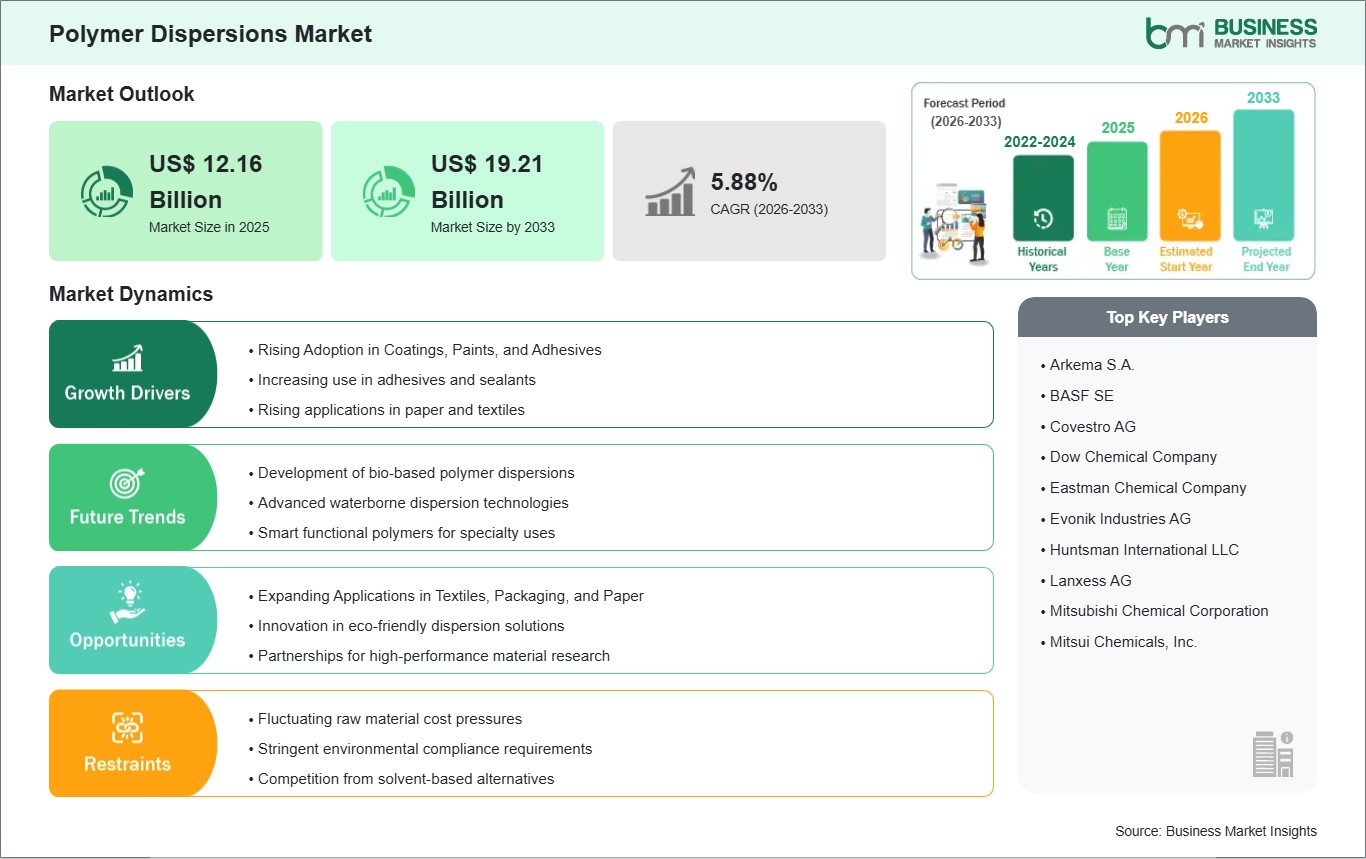
The Polymer Dispersions Market size is expected to reach US$ 19.21 billion by 2033 from US$ 12.16 billion in 2025. The market is estimated to record a CAGR of 5.88% from 2026 to 2033.
The polymer dispersions market is growing rapidly due to the increasing demand for environmentally friendly water-based polymer solutions. This is because polymer dispersions possess excellent properties such as improved film formation, adhesion, and flexibility. Moreover, they emit fewer VOCs, which is in line with the global trend towards sustainable solutions. End-users are increasingly opting for polymer dispersions because they are easier to apply and cost-effective.
Additionally, they can help improve various product properties such as durability, chemical resistance, and appearance. Technological advancements in polymer chemistry have also enabled manufacturers to produce acrylic, styrene-butadiene, and vinyl acetate polymer dispersions. These advanced solutions can help meet specific industry demands. The market has a highly competitive environment, with existing players emphasizing R&D to develop specialty dispersions that possess better mechanical, optical, and environmental characteristics.
Factors that influence the market include the increasing construction activities, growth in waterborne coatings, and increasing demand in industrial and packaging applications. Factors that affect the market include the prices of raw materials and regulations that influence the formulation and manufacturing processes. Overall, the market for polymer dispersions has a mix of innovative, sustainable, and increasing demand characteristics that make it a highly versatile and high-performance product for a number of applications.

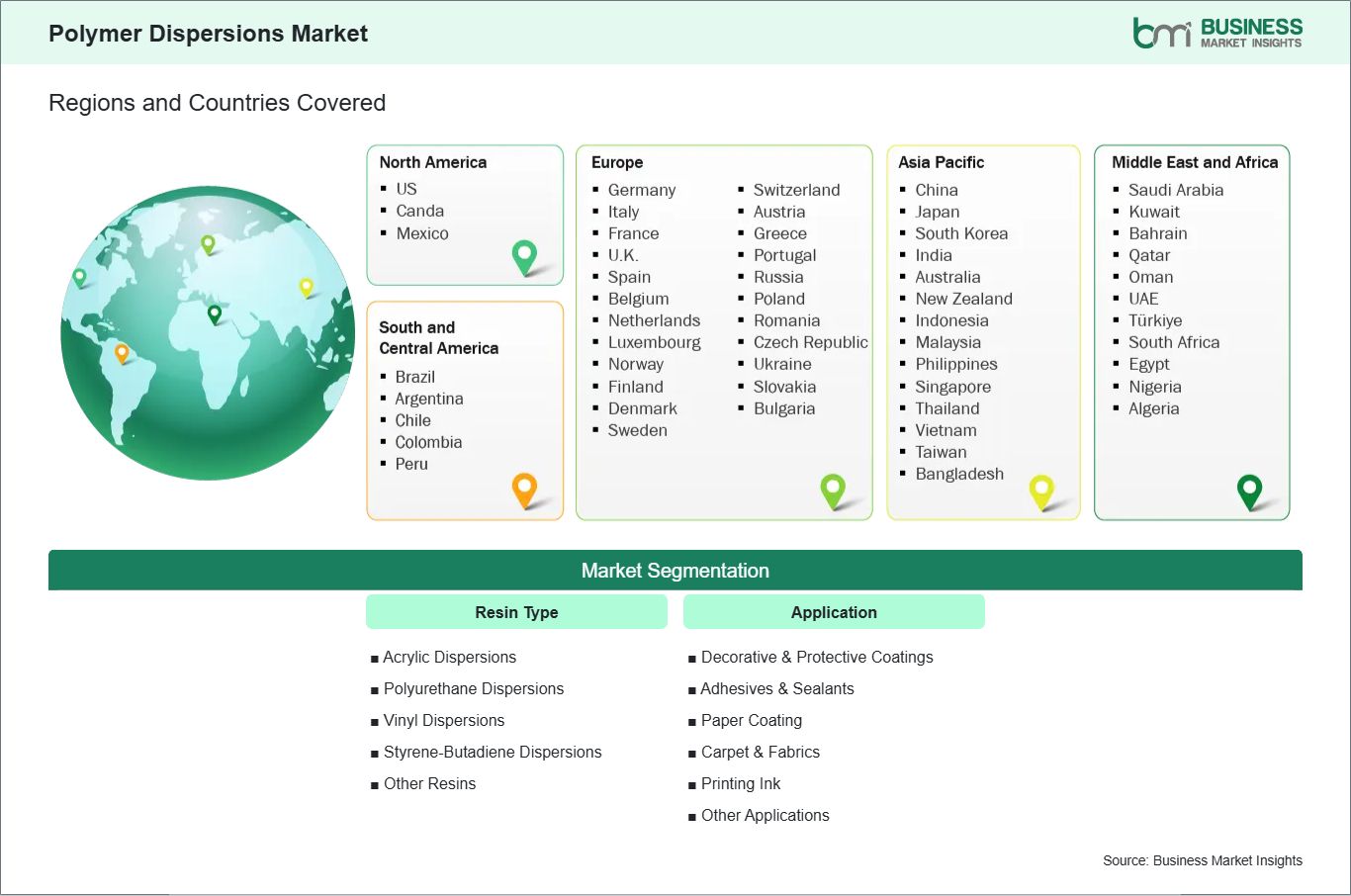
Key segments that contributed to the derivation of the polymer dispersions market analysis are resin type and application.
The market for polymer dispersions is growing significantly owing to the increasing demand for coatings, adhesives, and paint applications. Polymer dispersions are used to enhance the film-formation properties, bonding, and flexibility of the end product, making them a crucial component in industrial, construction, and consumer applications. Polymer dispersions are used in water-based coatings, which are gaining popularity in the coatings industry due to the increasing regulations and initiatives promoting environmentally friendly products. Polymer dispersions are used in coatings as they provide a robust, chemically stable, and visually attractive coating that meets the needs of a number of applications, including the construction industry, the automotive industry, and the consumer market.
In the case of adhesives, polymer dispersions provide bonding strength, durability, and flexibility to the end product. Polymer dispersions are used in pressure-sensitive adhesives, wood adhesives, and laminating applications, offering a reliable alternative to solvent-based products. Furthermore, the increasing demand for environmentally friendly products in the adhesive market has fueled the growth of the polymer dispersion market. Additionally, the rise in DIY projects and construction activities worldwide has fueled the growth of the polymer dispersion market.
In addition to this, sustainability and compliance are also contributing factors to the increased demand. Waterborne polymer dispersions provide benefits such as reduced VOC emissions, improved worker safety, and compliance with global environmental standards. In the pursuit of improved formulation of polymer dispersions with superior performance attributes such as improved resistance to chemicals, weathering, and application properties, industries are turning towards polymer dispersions as the future of coatings, adhesives, and paint formulations.
Polymer dispersions are increasingly used in textiles for enhancing softness, flexibility, and durability. They are used in finishing, coating, and laminating operations for improving mechanical properties, resistance to stains, and water repellency. There is a growing requirement for high-performance textiles for protective clothing, upholstery, and technical textiles. This is creating a market for polymer dispersions. They are also used for creating customized effects, including gloss, matte, and texture, on textiles.
In packaging, polymer dispersions are used for coatings, laminates, and films. They are used for improving printability, moisture resistance, and adhesion in paper, cardboard, and flexible packaging materials. With the rise of online shopping and a growing requirement for green packaging, there is a growing requirement for waterborne polymer dispersions. Similarly, in the paper industry, polymer dispersions are used for improving surface strength, gloss, and print quality.
Technological advancements in polymer dispersions are further expanding their applications. Innovations include specialty grades with improved thermal stability, UV resistance, and compatibility with diverse substrates. These developments enable broader use in industrial, construction, and consumer goods markets. As global demand grows for high-performance, environmentally friendly, and versatile polymers, polymer dispersions are positioned as a key ingredient in coatings, adhesives, textiles, packaging, and paper applications worldwide.

The polymer dispersions market demonstrates steady growth, with size and share analysis highlighting evolving trends and competitive dynamics among key players. The report examines subsegments categorized within resin type and application, offering insights into their contribution to overall market performance.
By Resin Type, the acrylic dispersions subsegment dominated the market in 2025, driven by its versatility, excellent adhesion, and strong performance in water‑based coatings and adhesives.
Based on Application, the decorative & protective coatings subsegment dominated the market in 2025, supported by rising construction activity and the shift toward low‑VOC, environmentally friendly coating solutions.
| Report Attribute | Details |
|---|---|
| Market size in 2025 | US$ 12.16 Billion |
| Market Size by 2033 | US$ 19.21 Billion |
| Global CAGR (2026 - 2033) | 5.88% |
| Historical Data | 2022-2024 |
| Forecast period | 2026-2033 |
| Segments Covered | By Resin Type
|
|
Regions and Countries Covered
| |
| North America | US, Canada, Mexico |
| Europe | Belgium, Austria, Finland, Denmark, Greece, Poland, Romania, Russia, Ukraine, Czech Republic, Slovakia, Bulgaria, Italy, Luxembourg, Germany, Switzerland, France, Netherlands, Norway, Portugal, Spain, Sweden, United Kingdom |
| Asia-Pacific | Australia, China, India, Japan, South Korea, Indonesia, Malaysia, Philippines, Singapore, Thailand, Vietnam, Bangladesh, New Zealand, Taiwan |
| South and Central America | Brazil, Argentina, Peru, Chile, Colombia |
| Middle East and Africa | Bahrain, Kuwait, Oman, Qatar, Saudi Arabia, United Arab Emirates, Turkiye, South Africa, Egypt, Algeria, Nigeria |
| Market leaders and key company profiles |
|
The "Polymer Dispersions Market Size and Forecast (2022 - 2033)" report provides a detailed analysis of the market covering below areas:
The geographical scope of the Polymer Dispersions Market report is divided into North America, Asia Pacific, Europe, Middle East & Africa, and South & Central America. North America held the largest share in 2025.
The polymer dispersions market exhibits distinct regional dynamics influenced by industrialization, construction growth, and regulatory frameworks, with North America dominating the market due to its mature coatings, adhesives, and construction industries.
The United States and Canada lead adoption of waterborne polymer dispersions driven by strict environmental regulations and sustainability initiatives, along with demand from high-performance coatings and specialty applications. In Europe, market growth is shaped by regulatory compliance, sustainability mandates, and advanced industrial manufacturing in countries such as Germany, France, and Italy, promoting widespread adoption of low-VOC polymer dispersions.
Asia Pacific is emerging as a high-growth region, fueled by urbanization, industrial expansion, and rising demand in paints, coatings, packaging, and textile applications in China, India, Japan, and South Korea, with large-scale manufacturing and cost-effective production supporting market penetration.
The Middle East & Africa region is gradually expanding, supported by infrastructure development, industrial coatings, and building projects, with imports and collaborations ensuring access to advanced polymer dispersion technologies. South & Central America is witnessing steady growth, led by Brazil, Mexico, and Argentina, driven by construction, adhesives, and industrial applications, although adoption is influenced by cost sensitivity and limited domestic production capabilities.
Overall, regional trends reflect the influence of industrial maturity, environmental regulations, and application-specific requirements on the global polymer dispersions market.

The Polymer Dispersions Market is evaluated by gathering qualitative and quantitative data post primary and secondary research, which includes important corporate publications, association data, and databases. A few of the key developments in the polymer dispersions market are:
The Polymer Dispersions Market is valued at US$ 12.16 Billion in 2025, it is projected to reach US$ 19.21 Billion by 2033.
As per our report Polymer Dispersions Market, the market size is valued at US$ 12.16 Billion in 2025, projecting it to reach US$ 19.21 Billion by 2033. This translates to a CAGR of approximately 5.88% during the forecast period.
The Polymer Dispersions Market report typically cover these key segments-
The historic period, base year, and forecast period can vary slightly depending on the specific market research report. However, for the Polymer Dispersions Market report:
The Polymer Dispersions Market is populated by several key players, each contributing to its growth and innovation. Some of the major players include:
The Polymer Dispersions Market report is valuable for diverse stakeholders, including:
Essentially, anyone involved in or considering involvement in the Polymer Dispersions Market value chain can benefit from the information contained in a comprehensive market report.
Please tell us your area of interest
(Market Segments/ Regions and Countries/ Companies)