
Emulsion Polymers Market Size, Share, Trends & Forecast Report, 2026–2033

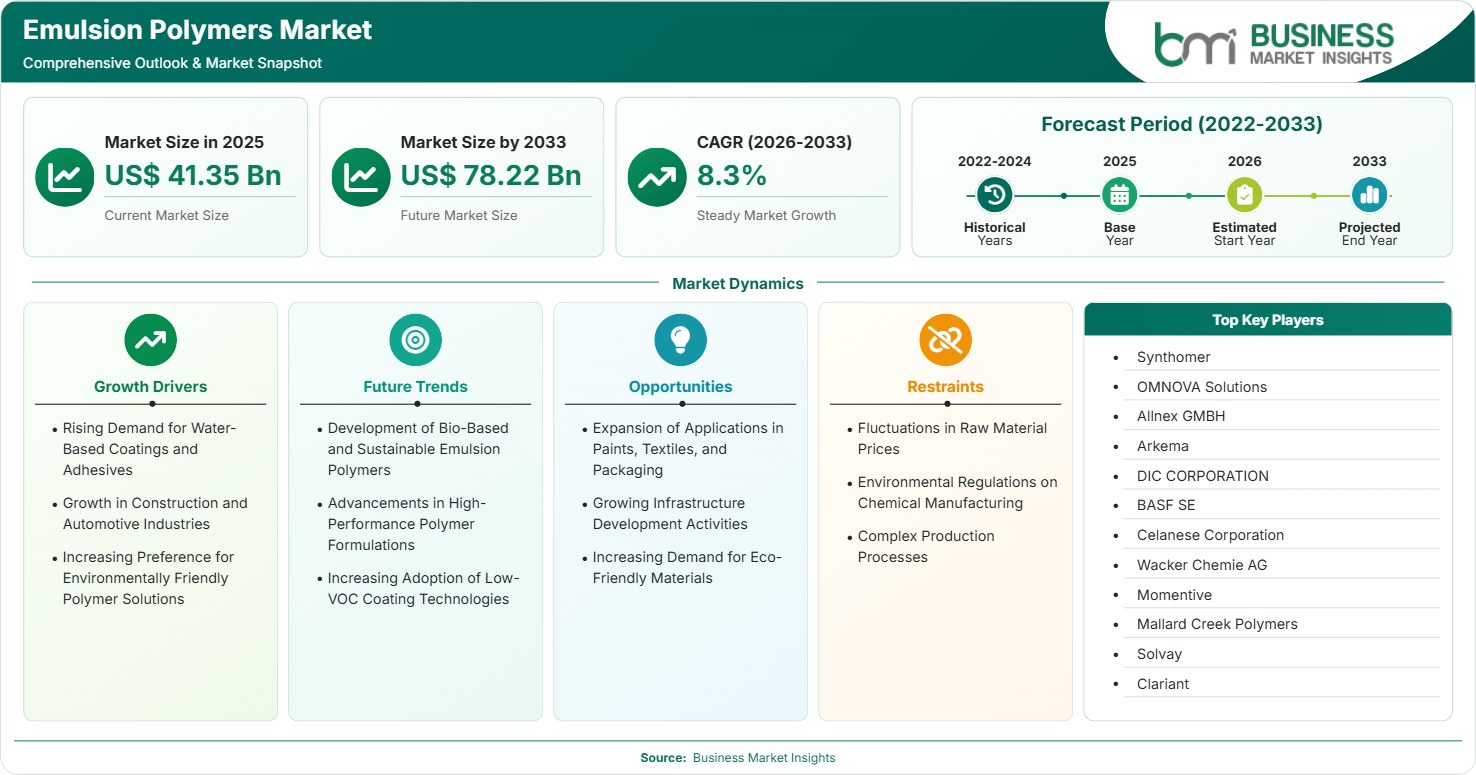
The Emulsion Polymers Market size was valued at US$ 41.35 Billion in 2025 and is projected to reach US$ 78.22 Billion by 2033, growing at a CAGR of US$ 8.3% during 2026–2033, driven by rising demand for water-based coatings, construction applications, sustainable materials, and advanced adhesive solutions.

Report Coverage
  • Type: Acrylics, Vinyl Acetate Polymer, SB Latex, Others
  • End Use Industries: Paints & Coatings, Adhesives & Sealants, Paper & Paperboard, and Others
US$ 41.35 Bn Market size in 2025
US$ 78.22 Bn Market Size by 2033
8.3% CAGR, 2026 - 2033
2026-2033 Forecast Period

01 AI Overview

Emulsion Polymers Market Summary

  • North America Region: The North American region is expected to hold a market share of 32% to 35% in 2025, growing at a CAGR of 7.8% to 8.8%, driven by innovations in coatings, packaging demand, and sustainable formulations. The market in the US is growing at a 7.7%-8.7% CAGR through 2033, driven by construction activities and industrial coatings.
  • Fastest Growing Region: Asia Pacific holds a market share of 38%–41% in 2025, growing with a CAGR of 9.0%–10.0% supported by infrastructure development, manufacturing expansion, urbanization, and increasing consumption of paints, adhesives, and specialty polymer products.
  • Leading Segment: Acrylics hold a market share of 35%–38% in 2025, growing with a CAGR of 8.2%–9.2% due to superior weather resistance, durability, and widespread adoption across coatings, adhesives, and industrial applications.
  • High Growth Segment: Adhesives and Sealants hold a market share of 28%–31% in 2025, growing with a CAGR of 8.8%–9.8% driven by packaging growth, construction activities, automotive manufacturing, and demand for lightweight bonding solutions.
  • Key Market Opportunity: Increased demand for sustainable polymer formulations presents opportunities for success through bio-based technology, low-VOC formulations, and innovative applications in coatings, packaging, construction materials, and industrial adhesive systems.
  • Major Market Players: Synthomer, OMNOVA Solutions, Allnex GmbH, Arkema, DIC Corporation, BASF SE, Celanese Corporation, Wacker Chemie AG, Momentive, Mallard Creek Polymers, Solvay, Clariant, and Asahi Kasei Corporation.
02 Strategic Insights

Emulsion Polymers Market: Strategic Insights

emulsion-polymers-market-market-strategic-framework
FREE PDF
Request your free sample
Request free sample
03 Stakeholder View

Key Takeaways

  • The supply chain structure is shifting toward integrated polymer production networks, with manufacturers expanding raw material sourcing capabilities, regional production facilities, and specialty formulation expertise to improve supply reliability.
  • High-growth opportunities are emerging in acrylic-based polymers and adhesive applications due to the need for robust, lightweight materials that adhere to environmental regulations in the construction, packaging, and automotive industries.
  • Product innovation include low-VOC products, bio-polymer products, durability and performance advancements, and efficiency in use to achieve sustainability objectives.
  • Asia Pacific presents a strong investment opportunity due to rapid infrastructure development, expanding manufacturing capacity, and rising consumption of coatings and adhesives in China, India, and Southeast Asian economies.
  • Competitive positioning through strategic partnerships, capacity expansion, and technology acquisition is being pursued by major global chemical players specializing in polymer segments.
04 Geographic Outlook

Emulsion Polymers Market Regional Highlights

North America Emulsion Polymers Market

North America accounted for a 32%–35% share in 2025 and is projected to grow at a CAGR of 7.8%–8.8% between 2026–2033. The region has the advantage of coatings industry presence, advanced manufacturing facilities, and need for sustainable formulations. The market share is indicative of widespread acceptance in architectural coatings, industrial coatings, and packaging markets.

  • The United States continues to be the largest regional contributor, aided by construction and renovation projects, automotive coatings requirements, and the growing use of low-emitting polymer technologies.
  • Canada is experiencing steady adoption through infrastructure development projects and growing demand for environmentally compliant coating solutions across commercial and industrial applications.
  • Manufacturers are investing in specialty acrylic and vinyl polymer production capabilities to support advanced coating formulations and improve regional supply resilience.
  • Sustainability regulations are encouraging companies to replace solvent-based products with water-based polymer systems offering reduced environmental impact and improved workplace safety.

US Emulsion Polymers Market

The US market represented a 27%–30% share in 2025 and is anticipated to expand at a CAGR of 7.7%–8.7% during 2026–2033. Demand is influenced by construction modernization, packaging consumption, and industrial coating requirements. The Emulsion Polymers market benefits from strong research capabilities and established chemical manufacturing infrastructure supporting advanced polymer development.

  • Residential and commercial construction activities continue driving demand for architectural coatings using acrylic and vinyl-based polymer technologies.
  • Automotive and transportation industries are adopting advanced coating systems requiring improved durability, flexibility, and resistance characteristics.
  • Packaging manufacturers are increasing usage of polymer-based adhesive solutions to support lightweight and recyclable packaging formats.

Europe Emulsion Polymers Market

Europe accounted for a 25%–28% share in 2025 and is expected to grow at a CAGR of 7.5%–8.5% through 2033. Germany, France, and the United Kingdom represent major markets due to strong chemical industries, sustainability policies, and demand for environmentally responsible coatings. Market growth is supported by regulatory pressure toward low-VOC materials and circular economy initiatives.

  • Germany leads regional adoption through automotive coatings, industrial applications, and advanced chemical manufacturing capabilities supporting specialty polymer production.
  • France demonstrates growth through construction refurbishment projects and increasing demand for sustainable architectural coating technologies.
  • The United Kingdom is expanding adoption through packaging applications and infrastructure improvements requiring efficient adhesive and coating solutions.
  • European regulations promoting reduced emissions are accelerating transition toward water-based polymer systems across multiple industries.

Asia Pacific Emulsion Polymers Market

Asia Pacific held a 38%–41% share in 2025 and is projected to record a CAGR of 9.0%–10.0% between 2026–2033. China, India, and Southeast Asian economies are driving regional expansion through infrastructure development, industrialization, and rising consumer demand. The Emulsion Polymers Market share remains highest in the region due to expanding manufacturing ecosystems and construction activity.

  • China dominates regional consumption through large-scale coatings, packaging, construction, and industrial manufacturing applications.
  • India is witnessing rapid adoption due to urbanization, infrastructure investment, and increasing demand for decorative and protective coatings.
  • Southeast Asian countries are attracting polymer production investments due to expanding manufacturing sectors and favorable industrial development conditions.
  • Regional producers are increasing capacity for acrylic, styrene-butadiene, and vinyl polymer systems to meet rising domestic demand.

Rest of World Emulsion Polymers Market

Latin America, Middle East, and Africa collectively represented a 7%–10% share in 2025 and are forecast to grow at a CAGR of 8.5%–9.5% during 2026–2033. Brazil, Saudi Arabia, and South Africa are emerging markets supported by construction expansion, industrial development, and increasing coatings consumption. The Emulsion Polymers Market growth is influenced by infrastructure investments and improving manufacturing capabilities.

  • Brazil is expanding polymer consumption through construction activities, packaging demand, and industrial coating requirements.
  • Mexico is benefiting from manufacturing growth and increasing demand for automotive and industrial applications.
  • Saudi Arabia is supporting market development through infrastructure projects and diversification of industrial sectors.
  • South Africa is adopting polymer solutions across construction, packaging, and consumer product manufacturing applications.
  • Regional suppliers are strengthening distribution networks to improve access to specialty polymer products and technical support services.
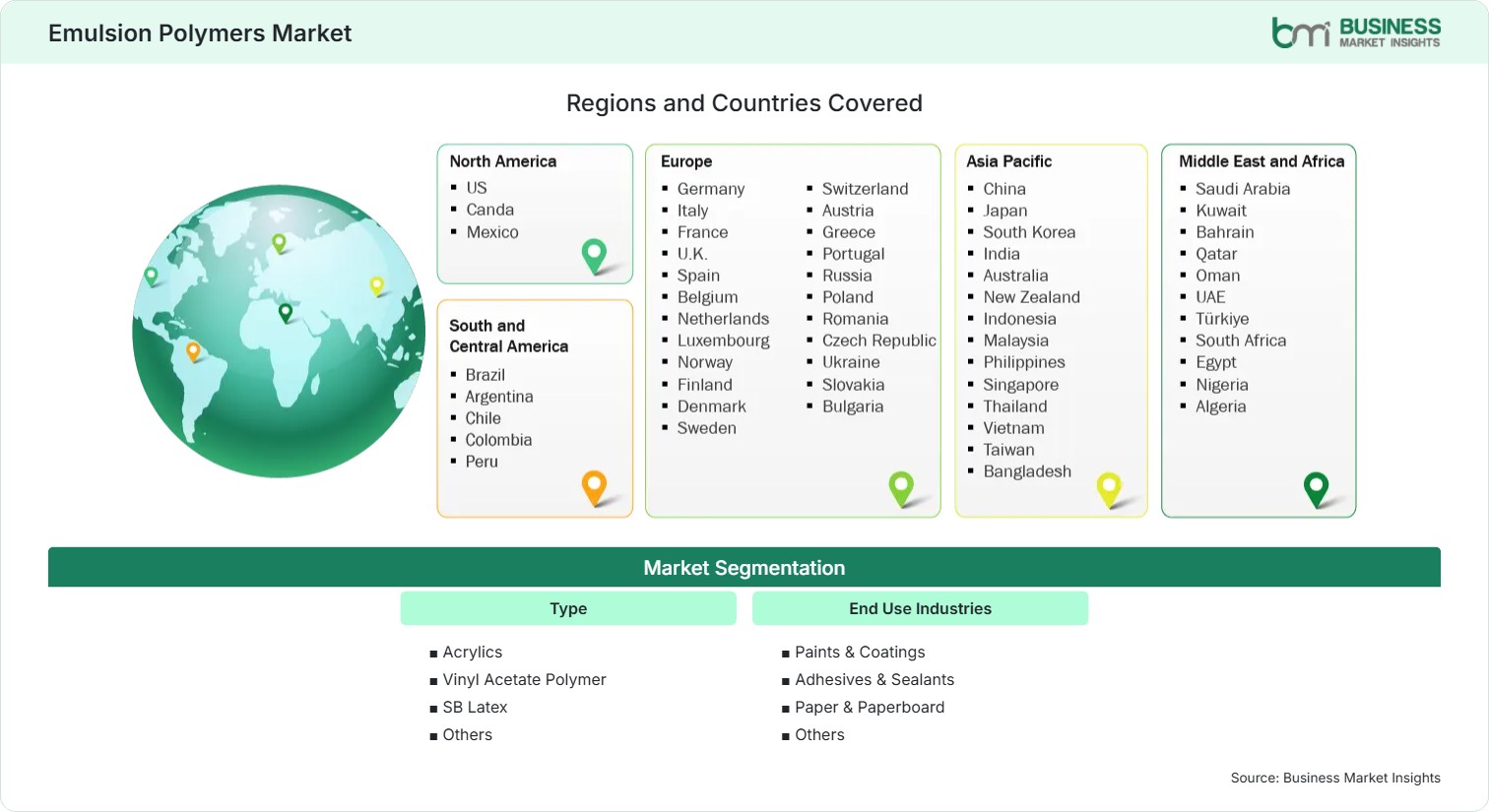
global-market-geography
FREE PDF
Request your free sample
Request free sample
05 Segment Analysis

Emulsion Polymers Market Segmentation

By Type

Type segment includes Acrylics, Vinyl Acetate Polymer, SB Latex, and Others, with acrylics maintaining leadership due to superior durability and broad application compatibility. The segment accounted for a 35%–38% share in 2025 and is projected to expand at a CAGR of 8.2%–9.2% between 2026–2034. The Emulsion Polymers Market scope is expanding through increasing demand for performance coatings, adhesives, and sustainable water-based formulations across industries.

  • Acrylics: Acrylic emulsion polymers provide excellent weather resistance, color retention, and durability, supporting applications in architectural coatings, industrial finishes, adhesives, and specialty formulations.
  • Vinyl Acetate Polymer: Vinyl acetate polymers deliver strong adhesion and flexibility, making them suitable for paints, paper coatings, construction materials, and adhesive manufacturing applications.
  • SB Latex: SB Latex polymers offer enhanced binding properties and mechanical strength, supporting demand from paper coatings, carpet backing, construction materials, and industrial applications.
  • Others: Other polymer types include specialized formulations designed for niche applications requiring customized performance characteristics, chemical resistance, and application-specific processing advantages.

By End Use Industries

End-use industries segment covers Paints & Coatings, Adhesives & Sealants, Paper & Paperboard, and Others, with paints and coatings representing the largest application area. The segment accounted for a 40%–43% share in 2025 and is projected to grow at a CAGR of 8.0%–9.0% through 2034. Increasing environmental regulations and demand for low-VOC materials are shaping industry adoption patterns.

  • Paints & Coatings: Paint and coating manufacturers utilize emulsion polymers for architectural, industrial, and protective applications requiring durability, appearance, and environmental compliance.
  • Adhesives & Sealants: Adhesive producers use emulsion polymers for packaging, construction, automotive, and consumer applications requiring reliable bonding performance and formulation flexibility.
  • Paper & Paperboard: Paper industries apply emulsion polymers as binders and coating agents to improve strength, printability, surface quality, and product performance.
  • Others: Other industries utilize specialized polymer solutions across textiles, construction additives, and consumer applications requiring tailored material properties and processing efficiency.
06 Market Forces

Emulsion Polymers Market Dynamics

Key Market Drivers

Rising Demand for Water-Based Coatings and Adhesives

Growing environmental awareness and regulatory pressure on volatile organic compound emissions are accelerating adoption of water-based coatings and adhesives. The expansion of the market is aided by the adoption of polymer products over solvents due to their safety, lower emissions, and broader applicability. The Emulsion Polymers Market trends indicate increased preference for acrylic and vinyl polymers across various sectors, including construction, packaging, and industry. Agencies such as the European Chemicals Agency have been emphasizing chemical safety and emissions management.

Growth in Construction and Automotive Industries

Expansion of construction and automotive manufacturing activities is increasing demand for emulsion polymer solutions used in protective coatings, sealants, and bonding applications. Global construction investment trends supported by urban development programs are strengthening consumption of architectural coatings and building materials. Automotive manufacturers are adopting advanced polymer-based coatings to improve corrosion resistance, appearance, and durability. Rising vehicle production in Asia Pacific markets, particularly China and India, is creating additional opportunities for specialty polymer suppliers. Manufacturers are developing application-specific formulations to meet performance requirements across infrastructure and mobility sectors.

Increasing Preference for Environmentally Friendly Polymer Solutions

Sustainability initiatives across chemical and manufacturing industries are encouraging adoption of environmentally friendly polymer technologies. Producers are investing in low-VOC, bio-based, and energy-efficient emulsion polymer formulations to address regulatory requirements and customer preferences. The shift toward sustainable materials is influencing research and development strategies among global chemical companies. Improved polymerization techniques are enabling manufacturers to enhance performance while reducing environmental impact. Growing corporate sustainability commitments and evolving chemical regulations are creating long-term demand for advanced water-based polymer solutions across multiple industries.

Key Market Opportunities

Expansion of Applications in Paints, Textiles, and Packaging

Increasing applications across paints, textiles, and packaging industries are creating new opportunities for emulsion polymer manufacturers. Growing demand for decorative coatings, flexible packaging, and specialty textile treatments is encouraging development of customized polymer solutions. The Emulsion Polymers Market Forecasts highlight opportunities for companies investing in high-performance formulations, regional production capabilities, and application-focused technologies. Packaging manufacturers are increasingly adopting polymer-based solutions to improve product quality and processing efficiency. Textile industries are also exploring advanced binders and coatings to enhance fabric performance while meeting sustainability expectations.

Growing Infrastructure Development Activities

Infrastructure expansion across developing economies is creating opportunities for polymer suppliers supporting construction coatings, adhesives, and protective materials. Government investments in transportation, residential development, and industrial facilities are increasing demand for durable construction materials. Companies offering specialized emulsion polymers for weather-resistant coatings and structural applications can benefit from these projects. Emerging markets including India, Southeast Asia, and Middle Eastern economies are attracting manufacturing investments that require advanced material solutions. Suppliers expanding regional distribution networks and technical support capabilities are positioned to capture growing construction-related demand.

Increasing Demand for Eco-Friendly Materials

Growing preference for sustainable materials is encouraging innovation in renewable and environmentally responsible polymer technologies. Manufacturers are developing bio-based emulsions, recyclable formulations, and low-energy production processes to support sustainability goals. Consumer goods companies and industrial users are increasingly evaluating material suppliers based on environmental performance and regulatory compliance. This trend creates opportunities for companies investing in research partnerships, advanced polymer chemistry, and sustainable production methods. Future market expansion will depend on the ability of manufacturers to balance performance requirements with environmental objectives.

Market Restraints and Challenges

Fluctuations in Raw Material Prices

Factor: Variations in prices of monomers, petrochemical feedstocks, and specialty chemical inputs create cost pressures for emulsion polymer manufacturers. Impact: Rising raw material costs can reduce profit margins, increase product pricing, and affect supply chain stability for downstream industries. Polymer producers depend on consistent availability of acrylic monomers, vinyl compounds, and other chemical intermediates. Market volatility caused by energy price changes and geopolitical conditions can influence production economics. Companies are responding through supplier diversification, operational efficiency improvements, and development of alternative raw material strategies to manage cost uncertainty.

Environmental Regulations on Chemical Manufacturing

Factor: Increasing regulatory requirements related to chemical emissions, waste management, and manufacturing processes create compliance challenges for polymer producers. Impact: Stricter regulations can increase operational costs, require additional investments in technology upgrades, and extend product approval timelines. Chemical manufacturers must implement improved production controls and monitoring systems to meet evolving environmental standards. Regulatory frameworks in regions such as Europe and North America are encouraging cleaner production practices while increasing compliance complexity. Companies investing in sustainable technologies and efficient manufacturing processes are better positioned to address these regulatory challenges.

07 Company Analysis

Competitive Landscape

The Emulsion Polymers Market analysis highlights a competitive environment shaped by global chemical manufacturers, specialty polymer producers, and application-focused suppliers. Companies are strengthening their positions through capacity expansions, sustainable formulation development, strategic collaborations, and innovations in water-based polymer technologies. Leading participants are focusing on acrylic, vinyl acetate, styrene-butadiene, and specialty emulsion systems to serve coatings, adhesives, paper, and industrial applications.

Company Name

Overview

Products and Services relevant to this market

Synthomer

Global specialty chemicals producer focused on advanced polymer solutions for multiple industries.

Acrylic emulsions, vinyl polymers, latex binders, coatings and adhesive polymer solutions.

OMNOVA Solutions

Specialty materials company providing performance polymers and surface technologies.

Emulsion polymers, coatings additives, specialty latex, and adhesive formulation solutions.

Allnex GmbH

Global resin manufacturer specializing in sustainable coating technologies.

Waterborne resins, acrylic polymers, coating binders, and performance polymer solutions.

Arkema

Specialty chemicals company developing advanced materials and polymer technologies.

Acrylic emulsions, specialty polymers, coating materials, and adhesive solutions.

DIC Corporation

Chemical manufacturer offering polymers and materials for industrial applications.

Synthetic resins, latex polymers, coating materials, and packaging polymer solutions.

BASF SE

Global chemical company supplying innovative polymer materials across industries.

Acrylic dispersions, polymer emulsions, coating binders, and adhesive ingredients.

Celanese Corporation

Specialty materials producer with strong polymer technology capabilities.

Vinyl acetate emulsions, adhesive polymers, coatings materials, and engineered solutions.

Wacker Chemie AG

Chemical company specializing in silicone and polymer-based materials.

Vinyl acetate ethylene dispersions, polymer binders, and construction additives.

Momentive

Advanced materials company serving industrial and specialty applications.

Silicone-based materials, polymer additives, coatings technologies, and performance solutions.

Mallard Creek Polymers

Specialty polymer manufacturer focused on custom emulsion systems.

Acrylic emulsions, styrene-butadiene latex, specialty binders, and coating polymers.

Solvay

Specialty chemicals company developing sustainable material solutions.

Polymer additives, specialty materials, coatings technologies, and industrial solutions.

Clariant

Specialty chemicals supplier focused on sustainable chemical innovations.

Polymer additives, formulation solutions, specialty chemicals, and coating technologies.

Asahi Kasei Corporation

Diversified chemical company providing advanced material technologies.

Polymer materials, coating solutions, specialty chemicals, and industrial applications.

08 Industry Activity

Recent Developments

February 2026

Synthomer plc announced a partnership with Godavari Biorefineries Limited to develop bio-based alternatives to fossil-based monomers. The collaboration focuses on commercializing bio-based butyl acrylate, supporting the development of lower-carbon raw materials for Synthomer’s polymer solutions, including applications linked to coatings and adhesives.

November 2025

Jubilant Agri & Consumer Products Limited (JACPL) announced plans to establish a new industrial polymer manufacturing facility at Savli, Gujarat, India. The facility will expand production capacity for industrial polymers used in latexes and adhesives, strengthening the company’s performance polymers and chemicals business.

September 2025

Synthomer plc expanded production capacity for specialty amorphous polyolefin (APO) polymers at its Longview, Texas facility by approximately 10%. The investment increased output of specialty polymers used in adhesive applications, strengthening Synthomer’s manufacturing capabilities in North America.

February 2025

BASF SE began construction of a new production line at its Dahej, India site to increase capacity for specialty materials. The expansion supports BASF’s broader strategy of strengthening local manufacturing capabilities in India and improving supply availability for advanced polymer solutions.

10 Trust & Transparency

Research Methodology

The market analysis combines proprietary research with secondary data from government agencies, company disclosures, regulatory filings, industry databases and expert interviews. Market estimates are validated through data triangulation, cross-market benchmarking and analyst review.

View Full Research Methodology

11 Questions Answered

Frequently Asked Questions

What information does the Emulsion Polymers Market Report provide?

The Emulsion Polymers Report provides analysis of market size, regional performance, segmentation trends, competitive developments, growth drivers, opportunities, challenges, and strategic insights for industry participants.

What role does the Asia Pacific play in industry expansion?

Asia Pacific remains a major growth center due to infrastructure development, manufacturing expansion, and increasing consumption of coatings and adhesives. China, India, and Southeast Asian countries are attracting production investments from global chemical companies.

How are sustainability trends affecting polymer manufacturers?

Sustainability trends are encouraging companies to develop low-VOC formulations, bio-based polymer technologies, and energy-efficient production processes. Regulatory requirements and customer preferences are accelerating investments in environmentally responsible polymer solutions.

Which application segment has strong Emulsion Polymers Market growth potential?

Adhesives and sealants are gaining momentum due to increasing demand from packaging, construction, automotive, and consumer goods industries. Lightweight materials and improved bonding technologies are supporting wider adoption of polymer-based adhesive solutions.

What factors are influencing demand for emulsion polymers?

Demand is influenced by the transition toward water-based coatings, increasing construction activities, packaging growth, and rising adoption of sustainable materials. Manufacturers are developing advanced formulations that provide durability, lower emissions, and improved application performance.

Access the Full Emulsion Polymers Market Report

Get segment-level forecasts, regional estimates, competitive benchmarking, company profiles and downloadable Excel datasets.

Access the full Emulsion Polymers Market Report
350 pages PDF & Excel | 2026-07-27