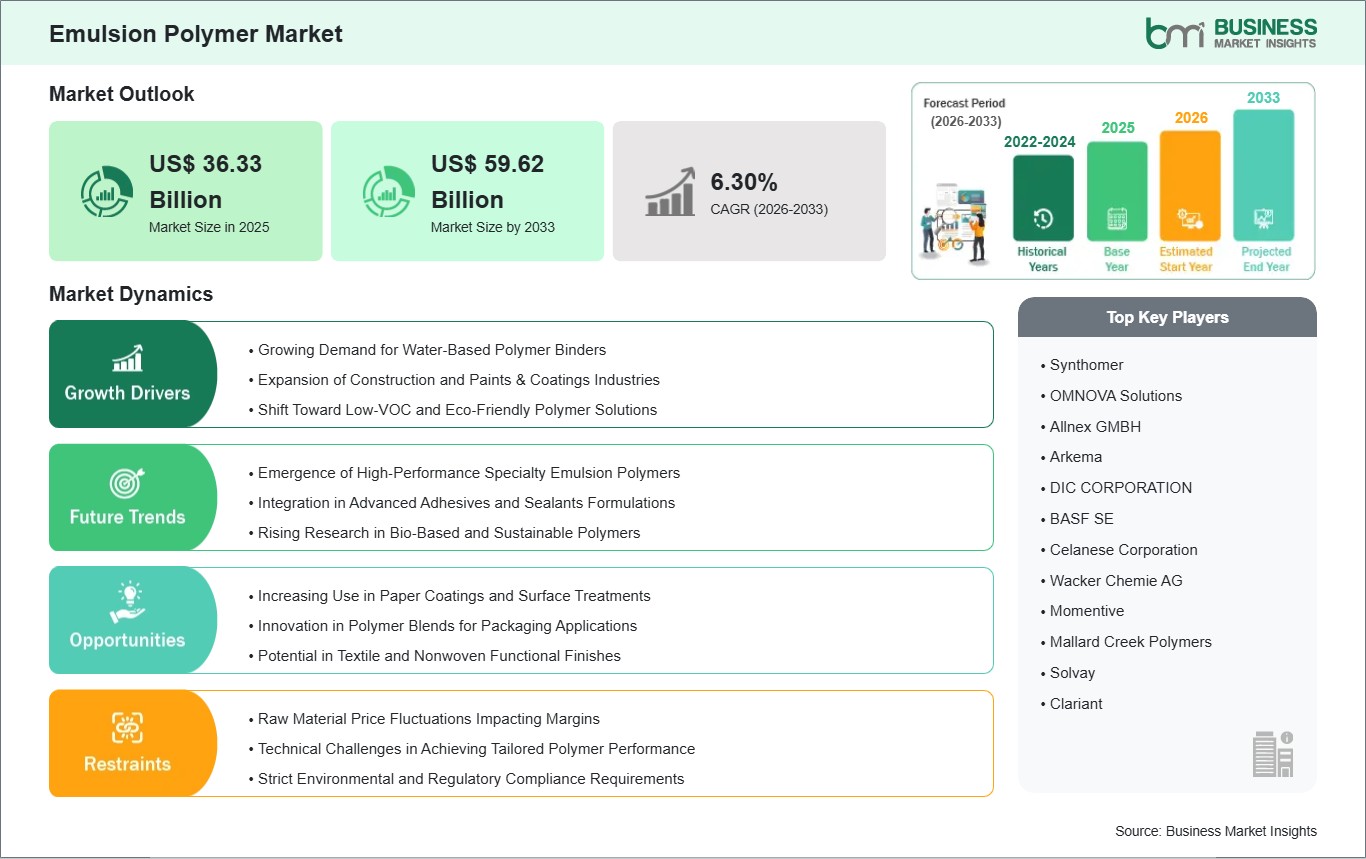
The Emulsion Polymer Market size is expected to reach US$ 59.62 Billion by 2033 from US$ 36.33 Billion in 2025 .The market is estimated to record a CAGR of 6.30% from 2026 to 2033.
The emulsion polymer market, as a whole, has thus come up as a key segment of industrial as well as consumer products, which require strong polymer-based solutions in the form of aqueous systems. Unlike other polymer-based systems, emulsion polymers provide enhanced safety, handling, and environmental benefits, thereby making the market more prominent. Moreover, the growth of the emulsion polymer market can be attributed to the increasing industrialization of the market, as well as the requirement for enhanced industrial products, which can provide superior abrasion resistance, flexibility, and chemical stability. Apart from this, the increasing need for environmental-friendly products from consumers has led the market towards the development of waterborne polymer-based systems. However, the market also faces unique challenges to achieve long-term stability and consistent performance under various storage and processing conditions. Some of the polymers may be prone to changes in pH levels and may be contaminated. Additionally, the shift from conventional solvent-based polymers to emulsion polymers may necessitate changes to the manufacturing process, which may be a deterrent for smaller companies. Nonetheless, the constant development of new polymerization processes, coupled with the investigation of hybrid emulsions consisting of various types of monomers for specific applications, is helping to expand the scope of the application of emulsion polymers and establish them as an essential element of the manufacturing process.

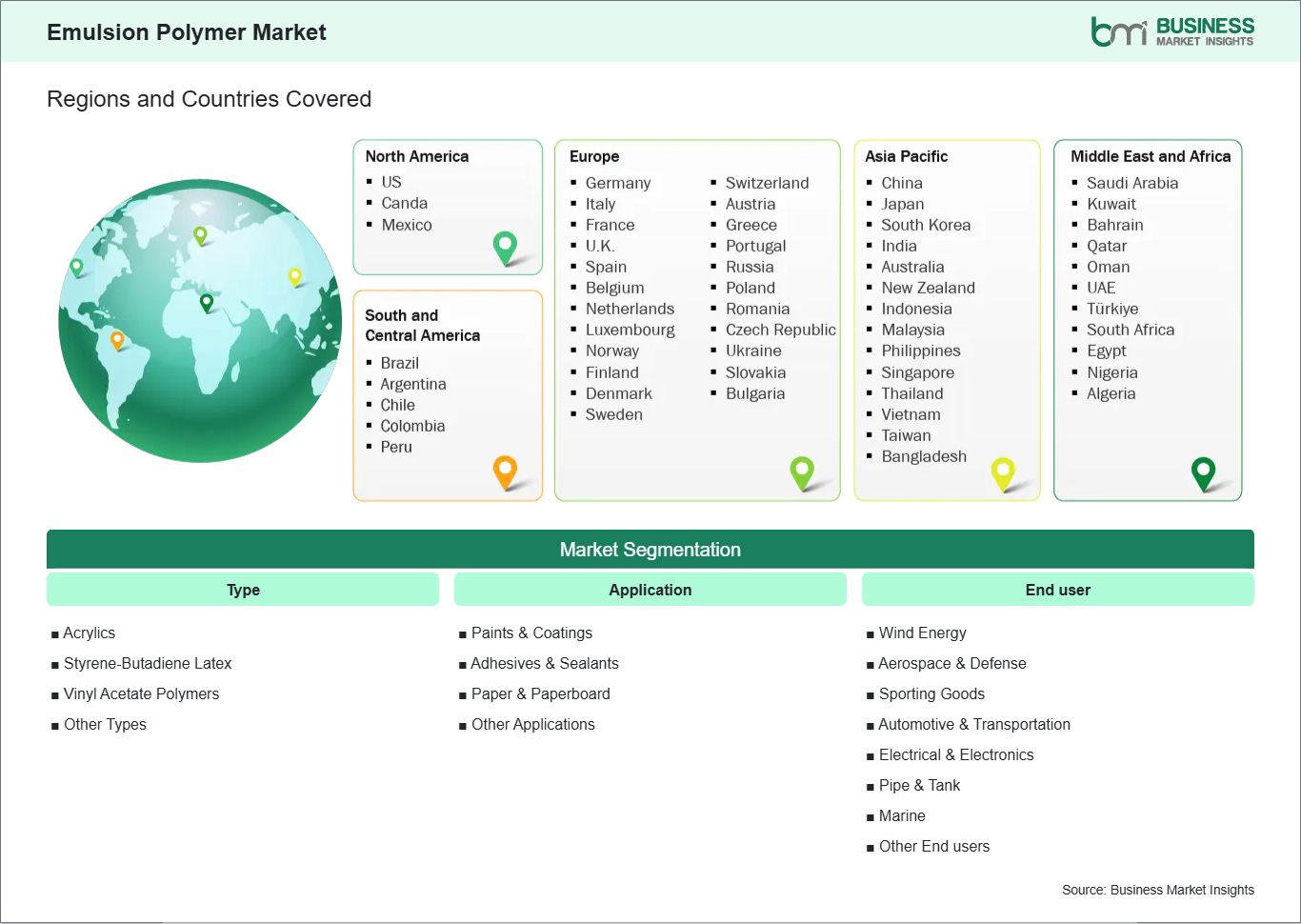
Key segments that contributed to the derivation of the emulsion polymer market analysis are type, application, and end user.
The demand for emulsion polymers is rising as industries increasingly adopt water-based polymer binders to replace solvent-based alternatives. These binders are widely used in paints, adhesives, coatings, and construction materials due to their reduced environmental impact and improved safety profile. Manufacturers are favoring water-based systems that minimize volatile organic compounds (VOCs) while maintaining performance characteristics such as adhesion, flexibility, and chemical resistance.
Sustainability initiatives are a key driver in the adoption of water-based polymer binders. Regulations and consumer expectations are pushing companies to formulate products that are eco-friendly and safe for indoor environments. Emulsion polymers provide an effective solution, enabling high-quality coatings and adhesives that comply with stringent environmental standards while still delivering durability and long-lasting performance.
Beyond regulatory pressures, the ease of handling and application of water-based emulsion polymers is encouraging wider use across industries. They can be formulated for various viscosities, surface properties, and curing requirements, giving formulators flexibility to meet specific project needs. The combination of safety, environmental compliance, and adaptability continues to fuel global demand for emulsion polymers in industrial and consumer applications.
The growing use of emulsion polymers in paper coatings and surface treatments represents a significant opportunity for the market. They are employed to enhance paper properties such as gloss, printability, stiffness, and resistance to water or grease. This is increasingly important as publishers, packaging manufacturers, and specialty paper producers seek high-performance, durable paper products.
Innovation in coating technologies is driving additional applications. Emulsion polymers can be engineered to create thin, uniform films on paper surfaces, improving mechanical strength and enabling functional treatments such as barrier properties for food packaging. These solutions allow paper manufacturers to offer products that meet both performance and sustainability requirements, broadening market potential.
The opportunity extends beyond traditional printing and packaging. Specialty applications, such as coated papers for labels, decorative laminates, and industrial substrates, are leveraging emulsion polymers to achieve precise surface characteristics. As demand for high-quality, functional, and environmentally friendly paper products grows globally, emulsion polymers are positioned to play a central role in supporting innovation and performance improvements in the paper industry.

The emulsion polymer market is experiencing steady growth, with market size and share analysis reflecting evolving treatment preferences and competitive dynamics among key players. The report evaluates important subsegments categorized within type, application, and end user, highlighting their respective contributions to overall market performance.
By type, the Acrylics subsegment dominated the Emulsion Polymer market in 2025. Acrylic emulsion polymers offer excellent film formation, adhesion, and durability, making them highly suitable for a wide range of industrial and commercial applications, which drives their widespread adoption.
Based on application, the Paints & Coatings subsegment dominated the Emulsion Polymer market in 2025. Paints and coatings benefit from emulsion polymers’ superior performance, including color retention, flexibility, and weather resistance, supporting strong market demand.
In terms of end user, the Building & Construction subsegment dominated the Emulsion Polymer market in 2025. Building and construction applications require high-performance polymers for coatings, adhesives, and protective materials, reinforcing the dominance of this segment.
| Report Attribute | Details |
|---|---|
| Market size in 2025 | US$ 36.33 Billion |
| Market Size by 2033 | US$ 59.62 Billion |
| Global CAGR (2026 - 2033) | 6.30% |
| Historical Data | 2022-2024 |
| Forecast period | 2026-2033 |
| Segments Covered | By Type
|
|
Regions and Countries Covered
| |
| North America | US, Canada, Mexico |
| Europe | Belgium, Austria, Finland, Denmark, Greece, Poland, Romania, Russia, Ukraine, Czech Republic, Slovakia, Bulgaria, Italy, Luxembourg, Germany, Switzerland, France, Netherlands, Norway, Portugal, Spain, Sweden, United Kingdom |
| Asia-Pacific | Australia, China, India, Japan, South Korea, Indonesia, Malaysia, Philippines, Singapore, Thailand, Vietnam, Bangladesh, New Zealand, Taiwan |
| South and Central America | Brazil, Argentina, Peru, Chile, Colombia |
| Middle East and Africa | Bahrain, Kuwait, Oman, Qatar, Saudi Arabia, United Arab Emirates, Turkiye, South Africa, Egypt, Algeria, Nigeria |
| Market leaders and key company profiles |
|
The "Emulsion Polymer Market Size and Forecast (2022 - 2033)" report provides a detailed analysis of the market covering below areas:
The geographical scope of the Emulsion Polymer market report is divided into five regions: North America, Asia Pacific, Europe, Middle East & Africa, and South & Central America. The Emulsion Polymer market in North America is expected to grow during the forecast period.
The emulsion polymer market share is dominated by North America, owing to the presence of high-end manufacturing, sustainability-oriented legislation, and developed end-user markets. In this particular market, there is a strong presence of emulsion polymers used in packaging films, coating materials, and adhesives, which require specific material characteristics. Industrial players in North America are increasingly utilizing emulsion polymers in multilayer constructions for high-performance end-user products, including barrier films for electronic devices or enhanced adhesives for vehicle interiors. A special feature in the market is the partnership between polymer producers and research centers to create new-generation emulsions with better thermal stability, bonding power, and environmental friendliness. This innovation strategy in the market has helped to address particular issues in industries, such as energy-saving coatings, fire retardation adhesives, and chemical resistance finishes for textiles. The complexity in production and procurement of materials may raise costs, yet with the high-end applications and environmental activities, this market will continue to be in the leading position globally.

The emulsion polymer market is evaluated by gathering qualitative and quantitative data post primary and secondary research, which includes important corporate publications, association data, and databases. A few of the key developments in the emulsion polymer market are:
The Emulsion Polymer Market is valued at US$ 36.33 Billion in 2025, it is projected to reach US$ 59.62 Billion by 2033.
As per our report Emulsion Polymer Market, the market size is valued at US$ 36.33 Billion in 2025, projecting it to reach US$ 59.62 Billion by 2033. This translates to a CAGR of approximately 6.30% during the forecast period.
The Emulsion Polymer Market report typically cover these key segments-
The historic period, base year, and forecast period can vary slightly depending on the specific market research report. However, for the Emulsion Polymer Market report:
The Emulsion Polymer Market is populated by several key players, each contributing to its growth and innovation. Some of the major players include:
The Emulsion Polymer Market report is valuable for diverse stakeholders, including:
Essentially, anyone involved in or considering involvement in the Emulsion Polymer Market value chain can benefit from the information contained in a comprehensive market report.
Please tell us your area of interest
(Market Segments/ Regions and Countries/ Companies)