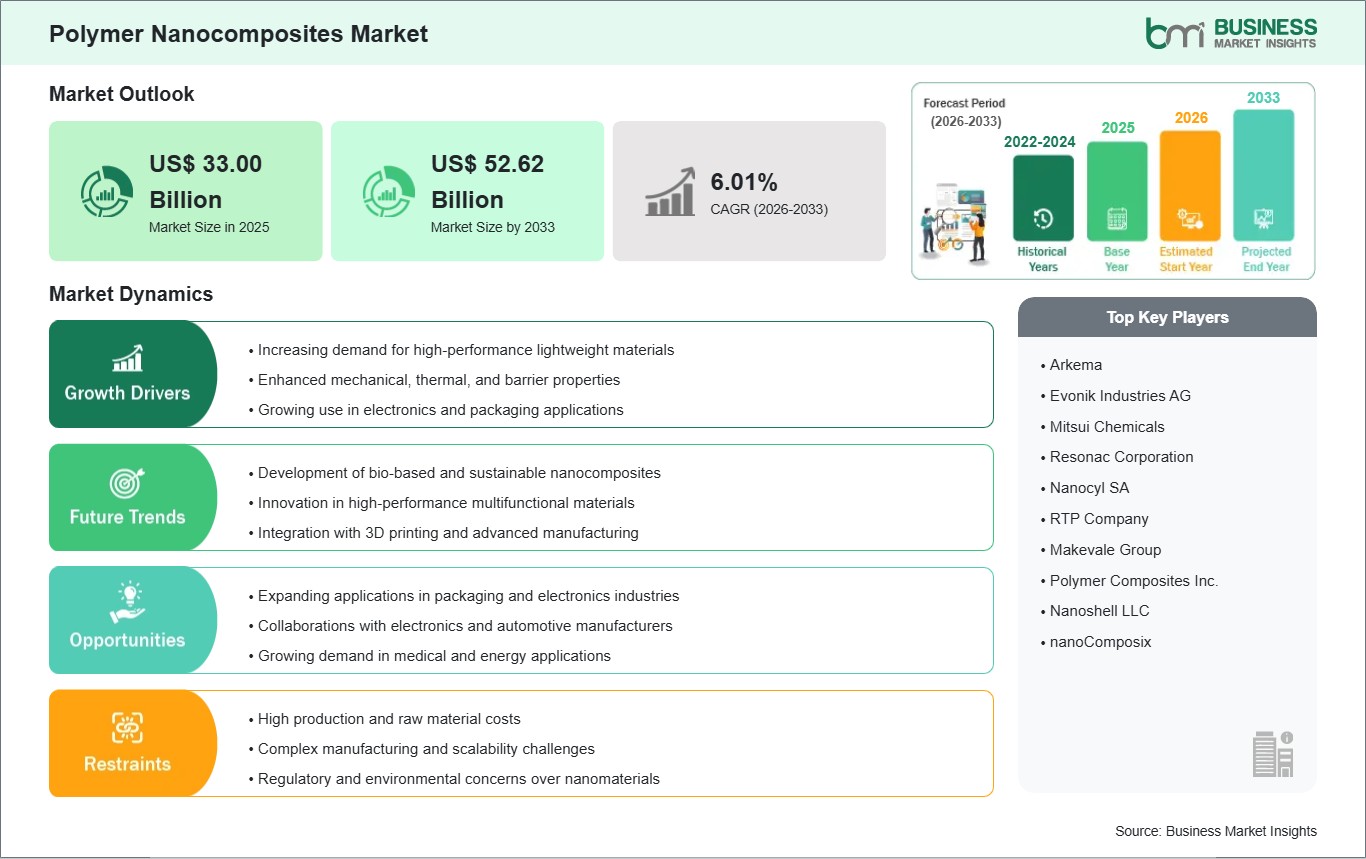
The Polymer Nanocomposites Market size is expected to reach US$ 52.62 billion by 2033 from US$ 33. billion in 2025. The market is estimated to record a CAGR of 6.01% from 2026 to 2033.
The polymer nanocomposites market is witnessing tremendous growth in terms of advancements, with increased demand for high-performance materials with enhanced properties such as mechanical, thermal, and barrier properties. Polymer nanocomposites are filled with nanomaterials such as nanoclays, carbon nanotubes, graphene, and metal oxides, which provide enhanced properties such as high strength-to-weight ratio, electrical conductivity, and durability. Polymer nanocomposites are witnessing increased demand in various industries such as automotive, aerospace, electrical, packaging, and healthcare, where optimization of material properties is critical. Innovation remains a key factor in driving the growth of this market, with increased efforts in achieving homogeneous dispersion of nanoparticles, surface modification techniques, and scalability of these materials.
Advances in nanotechnology are helping in creating multifunctional materials with properties such as flame retardancy, electrical conductivity, and antimicrobial activity. Nanocomposites, in particular, have shown promise in packaging, where they enhance barrier properties to oxygen and moisture, thus extending shelf life. In the automotive and aerospace industries, lightweight nanocomposites also contribute to fuel efficiency and reduced greenhouse gas emissions.
The competitive scenario in the polymer nanocomposites market is influenced by strategic alliances, IP developments, and innovation in specific areas of application. There is also a growing trend towards sustainable factors, where researchers and developers are looking at bio-based nanocomposites and green technologies. Thus, as various industries continue to look for advanced materials with superior properties, the polymer nanocomposites market has a strong growth prospect, thanks to technological breakthroughs and increased application areas.

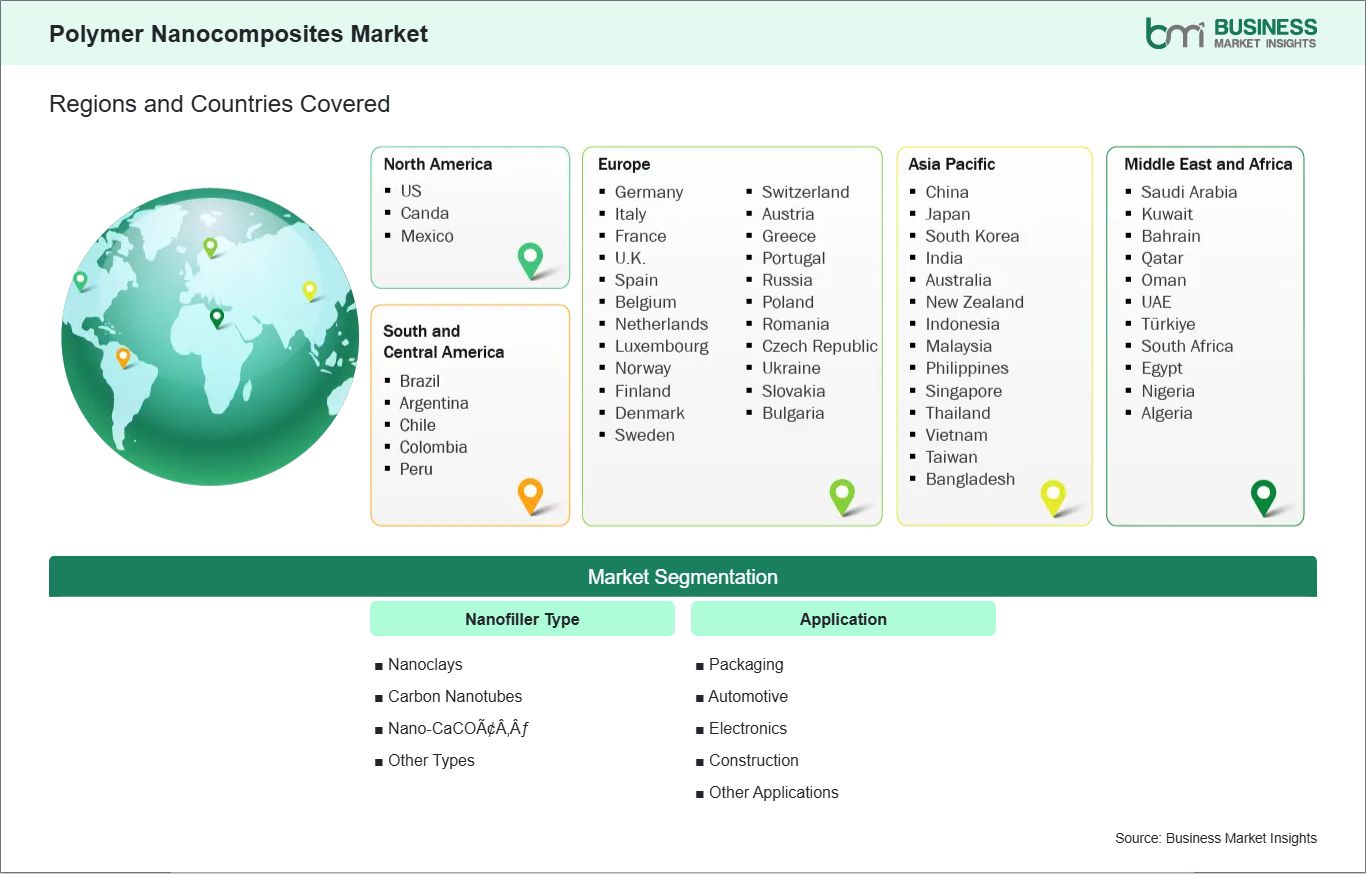
Key segments that contributed to the derivation of the polymer nanocomposites market analysis are nanofiller type and application.
The market for polymer nanocomposites is growing rapidly with the increasing demand for lightweight materials with high performance in various sectors such as the automobile industry, aerospace, electronics, and the packaging industry. In polymer nanocomposites, various nanomaterials such as nanoclays, nano-oxides, and nano-carbon are used as fillers. This helps the material to possess high mechanical strength, heat resistance, and barrier properties compared to the pure polymer. The material is also highly attractive as the performance is improved with the addition of less weight percent material. With the focus on reducing weight and improving the longevity of the material, polymer nanocomposites are gaining prominence worldwide.
This is particularly true in the automotive industry and in aerospace technology. Polymer nanocomposites are commonly employed in body panels, engine components, structural systems, and various other parts of automobiles in order to reduce weight and increase fuel efficiency. These materials can also help in reducing pollution levels in accordance with global regulatory requirements. For instance, in electric cars, nanocomposites can be employed in suspension systems, braking systems, and battery cases in order to increase strength while reducing weight. This is particularly true in accordance with global requirements in terms of electrification and energy efficiency.
Furthermore, the electronics industry and semiconductors are creating a significant demand for polymer nanocomposites due to their high electrical conductivity and miniaturization potential. Polymer nanocomposites are utilized in flexible electronics and electromagnetic shielding applications. These materials are expected to play a significant role in the production of miniaturized electronics as the world demands more smart devices, wearable technology, and communication systems. As a result, there is a growing need for these materials in various high-performance industries; therefore, there is a steady increase in the market due to continuous improvements in nanotechnology and material sciences.
Polymer nanocomposites are increasingly being utilized in the packaging sector, where enhanced barrier properties are essential for preserving product quality and extending shelf life. By incorporating nanofillers, manufacturers can create packaging materials that provide superior resistance to oxygen, moisture, and chemical contamination. This is particularly important in food and beverage packaging, where maintaining freshness and preventing spoilage are critical. The packaging segment currently represents one of the largest shares of the global polymer nanocomposites market, driven by demand for lightweight, durable, and high-performance materials that meet evolving consumer and regulatory requirements.
At the same time, the electronics industry is one of the most promising areas for the application of polymer nanocomposites, and it is considered to be one of the most promising areas in terms of growth rate. This is because these materials play a vital role in enhancing the performance of electronic devices. This can be achieved through improved electrical, dielectric, and thermal stability. The miniaturization of electronic devices, their increasing speeds, and their ability to consume less power have made these materials indispensable. The miniaturization of these devices can be achieved only through the application of these materials.
Moreover, the use of nanocomposites in new technologies such as renewable energy systems and health care devices is increasing the application landscape of these materials. In the energy sector, these materials are being utilized for components of batteries, films for conductivity, and transmission of power. In health care, these materials are being utilized for innovations in drug delivery systems and diagnostic imaging.

The polymer nanocomposites market demonstrates steady growth, with size and share analysis highlighting evolving trends and competitive dynamics among key players. The report examines subsegments categorized within nanofiller type and application, offering insights into their contribution to overall market performance.
By Nanofiller Type, the carbon nanotubes subsegment dominated the market in 2025, driven by their exceptional electrical conductivity, mechanical strength, and thermal stability.
Based on Application, the electronics subsegment dominated the market in 2025, owing to increasing demand for high-performance materials in advanced electronic components.
| Report Attribute | Details |
|---|---|
| Market size in 2025 | US$ 33.00 Billion |
| Market Size by 2033 | US$ 52.62 Billion |
| Global CAGR (2026 - 2033) | 6.01% |
| Historical Data | 2022-2024 |
| Forecast period | 2026-2033 |
| Segments Covered | By Nanofiller Type
|
|
Regions and Countries Covered
| |
| North America | US, Canada, Mexico |
| Europe | Belgium, Austria, Finland, Denmark, Greece, Poland, Romania, Russia, Ukraine, Czech Republic, Slovakia, Bulgaria, Italy, Luxembourg, Germany, Switzerland, France, Netherlands, Norway, Portugal, Spain, Sweden, United Kingdom |
| Asia-Pacific | Australia, China, India, Japan, South Korea, Indonesia, Malaysia, Philippines, Singapore, Thailand, Vietnam, Bangladesh, New Zealand, Taiwan |
| South and Central America | Brazil, Argentina, Peru, Chile, Colombia |
| Middle East and Africa | Bahrain, Kuwait, Oman, Qatar, Saudi Arabia, United Arab Emirates, Turkiye, South Africa, Egypt, Algeria, Nigeria |
| Market leaders and key company profiles |
|
The "Polymer Nanocomposites Market Size and Forecast (2022 - 2033)" report provides a detailed analysis of the market covering below areas:
The geographical scope of the Polymer Nanocomposites Market report is divided into North America, Asia Pacific, Europe, Middle East & Africa, and South & Central America. North America held the largest share in 2025.
Regionally, the polymer nanocomposites market exhibits varied growth patterns influenced by industrial capabilities, technological adoption, and end-use demand. North America dominates the market, supported by strong research infrastructure, advanced manufacturing capabilities, and high adoption across aerospace, automotive, and electronics industries. The United States leads in nanotechnology innovation, with significant investments in high-performance materials and collaborations between research institutions and industry players driving commercialization.
In the Asia Pacific, rapid industrialization, expanding electronics manufacturing, and growing automotive production are key growth drivers. China, Japan, South Korea, and India are investing heavily in nanotechnology research and large-scale production capabilities. The region benefits from cost-efficient manufacturing and increasing demand for lightweight, high-strength materials in consumer electronics and automotive applications.
Europe emphasizes sustainability, regulatory compliance, and advanced engineering applications. Countries such as Germany, France, and the United Kingdom are focusing on high-performance nanocomposites for automotive, aerospace, and packaging sectors. Strong collaboration between industry and academia supports innovation in environmentally friendly nanomaterials and scalable production processes.
The Middle East & Africa market is emerging, driven by industrial diversification and infrastructure development. Countries such as the UAE, Saudi Arabia, and South Africa are gradually adopting polymer nanocomposites in construction, packaging, and industrial applications, supported by investments in advanced materials and manufacturing technologies.
South & Central America is developing steadily, with Brazil and Argentina leading adoption in automotive, packaging, and industrial sectors. Growth is supported by increasing awareness of advanced materials, strategic partnerships with global manufacturers, and gradual improvements in local production capabilities, positioning the region for long-term expansion in polymer nanocomposites applications.

The Polymer Nanocomposites Market is evaluated by gathering qualitative and quantitative data post primary and secondary research, which includes important corporate publications, association data, and databases. A few of the key developments in the polymer nanocomposites market are:
The Polymer Nanocomposites Market is valued at US$ 33.00 Billion in 2025, it is projected to reach US$ 52.62 Billion by 2033.
As per our report Polymer Nanocomposites Market, the market size is valued at US$ 33.00 Billion in 2025, projecting it to reach US$ 52.62 Billion by 2033. This translates to a CAGR of approximately 6.01% during the forecast period.
The Polymer Nanocomposites Market report typically cover these key segments-
The historic period, base year, and forecast period can vary slightly depending on the specific market research report. However, for the Polymer Nanocomposites Market report:
The Polymer Nanocomposites Market is populated by several key players, each contributing to its growth and innovation. Some of the major players include:
The Polymer Nanocomposites Market report is valuable for diverse stakeholders, including:
Essentially, anyone involved in or considering involvement in the Polymer Nanocomposites Market value chain can benefit from the information contained in a comprehensive market report.
Please tell us your area of interest
(Market Segments/ Regions and Countries/ Companies)