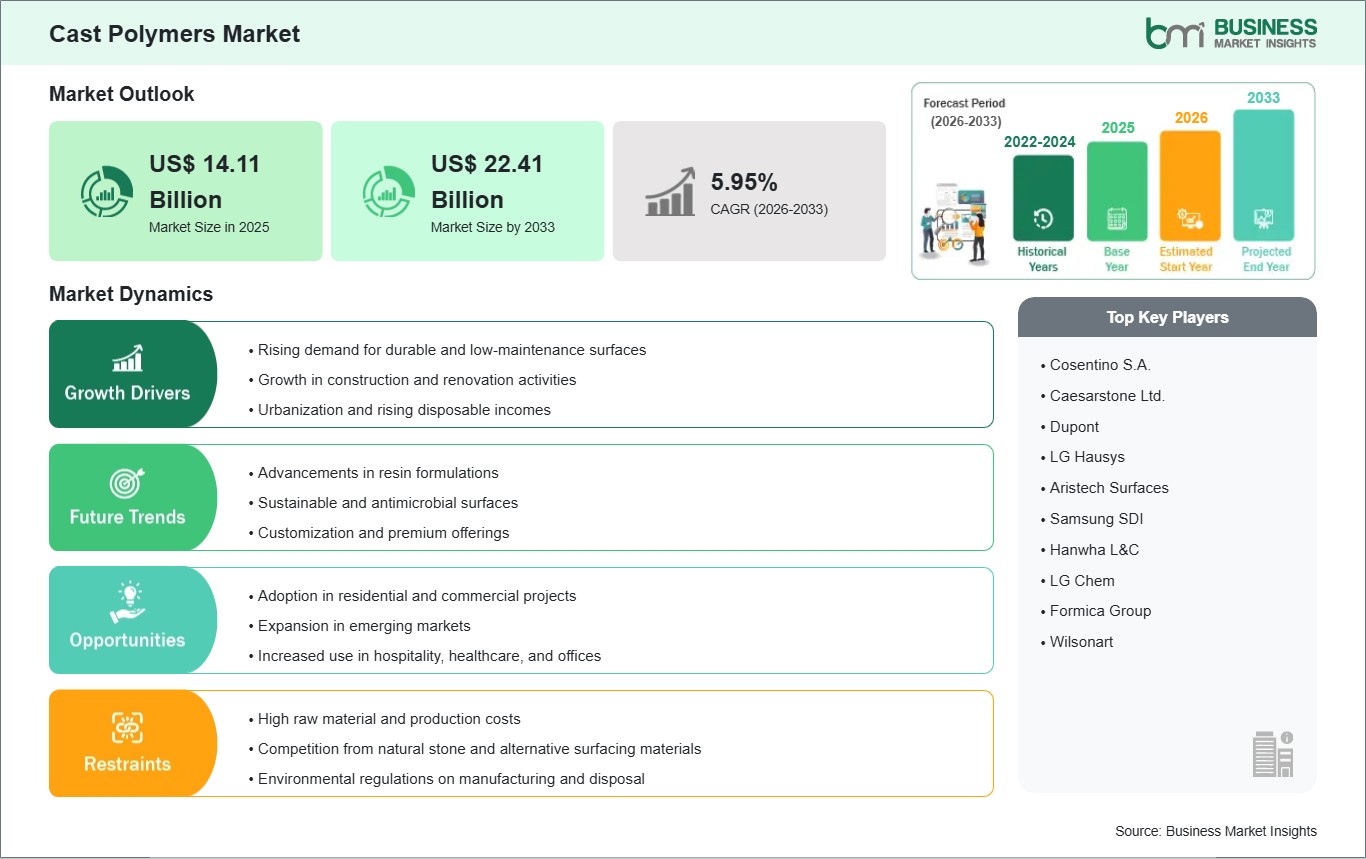
The Cast Polymers Market size is expected to reach US$ 22.41 Billion by 2033 from US$ 14.11 Billion in 2025. The market is estimated to record a CAGR of 5.95% from 2026 to 2033.
The global Cast Polymers Market is defined by rising demand for durable, low‑maintenance, and aesthetically appealing surfacing materials in construction and interior design globally. Market valuation forecasts point to continued expansion in both residential and non‑residential sectors as designers and builders increasingly select engineered surfaces over traditional natural stone alternatives. Cast polymers are manufactured by combining polymer resins with natural minerals, fillers, and pigments, then casting the mixture into sheets or molded products such as countertops, vanity tops, shower surrounds, and wall panels. The key types include solid surface, engineered stone, and cultured marble, each offering a balance of performance characteristics such as durability, stain resistance, design flexibility, and seamless appearance.
The market’s growth is closely associated with long‑term trends in construction, renovation, and interior design. Urbanization, rising disposable incomes, and increased spending on premium finishes in both homes and commercial spaces are major forces driving adoption of cast polymer surfaces. Enhanced manufacturing technologies and diversification of material compositions (including high‑performance resins and natural quartz applications) have expanded the appeal of cast polymers in both mainstream and specialty applications.

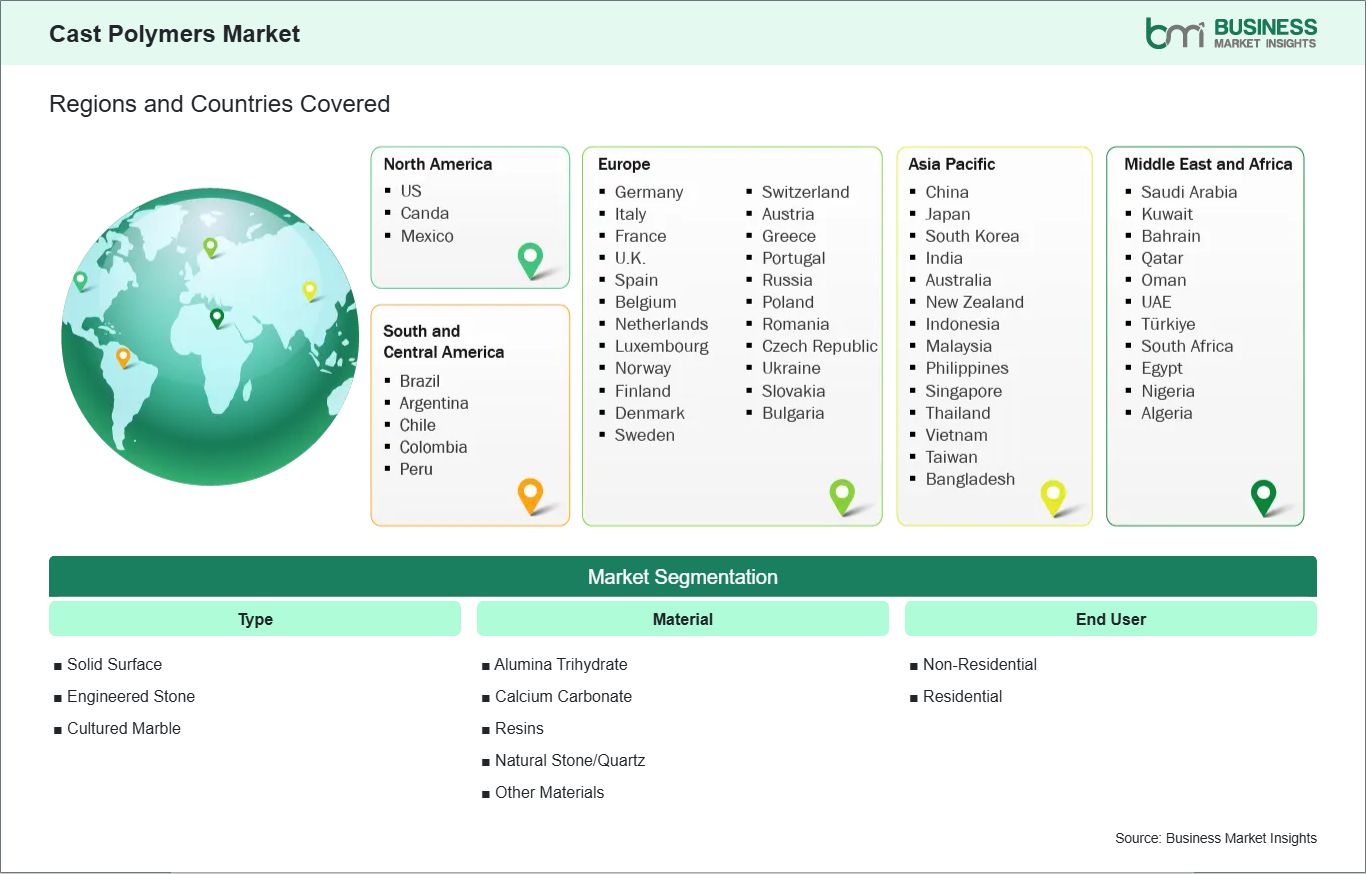
Key segments that contributed to the derivation of the cast polymers market analysis are type, material, and end user.
The demand for solid surfaces in new home construction and renovations are on the rise due to the increased requirement for durable, low maintenance and versatile materials. Cast polymer sheeting products such as solid surface, engineered stone and cultured marble, are in greater demand because of their ability to meet customer needs with their non-porous nature that supports ease of cleaning and maintenance, resist bacteria grow and stains. For homeowners, cast polymer surface products are used for kitchen countertops, vanities, backsplashes and wall panels due to their seamless appearance and ease of cleaning compared to natural materials such as granite or marble.
For commercial projects (i.e. hotel/motel, restaurant, health care facility and office), cast polymers are used for their hygienic and antimicrobial properties in high traffic areas and sanitary clean room environments (i.e. clinics and laboratories). Engineered stone surfaces which are made of natural quartz and resin shout out to specifiers looking for an expensive look but also excellent scratch resistance in high traffic locations.
The ongoing expansion of construction and renovation activities worldwide presents a significant opportunity for the cast polymers market. Urban growth, rising disposable incomes, and increased investment in both residential and commercial real estate contribute to heightened demand for surfacing materials. Cast polymer products are especially well‑positioned to capture this demand, given their adaptability to modern aesthetic trends and performance requirements.
In residential markets, cast polymers are widely used for countertops, bathroom vanities, shower surrounds, and other interior applications where homeowners prioritize durability and design. The popularity of open‑plan kitchens and integrated living spaces has amplified the importance of durable, visually appealing surfaces that maintain performance over time.
Commercial segments—including retail, hospitality, offices, and institutional facilities—are also buoyed by sustained renovation and new construction projects. Cast polymers, particularly engineered stone and solid surface materials, are often specified for reception areas, hotel bathrooms, retail display fixtures, and healthcare interiors due to their combination of aesthetics, ease of fabrication, and long lifecycle performance.
Infrastructure developments in emerging economies further fuel opportunity. Countries across Asia Pacific, Latin America, and the Middle East are investing heavily in urban infrastructure, including residential complexes, shopping centers, and mixed‑use developments. These projects frequently incorporate cast polymer surfaces for cladding, countertops, and decorative elements, broadening the application scope beyond traditional kitchen and bath uses.
Increasing sustainability awareness is also influencing product design and material sourcing. Manufacturers are exploring innovations in recycled content, bio‑based resins, and low‑VOC production processes to align with green building standards and consumer preferences. Such developments can create premium product tiers and differentiate offerings in competitive markets.

The Cast Polymers Market demonstrates steady growth, with size and share analysis highlighting evolving trends and competitive dynamics among key players. Subsegments categorized by type, material, and end user offer insights into their contribution to overall market performance.
By type, the solid surface subsegment dominated the market in 2025, driven by seamless finish, aesthetic versatility, and extensive adoption in residential and commercial applications.
Based on material, the resins subsegment dominated the market in 2025 due to their ability to enhance mechanical strength, durability, and design flexibility of cast polymer surfaces.
By end user, the residential subsegment dominated the market in 2025, driven by growing home renovation projects, new housing developments, and rising demand for premium, low-maintenance surfacing solutions.
| Report Attribute | Details |
|---|---|
| Market size in 2025 | US$ 14.11 Billion |
| Market Size by 2033 | US$ 22.41 Billion |
| Global CAGR (2026 - 2033) | 5.95% |
| Historical Data | 2022-2024 |
| Forecast period | 2026-2033 |
| Segments Covered | By Type
|
|
Regions and Countries Covered
| |
| North America | US, Canada, Mexico |
| Europe | Belgium, Austria, Finland, Denmark, Greece, Poland, Romania, Russia, Ukraine, Czech Republic, Slovakia, Bulgaria, Italy, Luxembourg, Germany, Switzerland, France, Netherlands, Norway, Portugal, Spain, Sweden, United Kingdom |
| Asia-Pacific | Australia, China, India, Japan, South Korea, Indonesia, Malaysia, Philippines, Singapore, Thailand, Vietnam, Bangladesh, New Zealand, Taiwan |
| South and Central America | Brazil, Argentina, Peru, Chile, Colombia |
| Middle East and Africa | Bahrain, Kuwait, Oman, Qatar, Saudi Arabia, United Arab Emirates, Turkiye, South Africa, Egypt, Algeria, Nigeria |
| Market leaders and key company profiles |
|
The "Cast Polymers Market Size and Forecast (2022 - 2033)" report provides a detailed analysis of the market covering below areas:
The geographical scope of the Cast Polymers Market report is divided into North America, Asia Pacific, Europe, Middle East & Africa, and South & Central America. North America held the largest share in 2025.
North America represents a mature market with steady demand for cast polymers in residential remodels, commercial buildings, and institutional environments. The United States and Canada, for example, exhibit strong adoption of engineered stone countertops and solid surface materials due to their performance characteristics and design flexibility.
Europe also demonstrates consistent growth, driven by renovation trends, sustainability preferences, and interest in long‑lasting, low‑maintenance surfaces. Countries such as Germany, the UK, and France contribute notably to regional demand. In Asia Pacific, both new housing developments and renovation projects are driving demand for cast polymer surfaces—particularly in kitchens and bathrooms, where solid surface and engineered stone materials are widely specified for durability and aesthetic appeal. Urban population growth and rising construction investment are key contributors to expanding market opportunities.
The Middle East & Africa and South & Central America are emerging markets, where increasing infrastructure development and commercial construction projects are gradually increasing the adoption of cast polymers. Regulatory frameworks, local construction norms, and economic growth rates are key factors influencing regional trends.

The Cast Polymers Market is evaluated by gathering qualitative and quantitative data post primary and secondary research, which includes important corporate publications, association data, and databases. A few of the key developments in the cast polymers market are:
The Cast Polymers Market is valued at US$ 14.11 Billion in 2025, it is projected to reach US$ 22.41 Billion by 2033.
As per our report Cast Polymers Market, the market size is valued at US$ 14.11 Billion in 2025, projecting it to reach US$ 22.41 Billion by 2033. This translates to a CAGR of approximately 5.95% during the forecast period.
The Cast Polymers Market report typically cover these key segments-
The historic period, base year, and forecast period can vary slightly depending on the specific market research report. However, for the Cast Polymers Market report:
The Cast Polymers Market is populated by several key players, each contributing to its growth and innovation. Some of the major players include:
The Cast Polymers Market report is valuable for diverse stakeholders, including:
Essentially, anyone involved in or considering involvement in the Cast Polymers Market value chain can benefit from the information contained in a comprehensive market report.
Please tell us your area of interest
(Market Segments/ Regions and Countries/ Companies)