Market Summary
Executive Summary and Global Market Analysis
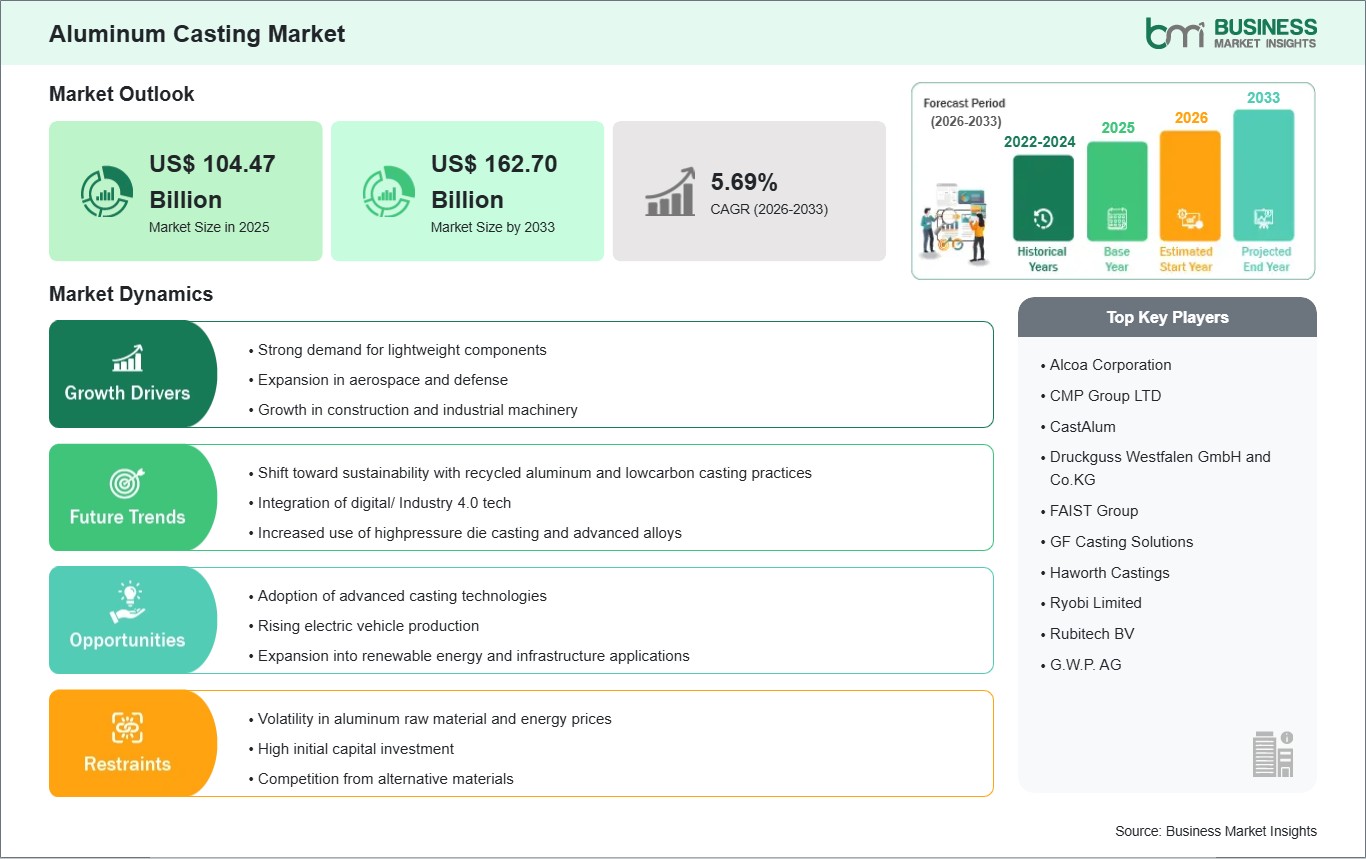
Aluminum casting has emerged as a key part of modern manufacturing across various industries. It focuses on delivering lightweight, durable, and high-performance components that help improve fuel efficiency, reduce emissions, and optimize structure. This market includes different casting methods, such as die casting, permanent mold casting, and sand casting. These methods serve applications in automotive, aerospace, industrial machinery, construction, electronics, and renewable energy. Manufacturers and OEMs are increasingly choosing aluminum castings over heavier materials like steel and iron. This shift is largely due to strict emissions regulations and the rising use of electric vehicles. Aluminum's recyclability and fit with automated manufacturing technologies further highlight its appeal in both developed and emerging markets.
The market is changing as quality, precision, and production efficiency improve owing to advancements in metallurgy, smart foundry technologies, and precision tools. However, challenges remain, such as raw material price volatility, energy-intensive production, and environmental regulations that affect costs and operational scalability. Nevertheless, investments from major automotive and aerospace companies, along with plans to expand capacity in Asia Pacific and North America, are driving innovation and expanding production capabilities. In the medium to long term, increased use of Industry 4.0 practices, new alloys, and recycling programs focused on sustainability are likely to boost the role of aluminum castings in promoting lightweight design, industrial growth, and global decarbonization efforts.
Segment Analysis
Aluminum Casting Market Segmentation
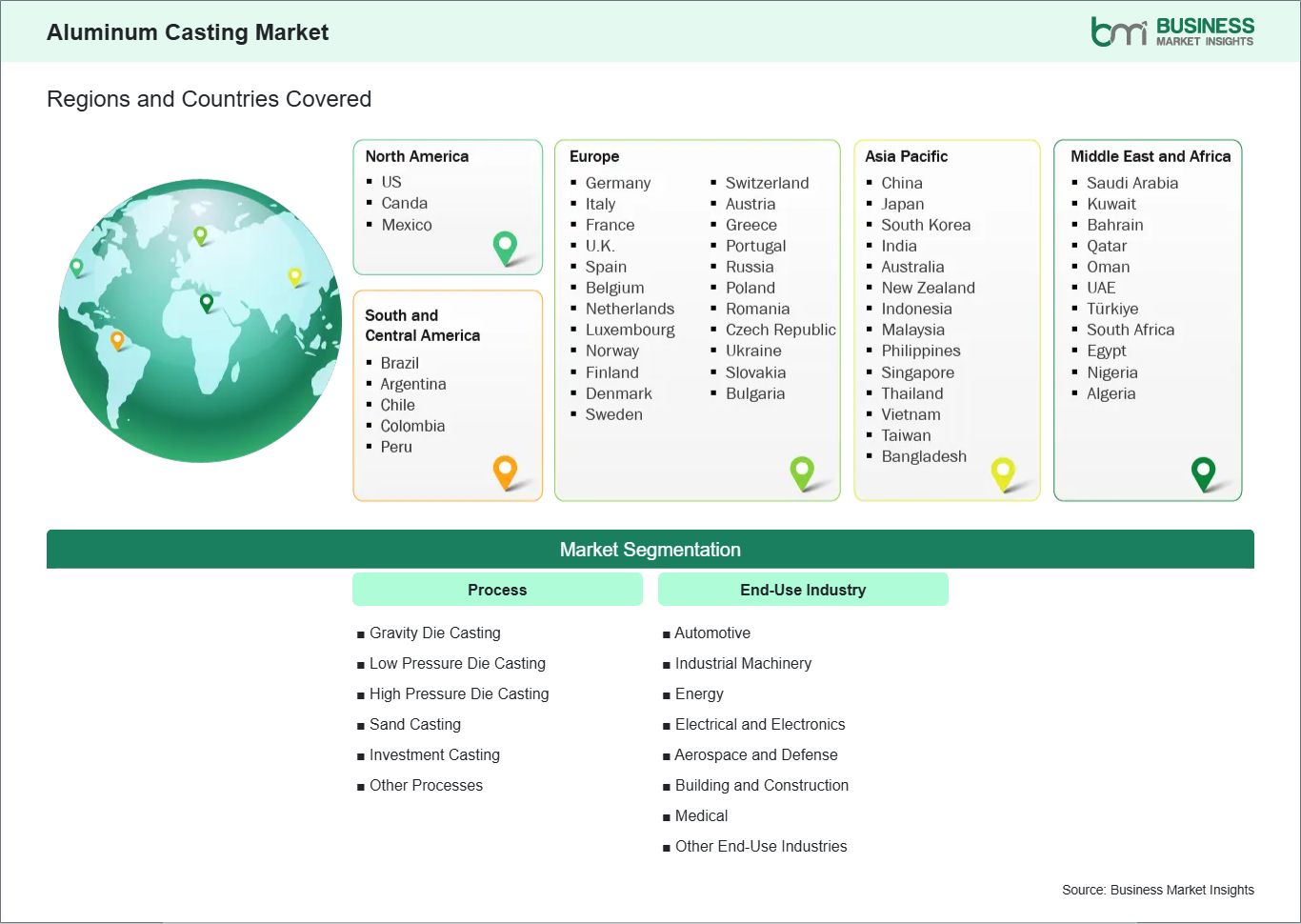
Key segments that contributed to the derivation of the aluminum casting market analysis are the process and end-use industry.
- By process, the market is segmented into gravity die casting, low-pressure die casting, high-pressure die casting, sand casting, investment casting, and others. The high-pressure die-casting segment accounted for the largest market share in 2025.
- By end-use industry, the market is segmented into automotive, industrial machinery, energy, electrical and electronics, aerospace and defense, building and construction, medical, and others. The automotive segment held the largest market share in 2025
Market Forces
Aluminum Casting Market Drivers and Opportunities
Increasing Demand from Automotive and Aerospace Industries
The aluminum casting market largely grows due to rising demand from the automotive and aerospace sectors. In these industries, lightweight materials are essential for better fuel efficiency, lower emissions, and improved overall performance. Aluminum castings are commonly found in engine parts, transmission housings, chassis components, and aerospace structural elements because of their high strength-to-weight ratio, resistance to corrosion, and great thermal conductivity.
The global shift toward electric vehicles (EVs) has further increased demand. Manufacturers are replacing heavier steel parts with aluminum to reduce battery weight while keeping structural strength. Stricter fuel efficiency and emission rules in North America, Europe, and Asia Pacific also push automakers to use aluminum casting solutions. The aerospace industry, now bouncing back from pandemic-related slowdowns, drives demand for lightweight but strong components to boost fuel efficiency and payload capacity. These factors underscore the important role of aluminum castings in high-performance transportation, supporting strong market growth over the medium to long term.
Expansion in Electric Vehicle and Renewable Energy Applications
A significant growth opportunity in the aluminum casting market comes from the rising use of electric vehicles (EVs) and renewable energy systems. EV manufacturers need lightweight but strong components for battery housings, motor housings, and chassis. This creates a strong demand for high-precision aluminum castings. The renewable energy sector, which includes wind turbine and solar equipment manufacturing, also relies more on aluminum castings for durable, corrosion-resistant parts that can stand up to tough environmental conditions.
Improvements in casting technologies, like high-pressure die casting, sand casting, and precision investment casting, allow manufacturers to create complex shapes with better mechanical properties, further boosting their use in these growing industries. Additionally, ongoing research into eco-friendly and energy-efficient casting methods supports sustainability goals. This attracts interest from automotive and energy companies that want to lower carbon footprints. As EV production increases worldwide and renewable energy infrastructure grows, these applications are likely to drive significant growth in the aluminum casting market over the next decade.
Size and Share Analysis
Aluminum Casting Market Size and Share Analysis
The aluminum casting market demonstrates steady growth, with size and share analysis revealing evolving trends and competitive positioning among key players. The report further examines subsegments categorized within the process and end-use industry, offering insights into their contribution to overall market performance. By process, the high-pressure die casting subsegment holds the largest market share due to its high production efficiency, excellent dimensional accuracy, and suitability for mass production of complex aluminum parts. High-pressure die casting is widely used in automotive structural parts, electrical components, and industrial machinery, which helps keep its strong market position. Growth in this segment is driven by the increasing demand for lightweight components, the rising adoption of electric vehicles, and technological advances in automated casting processes that improve precision and reduce production time.
Report Coverage
Aluminum Casting Market Report Coverage and Deliverables
The " Aluminum Casting Market Size and Forecast (2022–2033)" report provides a detailed analysis of the market covering below areas:
- Aluminum casting market size and forecast at global, regional, and country levels for all the key market segments covered under the scope
- Aluminum casting market trends, as well as market dynamics such as drivers, restraints, and key opportunities
- Aluminum casting market analysis covering key market trends, global and regional framework, major players, regulations, and recent market developments
- Industry landscape and competition analysis covering market concentration, heat map analysis, prominent players, and recent developments for the aluminum casting market
- Detailed company profiles, including SWOT analysis
Geographic Insights
Aluminum Casting Market Geographic Insights
The geographical scope of the aluminum casting market report is divided into five regions: North America, Asia Pacific, Europe, the Middle East & Africa, and South & Central America. The aluminum casting market in Asia Pacific is expected to grow significantly during the forecast period.
This growth mainly comes from the rapid growth of the automotive, electrical, and industrial machinery sectors in countries like China, India, and Japan. The rising demand for lightweight, fuel-efficient vehicles, especially electric and hybrid models, is leading automotive manufacturers to increasingly use aluminum cast components for structural, thermal, and electrical needs. Ongoing industrialization, urbanization, and infrastructure development are also driving demand for construction, machinery, and energy applications, all of which depend on durable, high-performance aluminum castings.
The region gains advantages from cost-effective labor, a strong manufacturing base, and government support for promoting manufacturing and green technologies. Advances in casting processes, such as high-pressure die casting and precision automated production, are improving efficiency and product quality. Together, these factors make Asia Pacific a vital growth center, attracting investments from global and regional manufacturers and promoting the long-term growth of the aluminum casting market across various industries.
Industry Activity
Recent Developments
The aluminum casting market is evaluated by gathering qualitative and quantitative data post-primary and secondary research, which includes important corporate publications, association data, and databases. A few of the key developments in the aluminum casting market are:
- In June 2025, Kaiser Aluminum introduced the new high-strength automotive die-casting alloy KA-9000. This alloy is made to improve energy efficiency and durability in electric vehicle powertrain components. The product aims to meet the growing demand for lightweight materials in EV applications and improve vehicle performance and sustainability.
- In March 2025, Hindalco Industries formed a collaboration with Constellium to co-develop low-carbon aluminum die-casting alloys specifically for automotive use. This partnership focuses on sustainable material solutions that lower carbon emissions while maintaining structural integrity in lightweight vehicle designs.
Trust & Transparency
Research Methodology
The market analysis combines proprietary research with secondary data from government agencies, company disclosures, regulatory filings, industry databases and expert interviews. Market estimates are validated through data triangulation, cross-market benchmarking and analyst
review.
View Full Research Methodology
Key Sources Referred:
World Bank – Global Trade IndicatorsWorld Trade Organization (WTO)International Monetary Fund (IMF)International Trade Administration (ITA)Company WebsitesCompany Annual ReportsCompany Investor PresentationsThe Aluminum Association (AA)International Aluminum Institute (IAI)World Foundry Organization (WFO)Asia Pacific Aluminum Council (APAC)European Foundry Association (CAEF)