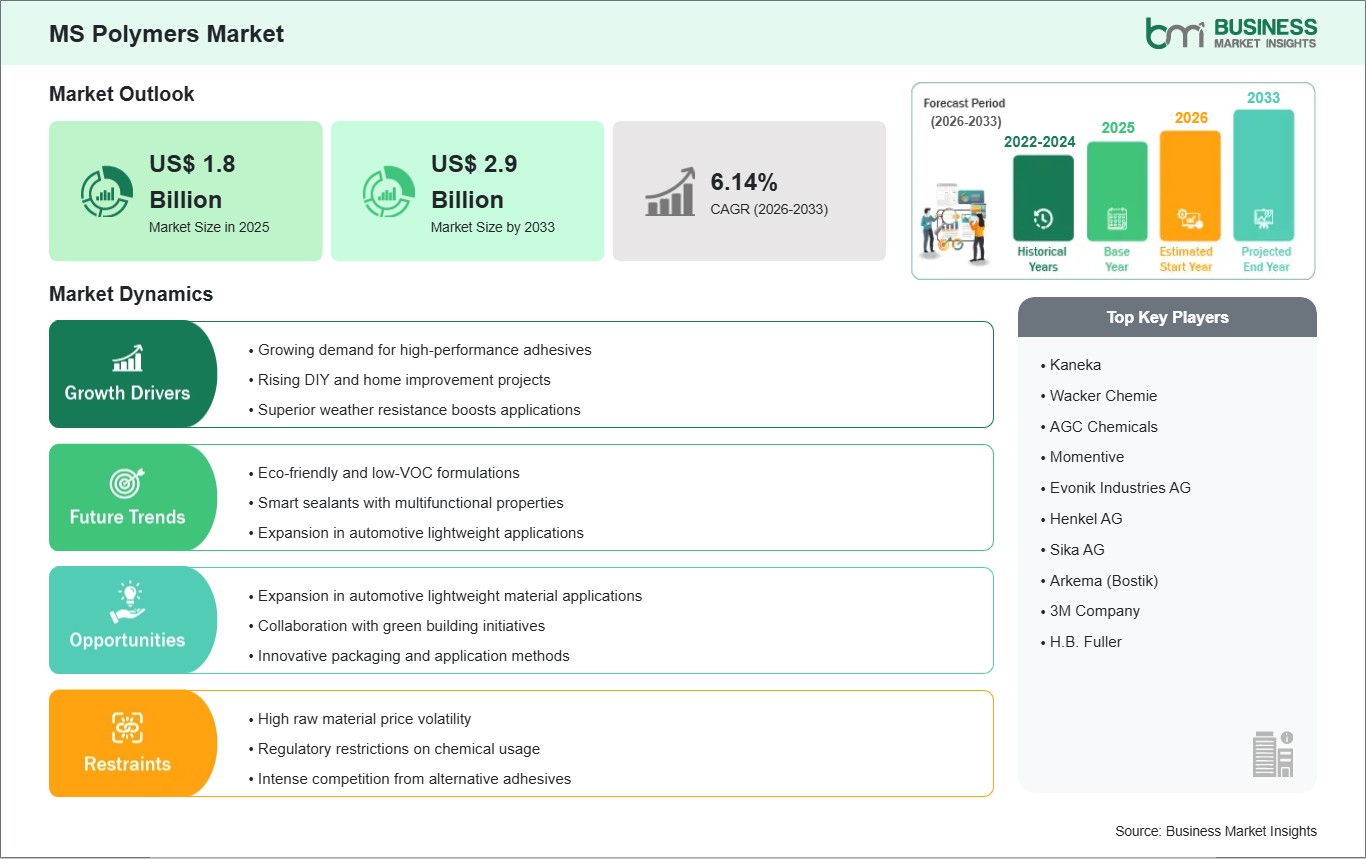
The MS Polymers Market size is expected to reach US$ 2.9 Billion by 2033 from US$ 1.8 Billion in 2025. The market is estimated to record a CAGR of 6.14% from 2026 to 2033.
The Milestones in Pommby relates the flexibility, characteristics of versatile performance which include excellent adhesion, weather resistance and being environmentally compliant and is making the Mercers know the presence of the construction industry can continue to build poices into products due to the combination of both circumstances. Due to the hybrid nature of these materials being made in proportion to another, and combining to create one material that has advantages such as a solvent-free formulation, and lower than standard VOCs being produced by the materials used, therefore creating more countries/regions to build using these hybrid materials and create a green building industry. As national regulatory bodies develop regulations that support clearly defined environmentally friendly products, the construction industry in developed countries will focus on creating other products to replace conventional sealants and adhesives. In addition to regulations supporting sustainable and market-directed regulations, California's regulatory body is focused on creating clear regulations that support eco-friendly construction practices in the future.
Technological advances in polymer modification have provided even more longevity, more elasticity in the finished product, and greater curing efficiency from a manufacturer's perspective to provide better products to produce for its customer base. The competitive landscape of the industry includes creating an innovative design in order to separate products from their competitors. Since many companies will continue to focus on product customization, application-based solutions, creating stronger competitive positions and entering into joint ventures to assist in completing product development faster and improving the supply chain. A shift towards the use of one-component systems to minimize labour dependency is demonstrated in the development of projects in the construction/redevelopment of infrastructure (e.g., bridge repair, road repair, and new buildings) due to their user-friendly application. The price volatility of raw materials such as silane compounds and polyethers, used in creating hybrid systems, will continue to limit potential margins.

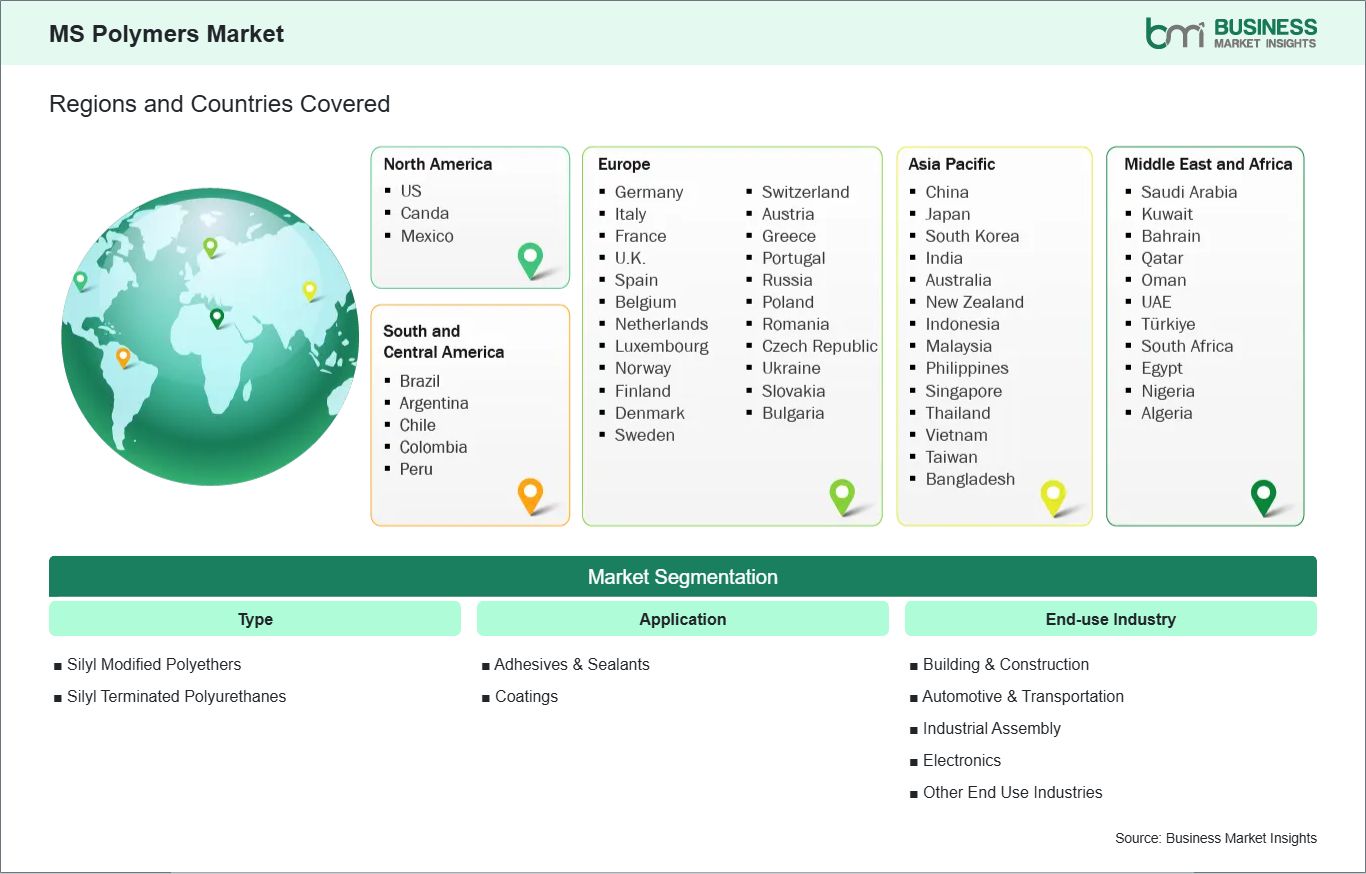
Key segments that contributed to the derivation of the MS polymers market analysis are type, application, and end-use industry.
The growing demand for high-performance adhesives is a key driver for the MS polymers market, as industries increasingly prioritize materials that offer strong bonding, flexibility, and long-term durability. MS polymers are widely recognized for their ability to bond a variety of surfaces without the need for additional primers, making them suitable for complex applications. Their resistance to environmental factors such as moisture, temperature variation, and UV exposure further enhances their appeal across multiple end-use sectors.
Another important factor contributing to this demand is the increasing focus on safer and more sustainable materials. MS polymers are formulated without harmful solvents and are known for low emissions, making them well suited for applications where health and environmental considerations are critical. This has encouraged their adoption in indoor construction, infrastructure projects, and industrial assembly processes where compliance with environmental standards is essential.
In addition, continuous improvements in product formulations are strengthening the performance capabilities of MS polymers. Enhanced curing properties, improved elasticity, and reliable adhesion under dynamic conditions make them a preferred choice in demanding environments. As industries continue to seek efficient and durable bonding solutions, the demand for high-performance adhesives is expected to support steady growth in the MS polymers market.
The increasing use of lightweight materials in the automotive industry is creating strong opportunities for the MS polymers market. Manufacturers are focusing on reducing vehicle weight to improve efficiency and overall performance, which has led to greater use of materials such as composites and advanced plastics. These materials require specialized bonding solutions, and MS polymers provide effective adhesion while maintaining structural integrity and flexibility.
MS polymers also support modern automotive design by enabling the bonding of dissimilar materials without compromising performance. Their ability to absorb vibration and withstand mechanical stress makes them suitable for both structural and non-structural applications. This helps improve durability and comfort while allowing for more innovative vehicle designs that rely less on traditional fastening methods.
Furthermore, the shift toward advanced manufacturing processes is encouraging the use of adhesive bonding over mechanical joining techniques. MS polymers contribute to streamlined production, improved surface finish, and reduced assembly complexity. Their compatibility with automated systems enhances efficiency and consistency in manufacturing operations. As the automotive industry continues to evolve toward lightweight and efficient designs, MS polymers are expected to play an increasingly important role.
The MS polymers market demonstrates steady growth, with size and share analysis highlighting evolving trends and competitive dynamics among key players. The report examines subsegments categorized within type, application, and end-use industry, offering insights into their contribution to overall market performance.
By Type, the silyl modified polyethers (SMP) subsegment dominated the market in 2025, driven by its superior flexibility, weather resistance, and wide applicability in sealants and adhesives.
Based on Application, the adhesives & sealants subsegment dominated the market in 2025, owing to its extensive use in construction and industrial bonding solutions.
On the basis of End-use Industry, the building & construction subsegment dominated the market in 2025, supported by rising infrastructure development and increasing demand for durable and high-performance materials.
| Report Attribute | Details |
|---|---|
| Market size in 2025 | US$ 1.8 Billion |
| Market Size by 2033 | US$ 2.9 Billion |
| Global CAGR (2026 - 2033) | 6.14% |
| Historical Data | 2022-2024 |
| Forecast period | 2026-2033 |
| Segments Covered | By Type
|
|
Regions and Countries Covered
| |
| North America | US, Canada, Mexico |
| Europe | Belgium, Austria, Finland, Denmark, Greece, Poland, Romania, Russia, Ukraine, Czech Republic, Slovakia, Bulgaria, Italy, Luxembourg, Germany, Switzerland, France, Netherlands, Norway, Portugal, Spain, Sweden, United Kingdom |
| Asia-Pacific | Australia, China, India, Japan, South Korea, Indonesia, Malaysia, Philippines, Singapore, Thailand, Vietnam, Bangladesh, New Zealand, Taiwan |
| South and Central America | Brazil, Argentina, Peru, Chile, Colombia |
| Middle East and Africa | Bahrain, Kuwait, Oman, Qatar, Saudi Arabia, United Arab Emirates, Turkiye, South Africa, Egypt, Algeria, Nigeria |
| Market leaders and key company profiles |
|
The "MS Polymers Market Size and Forecast (2022 - 2033)" report provides a detailed analysis of the market covering below areas:
The geographical scope of the MS Polymers Market report is divided into North America, Asia Pacific, Europe, Middle East & Africa, and South & Central America. North America held the largest share in 2025.
The MS polymers market exhibits varied growth trajectories shaped by industrial maturity, regulatory intensity, and construction activity. North America dominates the market, with the U.S. and Canada leading due to robust industrial infrastructure, widespread adoption of green building initiatives, and strong demand from construction and automotive sectors. High consumer awareness, advanced distribution networks, and regulatory compliance requirements further strengthen market penetration.
Europe maintains steady growth, particularly in Germany, France, and the U.K., where stringent environmental regulations, energy-efficient building standards, and the need for durable construction materials drive adoption. Industrial and automotive sectors increasingly rely on MS polymers for high-performance applications.
Asia Pacific is witnessing rapid expansion, led by China, India, and Southeast Asian countries. Urbanization, large-scale infrastructure projects, and rising industrial activity are key growth drivers, with increasing attention to sustainable construction solutions further boosting market demand.
Middle East & Africa shows growing adoption, particularly in Gulf countries and parts of Africa, where extreme climatic conditions require polymers with high UV and temperature resistance. Investments in real estate and infrastructure are further supporting market growth.
South & Central America is experiencing moderate expansion, with Brazil at the forefront due to infrastructure modernization, industrial development, and growing awareness of long-term performance benefits offered by MS polymers in construction and manufacturing applications.

The MS Polymers Market is evaluated by gathering qualitative and quantitative data post primary and secondary research, which includes important corporate publications, association data, and databases. A few of the key developments in the MS polymers market are:
The MS Polymers Market is valued at US$ 1.8 Billion in 2025, it is projected to reach US$ 2.9 Billion by 2033.
As per our report MS Polymers Market, the market size is valued at US$ 1.8 Billion in 2025, projecting it to reach US$ 2.9 Billion by 2033. This translates to a CAGR of approximately 6.14% during the forecast period.
The MS Polymers Market report typically cover these key segments-
The historic period, base year, and forecast period can vary slightly depending on the specific market research report. However, for the MS Polymers Market report:
The MS Polymers Market is populated by several key players, each contributing to its growth and innovation. Some of the major players include:
The MS Polymers Market report is valuable for diverse stakeholders, including:
Essentially, anyone involved in or considering involvement in the MS Polymers Market value chain can benefit from the information contained in a comprehensive market report.
Please tell us your area of interest
(Market Segments/ Regions and Countries/ Companies)