Polymer Processing Aid Market Outlook (2022-2033)

Historic Data: 2022-2024   |   Base Year: 2025   |   Forecast Period: 2026-2033
Report Content: Market Scope, Market Segmentation, Market Dynamics, and Competitive Analysis

Report Coverage:
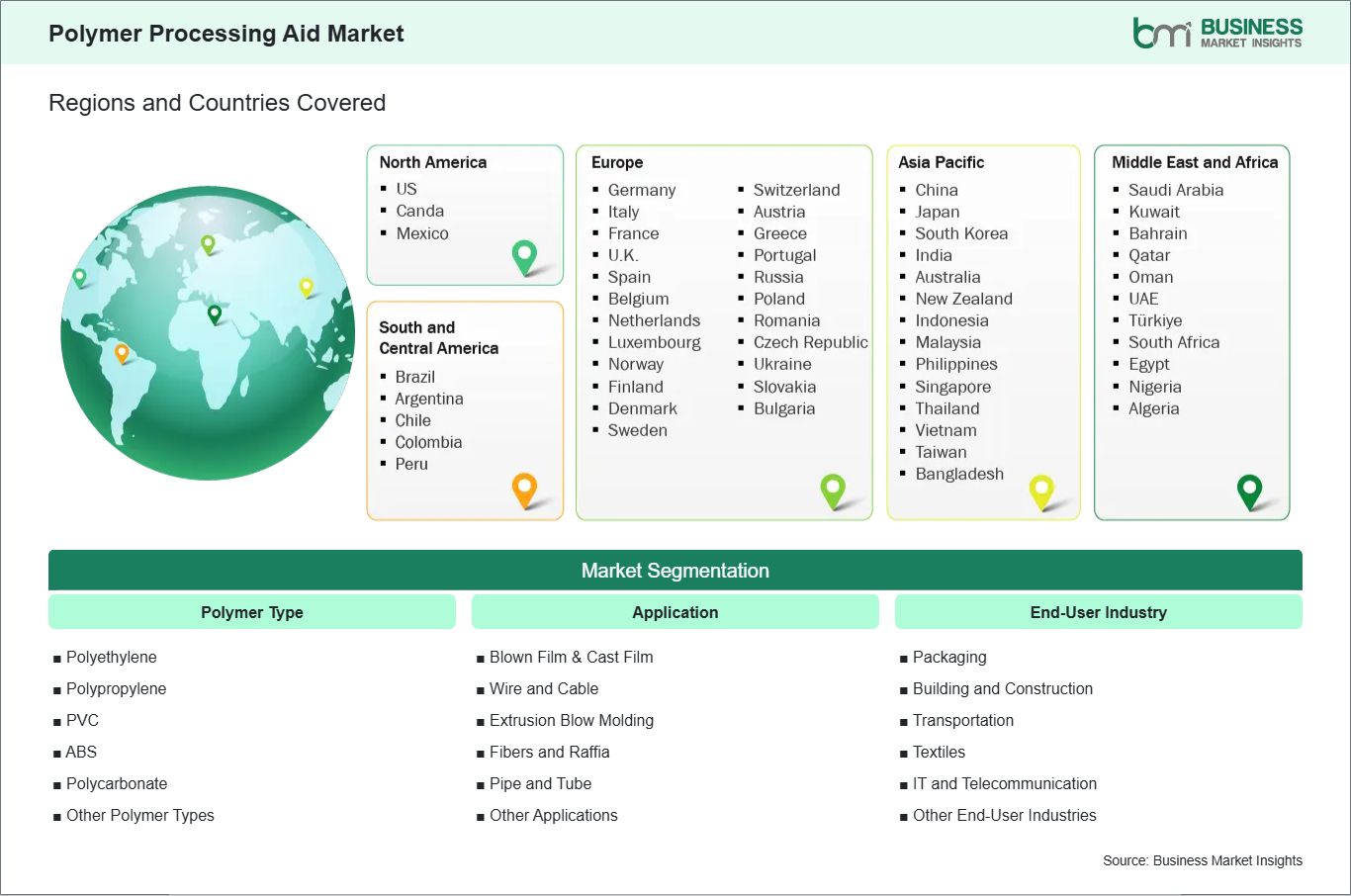
  • Polymer Type (Polyethylene, Polypropylene, PVC, ABS, and Polycarbonate, Other Polymer Types)
  • Application (Blown Film & Cast Film, Wire and Cable, Extrusion Blow Molding, Fibers and Raffia, Pipe and Tube, Other Applications)
  • End-User Industry (Packaging, Building and Construction, Transportation, Textiles, IT and Telecommunication, Other End-User Industries)

No. of Pages: 391
Report Code: BMIPUB00034185
Category: Chemicals and Materials
Polymer Processing Aid Market

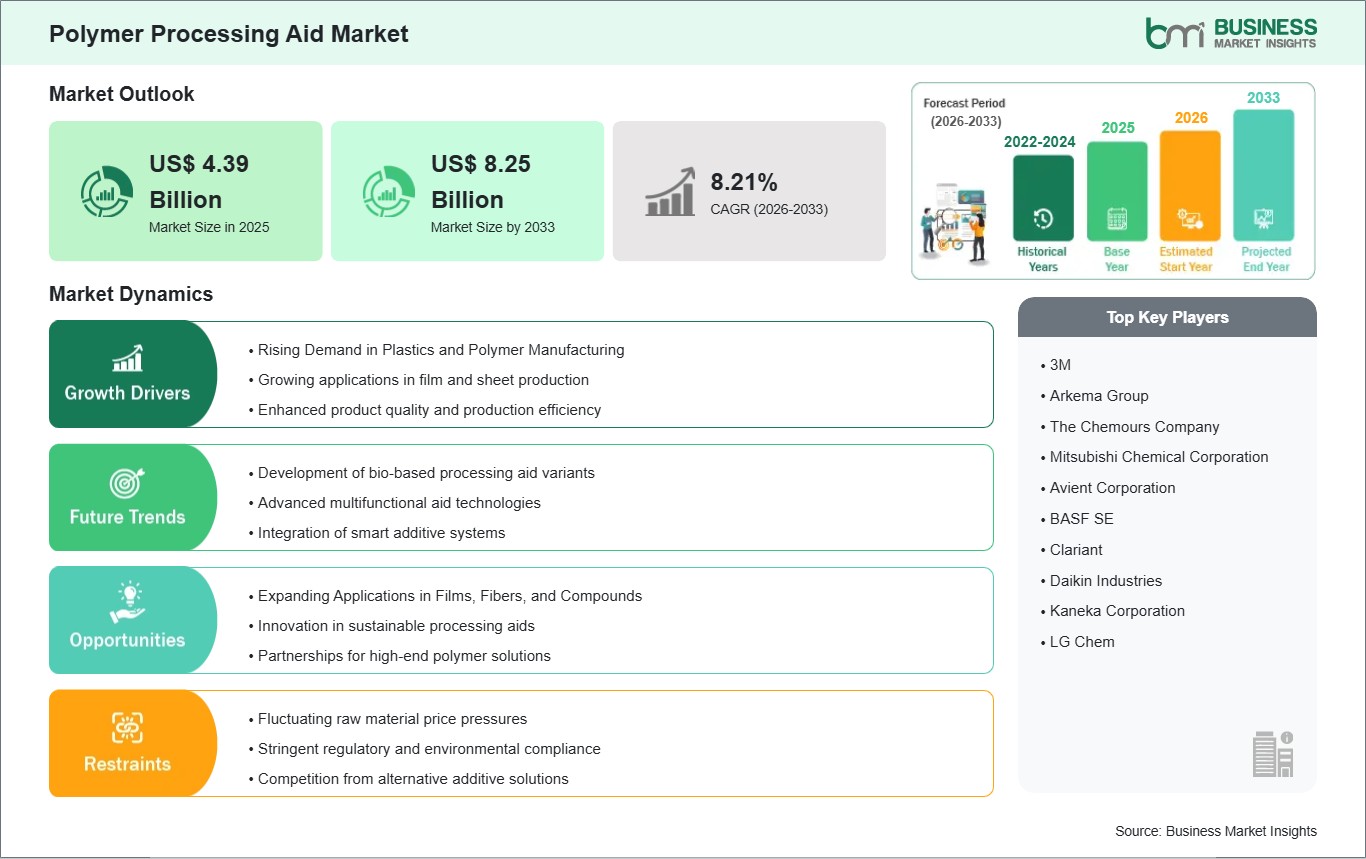
The Polymer Processing Aid Market size is expected to reach US$ 8.25 billion by 2033 from US$ 4.39 billion in 2025. The market is estimated to record a CAGR of 8.21% from 2026 to 2033.

Executive Summary and Global Market Analysis:

The polymer processing aid market is growing steadily with polymer manufacturers increasingly using polymer processing additives that help enhance processing efficiencies, product quality, and surface finish of polyolefin resins such as polyethylene and polypropylene. These polymer processing additives help reduce melt fracture, improve dispersion, and enhance flow properties of polymers. This enables manufacturers to produce thinner, stronger, and better products with minimal energy requirements. Increasing demand for polymer processing additives is being seen from various sectors such as packaging, automotive, construction, and consumer products. This is creating a greater need for polymer processing additives, especially for large volume products such as films, fibers, and injection molded parts.

Technological innovations in polymer processing aid chemistry help enhance compatibility with various polymer resin types, thermal stability, and environmental friendliness. The market is highly competitive, with leading chemical suppliers focusing on product differentiation, R&D for high-performance formulations, and sustainable solutions to meet regulatory requirements. Challenges include fluctuating raw material costs and process-specific application complexities, but the benefits of enhanced productivity, energy efficiency, and surface quality are supporting broader adoption across end-use industries. Overall, the polymer processing aid market reflects the convergence of process optimization, material innovation, and growing demand for high-performance polymer products across multiple industrial segments.

Polymer Processing Aid Market - Strategic Insights:

global-market-strategic-framework
Get more information on this report

Polymer Processing Aid Market Segmentation Analysis:

Key segments that contributed to the derivation of the polymer processing aid market analysis are polymer type, application, and end‑user industry.

  • By Polymer Type, the polymer processing aid market is segmented into polyethylene, polypropylene, PVC, ABS, and polycarbonate, and other polymer types. The polyethylene segment dominated the market in 2025.
  • Based on Application, the polymer processing aid market is classified into blown film & cast film, wire and cable, extrusion blow molding, fibers and raffia, pipe and tube, and other applications. The blown film & cast film segment dominated the market in 2025.
  • On the Basis of End‑User Industry, the polymer processing aid market is segmented into packaging, building and construction, transportation, textiles, IT and telecommunication, and other end‑user industries. The packaging segment dominated the market in 2025.

Polymer Processing Aid Market Drivers and Opportunities:

Rising Demand in Plastics and Polymer Manufacturing

The market for polymer processing aid is growing rapidly due to increased demand in plastics and polymer processing industries. These are highly specific additives that can enhance the processing of thermoplastics. These additives can reduce melt viscosity, prevent die buildup, and improve surface characteristics. These are highly essential in polyolefins, PVC, and other polymers used in various plastics and polymer processing. These additives can prevent various defects that occur in polymers. These defects include gels, streaks, and textures. Due to the rapid growth of polymers in various applications such as automobiles, packaging, household items, and construction, polymer processing aid is being used extensively to improve product quality.

In addition to improving processing characteristics, polymer processing aid also improves product properties. These can improve product gloss, slip, scratch resistance, and uniformity. These are highly essential in various household items. These can also reduce energy costs because they can reduce viscosity and friction. The increasing trend of using automated high-speed extrusion lines and the production of polymers on a large scale across the world has further emphasized the significance of PPAs in enhancing efficiency in operations as well as the quality of output.

Environmental factors and sustainability have also become favorable for the market. Modern PPAs are designed in such a way that the temperature required for the process is minimized, as is the amount of waste generated. With the efficiency, quality, and sustainability factors being met by the product, the importance of polymer processing aids as additives in the production of polymers cannot be undermined.

Expanding Applications in Films, Fibers, and Compounds

Polymer processing aids are increasingly being used in various applications, including film, fiber, and polymer compounds, due to their potential to improve processing efficiency and enhance the quality of finished products. In film and sheet extrusion, PPAs are used to enhance transparency, smoothness, and anti-blocking performance, making them vital in film applications. High-quality film products demand flawless surfaces, uniform thickness, and mechanical properties, all of which can be achieved through effective usage of PPAs. Increasing demand for film packaging in the global market, especially in the food, pharmaceutical, and electronic industries, is resulting in the extensive use of these film additives.

In the fiber and nonwoven industry, PPAs are used to enhance the quality of extrusion, fibers, and surfaces, making them critical in fiber applications. Fiber products demand flawless surfaces, quality, and mechanical properties, all of which can be achieved through effective usage of PPAs. Similarly, in polymer compounds, PPAs are used to enhance filler dispersion, prevent melt fracture, and improve compatibility between different materials, making them vital in compound applications. The multifunctionality of PPAs in enhancing quality in different polymer applications has made them indispensable in both high-performance and everyday polymer products.

Technological improvements in PPA formulations are also opening more avenues for the use of PPAs. The latest PPAs are available in low odor, high efficiency, and environmentally friendly forms, making them suitable for sensitive applications like medical film or food contact polymers. With the growing demand for polymers worldwide, the demand for defect-free, environmentally friendly, and high-quality polymers ensures the importance of polymer processing aids in the manufacturing process.

Polymer Processing Aid Market Size and Share Analysis:

The polymer processing aid market demonstrates steady growth, with size and share analysis highlighting evolving trends and competitive dynamics among key players. The report examines subsegments categorized within polymer type, application, and end‑user industry, offering insights into their contribution to overall market performance.

By Polymer Type, the polyethylene subsegment dominated the market in 2025, driven by its extensive use in blown and cast films, wire & cable manufacturing, pipes, tubes, and other processing applications.

Based on Application, the blown film & cast film subsegment dominated the market in 2025, supported by growing demand for flexible packaging films with enhanced clarity, surface smoothness, and processing efficiency.

On the Basis of End‑User Industry, the packaging subsegment dominated the market in 2025, owing to extensive adoption of processing aids in packaging films and products to improve film quality, uniformity, and performance.

Polymer Processing Aid Market Report Highlights:

Report Attribute Details
Market size in 2025 US$ 4.39 Billion
Market Size by 2033 US$ 8.25 Billion
Global CAGR (2026 - 2033)8.21%
Historical Data 2022-2024
Forecast period 2026-2033
Segments Covered By Polymer Type
  • Polyethylene
  • Polypropylene
  • PVC
  • ABS
  • Polycarbonate
  • Other Polymer Types
By Application
  • Blown Film & Cast Film
  • Wire and Cable
  • Extrusion Blow Molding
  • Fibers and Raffia
  • Pipe and Tube
  • Other Applications
By End-User Industry
  • Packaging
  • Building and Construction
  • Transportation
  • Textiles
  • IT and Telecommunication
  • Other End-User Industries
Regions and Countries Covered
North America US, Canada, Mexico
Europe Belgium, Austria, Finland, Denmark, Greece, Poland, Romania, Russia, Ukraine, Czech Republic, Slovakia, Bulgaria, Italy, Luxembourg, Germany, Switzerland, France, Netherlands, Norway, Portugal, Spain, Sweden, United Kingdom
Asia-Pacific Australia, China, India, Japan, South Korea, Indonesia, Malaysia, Philippines, Singapore, Thailand, Vietnam, Bangladesh, New Zealand, Taiwan
South and Central America Brazil, Argentina, Peru, Chile, Colombia
Middle East and Africa Bahrain, Kuwait, Oman, Qatar, Saudi Arabia, United Arab Emirates, Turkiye, South Africa, Egypt, Algeria, Nigeria
Market leaders and key company profiles
  • 3M
  • Arkema Group
  • The Chemours Company
  • Mitsubishi Chemical Corporation
  • Avient Corporation
  • BASF SE
  • Clariant
  • Daikin Industries
  • Kaneka Corporation
  • LG Chem
Get more information on this report

Polymer Processing Aid Market Report Coverage and Deliverables:

The "Polymer Processing Aid Market Size and Forecast (2022 - 2033)" report provides a detailed analysis of the market covering below areas:

  • Polymer Processing Aid Market size and forecast at global, regional, and country levels for all the key market segments covered under the scope
  • Polymer Processing Aid Market trends, as well as drivers, restraints, and opportunities
  • Polymer Processing Aid Market analysis covering key trends, global and regional framework, major players, regulations, and recent developments
  • Industry landscape and competition analysis covering market concentration, heat map analysis, prominent players, and recent developments for the Polymer Processing Aid Market
  • Detailed company profiles, including SWOT analysis

Polymer Processing Aid Market Geographic Insights:

The geographical scope of the Polymer Processing Aid Market report is divided into North America, Asia Pacific, Europe, Middle East & Africa, and South & Central America. North America held the largest share in 2025.

The polymer processing aid market exhibits diverse regional dynamics, with North America dominating the market due to a mature polymer manufacturing base, high adoption of advanced extrusion and molding technologies, and stringent quality standards in the United States and Canada. In Asia Pacific, rapid industrialization, expanding polymer production capacity, and rising demand from packaging, automotive, and construction sectors in China, India, Japan, and South Korea are driving strong growth, supported by cost-effective local manufacturing and large-scale polymer consumption.

Europe shows stable growth, with countries such as Germany, France, and Italy emphasizing sustainable manufacturing practices, regulatory compliance, and high-performance polymer applications in automotive and consumer goods. The Middle East & Africa region is gradually increasing adoption due to industrial expansion, infrastructure development, and growing polymer processing activities, often relying on imports and collaborations to access high-quality PPA products.

South & Central America is experiencing steady growth led by Brazil, Mexico, and neighboring markets, driven by packaging, construction, and automotive applications, although cost sensitivity and limited local production capacity influence adoption. Across all regions, market dynamics are shaped by industrial maturity, technological readiness, and end-use application requirements, positioning PPAs as essential additives for optimized polymer processing and high-quality finished products.

global-market-geography
Get more information on this report

Polymer Processing Aid Market Research Report Guidance:

  • The report includes qualitative and quantitative data in the Polymer Processing Aid Market across polymer type, application, end‑user industry, and geography.
  • The report starts with the key takeaways (chapter 2), highlighting key trends and outlook of the Polymer Processing Aid Market.
  • Chapter 3 focuses on the research methodology of the study.
  • Chapter 4 includes ecosystem analysis.
  • Chapter 5 highlights the major industry dynamics in the Polymer Processing Aid Market, including factors that are driving the market, prevailing deterrents, potential opportunities, as well as future trends. Impact analysis of these drivers and restraints is also covered in this section.
  • Chapter 6 discusses the Polymer Processing Aid Market scenario, in terms of historical market revenues, and forecast till the year 2033.
  • Chapters 7 to 10 cover Polymer Processing Aid Market segments across polymer type, application, end‑user industry, and geography across North America, Asia Pacific, Europe, the Middle East & Africa, and South & Central America. They cover the market revenue forecast and factors driving the market.
  • Chapter 11 describes the competitive analysis along with the heat map analysis for the key players operating in the market.
  • Chapter 12 describes the industry landscape analysis. It provides detailed descriptions of business activities such as market initiatives, new developments, mergers, and joint ventures globally, along with a competitive landscape.
  • Chapter 13 provides detailed profiles of the major companies operating in the Polymer Processing Aid Market. Companies have been profiled on the basis of their key facts, business descriptions, products, financial overview, SWOT analysis, and key developments.
  • Chapter 14, i.e., the appendix, is inclusive of a brief overview of the company, a list of abbreviations, and a disclaimer.

Polymer Processing Aid Market News and Key Development:

The Polymer Processing Aid Market is evaluated by gathering qualitative and quantitative data post primary and secondary research, which includes important corporate publications, association data, and databases. A few of the key developments in the polymer processing aid market are:

  • In September 2025, Dow Inc. announced that it launched DOWSIL 5‑1050 Polymer Processing Aid — a new silicone‑based PPA designed as an alternative to fluoropolymer‑based processing aids for blown and stretch film packaging applications. The product improves processing efficiency by reducing melt fracture and die lip buildup, while meeting food‑contact safety standards in major regulatory regions including the US and EU.
  • In June 2025, Clariant AG announced the launch of its AddWorks PPA product line, introducing PFAS‑free polymer processing aids tailored for polyolefin extrusion applications (including AddWorks PPA 101 FG and AddWorks PPA 122 G). These products deliver enhanced extrusion processability and smoother film surface properties, addressing tightening regulatory restrictions on fluorinated additives and sustainability demands in packaging and industrial markets.

Key Sources Referred:

  • International Organization for Standardization (ISO)
  • American Society for Testing and Materials (ASTM International)
  • Bureau of Indian Standards (BIS)
  • Environmental Protection Agency (EPA), USA
  • European Chemicals Agency (ECHA)
  • Central Pollution Control Board (CPCB), India
  • Ministry of Chemicals and Fertilizers, India
  • American Chemistry Council (ACC)
  • Indian Chemical Council (ICC)
  • European Chemical Industry Council (Cefic)
  • Specialty Chemical Association of India (SCAI)
  • Company Websites
  • Company Annual Reports
  • Company Investor Presentations
The List of Companies - Polymer Processing Aid Market
  • 3M
  • Arkema Group
  • The Chemours Company
  • Mitsubishi Chemical Corporation
  • Avient Corporation
  • BASF SE
  • Clariant
  • Daikin Industries
  • Kaneka Corporation
  • LG Chem
Frequently Asked Questions
How big is the Polymer Processing Aid Market?

The Polymer Processing Aid Market is valued at US$ 4.39 Billion in 2025, it is projected to reach US$ 8.25 Billion by 2033.

What is the CAGR for Polymer Processing Aid Market by (2026 - 2033)?

As per our report Polymer Processing Aid Market, the market size is valued at US$ 4.39 Billion in 2025, projecting it to reach US$ 8.25 Billion by 2033. This translates to a CAGR of approximately 8.21% during the forecast period.

What segments are covered in this report?

The Polymer Processing Aid Market report typically cover these key segments-

  • Polymer Type (Polyethylene, Polypropylene, PVC, ABS, and Polycarbonate, Other Polymer Types)
  • Application (Blown Film & Cast Film, Wire and Cable, Extrusion Blow Molding, Fibers and Raffia, Pipe and Tube, Other Applications)
  • End-User Industry (Packaging, Building and Construction, Transportation, Textiles, IT and Telecommunication, Other End-User Industries)

What is the historic period, base year, and forecast period taken for Polymer Processing Aid Market?

The historic period, base year, and forecast period can vary slightly depending on the specific market research report. However, for the Polymer Processing Aid Market report:

  • Historic Period : 2022-2024
  • Base Year : 2025
  • Forecast Period : 2026-2033
  • Who are the major players in Polymer Processing Aid Market?

    The Polymer Processing Aid Market is populated by several key players, each contributing to its growth and innovation. Some of the major players include:

  • 3M
  • Arkema Group
  • The Chemours Company
  • Mitsubishi Chemical Corporation
  • Avient Corporation
  • BASF SE
  • Clariant
  • Daikin Industries
  • Kaneka Corporation
  • LG Chem
  • Who should buy this report?

    The Polymer Processing Aid Market report is valuable for diverse stakeholders, including:

    • Investors: Provides insights for investment decisions pertaining to market growth, companies, or industry insights. Helps assess market attractiveness and potential returns.
    • Industry Players: Offers competitive intelligence, market sizing, and trend analysis to inform strategic planning, product development, and sales strategies.
    • Suppliers and Manufacturers: Helps understand market demand for components, materials, and services related to concerned industry.
    • Researchers and Consultants: Provides data and analysis for academic research, consulting projects, and market studies.
    • Financial Institutions: Helps assess risks and opportunities associated with financing or investing in the concerned market.

    Essentially, anyone involved in or considering involvement in the Polymer Processing Aid Market value chain can benefit from the information contained in a comprehensive market report.

    Available Report Formats

    pdf-format excel-format pptx-format
    Buy Now
    Sales Assistance
    +1 646 791 7070 (US & UK)
    Customization Form

    Please tell us your area of interest
    (Market Segments/ Regions and Countries/ Companies)