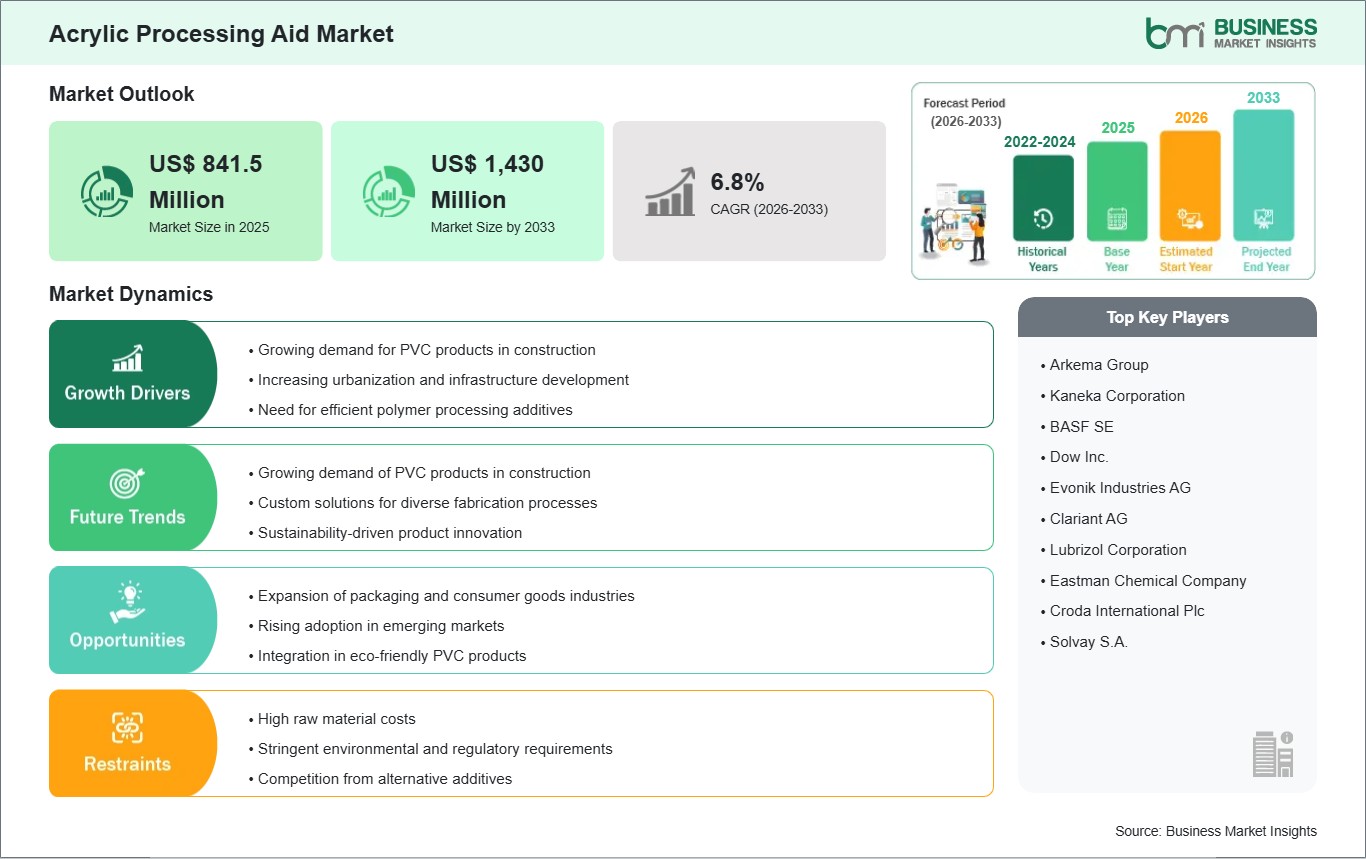
The Acrylic Processing Aid Market size is expected to reach US$ 1.43 Billion by 2033 from US$ 841.5 Million in 2025 .The market is estimated to record a CAGR of 6.8% from 2026 to 2033.
The global acrylic processing aid market is defined by increasing demand for high-performance additives that enhance the processability and performance of polymers, particularly polyvinyl chloride (PVC). Acrylic processing aids are widely used to improve melt strength, surface finish, and dimensional stability during polymer processing. These additives play a critical role in enabling efficient manufacturing of plastic products used across construction, packaging, automotive, and consumer goods industries. This shift reflects broader industrial priorities: improving production efficiency, reducing defects, and enhancing product quality.
Competitive dynamics increasingly center on formulation efficiency and compatibility with diverse polymer systems, with emphasis on achieving superior processing performance at lower additive concentrations. Manufacturers are investing in advanced polymer modification technologies to develop processing aids that offer improved thermal stability and faster fusion characteristics. Commercial strategies now include customized solutions tailored to specific fabrication processes and end-use applications.
Meanwhile, regulatory trends and sustainability considerations are influencing product development, encouraging the use of environmentally friendly and recyclable materials. Industries are integrating acrylic processing aids to optimize material performance while meeting regulatory standards. This evolving landscape positions acrylic processing aids as essential components in modern polymer processing and manufacturing operations.

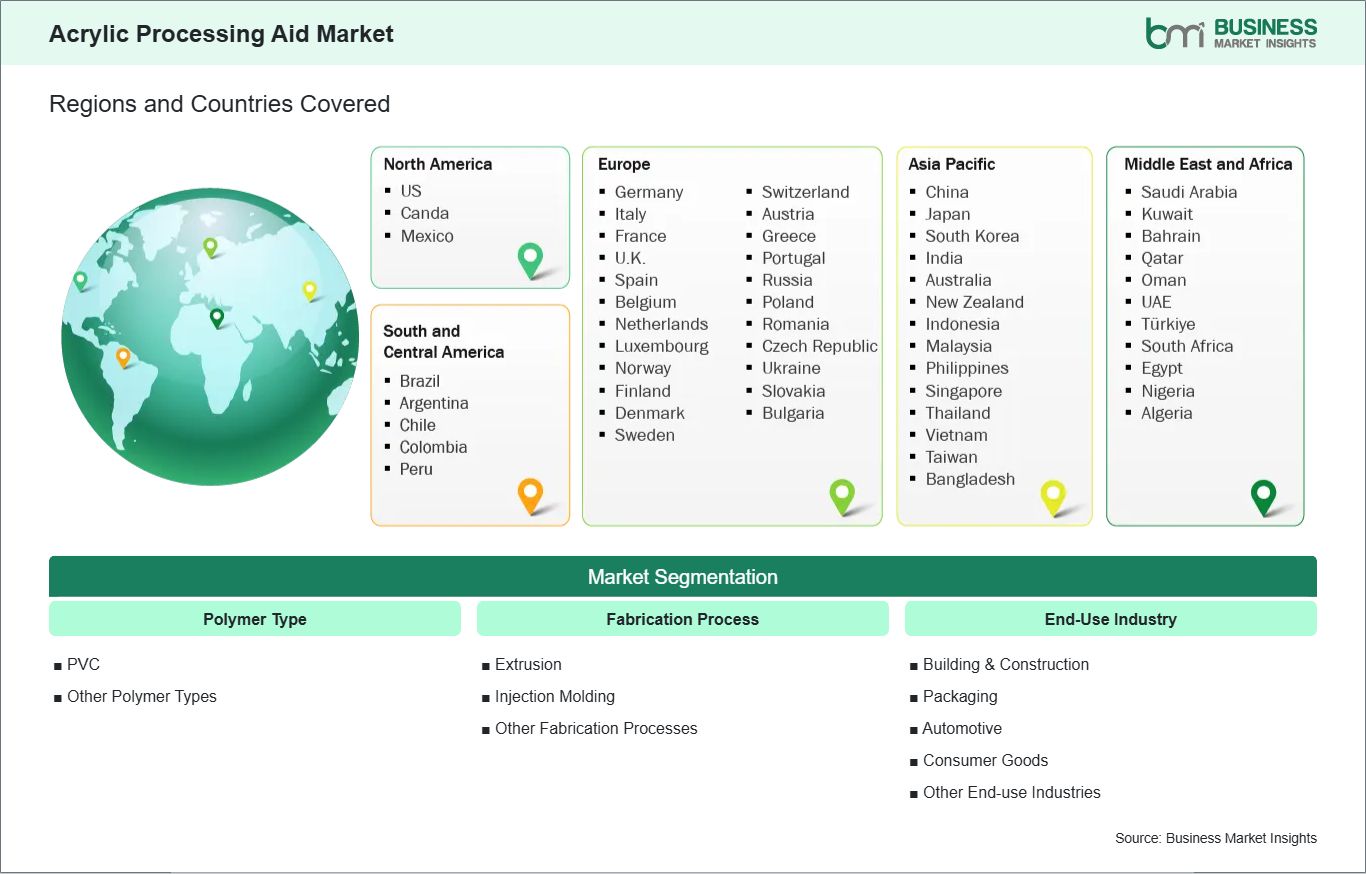
Key segments that contributed to the derivation of the acrylic processing aid market analysis are polymer type, fabrication process, and end-use industry.
The construction industry has become one of the largest consumers of PVC products, and this trend is a major driver for the acrylic processing aid market. PVC is widely used in pipes, fittings, window frames, flooring, and roofing due to its durability, cost‑effectiveness, and resistance to moisture, chemicals, and environmental stress. However, the efficient processing of PVC requires additives that can improve melt flow, reduce processing time, and ensure consistent product quality. Acrylic processing aids fulfill this role by enhancing the performance of PVC during extrusion and injection molding, resulting in smoother surfaces, better mechanical strength, and improved dimensional stability.
Global infrastructure development, particularly in emerging economies, is fueling demand for PVC‑based construction materials. Rapid urbanization, housing projects, and investments in water supply and sanitation systems are increasing the need for PVC pipes and fittings. Acrylic processing aids help manufacturers meet these demands by improving productivity and reducing defects in finished products. Additionally, the ability of these aids to enhance gloss and surface finish makes PVC more appealing for architectural applications such as decorative panels and window profiles.
Technological advancements in additive formulations are further expanding the scope of acrylic processing aids. New grades are being designed to be compatible with various PVC types, offering improved efficiency and sustainability. As construction activity continues to rise globally, the demand for PVC products—and consequently acrylic processing aids—will remain strong, positioning them as essential components in modern infrastructure development.
The packaging and consumer goods industries are experiencing rapid growth worldwide, creating significant opportunities for acrylic processing aids. These additives are critical in improving the processing and performance of plastics used in packaging films, containers, and everyday consumer products. By enhancing clarity, strength, and processability, acrylic processing aids ensure efficient production and high‑quality output, which is vital in industries where product appearance and durability directly influence consumer perception.
In packaging applications, acrylic processing aids contribute to lightweight yet durable solutions that meet the growing demand for convenience and sustainability. They enable manufacturers to produce films and containers with superior transparency and mechanical properties, ensuring that packaged goods remain protected while maintaining visual appeal. With the rise of e‑commerce and global trade, the need for reliable packaging materials has intensified, further driving adoption of these additives.
Consumer goods such as household items, toys, and appliances also benefit from acrylic processing aids, which improve surface finish, reduce production defects, and enhance overall product performance. Advancements in polymer processing technologies are enabling manufacturers to achieve faster cycle times and greater efficiency, reducing costs while maintaining quality.
The increasing focus on sustainable packaging is another key factor. Acrylic processing aids are being integrated into eco‑friendly formulations that minimize environmental impact while meeting regulatory standards. As global demand for packaged goods and consumer products continues to rise, the role of acrylic processing aids will expand significantly, making them indispensable in supporting innovation and sustainability in these industries.

The Acrylic Processing Aid Market demonstrates steady growth, with size and share analysis highlighting evolving trends and competitive dynamics among key players. The report examines subsegments categorized within polymer type, fabrication process, and end-use industry, offering insights into their contribution to overall market performance.
By polymer type, the PVC subsegment dominated the market in 2025, driven by its dominant usage in construction and infrastructure applications.
Based on fabrication process, the extrusion subsegment dominated the market in 2025, driven by high demand for continuous production of plastic products.
In terms of end-use industry, the building & construction subsegment dominated the market in 2025, driven by increasing infrastructure development and urbanization.
| Report Attribute | Details |
|---|---|
| Market size in 2025 | US$ 841.5 Million |
| Market Size by 2033 | US$ 1,430 Million |
| Global CAGR (2026 - 2033) | 6.8% |
| Historical Data | 2022-2024 |
| Forecast period | 2026-2033 |
| Segments Covered | By Polymer Type
|
|
Regions and Countries Covered
| |
| North America | US, Canada, Mexico |
| Europe | Belgium, Austria, Finland, Denmark, Greece, Poland, Romania, Russia, Ukraine, Czech Republic, Slovakia, Bulgaria, Italy, Luxembourg, Germany, Switzerland, France, Netherlands, Norway, Portugal, Spain, Sweden, United Kingdom |
| Asia-Pacific | Australia, China, India, Japan, South Korea, Indonesia, Malaysia, Philippines, Singapore, Thailand, Vietnam, Bangladesh, New Zealand, Taiwan |
| South and Central America | Brazil, Argentina, Peru, Chile, Colombia |
| Middle East and Africa | Bahrain, Kuwait, Oman, Qatar, Saudi Arabia, United Arab Emirates, Turkiye, South Africa, Egypt, Algeria, Nigeria |
| Market leaders and key company profiles |
|
The "Acrylic Processing Aid Market Size and Forecast (2022 - 2033)" report provides a detailed analysis of the market covering below areas:
The geographical scope of the Acrylic Processing Aid Market report is divided into North America, Asia Pacific, Europe, Middle East & Africa, and South & Central America. North America held the largest share in 2025.
The adoption and maturity of acrylic processing aids vary across regions, driven by industrial growth, infrastructure development, and polymer manufacturing capacity. In North America, established construction and packaging industries drive steady demand, supported by advanced manufacturing technologies and regulatory standards.
In Europe, sustainability regulations and circular economy initiatives influence the use of processing aids, encouraging efficient material utilization and recycling. Countries such as Germany, the UK, and France lead in adopting advanced polymer processing technologies.
Asia Pacific market is growing due to rapid urbanization, infrastructure expansion, and strong manufacturing growth in countries such as China, India, and Southeast Asia. Increasing investments in construction and packaging industries further boost regional demand.
The Middle East & Africa and South & Central America regions show moderate growth, driven by infrastructure development and industrialization. Across all regions, economic growth, regulatory frameworks, and industrial investments play a key role in shaping market dynamics.

The Acrylic Processing Aid Market is evaluated by gathering qualitative and quantitative data post primary and secondary research, which includes important corporate publications, association data, and databases. A few of the key developments in the acrylic processing aid market are:
The Acrylic Processing Aid Market is valued at US$ 841.5 Million in 2025, it is projected to reach US$ 1,430 Million by 2033.
As per our report Acrylic Processing Aid Market, the market size is valued at US$ 841.5 Million in 2025, projecting it to reach US$ 1,430 Million by 2033. This translates to a CAGR of approximately 6.8% during the forecast period.
The Acrylic Processing Aid Market report typically cover these key segments-
The historic period, base year, and forecast period can vary slightly depending on the specific market research report. However, for the Acrylic Processing Aid Market report:
The Acrylic Processing Aid Market is populated by several key players, each contributing to its growth and innovation. Some of the major players include:
The Acrylic Processing Aid Market report is valuable for diverse stakeholders, including:
Essentially, anyone involved in or considering involvement in the Acrylic Processing Aid Market value chain can benefit from the information contained in a comprehensive market report.
Please tell us your area of interest
(Market Segments/ Regions and Countries/ Companies)