
Polymer Foam Market Size, Share, Trends & Forecast Report, 2026–2033

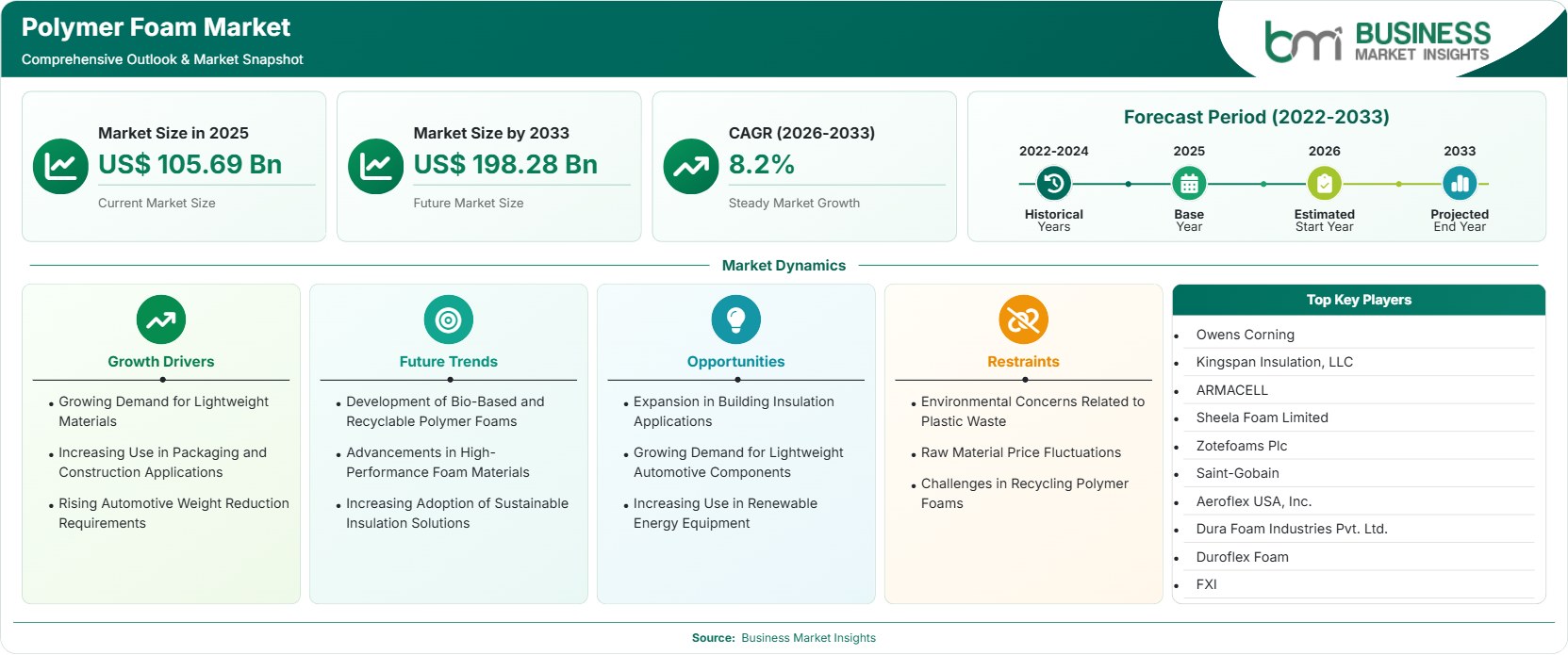
The Polymer Foam Market size was valued at US$ 105.69 Billion in 2025 and is projected to reach US$ 198.28 Billion by 2033, growing at a CAGR of US$ 8.2% during 2026–2033, driven by lightweight material adoption, insulation demand, automotive efficiency requirements, packaging expansion, and emerging opportunities in renewable energy equipment applications.

Report Coverage
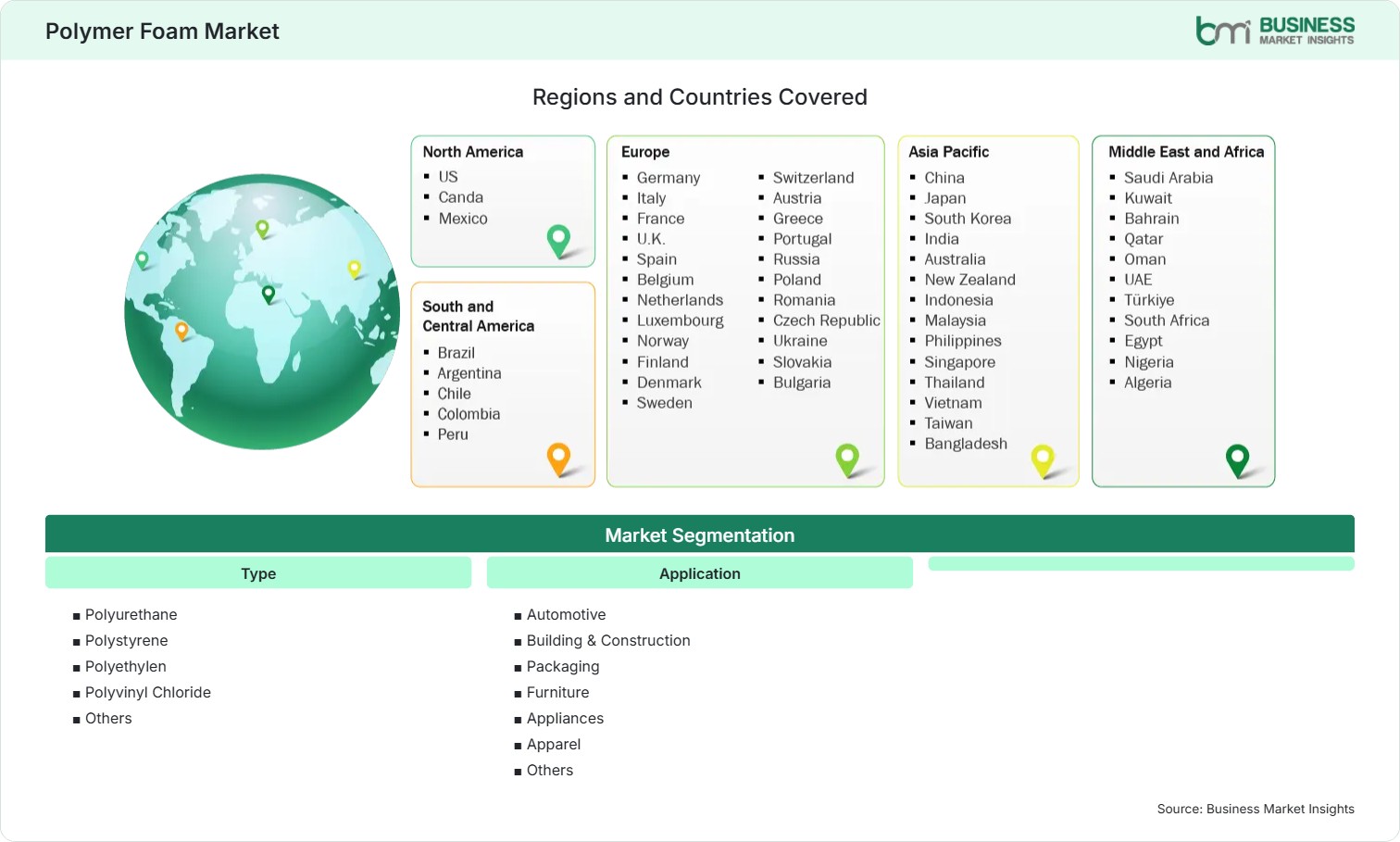
  • Type: Polyurethane, Polystyrene, Polyethylen, Polyvinyl Chloride, Others
  • Application: Automotive, Building & Construction, Packaging, Furniture, Appliances, Apparel, Others
US$ 105.69 Bn Market size in 2025
US$ 198.28 Bn Market Size by 2033
8.2% CAGR, 2026 - 2033
2026-2033 Forecast Period

01 AI Overview

Polymer Foam Market Summary

  • North America Region: North America holds a market share of 32%–35% in 2025, growing with a CAGR of 7.5%–8.5% influenced by construction insulation upgrades, automotive lightweighting initiatives, and packaging innovation. The US market analysis indicates steady expansion with a CAGR of 7.8%–8.6% supported by sustainable material demand and industrial applications.
  • Fastest Growing Region: Asia Pacific accounts for a share of 36%–39% in 2025, expanding with a CAGR of 8.8%–9.8% driven by urbanization, manufacturing growth, infrastructure investments, and rising automotive production across China, India, and Southeast Asian economies.
  • Leading Segment: Polyurethane (PU) technology represents a leading segment with a share of 38%–41% in 2025, achieving a CAGR of 8.0%–9.0% supported by versatile insulation properties, furniture applications, automotive components, and energy-efficient building solutions.
  • High Growth Segment: Building & Construction application demonstrates strong momentum with a share of 27%–30% in 2025, registering a CAGR of 9.0%–10.0% due to demand for thermal insulation, green buildings, and regulatory-driven energy efficiency improvements.
  • Key Market Opportunity: Growing adoption of recyclable foam technologies, bio-based materials, and advanced insulation systems creates investment opportunities across construction, transportation, packaging, and renewable energy sectors seeking improved efficiency and reduced environmental impact.
  • Major Market Players: Owens Corning, Kingspan Insulation, LLC, ARMACELL, Sheela Foam Limited, Zotefoams Plc, Saint-Gobain, Aeroflex USA, Inc., Dura Foam Industries Pvt. Ltd., Duroflex Foam, and FXI.
02 Strategic Insights

Polymer Foam Market: Strategic Insights

polymer-foam-market-market-strategic-framework
FREE PDF
Request your free sample
Request free sample
03 Stakeholder View

Key Takeaways

  • Supply chain integration is becoming a strategic priority as foam producers strengthen relationships with polymer suppliers, converters, and end-use manufacturers to manage raw material availability and production efficiency.
  • Building insulation and automotive lightweight applications represent high-value growth avenues as industries prioritize energy savings, emissions reduction, and improved product performance through advanced foam solutions.
  • Innovation is shifting toward recyclable formulations, bio-based feedstocks, and enhanced cellular structures that improve thermal performance while addressing environmental concerns associated with conventional plastics.
  • Asia Pacific presents a compelling investment case due to rapid urban development, expanding automotive manufacturing bases, and increasing demand for energy-efficient construction materials in emerging economies.
  • Industry consolidation is progressing through capacity expansions, technology partnerships, and strategic investments as established manufacturers seek broader geographic presence and specialized foam capabilities.
  • Digital manufacturing systems and process automation are improving production consistency, reducing waste generation, and enabling customized foam solutions for specialized industrial applications.
04 Geographic Outlook

Polymer Foam Market Regional Highlights

North America Polymer Foam Market

North America accounted for a share of 32%–35% in 2025 and is projected to expand at a CAGR of 7.5%–8.5% during 2026–2033. The region has the advantage of established construction activities, automobile innovations, and high demand for insulation materials. The Polymer Foam Market share is fueled by sustainability-driven building regulations and lightweight material use in various industries.

  • Rising renovation activities in the US and Canada are increasing demand for advanced insulation foams that improve building energy efficiency and support regulatory compliance requirements.
  • Automotive manufacturers are adopting lightweight foam components to improve fuel efficiency and electric vehicle performance while reducing vehicle weight across passenger and commercial transportation segments.
  • Packaging producers are integrating protective foam materials for logistics applications, driven by e-commerce growth and increasing requirements for durable product protection during transportation.
  • Industrial manufacturers are investing in high-performance foam solutions that provide thermal management, vibration reduction, and improved operational efficiency across specialized applications.

US Polymer Foam Market

The US held a market share of 28% to 31% in 2025, with a forecasted CAGR of 7.8% to 8.6% from 2026 to 2033. High construction spending, lightweight vehicles, and advanced manufacturing technologies will keep on driving the domestic market. It is one of the main innovation hubs of high performance foam and sustainable materials.

  • Building code improvements and energy efficiency programs are encouraging wider adoption of polyurethane and polystyrene insulation solutions in residential and commercial construction projects.
  • Automotive suppliers are increasing foam utilization in seating, interior components, and acoustic systems to improve comfort, safety, and vehicle performance.
  • Packaging companies are developing specialized foam products for healthcare, electronics, and industrial shipping applications requiring enhanced protection and temperature control.

Europe Polymer Foam Market

Europe held a share of 23%–26% in 2025 with an anticipated CAGR of 6.8% to 7.8% up until 2033. Germany, France, and the UK continue to dominate the market owing to their high levels of manufacture and sustainability measures. Germany shows a CAGR of 7.0% to 7.8%, while France and the UK keep expanding through improved construction.

  • European energy efficiency regulations are increasing demand for insulation materials that reduce building energy consumption and support climate-neutral construction targets.
  • Germany’s automotive industry is driving adoption of lightweight foam materials for electric vehicles, interior systems, and thermal management applications.
  • France is expanding foam applications through sustainable packaging solutions and infrastructure refurbishment projects focused on energy conservation.
  • The UK market benefits from residential renovation programs and demand for improved building insulation performance.

Asia Pacific Polymer Foam Market

Asia Pacific accounted for a share of 36%–39% in 2025 and is projected to register the highest CAGR of 8.8%–9.8% from 2026–2033. China, India, Japan, and Southeast Asian economies are driving regional expansion through manufacturing growth, construction activity, and automotive production. The Polymer Foam Market growth is strengthened by increasing industrial investments and infrastructure development.

  • China remains the largest regional contributor due to extensive construction projects, automotive manufacturing capacity, and packaging sector expansion.
  • India is experiencing faster adoption through urbanization, housing development, and rising demand for thermal insulation solutions.
  • Japan is advancing specialty foam applications through automotive innovation, electronics manufacturing, and precision industrial production.
  • Southeast Asian countries are attracting investments in manufacturing facilities, increasing demand for protective packaging and industrial foam products.

Rest of World Polymer Foam Market

South and Central America, along with Middle East and Africa markets, represented a share of 8%–11% in 2025 and are expected to grow at a CAGR of 7.0%–8.0% during 2026–2033. Brazil, Mexico, Saudi Arabia, and the UAE are emerging contributors due to construction expansion, industrial diversification, and infrastructure investments.

  • Brazil is supporting demand through residential construction growth, packaging requirements, and expanding industrial manufacturing activities.
  • Mexico benefits from automotive manufacturing investments and supply chain expansion linked with North American production networks.
  • Middle Eastern countries are adopting foam insulation materials in large-scale construction and energy-efficient infrastructure developments.
  • African markets are gradually increasing foam consumption through urban development, housing projects, and improving industrial capabilities.
global-market-geography
FREE PDF
Request your free sample
Request free sample
05 Segment Analysis

Polymer Foam Market Segmentation

Type

Type segment witnesses varied adoption rate in construction, transportation, packaging, and consumption segments. PU continues to be the most used type owing to its flexibility, insulating capacity, and wide usage in industries. The market share of this type stood at 38%-41% in 2025 and is expected to witness CAGR of 8.0%-9.0% over the period of 2026-2034.

  • Polyurethane (PU): Widely used in insulation, furniture, automotive interiors, and appliances due to superior flexibility, durability, thermal resistance, and processing versatility.
  • Polystyrene (PS): Applied in packaging and construction insulation systems, offering lightweight performance, moisture resistance, and cost advantages for large-volume applications.
  • Polyethylene (PE): Utilized for protective packaging, cushioning, and industrial applications requiring chemical resistance, flexibility, and impact absorption properties.
  • Polyvinyl Chloride (PVC): Supports construction and industrial applications through durable foam structures used in profiles, insulation, and specialized components.

Application

The demand arising from applications is driven by considerations of efficiency in industry, consumer products, and infrastructure development. Building & Construction is one of the main segments of applications, whereas automobile and packaging segments are seeing growing demand. The Polymer Foam market scope is widening due to the development of specific formulations for various purposes.

  • Automotive: Foam materials support vehicle interiors, seating systems, insulation, and lightweight component requirements focused on efficiency and passenger comfort.
  • Building & Construction: Used extensively for insulation, roofing, sealing, and energy-efficient structures requiring improved thermal and acoustic performance.
  • Packaging: Provides cushioning, protection, and lightweight solutions for electronics, food products, healthcare supplies, and industrial transportation.
  • Furniture: Enables comfort, durability, and design flexibility through foam cushioning materials used in residential and commercial furniture products.
  • Appliances: Supports insulation and structural requirements in refrigeration, electronics, and household equipment manufacturing.
  • Apparel: Provides specialized cushioning and protective applications through flexible foam materials used in footwear and performance products.
06 Market Forces

Polymer Foam Market Dynamics

Key Market Drivers

Growing Demand for Lightweight Materials

The growing tendency to use lightweight materials in industries such as transportation, construction, and packaging will create strong demands for better foam solutions. Industrial companies are using lighter materials in place of heavy materials through the usage of foam structures. The Polymer Foam Market growth is driven by the automobile companies who are looking for efficiency in their products. Market trends are showing that there is an increase in investments into environmentally friendly and efficient foam technology due to the balancing act between efficiency and sustainability of materials. The increase in the number of electric vehicles is another factor driving the use of lightweight materials.

Increasing Use in Packaging and Construction Application

There is increased use of foam in the packaging and construction industries due to the need for protective materials, thermal insulation, and energy efficiency. The foam used in packaging acts as a cushioning material while also reducing transportation weight. In the construction industry, the use of foam is becoming more popular because of government initiatives aimed at improving buildings' energy performance. Regulatory efforts aimed at conserving energy have led to the use of insulation products in buildings. The manufacturers of these products are working to improve their durability and recyclability.

Rising Automotive Weight Reduction Requirements

Car manufacturers are using more foam due to weight reduction, improved passenger comfort, and improved vehicle performance. High-quality foams are being used in seat cushions, interior panels, acoustic insulation, and structure parts. Electric vehicle development is also driving the trend because of the need for light components that optimize battery performance and range. There is more investment by suppliers in foam technology that ensures strength and minimization of the component weight. Polymer Foam Market Trends reveal collaborations between the materials suppliers and automobile manufacturers to come up with customized products. Vehicle production growth in the Asia Pacific and North America regions is driving foam applications in automobiles.

Key Market Opportunities

Expansion in Building Insulation Applications

Insulation of buildings is a key area for significant investment in the context of energy-efficient infrastructure development. Growing construction activity in emerging markets and renovations in developed countries are driving higher consumption of polyurethane and other foam-based insulation materials. The Polymer Foam Market Forecast report indicates ample scope for investment driven by growing interest in green building practices, sustainable construction, and stringent energy performance requirements. Companies offering low-emission and recyclable insulations are expected to benefit from the increased demand.

Growing Demand for Lightweight Automotive Components

The automotive sector provides opportunities through increasing adoption of lightweight components in conventional and electric vehicles. Foam materials contribute to reduced vehicle weight, improved passenger safety, and enhanced interior performance. The automakers want suppliers who can provide customized solutions that are more durable and sustainable. The production of electric vehicles is increasing the need for thermal management and acoustic insulation solutions. Companies need to invest in foam manufacturing technologies that meet the evolving demands of the automobile industry. Collaboration between foam manufacturers and automotive suppliers will be crucial for innovations in the coming years.

Increasing Use in Renewable Energy Equipment

Manufacturers of renewable energy machinery are now turning to foam for insulation, protection, and lightweight applications. Wind energy machines need foam for durability and reliable operation, whereas solar machinery needs protective and insulating materials. Foam manufacturers have been developing special formulations designed to withstand the toughest environments and last longer. Increased investments in renewable energy infrastructure will allow manufacturers to expand the Polymer Foam market reach beyond conventional markets.

Market Restraints and Challenges

Environmental Concerns Related to Plastic Waste

Factor: Increasing concerns regarding plastic waste generation and limited recycling infrastructure create challenges for conventional foam products. Impact: Manufacturers face pressure to redesign materials, improve recyclability, and invest in circular economy solutions. Foam waste management remains a critical issue because certain formulations require specialized recycling processes. Regulatory authorities are introducing stricter sustainability requirements that influence product development strategies across the industry. Companies are responding through bio-based materials, chemical recycling technologies, and improved recovery systems. These initiatives increase development costs but encourage long-term innovation. Environmental compliance has become a key factor influencing investment decisions and competitive positioning among foam producers.

Raw Material Price Fluctuations

Factor: Volatility in petrochemical feedstock prices affects production costs for major foam materials including polyurethane, polyethylene, and polystyrene. Impact: Manufacturers experience margin pressure and must optimize supply chains to maintain pricing competitiveness. Changes in crude oil markets, energy costs, and raw material availability can influence operational stability. Companies are improving procurement strategies, expanding supplier networks, and exploring alternative feedstocks to reduce exposure. Price fluctuations remain a significant challenge because foam production relies heavily on chemical inputs. Strategic sourcing and manufacturing efficiency improvements are becoming essential for maintaining profitability in competitive markets.

07 Company Analysis

Competitive Landscape

The Polymer Foam Market analysis highlights a competitive environment shaped by global manufacturers focusing on material innovation, production expansion, sustainability initiatives, and application-specific solutions. Leading companies are strengthening capabilities across insulation, automotive, packaging, and industrial applications.

Company Name

Overview

Products and Services relevant to this market

Owens Corning

Global building materials company specializing in insulation and composites.

Fiberglass insulation, foam insulation products, construction solutions, and energy-efficient materials.

Kingspan Insulation, LLC

International insulation manufacturer focused on sustainable building solutions.

Rigid foam insulation boards, thermal solutions, and construction efficiency products.

ARMACELL

Advanced insulation materials producer serving industrial and construction markets globally.

Flexible foam insulation, engineered foam products, and thermal management solutions.

Sheela Foam Limited

Indian foam manufacturer with strong consumer and industrial presence.

Polyurethane foams, mattresses, cushioning materials, and specialty foam products.

Zotefoams Plc

UK-based manufacturer specializing in high-performance foam technologies.

Polyolefin foams, cross-linked foam materials, and specialty applications.

Saint-Gobain

Global materials company supplying construction and industrial products.

Insulation foams, building solutions, and advanced material technologies.

Aeroflex USA, Inc.

Manufacturer focused on flexible elastomeric insulation solutions.

Thermal insulation foams, HVAC materials, and industrial insulation products.

Dura Foam Industries Pvt. Ltd.

Indian foam producer serving industrial and commercial sectors.

Polyurethane foam products, insulation materials, and custom foam solutions.

Duroflex Foam

Indian foam company serving consumer and commercial applications.

PU foam mattresses, comfort products, and specialized foam materials.

FXI

US-based foam manufacturer providing engineered foam solutions.

Flexible polyurethane foams, packaging solutions, healthcare and industrial foam products.

08 Industry Activity

Recent Developments

March 2026

BASF SE expanded its sustainable polyurethane foam raw material portfolio with biomass balance polyether polyols for flexible foam applications used in sleep products, automotive, and industrial markets. The drop-in solutions allow foam manufacturers to reduce product carbon footprints without major process changes.

February 2026

BASF SE launched biomass balance (BMB) Autofroth polyurethane foam systems for the North American low-pressure polyurethane foam market. The new foam systems are designed to help customers reduce product carbon footprints while maintaining existing processing performance, supporting sustainable polyurethane foam adoption in automotive, industrial, and other applications.

April 2025

TotalEnergies Corbion partnered with Useon to accelerate the industrial adoption and global commercialization of Expanded PLA (EPLA) molded foams. The sustainable polymer foam technology combines Useon’s direct bead foaming technology with TotalEnergies Corbion’s Luminy PLA bioplastics for applications including packaging and thermal protection.

February 2025

Woodbridge Corporation opened a new joint venture manufacturing plant in Pune, India, with TM Automotive Seating Systems to produce molded foam components, interior parts, and seating systems for passenger vehicles, commercial vehicles, and buses. The expansion strengthens Woodbridge’s polymer foam manufacturing footprint in the Asia-Pacific region.

10 Trust & Transparency

Research Methodology

The market analysis combines proprietary research with secondary data from government agencies, company disclosures, regulatory filings, industry databases and expert interviews. Market estimates are validated through data triangulation, cross-market benchmarking and analyst review.

View Full Research Methodology

11 Questions Answered

Frequently Asked Questions

Which regions present major investment opportunities?

Asia Pacific presents significant opportunities due to industrial expansion, construction activity, automotive manufacturing growth, and increasing demand for insulation materials across emerging economies.

What role does innovation play in the Polymer Foam market Report outlook?

Innovation supports development of specialized materials with improved thermal resistance, durability, recyclability, and application flexibility. Companies are focusing on advanced formulations and processing technologies to meet evolving industrial requirements.

How are manufacturers addressing sustainability challenges?

Manufacturers are investing in recyclable foam technologies, bio-based raw materials, improved recovery systems, and lower-emission production methods. These approaches help reduce environmental impact while maintaining required performance characteristics.

Which application segment offers strong future growth potential?

Building and construction applications offer strong potential due to increasing insulation requirements, green building initiatives, and regulatory emphasis on reducing energy consumption. Automotive applications also provide opportunities through lightweight component adoption.

What factors are influencing demand for polymer foam materials?

Demand is influenced by lightweight material requirements, energy-efficient construction standards, automotive efficiency targets, and expanding protective packaging needs. Growth in electric vehicles and sustainable infrastructure is also increasing adoption of advanced foam technologies.

Access the Full Polymer Foam Market Report

Get segment-level forecasts, regional estimates, competitive benchmarking, company profiles and downloadable Excel datasets.

Access the full Polymer Foam Market Report
350 pages PDF & Excel | 2026-07-28