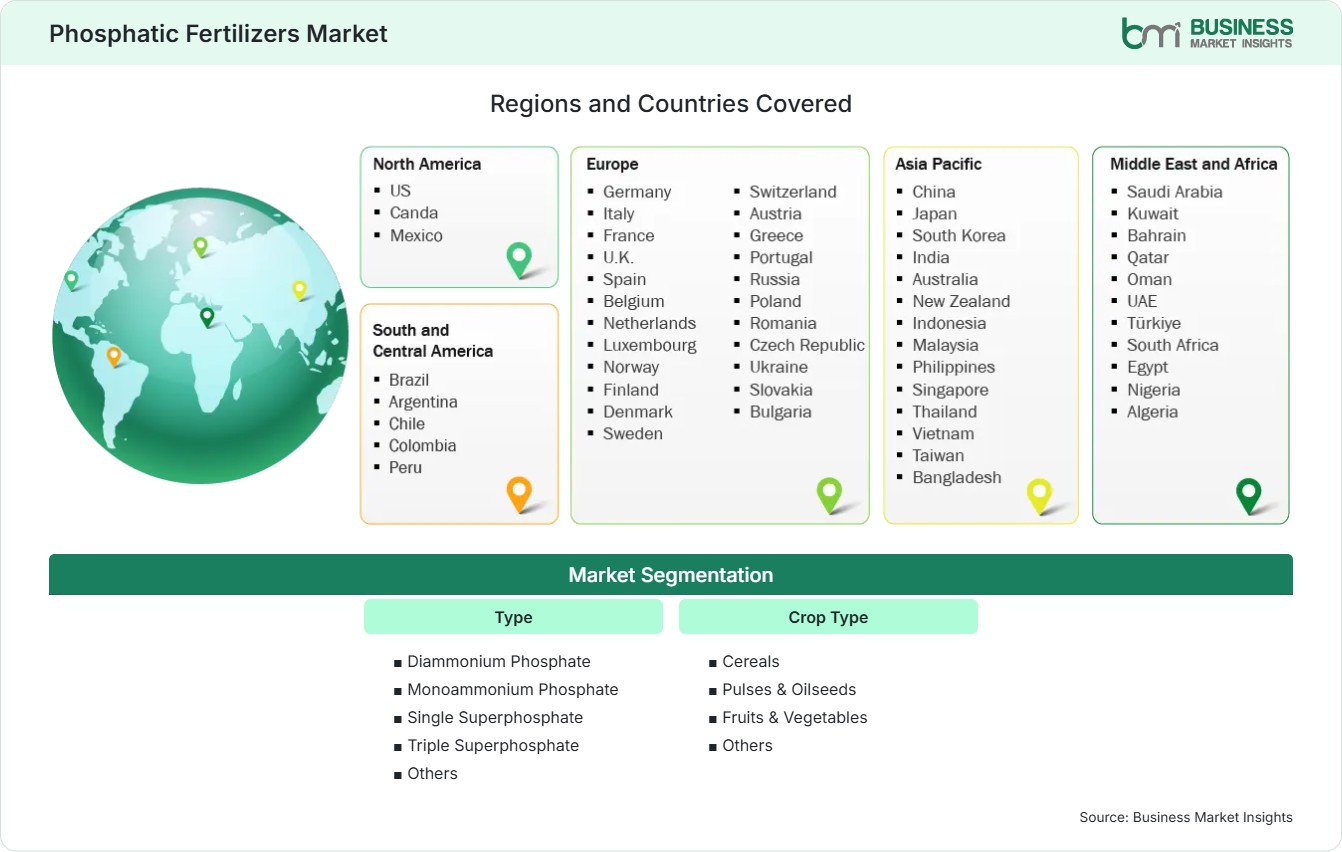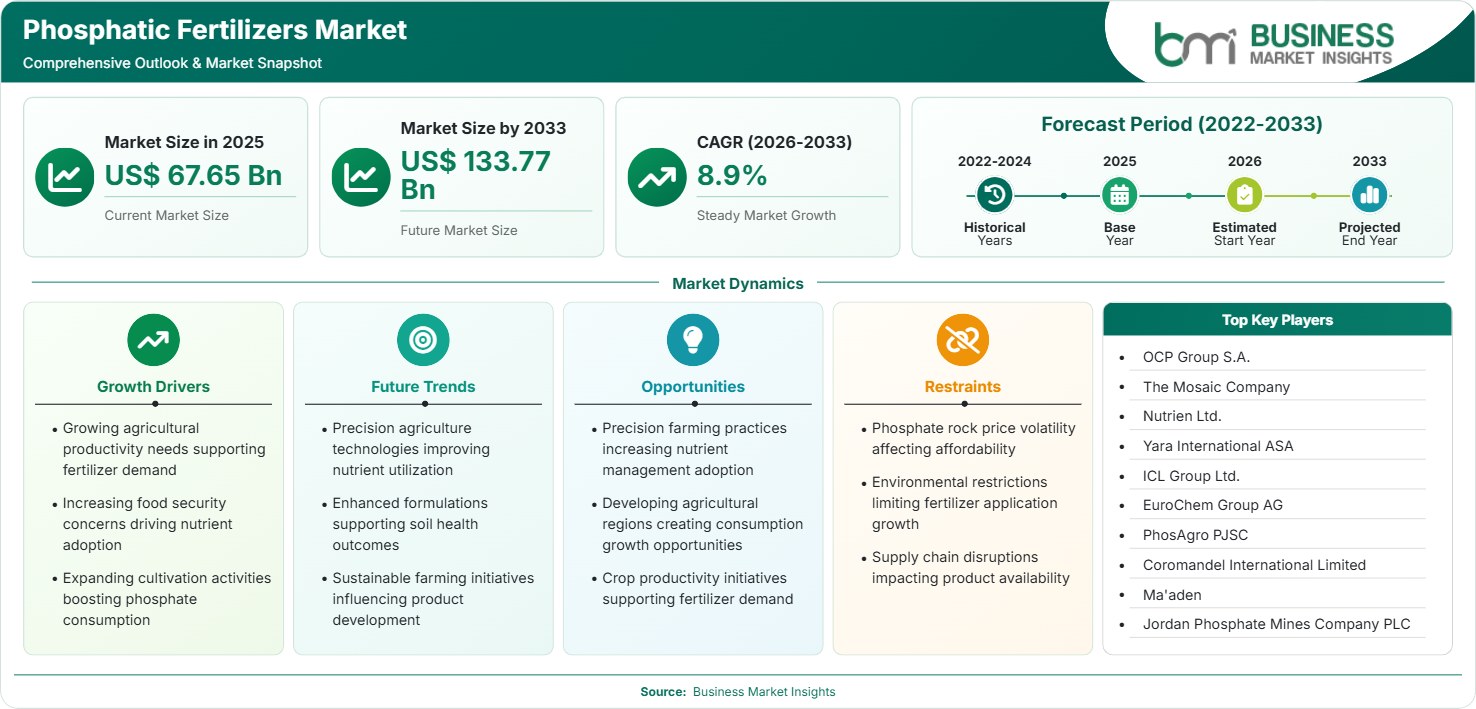
Phosphatic Fertilizers Market Regional Highlights
North America Phosphatic Fertilizers Market
The Phosphatic Fertilizers Market share in North America was reported at 17%-19% in 2025 and is anticipated to continue growing at a CAGR of 7.4%-8.1% through 2033. This is mainly due to mechanization in agriculture, efficient fertilizer distribution systems, and increasing demand for crop nutrient management in corn, soybean, and wheat crops. The United States is the major consumer of products from this region, whereas Canada supports them through grain farming. 72% of concentrated phosphate crop nutrients are manufactured by the Mosaic Company in North America.
- Demand is supported by precision nutrient application, soil testing, and variable-rate spreading, allowing growers to optimize phosphorus placement while managing input costs and reducing unnecessary applications across large commercial farms.
- The US remains the primary demand center because corn and soybean systems require substantial nutrient replenishment, while established dealer networks facilitate rapid movement of DAP, MAP, and blended phosphate products.
- Canada provides a smaller but strategically important consumption base, particularly across prairie grain production, where phosphorus application supports root development, crop establishment, and yield optimization in nutrient-deficient soils.
- Supply concentration creates strategic value for integrated producers. Mosaic's reported approximately 72% share of North American concentrated phosphate production illustrates the importance of domestic production assets and logistics.
US Phosphatic Fertilizers Market
The United States accounted for 72-76% of fertilizer consumption in North America in 2025 and is estimated to have a growth rate of 7.2%-7.9%. North America is well known for producing crops such as corn, soybeans, and wheat, as well as specialty crops, for which there is greater consideration of soil conditions and the economics of fertilizer purchases. There is much production in North America; however, the importation of sulfur and phosphate rock influences fertilizer prices and availability. Mosaic is estimated to account for 72% of North American concentrated phosphate crop nutrient production.
- Corn and soybean planting result in a constant need for phosphorus, especially when soil nutrients are depleted and must be replenished to maintain productivity in high-yielding crops.
- The increased efficiency of precision farming through the use of GPS, field mapping, variable-rate technology, and nutrient recommendations drives increased demand for specialty phosphate products.
- Domestic production concentration gives integrated producers a lot of power over product availability in the region, while imports add flexibility at internationally competitive prices.
Europe Phosphatic Fertilizers Market
In the Phosphatic Fertilizers Market, Europe accounted for 14%-16% of market share in 2025 and is projected to register a CAGR of 7.8%-8.5% from 2026 to 2033. Countries like Germany, France, and Spain play an important role in agricultural activity, and it is expected that Spain will see higher growth, at 8.6%-9.3% CAGR. The requirements of this region have been attributed to proper nutrient management, environmental issues, soil management, and productivity under limitations.
- Germany remains a leading market because of its extensive cereal, oilseed, and industrial farming base, with fertilizer decisions increasingly incorporating nutrient-balancing and environmental compliance requirements.
- France benefits from large wheat, maize, oilseed, and sugar-beet production systems, supporting recurring phosphate demand while encouraging more precise application and nutrient budgeting.
- Spain offers stronger growth potential because irrigation, horticulture, intensive cropping, and expanding productivity requirements support fertilizer consumption in high-value agricultural systems.
- European producers increasingly emphasize nutrient efficiency and differentiated formulations as regulatory pressure encourages lower environmental impact while maintaining agronomic performance.
Asia Pacific Phosphatic Fertilizers Market
The Asia Pacific market contributed to 36%-39% in 2025 and is expected to exhibit a CAGR of 9.5%-10.2% over the forecast period, making it the fastest-growing regional segment. The Asia Pacific region is dominated by China and India in agricultural applications, whereas other countries, such as Indonesia, Vietnam, Australia, and others, offer growth opportunities. India is significant for its annual phosphate rock imports of 11.0 million metric tons.
- India combines high agricultural intensity with substantial phosphate feedstock imports, creating opportunities for domestic capacity, upstream mining investments, and long-term international sourcing agreements.
- China remains a major producer and consumer, but export restrictions and domestic policy measures have altered international availability, creating opportunities for alternative suppliers in Morocco, Saudi Arabia, Russia, and other origins.
- Southeast Asian markets benefit from palm oil, rice, horticulture, and plantation agriculture, where nutrient replenishment supports yield improvement and commercial farm productivity.
- Australia offers demand opportunities in broadacre agriculture, where soil phosphorus deficiency and crop establishment requirements sustain fertilizer use across wheat, barley, canola, and pulse systems.
Rest of World Phosphatic Fertilizers Market
The rest of the world accounted for 28%-31% of the global Phosphatic Fertilizers Market in 2025 and is expected to grow at a CAGR of 8.2%-9.0% between 2023 and 2033. Latin America has a competitive edge by virtue of having Brazil produce soybeans, maize, sugarcane, and cotton. Meanwhile, the Middle East and Africa stand to benefit from integrating their phosphate mineral resources with rising agricultural demand. Morocco and Egypt have retained their positions as major producers of phosphates.
- Brazil represents a high-value agricultural demand center, with large soybean and maize acreage creating sustained requirements for phosphorus and balanced fertilizer programs.
- Morocco benefits from exceptional phosphate-resource integration and continues investing in sustainable fertilizer capacity, with OCP targeting expansion of phosphate-based fertilizer capacity toward 20 million tonnes annually.
- Africa provides long-term growth potential as fertilizer accessibility, domestic production, and agricultural intensification remain priorities across food-importing economies.
- Saudi Arabia is strengthening its role as a phosphate production hub through large-scale mining and fertilizer projects designed to serve domestic and international markets.