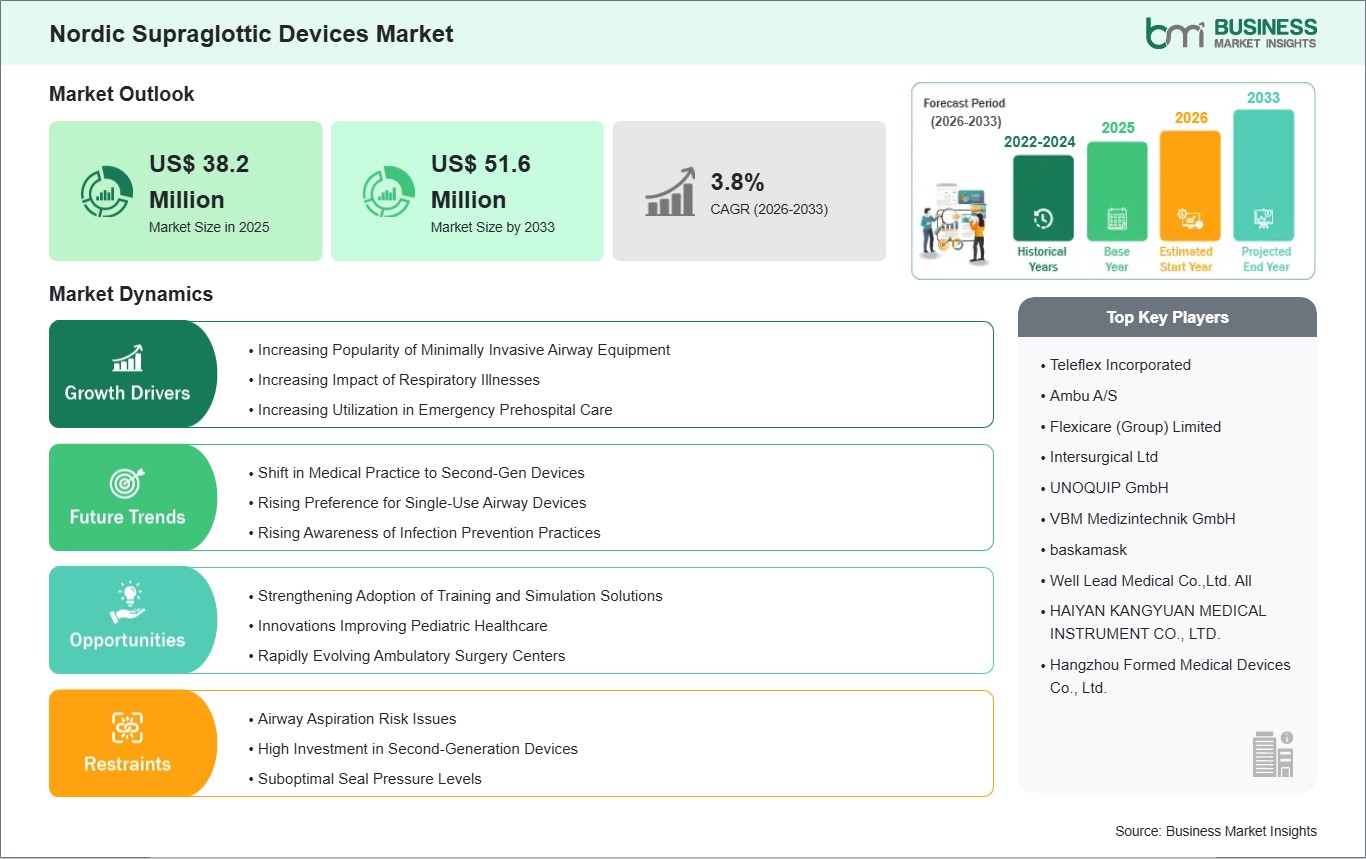
The Nordic Supraglottic Devices market size is expected to reach US$ 51.6 million by 2033 from US$ 38.2 million in 2025. The market is estimated to record a CAGR of 3.8% from 2026 to 2033.
The Nordic market for supraglottic airway devices presents itself as a sophisticated and progressively oriented environment that has been heavily influenced by the presence of highly developed healthcare infrastructures and high standards regarding patient care and safety issues. It should be noted that supraglottic airway devices are extensively used within the Nordic region due to their ability to significantly simplify airway management and decrease risk factors associated with other, more invasive airway management tools. Within the scope of Nordic health policies, a greater focus is being placed on the use of innovative medical equipment during surgery operations and in emergency situations; therefore, the use of supraglottic airway devices is gaining increased popularity among clinicians.
However, this supportive context has been characterized by certain limitations as well. The procurement procedures adopted by the healthcare organizations in the Nordics have been highly stringent and economical, with major considerations being long-term cost-efficiency and sustainability. This may act as an impediment to the usage of new versions of expensive airway management devices in comparison to their traditional counterparts, despite the fact that they possess certain clinical benefits. Moreover, considering that the frequency of critical patients needing emergency medical assistance is relatively lower than that found in other parts of the world, the use of supraglottic airway devices in emergency medical services depends largely on the municipality concerned.

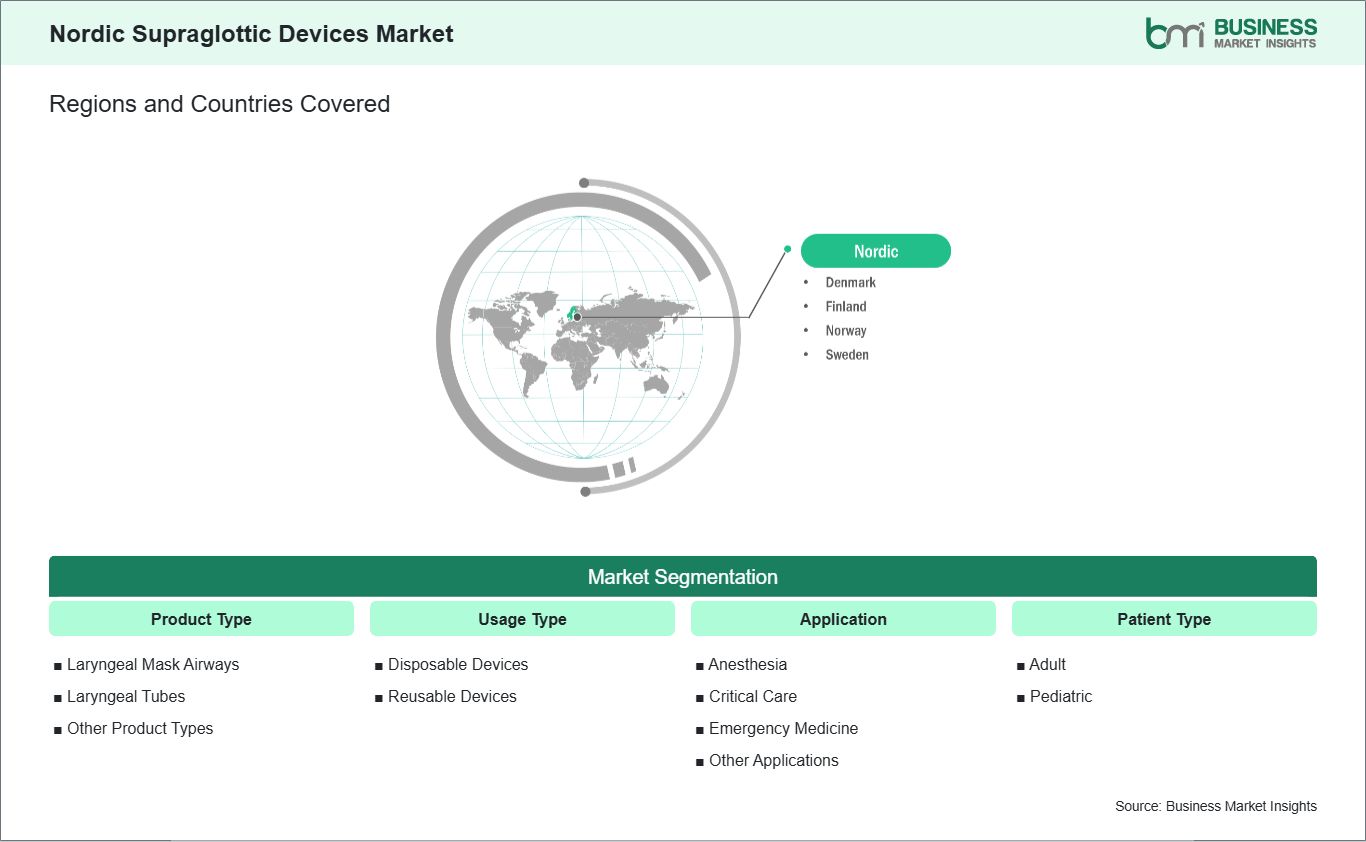
Key segments that contributed to the derivation of the Nordic Supraglottic Devices therapy market analysis are product type, usage type, application, patient type, and end user.
The Nordic supraglottic devices market is witnessing increasing popularity of minimally invasive airway equipment as healthcare systems emphasize efficiency, patient safety, and reduced procedural complexity. Supraglottic airway devices (SGAs) offer a fast and reliable method for airway management, making them particularly valuable in high-volume surgical centers and emergency care units. Their ease of insertion and reduced reliance on specialized skills allow clinicians to maintain workflow efficiency while ensuring optimal patient outcomes.
Rising focus on elective and day-surgery procedures is also fueling demand. Hospitals in the region are implementing SGAs to reduce anesthesia time and streamline operating room turnover. The devices’ versatility across routine and complex procedures provides clinical teams with an adaptable solution, minimizing procedural delays while maintaining consistent care quality. This efficiency aligns well with the Nordic healthcare model, which emphasizes patient-centered care and streamlined clinical operations.
Sustainability and hygiene considerations are further supporting adoption. Single-use supraglottic devices minimize the risk of cross-contamination and reduce sterilization requirements, aligning with strict regional infection-control standards. Additionally, ergonomic and improved sealing designs enhance patient safety and comfort, reinforcing SGAs as essential tools for modern airway management in Nordic hospitals.
The Nordic market is also experiencing a strengthening adoption of training and simulation solutions to support safe and effective use of supraglottic airway devices. Healthcare institutions are increasingly using simulation-based programs to provide hands-on experience for clinicians, nurses, and emergency responders. These programs enable practitioners to practice insertion techniques, manage complications, and refine decision-making in a controlled environment, ensuring readiness for real-world clinical scenarios.
Structured workshops and scenario-driven simulations are central to these programs. Participants gain experience with multiple SGA types and diverse patient anatomies, which helps standardize airway management protocols across healthcare facilities. Simulation also fosters teamwork and coordination among multidisciplinary clinical teams, improving overall procedural reliability and patient safety.
The integration of simulation into continuing professional education is making training more accessible and consistent. Low-cost training models, mobile simulation labs, and peer-led sessions allow even smaller healthcare facilities to enhance staff competency. Regular exposure to realistic scenarios builds confidence and proficiency, promoting wider adoption of supraglottic devices and ensuring their effective use across the Nordic healthcare landscape.
The Nordic Supraglottic Devices market demonstrates steady growth, with size and share analysis highlighting evolving trends and competitive dynamics among key players. The report evaluates important subsegments categorized within product type, usage type, application, patient type, and end user, highlighting their respective contributions to overall market performance.
By product type, the laryngeal mask airways subsegment dominated the supraglottic devices market in 2025. The dominance of laryngeal mask airways is driven by their ease of insertion, high success rate in securing the airway, reduced risk of complications compared to traditional intubation, and broad adoption in surgical and emergency settings, making them a key revenue contributor for manufacturers.
Based on usage type, the disposable devices subsegment led the market in 2025. Disposable supraglottic devices are preferred due to their reduced risk of cross-contamination, lower sterilization requirements, and convenience for high-volume clinical environments, which supports their widespread adoption across hospitals and emergency care facilities.
In terms of application, the anesthesia subsegment dominated the market in 2025. This leadership is attributed to the frequent use of supraglottic devices in elective and emergency surgical procedures, the increasing number of surgeries worldwide, and the clinical benefits of providing a safe and effective airway without the need for invasive intubation.
By patient type, the adult subsegment dominated the market in 2025. The preference for adult patients is driven by higher procedural volumes in adult surgeries, the established clinical efficacy of supraglottic devices in adult airway management, and increasing adoption in critical care and emergency settings.
Based on end user, the hospitals subsegment dominated the market in 2025. Hospitals lead due to their well-established anesthesia and critical care departments, access to advanced airway management devices, trained staff, and the capability to perform a high volume of surgical and emergency procedures requiring reliable airway management.
| Report Attribute | Details |
|---|---|
| Market size in 2025 | US$ 38.2 Million |
| Market Size by 2033 | US$ 51.6 Million |
| CAGR (2026 - 2033) | 3.8% |
| Historical Data | 2022-2024 |
| Forecast period | 2026-2033 |
| Segments Covered | By Product Type
|
|
Regions and Countries Covered
| |
| Nordic | Sweden, Denmark, Norway, Finland |
| Market leaders and key company profiles |
|
The "Nordic Supraglottic Devices Market Size and Forecast (2022–2033)" report provides a detailed analysis of the market covering below areas:
The geographical scope of the Nordic Supraglottic Devices market report is divided into: Sweden, Norway, Denmark, and Finland. Sweden held the largest share in 2025.
Sweden dominates the Nordic supraglottic devices market due to its advanced healthcare infrastructure, strong focus on clinical excellence, and early adoption of best practices in airway management. Swedish hospitals and surgical centers are known for prioritizing patient safety, and supraglottic devices play a critical role in supporting rapid and less invasive airway control during anesthesia and emergency interventions. Clinical guidelines and national healthcare policies support the adoption of contemporary airway technologies, fostering broad use across both urban and regional healthcare facilities.
The Swedish anesthesiologists and emergency medicine practitioners are currently involved in different research activities, such as testing of novel airway management tools, hence gaining experience with the supraglottic airways. Due to the clinical evidence-based procurement policy for medical supplies in Sweden, there is consideration for the cost-effectiveness of the supraglottic airways during their deployment, hence ensuring the adoption of superior devices. Supraglottic airway devices are becoming increasingly popular in the protocols for pre-hospital airway management in Sweden, especially in situations where fast access to the airway is crucial. This creates a favorable environment for the development of the Nordic market of supraglottic devices.

The Nordic Supraglottic Devices market is evaluated by gathering qualitative and quantitative data post primary and secondary research, which includes important corporate publications, association data, and databases. A few of the key developments in the Nordic Supraglottic Devices market are:
The Nordic Supraglottic Devices Market is valued at US$ 38.2 Million in 2025, it is projected to reach US$ 51.6 Million by 2033.
As per our report Nordic Supraglottic Devices Market, the market size is valued at US$ 38.2 Million in 2025, projecting it to reach US$ 51.6 Million by 2033. This translates to a CAGR of approximately 3.8% during the forecast period.
The Nordic Supraglottic Devices Market report typically cover these key segments-
The historic period, base year, and forecast period can vary slightly depending on the specific market research report. However, for the Nordic Supraglottic Devices Market report:
The Nordic Supraglottic Devices Market is populated by several key players, each contributing to its growth and innovation. Some of the major players include:
The Nordic Supraglottic Devices Market report is valuable for diverse stakeholders, including:
Essentially, anyone involved in or considering involvement in the Nordic Supraglottic Devices Market value chain can benefit from the information contained in a comprehensive market report.
Please tell us your area of interest
(Market Segments/ Regions and Countries/ Companies)