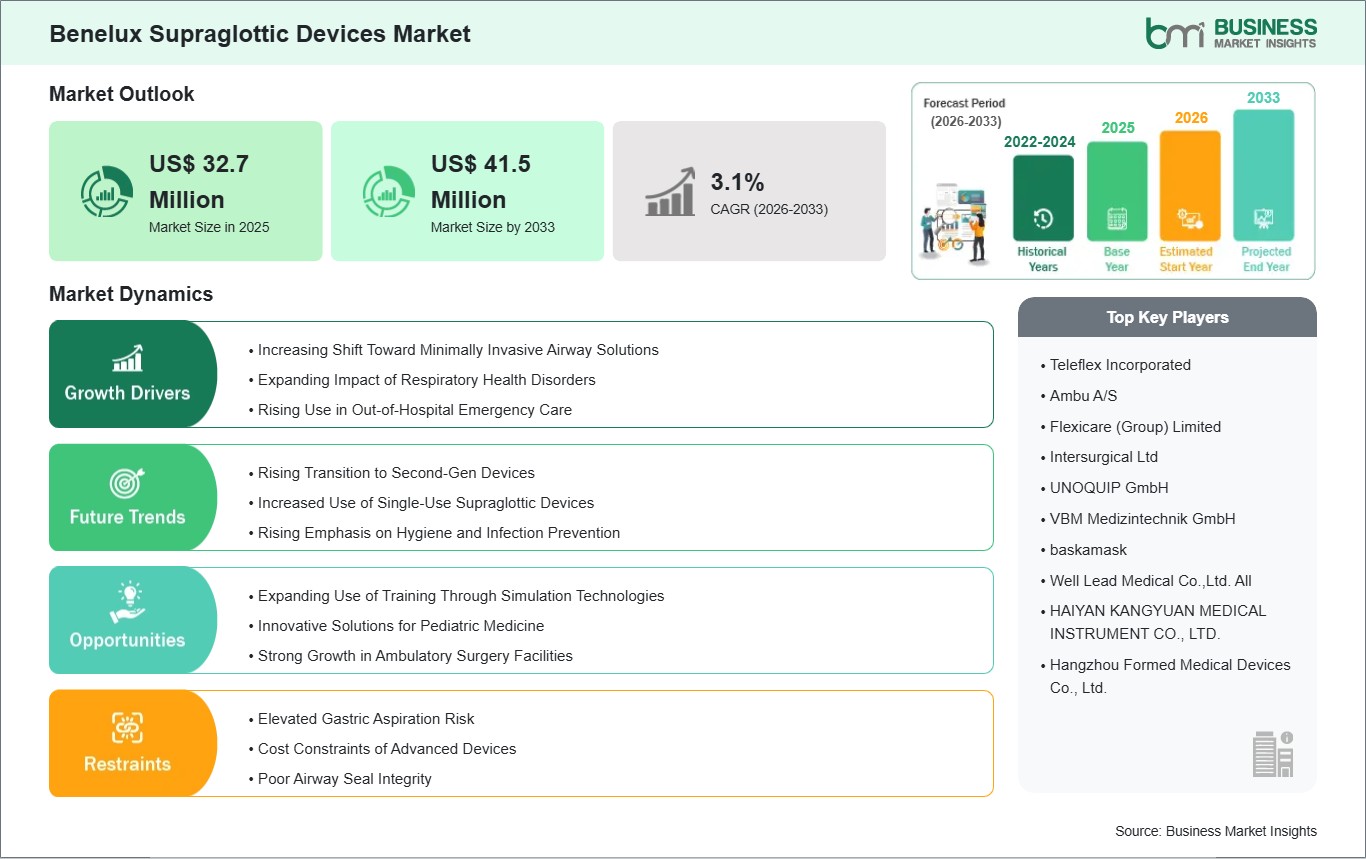
The Benelux Supraglottic Devices market size is expected to reach US$ 41.5 million by 2033 from US$ 32.7 million in 2025. The market is estimated to record a CAGR of 3.1% from 2026 to 2033.
The Benelux market for supraglottic airway devices functions in a highly advanced and organized healthcare system that includes Belgium, the Netherlands, and Luxembourg. This region has a culture of patient safety, efficient process execution, and evidence-based medicine, which all favor the use of supraglottic airway devices during perioperative procedures, emergencies, and critical care situations. Supraglottic airway devices are considered more favorable because of their ease of placement and lesser invasiveness than conventional endotracheal intubation. Supraglottic airway devices are widely utilized for elective surgical procedures, outpatients, and monitored anesthesia care services.
A significant driver of the market is the region’s focus on clinical excellence and standardized protocols. Hospitals and surgical centers regularly assess newer airway management technologies to improve procedural outcomes, reduce complication rates, and enhance workflow efficiency. Moreover, effective professional training of anesthesia doctors, emergency medical personnel, and critical care specialists helps make sure that healthcare professionals are adept at using different airway management tools, thus making them receptive to the concept of supraglottic airways. Nevertheless, budgeting procedures at smaller hospitals or rural health centers may impede the incorporation of new equipment despite the clinical inclination. In addition, continuous dialogue between medical practitioners regarding optimal scenarios for using supraglottic devices compared to conventional means, particularly in difficult airways, may impact the rate of adoption. The Benelux countries maintain an enabling atmosphere for introducing supraglottic airway devices in clinical practice due to their advanced health care system, highly trained personnel, and patient-centered care approach.

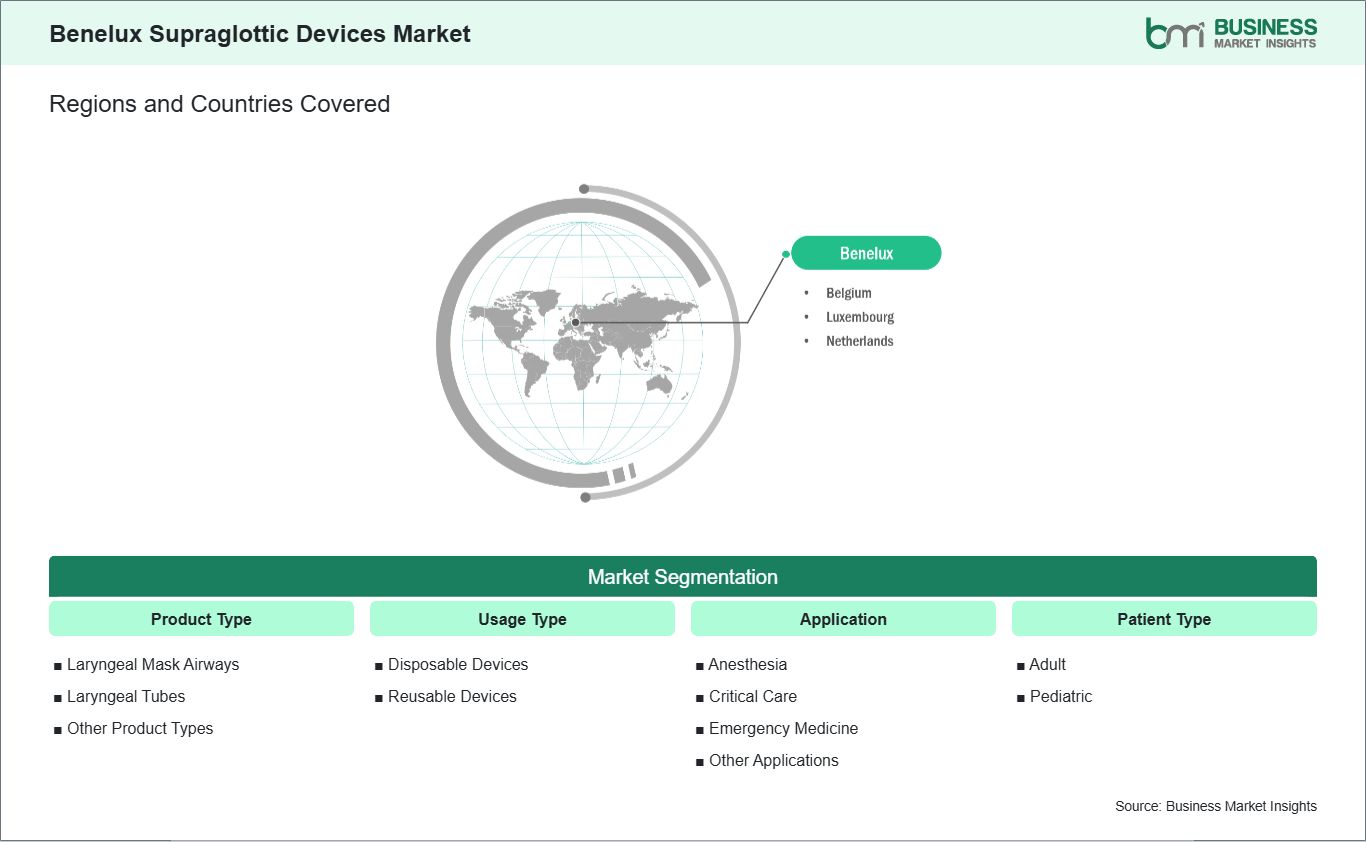
Key segments that contributed to the derivation of the Africa Supraglottic Devices market analysis are product type, usage type, application, patient type, and end user.
The Benelux supraglottic devices market is increasingly driven by a shift toward minimally invasive airway solutions as healthcare providers aim to optimize patient safety and procedural efficiency. Supraglottic airway devices (SGAs) are gaining preference because they simplify airway management, allowing clinicians to secure the airway quickly without requiring extensive intubation expertise. In high-traffic surgical units and emergency care settings, the ability to perform rapid, reliable airway management is essential, making SGAs a practical choice for both routine and urgent interventions.
The shift is further supported by the growing emphasis on reducing patient recovery times and minimizing procedure-related complications. Minimally invasive techniques, including SGAs, allow faster airway control and reduced anesthesia duration, which improves patient throughput and overall operational efficiency. Hospitals increasingly favor devices that balance ease of use with clinical effectiveness, particularly in multi-disciplinary surgical environments where standardizing airway protocols enhances safety and workflow.
Cost-effectiveness and hygiene considerations also play a significant role in this transition. Single-use SGAs reduce the need for extensive sterilization and mitigate infection risks, aligning with the strict safety and regulatory standards typical of healthcare systems in the Benelux region. Combined with ergonomic designs and improved sealing mechanisms, these devices are becoming central to modern airway management strategies, supporting a continued trend toward minimally invasive solutions.
The adoption of training through simulation technologies is accelerating in the Benelux supraglottic devices market, reflecting a strong focus on skill development and clinical competence. Simulation-based programs provide healthcare professionals with opportunities to practice device insertion, troubleshoot complications, and refine procedural techniques in a controlled environment, reducing the risk of errors during actual patient care. This approach is particularly important for multidisciplinary teams working in surgical or emergency settings, where consistent proficiency across staff is critical.
Structured workshops and interactive training modules are increasingly integrated into professional development programs, combining theoretical instruction with hands-on practice. Simulation exercises allow clinicians to gain experience with multiple types of SGAs and patient scenarios, ensuring readiness for diverse clinical situations. By reinforcing standardized airway management protocols, these programs help maintain high levels of patient safety and procedural reliability throughout hospital systems.
Integration of simulation technologies into ongoing medical education is enhancing the long-term adoption of supraglottic devices. Even facilities with limited resources are implementing low-cost simulation models or peer-led training sessions to build staff competency. Repeated practice in realistic scenarios strengthens confidence and technique, driving consistent use of SGAs in clinical workflows. As a result, training through simulation is increasingly recognized as a cornerstone of safe, efficient airway management in the Benelux region.
The Benelux Supraglottic Devices market demonstrates steady growth, with size and share analysis highlighting evolving trends and competitive dynamics among key players. The report evaluates important subsegments categorized within product type, usage type, application, patient type, and end user, highlighting their respective contributions to overall market performance.
By product type, the laryngeal mask airways subsegment dominated the supraglottic devices market in 2025. The dominance of laryngeal mask airways is driven by their ease of insertion, high success rate in securing the airway, reduced risk of complications compared to traditional intubation, and broad adoption in surgical and emergency settings, making them a key revenue contributor for manufacturers.
Based on usage type, the disposable devices subsegment led the market in 2025. Disposable supraglottic devices are preferred due to their reduced risk of cross-contamination, lower sterilization requirements, and convenience for high-volume clinical environments, which supports their widespread adoption across hospitals and emergency care facilities.
In terms of application, the anesthesia subsegment dominated the market in 2025. This leadership is attributed to the frequent use of supraglottic devices in elective and emergency surgical procedures, the increasing number of surgeries worldwide, and the clinical benefits of providing a safe and effective airway without the need for invasive intubation.
By patient type, the adult subsegment dominated the market in 2025. The preference for adult patients is driven by higher procedural volumes in adult surgeries, the established clinical efficacy of supraglottic devices in adult airway management, and increasing adoption in critical care and emergency settings.
Based on end user, the hospitals subsegment dominated the market in 2025. Hospitals lead due to their well-established anesthesia and critical care departments, access to advanced airway management devices, trained staff, and the capability to perform a high volume of surgical and emergency procedures requiring reliable airway management.
| Report Attribute | Details |
|---|---|
| Market size in 2025 | US$ 32.7 Million |
| Market Size by 2033 | US$ 41.5 Million |
| CAGR (2026 - 2033) | 3.1% |
| Historical Data | 2022-2024 |
| Forecast period | 2026-2033 |
| Segments Covered | By Product Type
|
|
Regions and Countries Covered
| |
| Benelux | Belgium, Netherlands, Luxembourg |
| Market leaders and key company profiles |
|
The "Benelux Supraglottic Devices Market Size and Forecast (2022–2033)" report provides a detailed analysis of the market covering below areas:
The geographical scope of the Benelux Supraglottic Devices market report is divided into: Belgium, the Netherlands, and Luxembourg. The Netherlands held the largest share in 2025.
The Netherlands dominates the Benelux supraglottic devices market due to the presence of advanced healthcare facilities and a proactive stance toward innovations in medical practice. The Dutch hospitals and clinics are known to have a systemized approach to managing patients' airways and integrating supraglottic devices into anesthesia and emergency procedures in particular. Patient safety and the effectiveness of the procedure become primary concerns in the Netherlands. Consequently, supraglottic devices become an efficient means for dealing with both elective and emergency cases.
Professional education is crucial for achieving supremacy in the Benelux market. The training of anesthesiologists, emergency specialists, and critical care specialists is carried out on a regular basis in order for doctors to be familiar with various means of managing patients' airways. Moreover, collaboration and networking by academic medical centers and community hospitals foster the exchange of information and practices, making it possible for the integration of supraglottic devices within clinical guidelines to occur at a much faster pace. There is a careful review of more modern types of equipment, weighing the aspects of innovation and cost-effectiveness. Although budgetary limitations and cautious clinical practices might slow down the process in some hospitals, the Netherlands is leading the way when compared to other countries in the Benelux region.

The Benelux Supraglottic Devices market is evaluated by gathering qualitative and quantitative data post primary and secondary research, which includes important corporate publications, association data, and databases. A few of the key developments in the Benelux Supraglottic Devices market are:
The Benelux Supraglottic Devices Market is valued at US$ 32.7 Million in 2025, it is projected to reach US$ 41.5 Million by 2033.
As per our report Benelux Supraglottic Devices Market, the market size is valued at US$ 32.7 Million in 2025, projecting it to reach US$ 41.5 Million by 2033. This translates to a CAGR of approximately 3.1% during the forecast period.
The Benelux Supraglottic Devices Market report typically cover these key segments-
The historic period, base year, and forecast period can vary slightly depending on the specific market research report. However, for the Benelux Supraglottic Devices Market report:
The Benelux Supraglottic Devices Market is populated by several key players, each contributing to its growth and innovation. Some of the major players include:
The Benelux Supraglottic Devices Market report is valuable for diverse stakeholders, including:
Essentially, anyone involved in or considering involvement in the Benelux Supraglottic Devices Market value chain can benefit from the information contained in a comprehensive market report.
Please tell us your area of interest
(Market Segments/ Regions and Countries/ Companies)